A Boy and Unexplained Sounds in *Tales of Tōno*
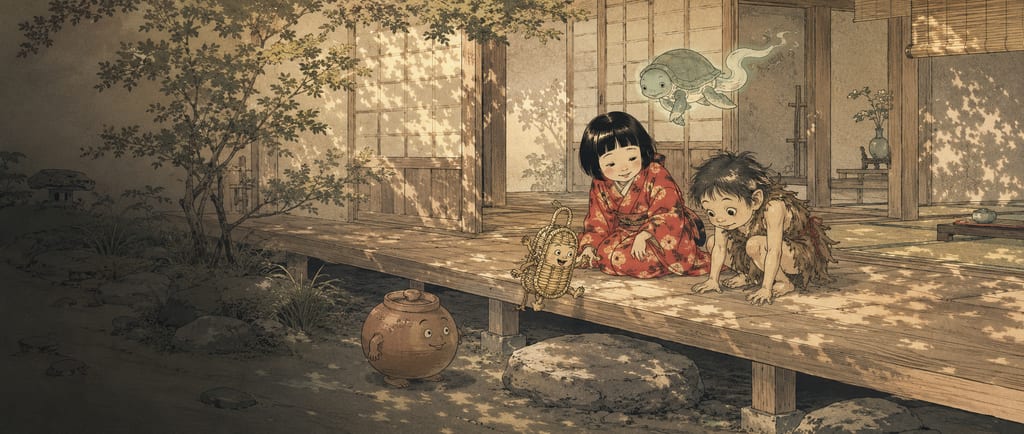
To understand the zashiki-warashi only as a “little god of good fortune in red clothes” is to miss the range preserved in early records. Kunio Yanagita’s *Tales of Tōno*, Tale 17[1] gives a concrete sighting: a daughter returning home in Iide, Tsuchibuchi Village, sees in the corridor a boy of about twelve or thirteen. Yet at the Sasaki household in Yamaguchi in the same account, a mother at her sewing hears paper rustling in the next room. She opens the door to find no one there; later, she hears snuffling. The zashiki-warashi is told not only as a child who has been seen, but as a sound that makes an empty room seem occupied.
Tale 17 calls such a being a “kami called zashiki-warashi” and says that a house where it dwells may enjoy wealth and distinction. What is linked to a household’s prosperity here is not a perpetually laughing, endearing guardian, but a domestic kami that may never show itself. The child’s appearance, the unexplained sounds, and the household’s fortunes stand together in one account.
The Departure of Two Young Girls and a Household’s Decline
Tale 18 of *Tales of Tōno*[1] says that the Yamaguchi Magozaemon household had two child-girl kami. Near the bridge at Tomeba, a man meets two girls who say that they are leaving the Yamaguchi house for another. Soon afterward, the household head and more than twenty people in his service die in one day after eating poisonous mushrooms. Only a seven-year-old girl who had not returned for lunch remains, and the household’s possessions are gradually lost.
The original does not say that the girls prepared the poison or punished the household in anger. Their departure is narrated before the disaster and the household’s decline, so the loss of the domestic kami and the turn in the home’s fortunes seem to overlap. Rather than a being that judges a household’s fate at will, the zashiki-warashi appears as the narrative center that joins an inhuman presence within the home to the home’s rise and fall.
Kizen Sasaki’s Survey of Names and Forms
Kizen Sasaki’s *Ōshū no Zashikiwarashi no Hanashi*[2] does not confine the zashiki-warashi to a single lineage. Sasaki distinguishes childhood memories, reports heard in recent years, accounts passed down as fact, stories shaped into tales, and inquiries from different localities. He records not only regions that replied that such beings existed, but those that said they did not. He also compares Okunaisama, Oshirasama, tatami-korogashi, and the souls of infants as matters that “may be related.” Associations with infant death or infanticide are one significant local explanation, but the book does not present them as the origin of every zashiki-warashi.
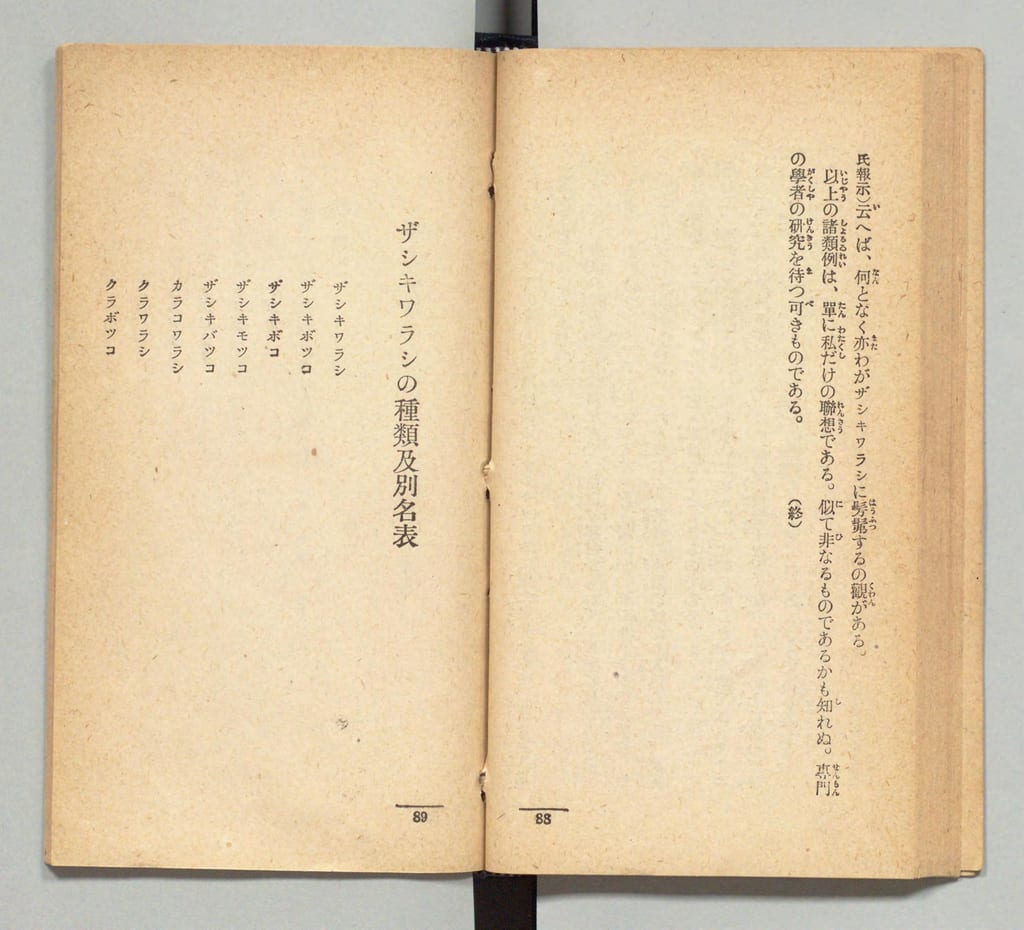
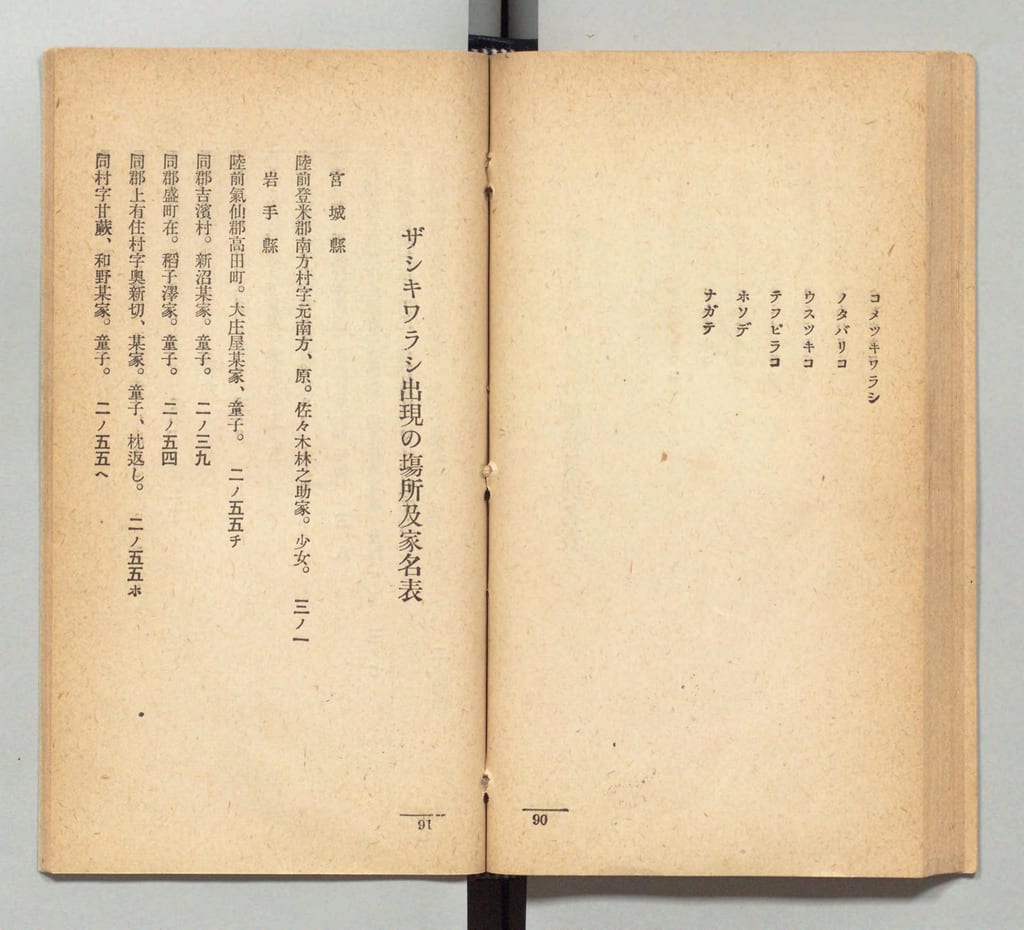
The book’s concluding tables of zashiki-warashi types and alternate names, and of appearance sites and household names, make the diversity of names, forms, and places visible. In the same survey appear the kura-warashi of the storehouse; zashiki-bakko, described as an old woman with a shaved head; zashiki-jikko, described as a bent old man; and hosode and nagate, which show only long, slender hands—forms far removed from a child. “Zashiki-warashi” thus works less as the name of one fixed character than as a term that gathers many uncanny presences felt within the home.
House Construction and Local Variants
The local records of 1924 also reveal how widely descriptions of appearance and origin could vary. The kura-warashi of the Morioka area[3] is recorded as a beautiful child in a red kosode who lives in an earthen storehouse and sometimes dances. There is reliable local evidence for this image of a child in red, but it cannot be made the standard appearance throughout Tōhoku. The boy in Tōno, the unseen sounds at Yamaguchi, and the child of the Morioka storehouse belong to different houses and places.
An Iwaizumi story about burying a child-shaped wooden figure beneath the floor of a formal room when a new house is built[4] connects the zashiki-warashi not only with the spirits of dead children, but with the making of a building and the awe attached to the carpenter. An explanation that associates the usugoro of Hasama with infant death[5] is recorded as speculation; Hanamaki also has accounts of male and female or married-pair zashiki-warashi that become horses when they go outside[8]. The more these local examples are compared, the more the zashiki-warashi takes shape not through a fixed appearance but as something uncanny that remains within a home.
An Inn Legend That Continues into the Present
The Enju Room at Ryokufūsō in Kindaichi Onsen[7] is a contemporary place where a zashiki-warashi is said to appear. Ninohe City’s guide[6] likewise introduces an inn at Kindaichi Onsen where a zashiki-warashi legend endures. The Kamemaro legend told there is not the same event as Tales 17 and 18 of *Tales of Tōno*. It nevertheless carries into contemporary lodging culture the sense that an other-than-human presence may dwell in a building and that people may find meaning in the good and ill that happen there.
When the early Tōno records, variants from across Tōhoku, and present-day inn legends are read in their own places and periods, the zashiki-warashi ceases to be a simple mascot of good luck. The seen child, the unseen sounds, the girls who leave a home, the red kosode in a storehouse, the wooden figure beneath the floor, and Kamemaro at an inn should not be pressed into one image. Their depth lies in receiving them as memories that differ from one household to another.
Character Profile
This section is our own creative profile for storytelling. It is not historical fact or scholarship.
Yokai Type - Traditional Yokai
Category - Household Spirits
Rarity - Legendary
Personality - No single temperament defines it. Some accounts show a child, while others leave only unexplained sounds; local traditions differ in whether they describe it as familiar, unsettling, or oppressive.
Compatibility - No uniform pattern of human compatibility is recorded. Those who listen closely to the memories of old homes and to traditions that differ from place to place may better perceive its many outlines.
Abilities - Said to appear as a child, or as an unexplained sound or presenceIn a prominent Tōno tradition, associated with the wealth and distinction of the home where it dwellsIn some stories, associated with a household’s declining fortunes after it leavesReported in different indoor spaces by region, including storehouses, formal rooms, kitchen areas, and underfloor spacesTakes different forms and names in different local traditions
Weaknesses - No shared weakness is recorded. Conditions such as leaving when shot with a bow or always departing after mistreatment are not traditions common to every zashiki-warashi.
Habitat - Old homes and interior spaces in Tōhoku. The formal room is well known, but regional accounts also associate it with storehouses, kitchen areas, earthen-floored rooms, and beneath the floor.