1 yokai rooted in Ryokufūsō. Explore the legends tied to this land.
za-shi-ki-wa-ra-shi
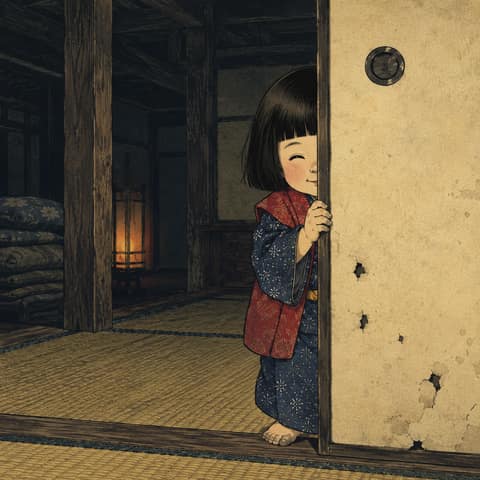
The Zashiki-warashi — Child Who Guards the House in Iwate
This version turns to another aspect of the zashiki-warashi, the one behind its bright face as a god of good fortune. It has long been said that the zashiki-warashi has differences of rank according to where it dwells. The high-ranking ones—fair-skinned and beautiful, appearing in the inner parlor—are called choppirako and welcomed with joy, while the low-ranking ones that crawl about the earthen floor or beneath the rice mortar are called notabariko or usutsukiko and held to be somehow eerie beings. The zashiki-warashi straddles both the pure high seat within the house and the darkness close to the earth. This place beneath the earthen floor and the mortar is deeply tied to the dark theory of the zashiki-warashi’s origins. In the poor villages of a famine-stricken Tōhoku, it is said, infants who could not be raised were put to death under the names mabiki ("thinning out") or kogaeshi ("returning the child"), and were buried not in graveyards but on the earthen floor of the house or beside the hearth. Might the zashiki-warashi be the spirit of a child buried in this way within the house? Sasaki Kizen is recorded as having stated that the zashiki-warashi was the spirit of a child smothered and buried inside the home. The endearing figure of a god of fortune was also a thin skin covering the most painful part of village life. Even so, people did not hate these children but enshrined them as gods who guard the house. Yanagita Kunio saw the zashiki-warashi as a gohō-dōji, a divine child who protects the Buddha, transformed into a guardian of the home, while Orikuchi Shinobu placed it in the lineage of the marebito—visiting deities who come from outside to bring blessings to a house—and of ancestral spirits. It is where remorse for a dead child and longing for the prosperity of the house melt into one that this strange being, the zashiki-warashi, stands.