Kiyohime is the serpent woman from the legend of Anchin and Kiyohime, passed down at Dojoji Temple in Kii Province. She fell in love with Anchin, a monk on a pilgrimage to Kumano. Believing he broke his promise, she chased him across the Hidaka River, transformed into a giant serpent, and burned Anchin to death as he hid inside the temple bell at Dojoji. Dojoji Temple claims this story took place in the year 928 (Encho 6) and it was recorded in the 11th-century *Hokke Genki*, later expanding into the "Dojojimono" plays of Noh, Ningyo Joruri, and Kabuki [1][2]. In older tales, the woman's name was not fixed; she became established as "Kiyohime" through later temple legends, picture storytelling (etoki), and performing arts. As a yokai, Kiyohime is not a serpent deity in her own right, but a liminal being whose human love was burned by jealousy and obsession into a serpentine form. Much like Hannya and Hashihime, she is a representative demoness (kijo) whose grudge gained a face, a body, and fire.
Folklore & Legends
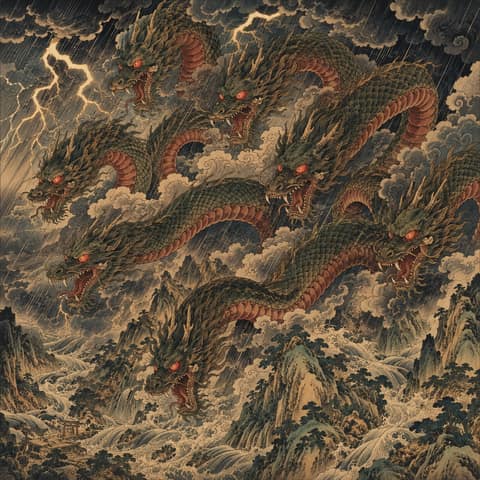
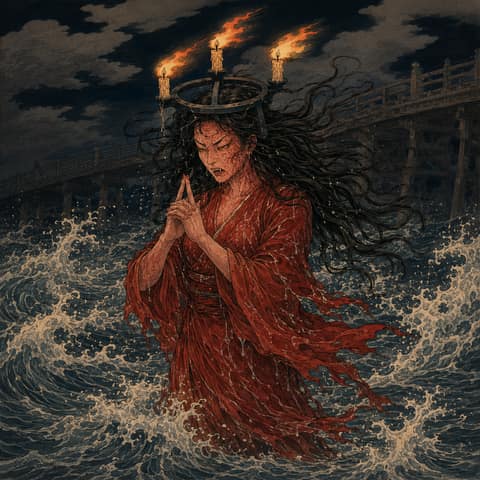
The core of the story lies in a broken promise between Anchin, who requested lodging on his way to Kumano, and the innkeeper's daughter (or the local manor lord's daughter). The daughter loved Anchin so much she considered him her husband, but Anchin tried to avoid her and fled. Her pursuit shifted from a human's sprint to a supernatural transformation. At the Hidaka River, when the ferryman refused to provide a boat, the woman threw herself into the river in a rage and crossed the water in the form of a serpent. Anchin fled to Dojoji Temple and was hidden inside its bell, but the serpent woman wrapped herself around it, reducing the bell and Anchin to ashes with her intense heat [1].
What is crucial in this legend is that Kiyohime is not a monster from the beginning. A broken promise, romance, shame, jealousy, and distrust toward a religious figure all overlap at once, turning a human woman into a snake. This is why Kiyohime is not a primordial great serpent monster like Yamata no Orochi, but closer to the "coexistence of anger and sorrow" represented by a Hannya mask. Considering that Hannya carries the facial transformation, Hashihime the boundary of the waterfront and bridge, and Kiyohime the serpent body and the bell, we can see their respective roles in Japanese tales of female demons [3].
The lore of Dojoji has been passed down not only as the origin story of the temple, but recreated numerous times through picture storytelling and performing arts. In the Noh play *Dojoji*, a shirabyoshi dancer appears at a bell consecration ceremony where women are forbidden. She approaches the bell while dancing and jumps inside. Before long, a serpentine demoness emerges from within, eventually quelled by the monks' prayers. Here, the past tale of Anchin and Kiyohime is rebooted as an active, present-day apparition on stage [3].
In the early modern period, it expanded to Ningyo Joruri, Kabuki, and traditional dance, creating a massive lineage of works such as *Musume Dojoji*. The official Dojoji Temple website also outlines how the Anchin and Kiyohime legend was incorporated into Nohgaku, Ningyo Joruri, Kabuki, and more [2]. Kiyohime is not merely a moral lesson about a "jealous woman," but a strong knot tying together the temple's history, the Kumano pilgrimage route, bell consecration, performing arts, and snake worship.
This version places Kiyohime's personal nature at the forefront of the Dojoji legend. She is not merely a serpentine monster. Four layers overlap within her: the woman who confessed her love, the woman who was fled from, the woman who crossed the river, and the serpent woman who burned the bell. Dojoji Temple conveys the story through picture scroll storytelling (etoki), and in the Noh play *Dojoji*, the shirabyoshi dancer from the sequel tale disappears under the bell, only to reappear as a serpentine demoness [4][3]. In other words, the terror of Kiyohime lies in the fact that the incident of the past is never truly over, being continually actualized on the stage of performing arts.
In terms of yokai classification, Kiyohime is simultaneously a "serpent woman" and a "woman turning into a Hannya." She gathers within a single human body the anger and sorrow carved into the Hannya mask, the jealousy Hashihime left at the bridge and river, and the serpentine calamity mythologically displayed by Yamata no Orochi. The temple bell should have been a safe hiding place, but upon touching Kiyohime's obsession, it becomes a furnace instead of a refuge. This is where the symbolic nature of the Dojoji legend lies. The Buddhist temple, the Kumano pilgrimage route, the water of the Hidaka River, the metallic sound of the bell, and the fire of a woman collide at a single point, changing a romance tale into a yokai tale.
Character Profile
This section is our own creative profile for storytelling. It is not historical fact or scholarship.
Single-minded and fierce, with a thin boundary between love and anger. When faced with rejection or deceit, she cannot quell her sorrow inwardly, transforming it into fire and a serpentine body.
Compatibility
She forms deep emotional bonds with those who face her sincerely and leave no vague promises. For those who repeatedly flee or lie, a story of pursuit and vengeance begins.
Abilities
Serpentine TransformationCrossing the Hidaka RiverObsessive PursuitBurning the Bell with Intense HeatReplication via Stage and Picture Scrolls
Weaknesses
Sincere confessions, memorial services, sutra chanting, and being retold as a story. If her anger is accepted rather than denied, there is room for her to be appeased as the spirit of a tragic love rather than just a monster.
Habitat
The Kumano pilgrimage route in Kii Province, Hidaka River, the bell of Dojoji Temple, Dojojimono plays on Noh and Kabuki stages
The diagram below is a diagnostic evaluation chart for Kiyohime, the Serpent Woman Who Burned Dojoji. The higher the value of each item, the stronger that characteristic is expressed.