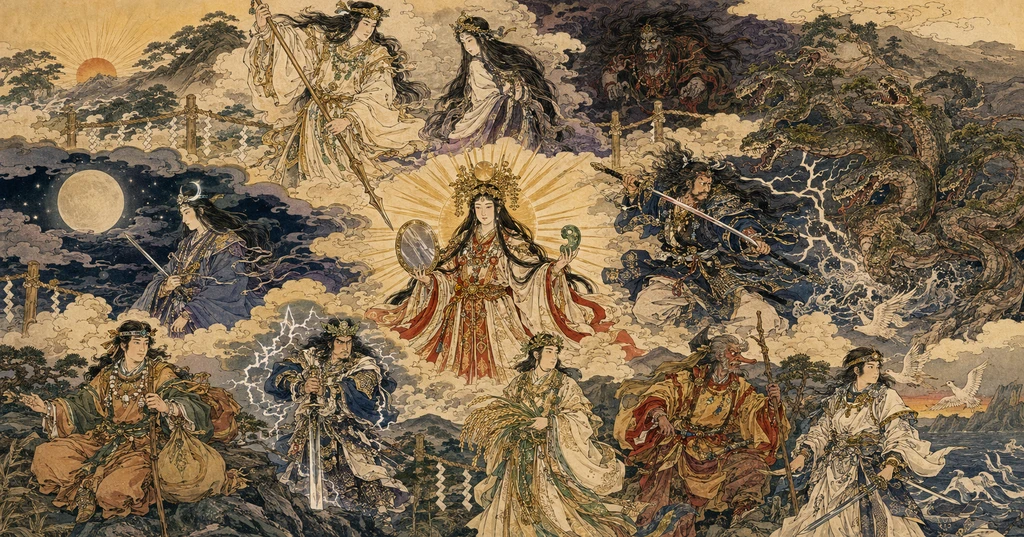
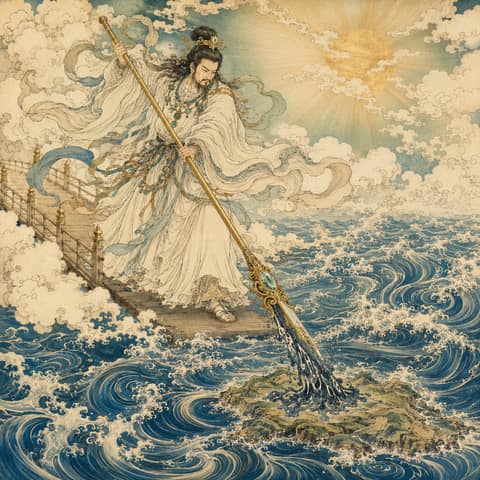
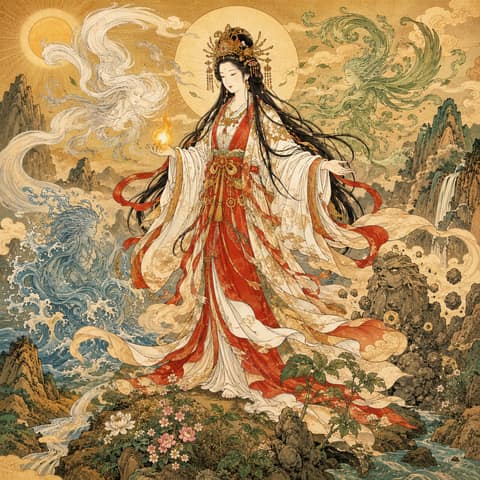
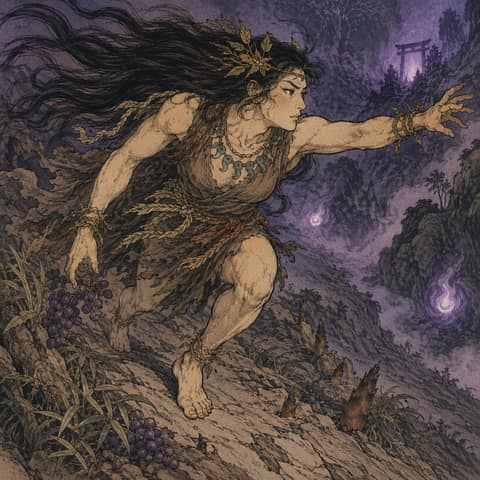
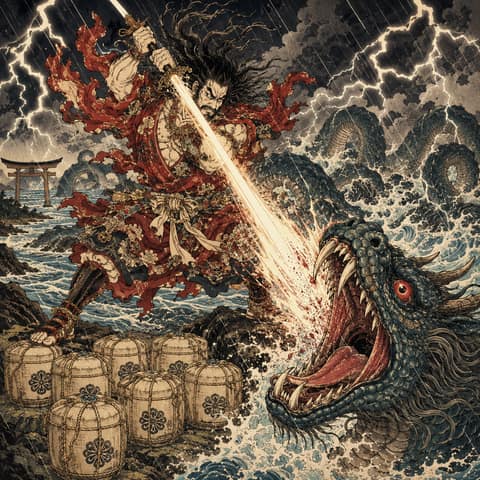
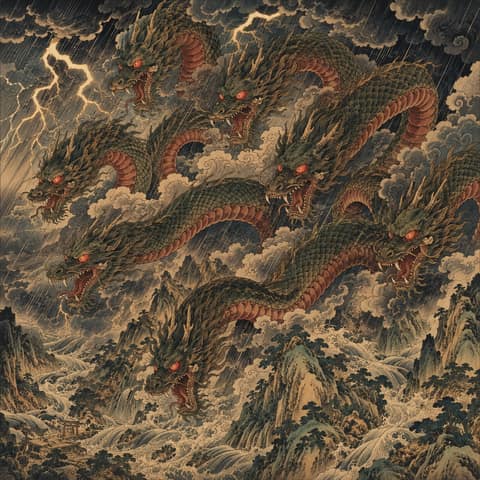
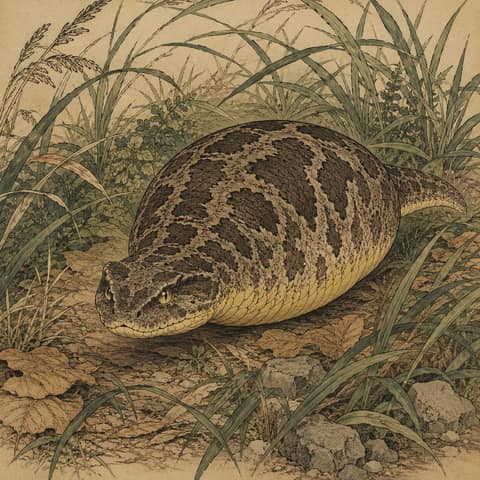
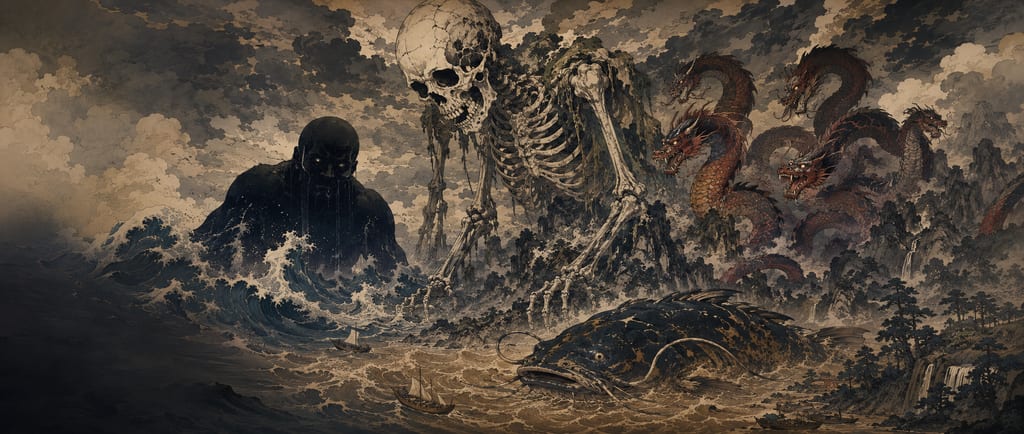
Yamata no Orochi is the enormous serpent deity of Izumo mythology, recorded in the Kojiki, upper volume, completed in 712[1] and the Nihon Shoki, book one, section eight, completed in 720[2]. It is said to have lived in the upper reaches of the Hii River, anciently called the Hi River, and to have been slain by Susanoo. Yet Orochi is not simply a monster to be defeated. It can be read as the spirit of Izumo's mountains and rivers, the memory of a flooding river, a mythic image of sand iron and tatara ironmaking, and a sign of local Izumo cults being drawn into the mythology of Yamato rule. The Kojiki describes eyes red like winter cherries, one body with eight heads and eight tails, moss, cypress, and cedar growing on its back, a body stretching across eight valleys and eight ridges, and a belly always bloody and raw. Susanoo prepares eight vats of strong yashiori sake and an eightfold fence, lets the eight heads drink themselves senseless, cuts the serpent down with his totsuka sword, and finds the great sword Tsumugari in the middle tail: the later Kusanagi, or Ame-no-Murakumo. This sword becomes the martial treasure among the Three Sacred Treasures. After the victory, Susanoo marries Kushinada-hime, builds a palace at Suga in Izumo, and composes the celebrated "Yakumo tatsu" poem, often treated as Japan's earliest waka. Today Unnan records roughly fifty sites tied to the Orochi legend[3], while the Iwami Kagura drama Orochi[4] keeps the serpent on stage in the present.
Folklore & Legends
The Kojiki account.The Kojiki, upper volume[1], begins the episode with Susanoo expelled from Takamagahara and descending to Torikami on the upper Hi River in Izumo. There he meets the old couple Ashinazuchi and Tenazuchi and their youngest daughter, Kushinada-hime. They explain that the serpent called Koshi no Yamata no Orochi comes every year to devour one daughter; seven of their eight daughters are already gone, and Kushinada-hime is next. Susanoo has them brew yashiori sake, a strong liquor made through repeated brewing, builds an enclosure with eight gates, and places a vat at each gate. Orochi arrives, pushes each of its eight heads into a vat, drinks, and falls asleep. Susanoo cuts it apart with his totsuka sword. When the blade chips against the middle tail, he splits it open and finds Tsumugari, the sword later called Kusanagi or Ame-no-Murakumo, which he presents to Amaterasu. He then marries Kushinada-hime, builds a palace at Suga, and composes the "Yakumo tatsu" poem remembered at Suga Shrine as the origin of the "first palace of Japan."
Differences in the Nihon Shoki.The Nihon Shoki, book one, section eight[2], writes the name as Yamata no Orochi and gives much the same form: red winter-cherry eyes, one body with eight heads and eight tails, pine and cypress on the back, and a body coiling through eight hills and eight valleys. It also agrees on the eight vats of strong sake. But the Nihon Shoki preserves variant accounts. In one, Susanoo descends not in Izumo but by the upper Enokawa, the Kawai River of Aki Province in what is now Hiroshima. The old couple's names and the names around Inada-hime also differ. This suggests the joining of Izumo and Aki traditions. Strikingly, the Izumo no Kuni Fudoki of 733 does not include the Orochi-slaying tale, even though it preserves place-name traditions connected with Susa and Hii shrines. The official court myth and local Izumo memory were not identical.
Body, landscape, and the sacred number eight. Orochi's body has always invited interpretation. The red eyes evoke ripe winter cherries; the moss, vines, cypress, and cedar on its back turn the creature into a forested mountain range; and the "tails" in "eight valleys and eight tails" can also mean mountain ridges. "Yamata" means forking in eight directions, but the number eight need not be a bare physical count. In ancient Japanese myth it often carries the sense of abundance and sacred multiplicity. The bleeding belly, later read through the ironmaking theory, can be understood as a mythic image of red riverbeds stained by kanna-nagashi, the washing of sand iron from mountain soil.
River, iron, invasion, and natural force. One major reading treats Orochi as a flood myth: the Hii River rushes from the Chugoku Mountains into the plain and was long known for flooding, so the winding river could become an eight-forked serpent in story. Local historical interpretation in Izumo often presents this as one of the central readings[3]. A second reading links Orochi to iron. Oku-Izumo was a rich sand-iron region; tatara production, red riverbeds, red furnace fire, and independent ironworking groups all fit a myth in which the river's iron people are conquered by a central figure, Susanoo. Mizu no Bunka issue 54[5] summarizes this as an important local theory. Other proposals see "Koshi" as pointing to invaders from Echigo and the Hokuriku region, compare the serpent's form to lava flows, or place the yearly devouring of girls among wider dragon-slayer and sacrifice myths.
A map of legend sites in Unnan.Izumo-area tradition records about fifty Orochi sites within Unnan alone[3]. Ama-ga-fuchi is the deep pool where the serpent lived; Hachihonsugi is where the eight severed heads were buried; Inse no Tsubogami and Kamaishi are linked to the jars and hearths for the sake; Kawabe Shrine, Onsen Shrine, Sase Shrine, Suga Shrine, Kusamakura-yama, the former Otome Daimyojin site, and Yamata-no-Orochi Park attach individual scenes to the landscape. Susa Shrine in Izumo preserves traditions of Orochi's bones, and Yaegaki Shrine in Matsue remembers the hiding of Kushinada-hime. The myth is therefore not only a text. It is a regional map across Unnan, Izumo, and Matsue.
Iwami Kagura's Orochi.The Iwami Kagura performance Orochi[4] is one of the clearest signs that the myth remains alive. In the Meiji period, the dancer and priest Ueda Kikuichi devised a lantern-style serpent body made from Sekishu washi and bamboo, light enough to coil, extend, and fight on stage. Four serpents commonly appear at once, and major performances may use eight or more. Their whirling bodies, clashes, and sudden lunges turn the battle with Susanoo into spectacle. Izumo Kagura, Aki Junijinji Kagura, and Bitchu Kagura also stage Orochi. Across the Sanin and Sanyo regions, the serpent slaying is one of the most popular kagura subjects.
Modern reception.Toho's 1994 film Yamato Takeru[6] remade Orochi as a massive tokusatsu monster, while Capcom's Okami from 2006[7] made the serpent a major boss whose eight heads carry different attributes such as fire, thunder, wind, poison, and darkness. Orochi has also reappeared in Onmyoji, Yo-kai Watch, Fate/Grand Order, Kingdom Hearts II, and other games. Beyond fiction, the serpent appears in the logo of the JMSDF destroyer Izumo, the Mitsuoka Orochi sports car, and products such as Izumo orochi daikon. The old Izumo serpent has become one of Japan's most recognizable mythic monsters.
Related deities and the sword's path. Orochi's defeat links several divine genealogies. Ashinazuchi and Tenazuchi are local Izumo kami; Kushinada-hime is a spirit of the rice fields; Susanoo's marriage to her leads toward the ancestry of Okuninushi. The sword from the tail, Ame-no-Murakumo or Kusanagi, passes through Ninigi, Yamato-hime, Yamato Takeru, and Miyazu-hime before being enshrined at Atsuta Jingu[8]. Yamato Takeru's escape from the burning field gives the sword its Kusanagi name, "grass-cutter." Through this sword, the Orochi myth connects Izumo, Susanoo, Okuninushi, Yamato Takeru, and the imperial regalia.
Orochi is more than a snake. The old word orochi is often explained as combining a term for peak or ridge with chi, a word for spirit-power. The Kojiki[1] describes moss, cypress, and cedar growing on the serpent and a body spanning eight valleys and eight ridges. That is closer to a living mountain range than to an animal. Other Japanese serpent-slaying tales, from Koga Saburo at Suwa to the Yahiko serpent of Echigo and the Aso traditions around Takeiwatatsu, can be read in the same serpent-deity line. The Kojiki's account of Omononushi in the reign of Sujin[1], where a god appears as a snake, forms another great pole of ancient Japanese serpent worship.
Sand iron and the bloody riverbed. Oku-Izumo was a center of sand iron and tatara smelting. Kanna-nagashi washed mountain soil through channels, separating sand iron and staining riverbeds with red earth and iron. The Kojiki's image of Orochi's belly as always bloody and raw[1] can therefore be read as the mythic language of a red river. Furnace fire, the relative independence of ironworking groups, and the seizure of good blades by central power all make the ironmaking reading persuasive. Mizu no Bunka issue 54[5] presents this as one of the key local theories.
The repeated eight. Yamata, eight heads and eight tails, eight valleys and eight ridges, yashiori sake, eight vats, and the "Yakumo tatsu" poem all make eight the story's organizing number. It may mean literal eight, sacred multiplicity, or both. The eightfold fence around Kushinada-hime gives the number a ritual and spatial force. Even the placement of the tale in book one, section eight of the Nihon Shoki has invited speculation, though that remains an inference about editorial intent.
Izumo drawn into Yamato myth. Orochi's defeat can also be read politically. A serpent deity of Izumo is slain by Susanoo from the Takamagahara sphere, and the treasure inside its tail enters the imperial regalia. The later kuni-yuzuri myth of Okuninushi follows the same broad problem: how Izumo is brought into the central mythic order. The Izumo no Kuni no Miyatsuko lineage[9] claims descent in the Susanoo line while serving Okuninushi's cult, so the story survives both as a myth of conquest and as Izumo's own ritual memory.
Iwami Kagura keeps the serpent moving.Iwami Kagura's Orochi[4] turns the ancient myth into a present-day bodily performance. Paper-and-bamboo serpent bodies coil and strike across the stage, and several serpents may fight at once. Once an offering at shrine festivals, the performance also became a postwar attraction and regional symbol. What the audience sees is not an abstract myth, but the way Izumo and Iwami continue to tell the serpent story through movement, sound, and spectacle.
Character Profile
This section is our own creative profile for storytelling. It is not historical fact or scholarship.
A mountain-range body that descends the river each year in search of young women.
Compatibility
Resonates with those who revere rivers, mountain gods, iron, and ritual sake; clashes with bearers of sacred swords and anyone who exposes the politics inside a myth.
Abilities
Spans eight valleys and eight ridges with a mountain-range bodyDrinks, devours, and watches in eight directions with eight headsDescends the Hii River each year to demand young womenCarries Tsumugari, the later Ame-no-Murakumo and Kusanagi sword, within its tail
Weaknesses
Yashiori sake; Susanoo's eightfold fence and eight vats; the totsuka sword; readings that break the myth open into river, iron, and political memory.
Habitat
The Hii River basin of Izumo; Oku-Izumo's valleys, ridges, and sand-iron country; red riverbeds shaped by kanna-nagashi; legend sites across Unnan, Izumo, and Matsue; and Iwami Kagura stages.
The diagram below is a diagnostic evaluation chart for Serpent God of Izumo's Hii River: Yamata no Orochi. The higher the value of each item, the stronger that characteristic is expressed.