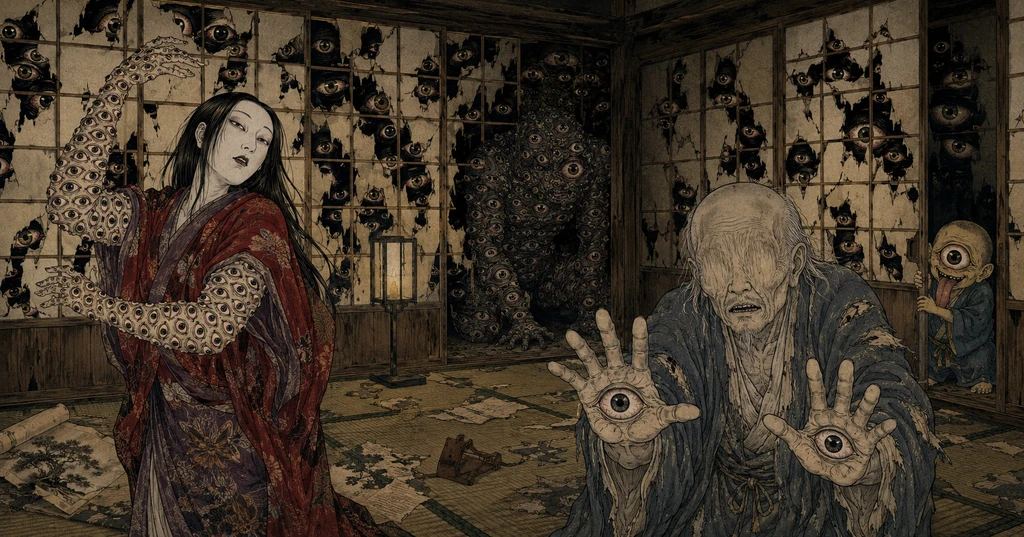
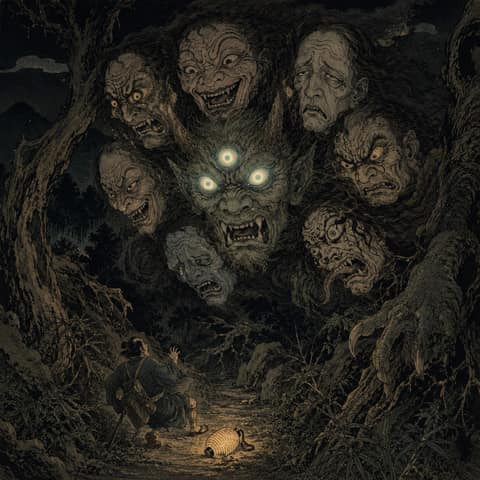
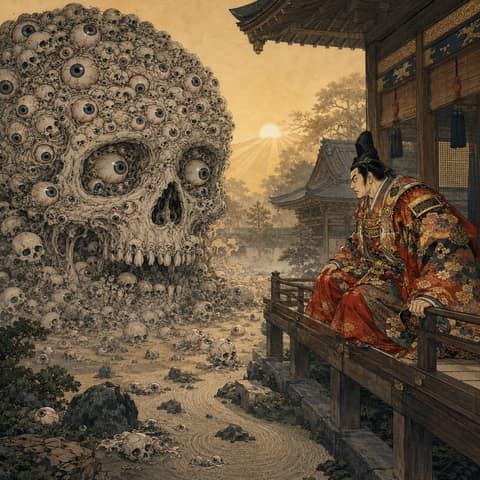
Three-Eyed, Eight-Faced is a monstrous entity said to dwell on Saruyama in old Tosa. True to its name, it had three eyes and eight faces. It attacked travelers headed toward the forest hamlet and devoured them. Its exact appearance is unknown, but its charred corpse was so enormous it was said to sprawl across the neighboring village. Local lore ties the site to mountain-pacifying rites, remembered in place-names like “Shizume Stone” and “Shizume Site.”
Folklore & Legends
A man called Shimen Dayu, said to be the younger brother of Mizuno Wakasa-no-kami, a powerful lord of Tosayama, set up purification gohei and put Saruyama to the torch. Three-Eyed, Eight-Faced rampaged within the flames and finally burned to death. After the conflagration, only the gohei remained, and the place was revered thereafter as a sacred site for calming the mountain. The creature’s body was so vast it was said to stretch into the next village. Some note parallels to Tosa tales of multi-headed giant serpents, though details remain unclear.
Yokai Cards1
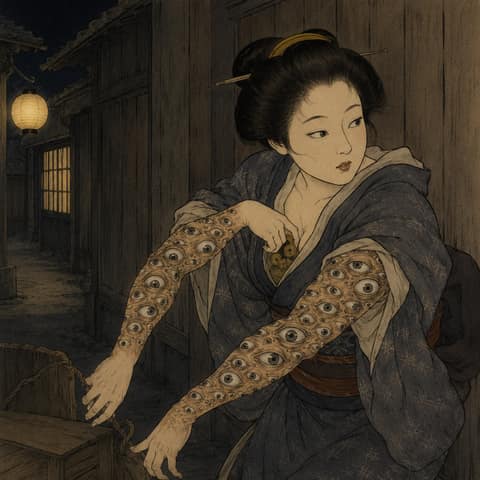
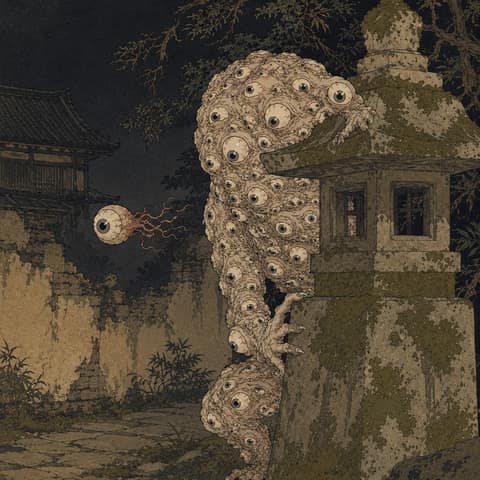
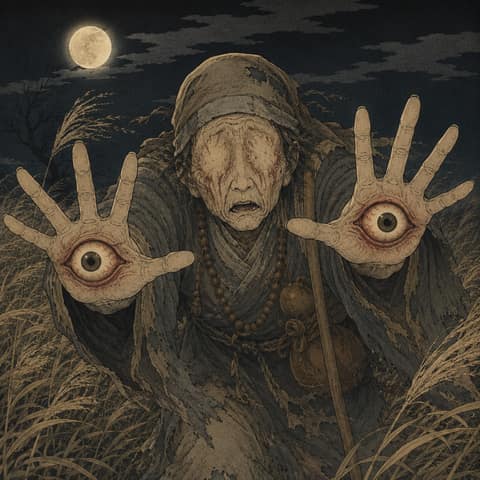
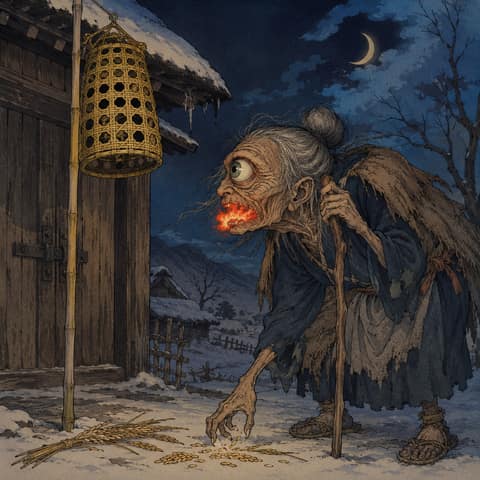
Three-Eyed, Eight-Faced across multiple art-style decks
This version organizes the Saramiyama monster tale preserved around Takagawa in Tosayama Village, Tosa Province. Aside from the aberrant traits of three eyes and eight faces, its appearance is left undescribed, with only the enormity of its remains emphasized. Cast as a mountain demon that attacks passersby, the tale centers on pacifying the mountain and slaying it with fire under the leadership of a local notable. A ritual wand (gohei) is said to have endured amid the blaze, leaving traces in toponyms and legendary sites known as the Pacifying Stone and Pacifying Place. While linked by association to regional stories of multi-headed serpents, it is not directly identified with them, and the true nature of the three-eyed, eight-faced being remains unknown. The story conveys taboos against crossing mountain boundaries and the folk theme of calming with fire and purification, though details such as dates, identities, and specific rites are unclear in tradition.
Character Profile
This section is our own creative profile for storytelling. It is not historical fact or scholarship.
The diagram below is a diagnostic evaluation chart for Tradition-Concordant Version: The Tosa Saramiyama Tale. The higher the value of each item, the stronger that characteristic is expressed.
Love Yokai Type Test
The diagram below is a diagnostic evaluation chart for Tradition-Concordant Version: The Tosa Saramiyama Tale. The higher the value of each item, the stronger that characteristic is expressed.