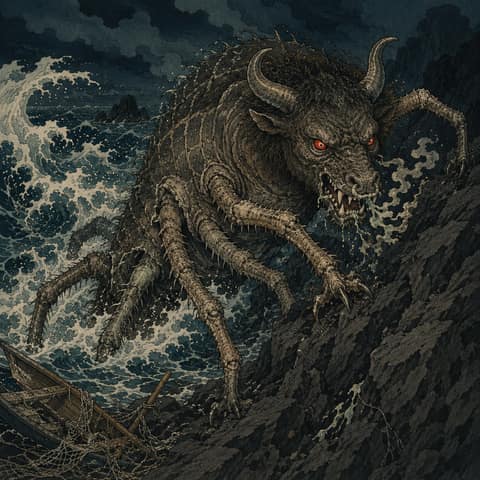
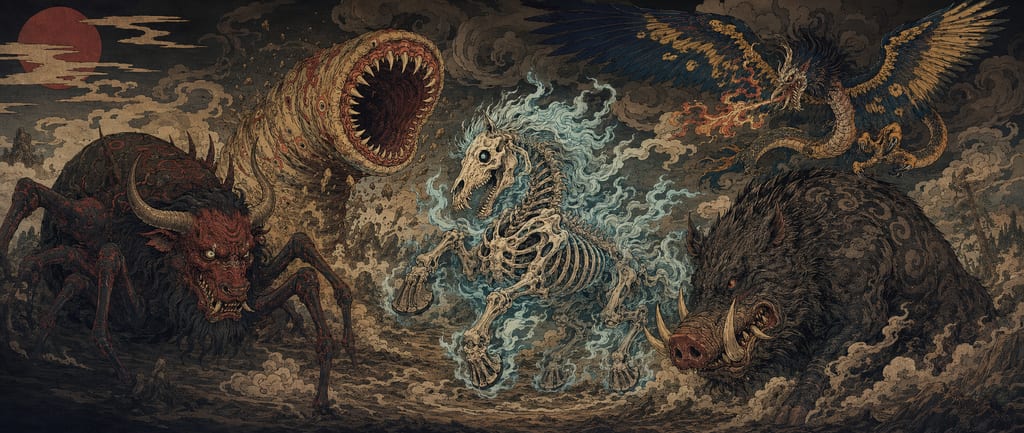
Ushi-oni appears chiefly on the coasts, in deep pools, and in the mountains of western Japan. It is among the fiercest and most numinous beings in the yokai tradition. Its body has no single form: some artists give it a bull's head on an oni's body, while others set the same head on the body of a spider. The Heian-period Pillow Book[1] already names Ushi-oni among the things that inspire terror.
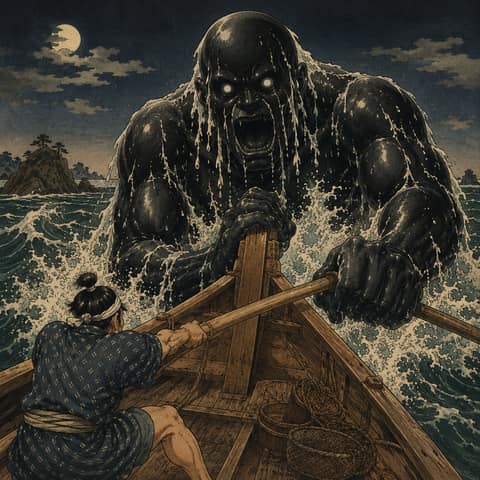
Its most striking quality is a radical dual nature. In one guise, Ushi-oni is a cruel man-eater and bringer of disease that spreads poisonous breath without discrimination. In another, it leads a mikoshi procession and uses its tremendous force to drive away other evil spirits. Over time, a frightening presence in literature became part of regional worship and festival performance. Few yokai show so clearly how a destructive power could also be received as a guardian.
Folklore & Legends
Ushi-oni has a long literary record. The Kamakura-period Azuma Kagami[2] reports that in 1251 a cowlike apparition appeared at Sensōji, breathed poison, and killed seven monks. In volume 32 of the Taiheiki[3], Watanabe no Tsuna, a retainer of Minamoto no Yorimitsu, cuts off the arm of an Ushi-oni in Uda District, Yamato. It later takes the form of Yorimitsu's mother and returns to recover the limb. The plot is identical to the famous Rashōmon story of Ibaraki-dōji, suggesting that medieval writers could treat Ushi-oni and other oni as interchangeable.
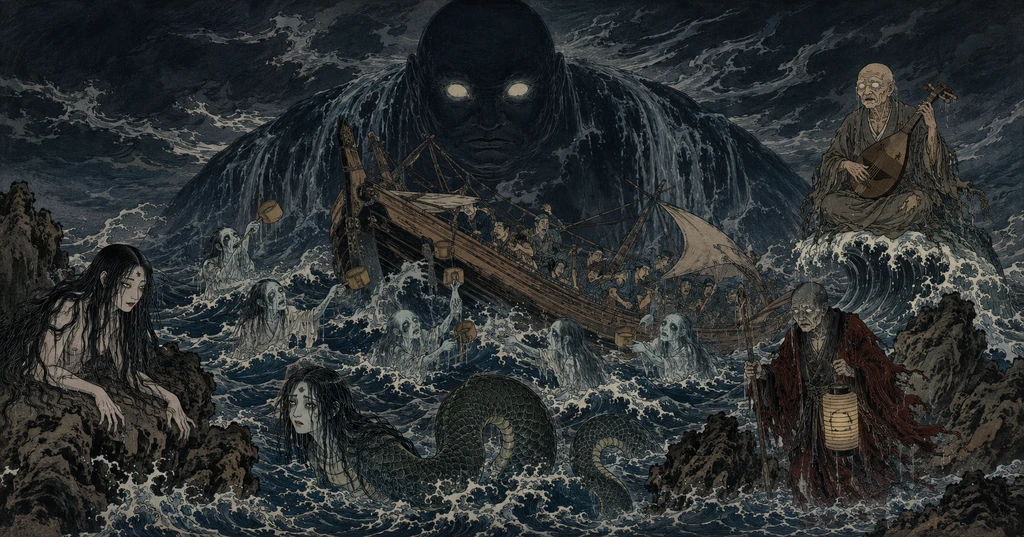
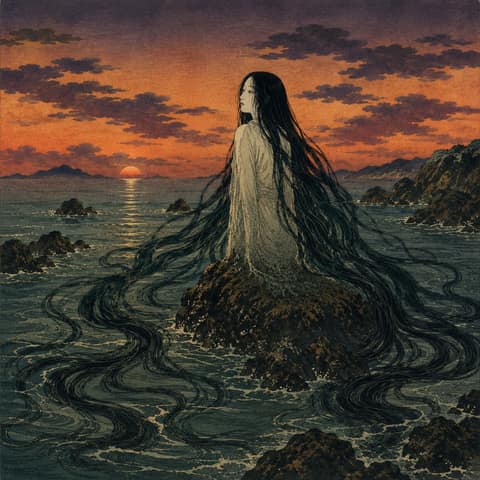
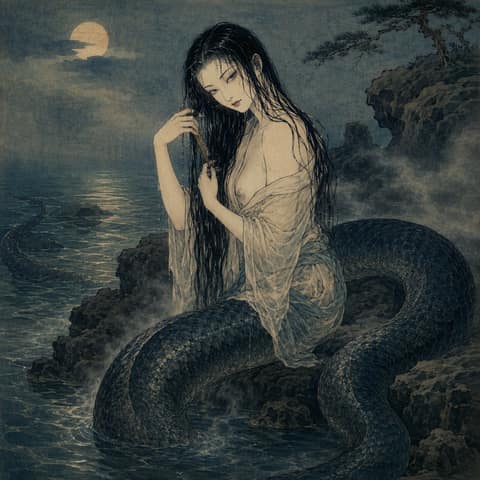
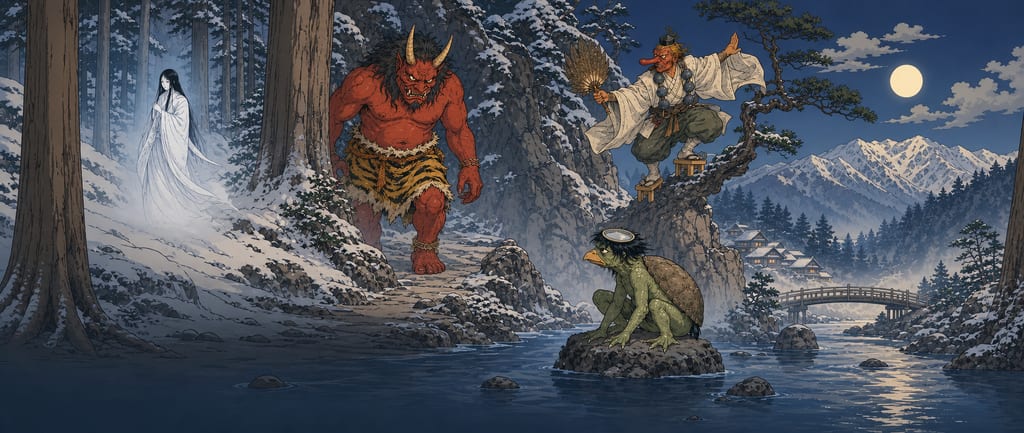
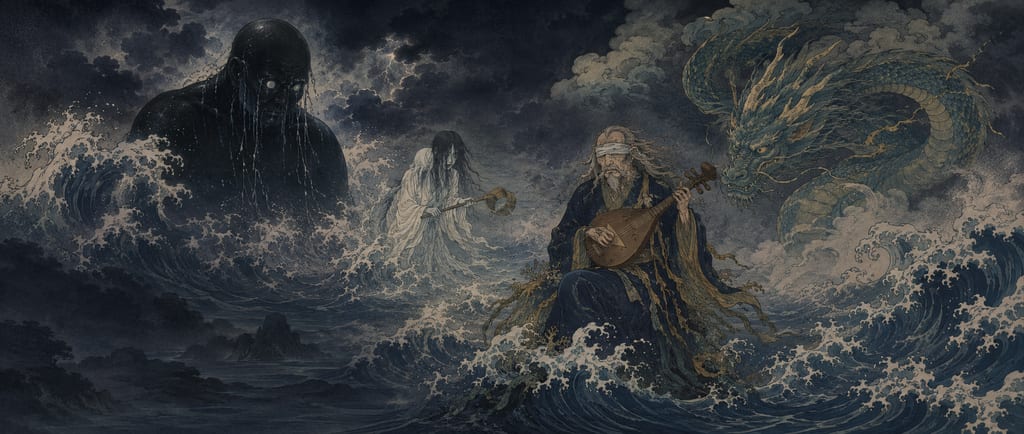
In local tradition, Ushi-oni is more strongly tied to the water. Along the coast from San'in to northern Kyūshū, it may work with Nure-onna or Iso-onna. The woman hands a passerby a baby that becomes as heavy as stone; while the victim is unable to move, Ushi-oni rises from the sea and devours them. At Ushi-oni-buchi in Wakayama, anyone whose reflection on the water is licked by the creature is said to develop a high fever and die within days. Fear of drowning and local disease thus takes the form of the monster.
Yet the same violence can be turned toward protection. At Negoroji in Kagawa, horns said to come from an Ushi-oni slain by the archer Yamada Kurando Takakiyo are preserved as a ward against evil. During festivals at Warei Shrine[4] in Uwajima and elsewhere, enormous Ushi-oni floats move through the streets, using their intimidating presence to clear away malign spirits and impurity. The custom follows a familiar pattern in Japanese belief: once a terrifying force is properly enshrined, its very ferocity can protect the community.
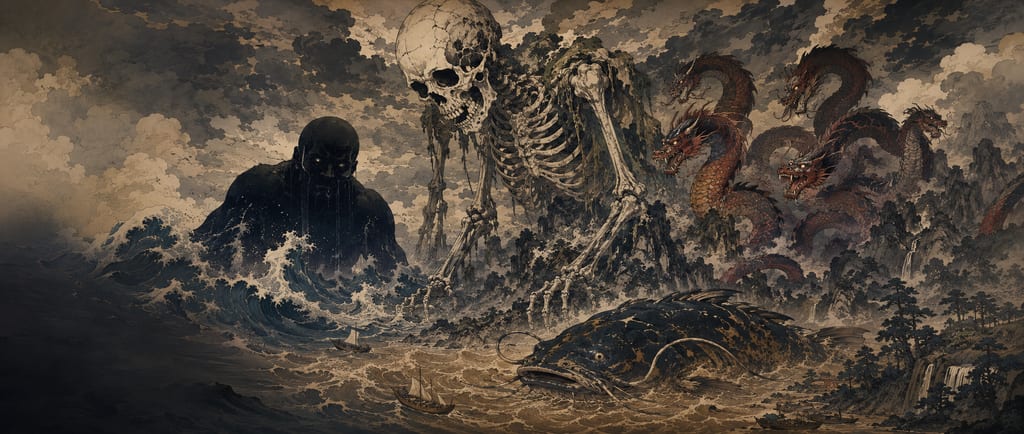
Edo-period picture scrolls and modern yokai encyclopedias often give Ushi-oni its best-known form: a sea demon with the head of a bull and the body of a spider. The image joins a primal fear of dark, deep water to the spider's refusal to release anything caught in its web.
Cattle were closely bound to farming and water control in older Japanese life, and could be revered as sacred animals, messengers of a water deity, or divine beings in their own right, as in the case of Gozu Tennō. One influential interpretation therefore sees the Ushi-oni lurking in a deep pool as the fallen form of a violent water deity—a power once worshiped and feared that became a yokai as its cult declined.
This is no mindless beast. Ushi-oni can supposedly kill a person merely by licking their reflection, and it uses Nure-onna as bait before striking at a vulnerable victim. Such arbitrary, absolute power retains the character of a dangerous deity. Its resentment is strong enough to keep a severed body part moving, leaving an ordinary person almost no hope of resistance. People instead appealed to higher Buddhist powers such as Senju Kannon, or brought Ushi-oni itself into a festival at the head of the mikoshi procession. Properly received as an aramitama—a rough and violent divine spirit—its ferocity could be turned toward defending the town from other evils.
Character Profile
This section is our own creative profile for storytelling. It is not historical fact or scholarship.
It combines overwhelming violence that still feels like divine wrath with an obsession as fathomless as the pool where it waits.
Compatibility
Only those who enshrine it with reverence, or an exorcist capable of subduing its force, can hope to live beside it.
Abilities
Killing through a curse by licking a victim's reflectionPursuing prey across land and water on a spiderlike bodyKeeping severed limbs in motion through immense resentment
Weaknesses
Prayers invoking powerful Buddhist figures such as Senju Kannon, or reverent enshrinement that incorporates Ushi-oni into a community festival.
Habitat
The coast of the Seto Inland Sea, deep river pools, and caves in steep coastal cliffs.
The diagram below is a diagnostic evaluation chart for Ushi-oni, the Bull-Headed Spider of the Deep. The higher the value of each item, the stronger that characteristic is expressed.
Love Yokai Type Test
The diagram below is a diagnostic evaluation chart for Ushi-oni, the Bull-Headed Spider of the Deep. The higher the value of each item, the stronger that characteristic is expressed.