Shimaneしまね
15 yokai rooted in Shimane (Chugoku region). Explore the legends tied to this land.
Legendary places in this prefecture
Specific places within Shimane — mountains, shrines, pools — where yokai are told. Visit each.

神格 Gozu Tenno
ごずてんのう
Gion's Supreme Plague-Dispelling Deity - Gozu Tenno
Divine Spirit / DeityYasaka Shrine / Gion Shrine (Gion-machi, Higashiyama-ku, Kyoto City, Kyoto Prefecture; founded in 656 by Korean envoy Irishi, Gion Goryo-e in 869) / Hiromine Shrine (Hiromineyama, Himeji City, Hyogo Prefecture; purported head shrine, founded in 733) / Tsushima Shrine (Shinmei-cho, Tsushima City, Aichi Prefecture; center of Gozu Tenno worship in the Tokai region) / Suga Shrine (Daito-cho, Unnan City, Shimane Prefecture; syncretism with Susanoo, birthplace of Susanoo)Gozu Tenno (also known as Mutō-no-Kami) is a uniquely Japanese deity whose existence is unconfirmed in foreign lands like India, China, or Korea. Several theories regarding his origin coexist and remain academically unconfirmed: 1) A Buddhist origin theory claiming he is the guardian deity of Jetavana (an ancient Indian monastery where Shakyamuni preached). The name 'Gozu' (ox head) is said to derive from Mount Gośīrṣa in Magadha, India, known for sandalwood, where a guardian named 'Gozu Tenno' was purportedly worshipped. 2) A Korean Peninsula origin theory attributing him to Mount Sudusan, introduced to Japan by ancient Korean immigrants (related to Mount Gozu where Dangun descended in Korean founding myth). 3) A syncretic theory suggesting he is an ancient Japanese immigrant/agricultural deity (the ox being a symbol of farming) reinterpreted through Buddhism and Taoism. Though conclusive evidence is lacking, immigrant influence and his later syncretism with Susanoo-no-Mikoto are the prevailing views from the Middle Ages onward. The core narrative of his worship is the Somin Shōrai legend found in the 'Bingo-no-kuni Fudoki' (compiled in the early 8th century, now surviving only as fragments cited in the 'Shaku Nihongi'). While traveling to the Southern Sea to marry the Dragon King's daughter, Mutō-no-Kami (= Gozu Tenno; 'Mutō' is also theorized to derive from the ancient Indian Maheśvara) sought lodging at the home of the brothers Kotan Shōrai and Somin Shōrai in Bingo Province (modern-day eastern Hiroshima). The wealthy elder brother, Kotan Shōrai, refused him, while the poor younger brother, Somin Shōrai, welcomed him with a humble meal of millet. Years later, Mutō-no-Kami returned with his eight divine children and told Somin Shōrai, 'Wear a woven reed ring (chinowa) around your waist and chant "I am a descendant of Somin Shōrai" to escape the plague,' before departing. The next day, Kotan Shōrai's entire family was wiped out by the plague, while Somin Shōrai's family survived thanks to the chinowa. This is the origin of the 'Amulet of Somin Shōrai's Descendants' (an amulet placed at doorways) and the 'Chinowa-kuguri' (a purification ritual held at the end of June), rituals still performed at Gion shrines, Tenno shrines, and Ise Jingu nationwide. Kyoto's Yasaka Shrine (formerly Gion Shrine / Kanjin-in Gion Shrine / Gion Kanjin-in) is the hub of Gozu Tenno worship. The shrine's history holds multiple theories: 1) Founded in 656 by the Korean envoy Irishi, who enshrined Susanoo from Mount Gozu (most plausible); 2) Enshrined by Ennyo, a monk from the southern capital, in 876; 3) The Imperial Court began praying at Gion during the great plague of 869 (the origin of the Gion Goryo-e). Ranked among the twenty-two elite shrines during the Heian period, the Gion Shrine became the most critical religious center for the Imperial Court, nobility, and Kyoto's citizens. The Gion Festival was established in 869 as a ritual for Gozu Tenno (= Susanoo) to ward off plagues and is one of Japan's three major festivals (alongside the Aomori Nebuta and Awa Odori). When a massive plague swept Kyoto and the nation in 869, the Imperial Court ordered prayers at the Gion Shrine. They created 66 halberds (hoko) representing the 66 provinces of the time to gather the plague gods, then banished them to Shinsen-en (modern-day Nakagyo-ku, Kyoto) — an event known as the 'Gion Goryo-e.' It evolved through the medieval and early modern periods, establishing the Yamahoko float procession, folding screen displays, and Yoiyama eves during the Muromachi period. It is now a month-long summer hallmark of Kyoto and was registered as a UNESCO Intangible Cultural Heritage in 2009, representing the pinnacle of Kyoto's tourism resources. Among other major centers of Gozu Tenno worship, Hiromine Shrine (Hiromineyama, Himeji City, Hyogo Prefecture; supposedly founded by imperial decree of Emperor Shomu in 733, with alleged involvement by Kibi no Makibi) claims to be the 'Head Shrine of Gozu Tenno,' asserting that Kyoto's Gion Shrine was established as a branch of Hiromine. However, due to lengthy medieval and Edo-period disputes over hierarchy among Kyoto's Gion, Hiromine, Tsushima, and Yasaka, the academic consensus on the 'true head shrine' remains undetermined. Tsushima Shrine (Tsushima City, Aichi) serves as the core of Gozu Tenno worship in the Tokai region, with its Tenno Festival (August) being one of Japan's three major river festivals. The countless shrines nationwide bearing the names 'Tenno', 'Yakumo', 'Gion', 'Susanoo', or 'Hikawa' demonstrate the vast spread of Gozu Tenno worship. With the Shinto-Buddhism Separation Order of the Meiji Restoration (1868) and the abolition of Shugendo (1872), the Buddhist title 'Gozu Tenno' was banned, and all Gozu Tenno, Tenno, Gion, and Kanjin-in shrines were forcibly renamed as shrines dedicated to Susanoo-no-Mikoto. Kyoto's Gion Kanjin-in became 'Yasaka Shrine,' while local shrines were renamed to Yasaka, Susanoo, Hikawa, or Gion shrines. However, commoners retained colloquial names like 'Tenno-san' and 'Gion-san,' and folk customs such as passing through the chinowa, the Somin Shōrai amulets, and the Gion Festival persisted seamlessly. During the modern COVID-19 pandemic (2020-), the Gion Festival and chinowa rituals regained attention, reawakening memories of Gozu Tenno as the deity of plague dispellment. In folklore and religious history, he is positioned as 'the greatest victim of the Shinto-Buddhism separation.'

神格 Yamata no Orochi
Yamata no Orochi
Serpent God of Izumo's Hii River: Yamata no Orochi
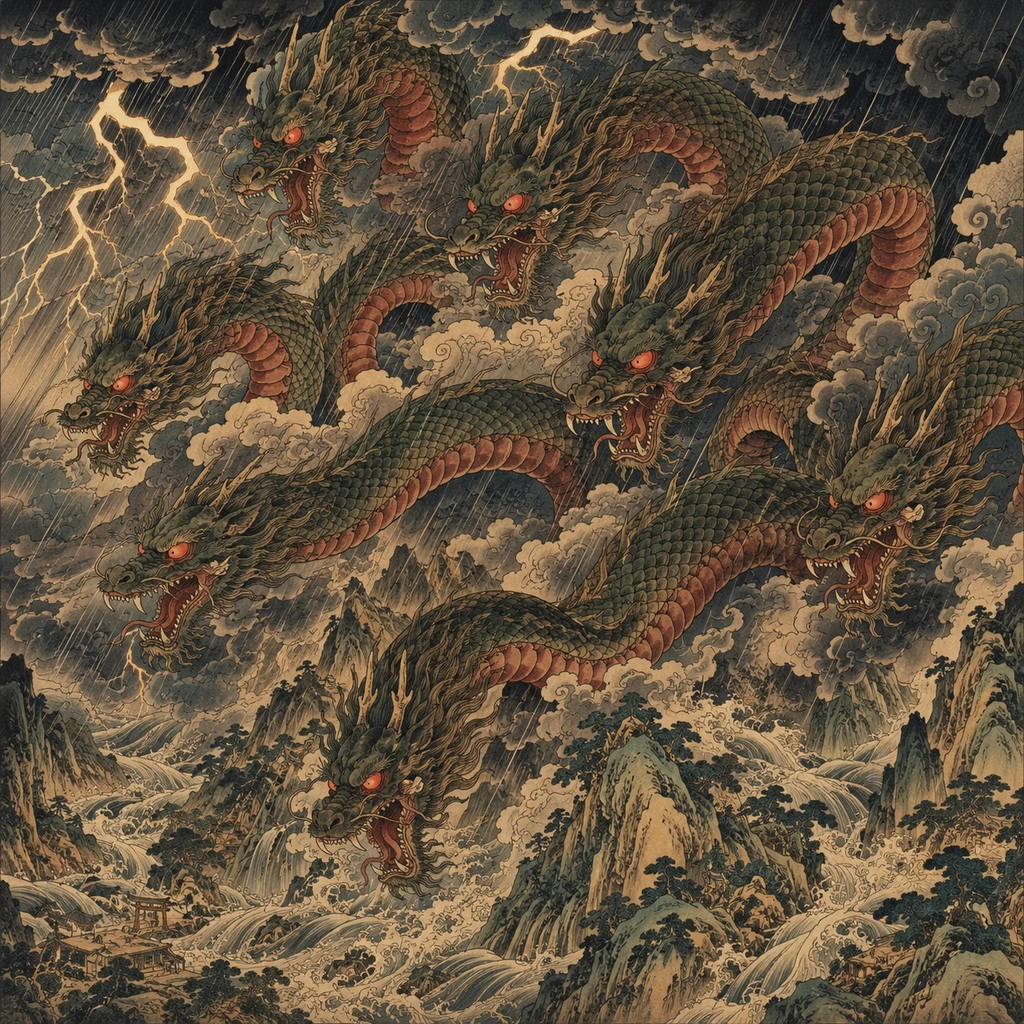
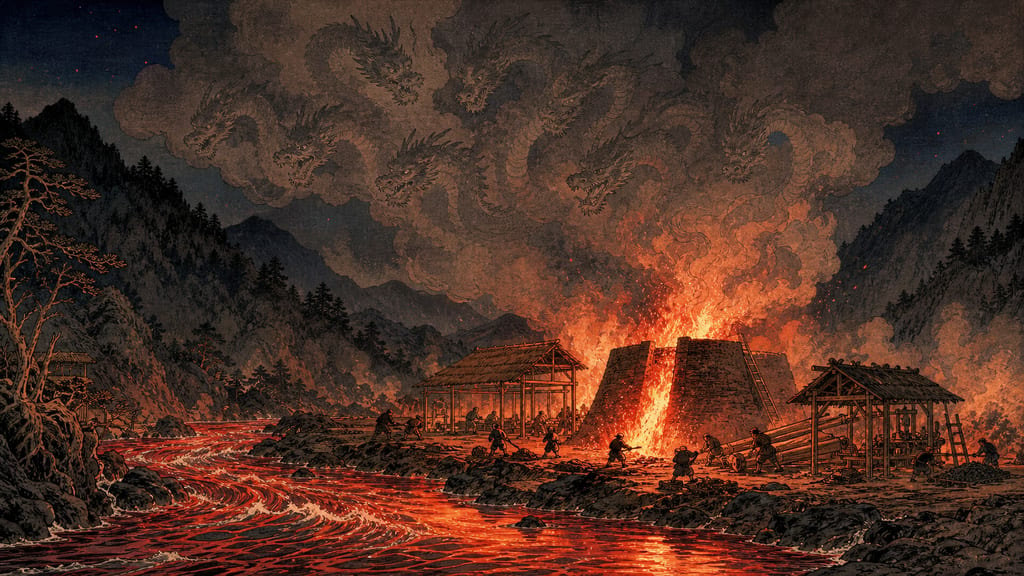
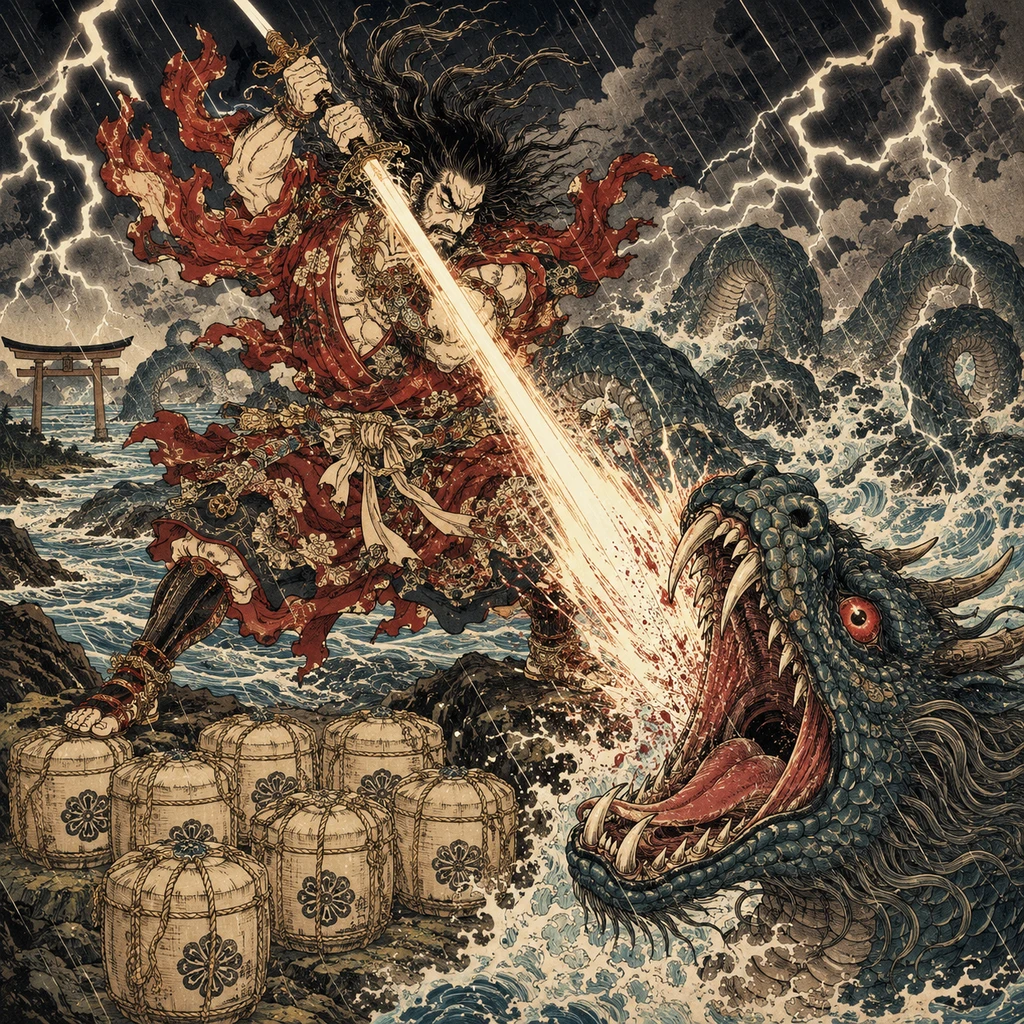
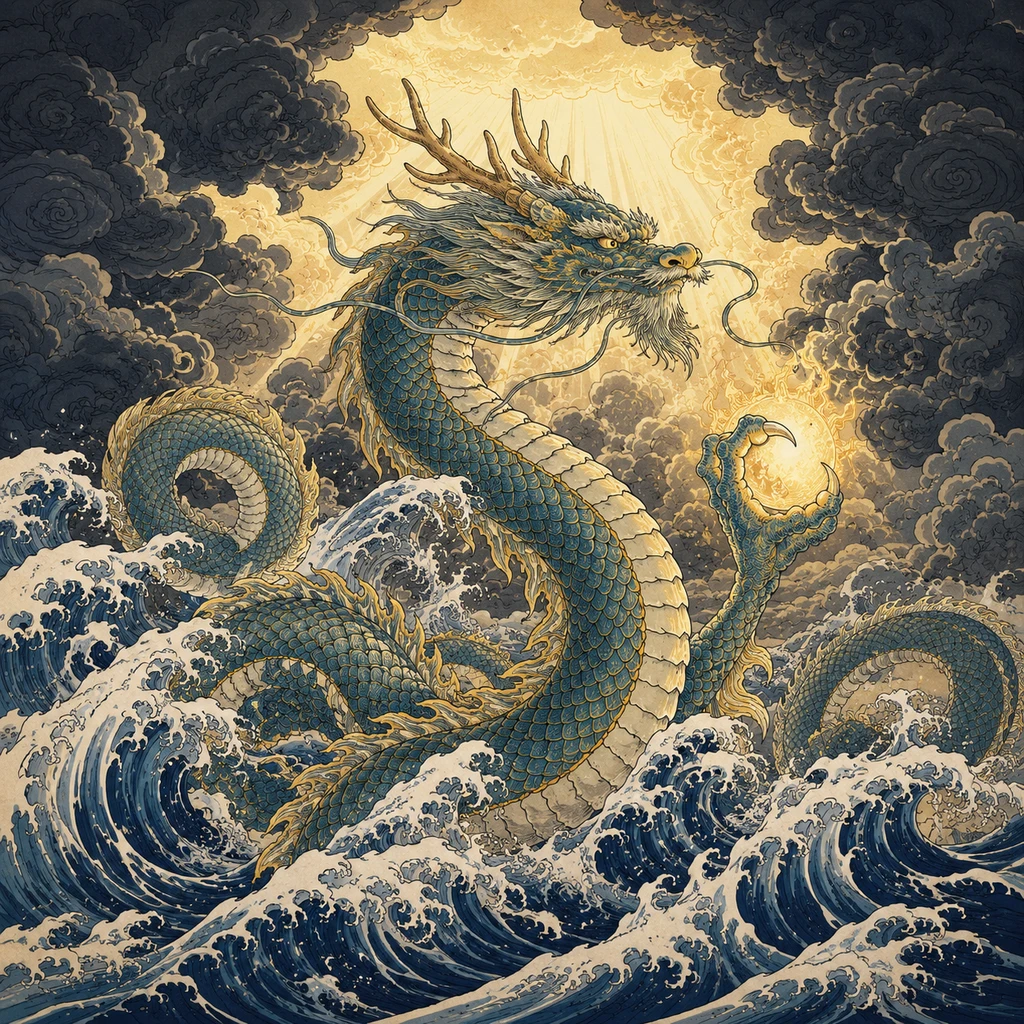
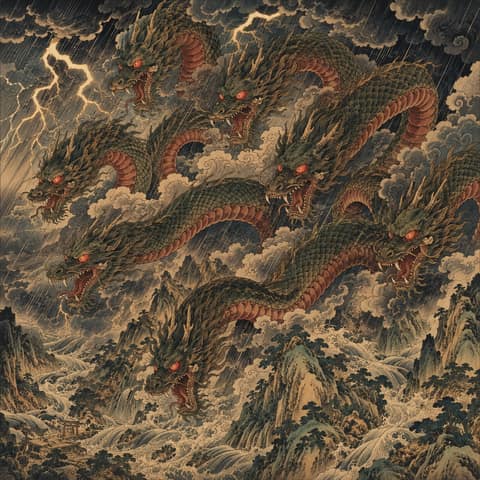
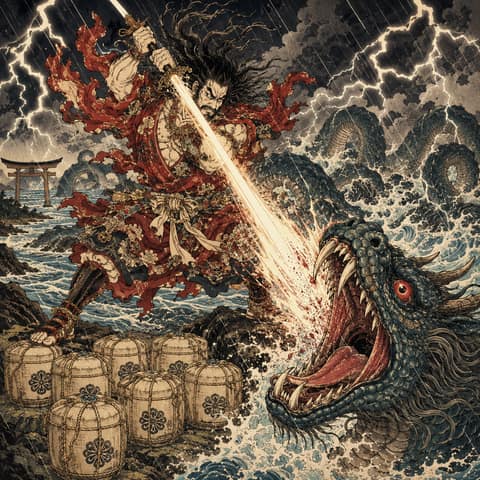
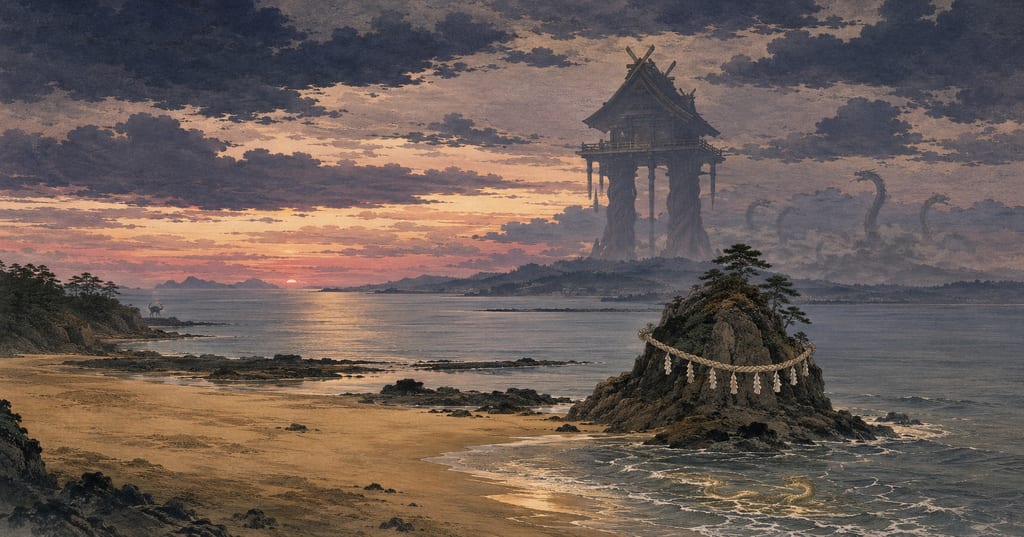
Divine spirit / serpent deityThe upper Hii River basin in Izumo Province, now Unnan and Izumo in Shimane PrefectureOrochi is more than a snake. The old word orochi is often explained as combining a term for peak or ridge with chi, a word for spirit-power. The Kojiki describes moss, cypress, and cedar growing on the serpent and a body spanning eight valleys and eight ridges. That is closer to a living mountain range than to an animal. Other Japanese serpent-slaying tales, from Koga Saburo at Suwa to the Yahiko serpent of Echigo and the Aso traditions around Takeiwatatsu, can be read in the same serpent-deity line. The Kojiki's account of Omononushi in the reign of Sujin, where a god appears as a snake, forms another great pole of ancient Japanese serpent worship. Sand iron and the bloody riverbed. Oku-Izumo was a center of sand iron and tatara smelting. Kanna-nagashi washed mountain soil through channels, separating sand iron and staining riverbeds with red earth and iron. The Kojiki's image of Orochi's belly as always bloody and raw can therefore be read as the mythic language of a red river. Furnace fire, the relative independence of ironworking groups, and the seizure of good blades by central power all make the ironmaking reading persuasive. Mizu no Bunka issue 54 presents this as one of the key local theories. The repeated eight. Yamata, eight heads and eight tails, eight valleys and eight ridges, yashiori sake, eight vats, and the "Yakumo tatsu" poem all make eight the story's organizing number. It may mean literal eight, sacred multiplicity, or both. The eightfold fence around Kushinada-hime gives the number a ritual and spatial force. Even the placement of the tale in book one, section eight of the Nihon Shoki has invited speculation, though that remains an inference about editorial intent. Izumo drawn into Yamato myth. Orochi's defeat can also be read politically. A serpent deity of Izumo is slain by Susanoo from the Takamagahara sphere, and the treasure inside its tail enters the imperial regalia. The later kuni-yuzuri myth of Okuninushi follows the same broad problem: how Izumo is brought into the central mythic order. The Izumo no Kuni no Miyatsuko lineage claims descent in the Susanoo line while serving Okuninushi's cult, so the story survives both as a myth of conquest and as Izumo's own ritual memory. Iwami Kagura keeps the serpent moving. Iwami Kagura's Orochi turns the ancient myth into a present-day bodily performance. Paper-and-bamboo serpent bodies coil and strike across the stage, and several serpents may fight at once. Once an offering at shrine festivals, the performance also became a postwar attraction and regional symbol. What the audience sees is not an abstract myth, but the way Izumo and Iwami continue to tell the serpent story through movement, sound, and spectacle.

伝説 Izanami
Izanami
Izanami no Mikoto, Ancient Mother Goddess of Birth and Death
Deity / divine spiritHana no Iwaya Shrine in Kumano, Mie Prefecture, as a burial tradition / Mount Hiba in Hiroshima and Shimane, as a second burial tradition / Izanami-related shrines in AwajiThe cycle of birth and death: the nature of an ancient mother goddess. The basic profile described Izanami's mythic role; the deeper issue is that she embodies birth and death in a single archaic mother figure. Izanami gives birth to the Oyashima islands and thirty-five nature deities, and even on her deathbed continues to produce gods of mines, earth, and grain from her vomit, urine, and excrement. This resembles the ambivalence of mother goddesses across the ancient world, such as Gaia in Greece, Inanna in Sumer, or Kali in India: the one who gives life also contains death. Izanami is more than a creator deity. She joins birth and death, the living world and the underworld, purity and pollution into one Japanese variation of the archaic mother goddess. Kagutsuchi's birth and the symbolism of fire. Izanami dies because she gives birth to the fire god Kagutsuchi, an event of major symbolic force in ancient Japanese cosmology. Fire begins civilization: forging, pottery, cooking. Yet fire also brings destruction and death. In ancient societies, childbirth itself could threaten a woman's life, and the myth binds those dangers together. Kagutsuchi is born, Izanami dies, and from her dead or dying body arise deities of mines, earth, and grain. This chain makes the material foundations of civilization, metallurgy, agriculture, land-making, emerge from the sacrifice of the mother goddess. The myth gives a stark expression to an ancient worldview: civilization stands on the body of the mother. Yomi no Kuni and the queen of the dead. After burial, Izanami reigns as queen of Yomi no Kuni. This is an unusual structure in ancient myth. Chinese underworlds are often ruled by male figures such as Fengdu or the Lord of Mount Tai; India has Yama, and Greece has Hades. In Japanese myth, however, the realm of the dead is ruled by the former creation goddess. Izanami's rule over Yomi shows the close ancient Japanese linkage of woman, death, and underworld. Later images of Enma, Jizo, and the Sanzu River grow in soil prepared by this imagination of the dead. The idea of death as a feminine principle is one of the most striking points for comparative religion. The burial debate: Izumo and Kumano. The Kojiki names Mount Hiba, on the Izumo-Hoki border, as Izanami's burial place, while a variant in the Nihon Shoki names Kumano in Kii. The two traditions map onto two religious geographies. The Izumo line, Shobara in Hiroshima, Yasugi in Shimane, and Higashi-Izumo in Matsue, connects with Izumo ritual lineages and faith in Ne no Katasukuni. The Kumano line, Hana no Iwaya in Mie and Kumano Hayatama Taisha in Wakayama, connects with Kumano Sanzan worship, Fudaraku sea-crossing beliefs, and Pure Land imagination. Izumo lies to the north, facing the Sea of Japan; Kumano lies to the south, facing the Pacific. Together the two burial traditions form a core problem in the religious geography of ancient Japan. Hana no Iwaya Shrine and ancient iwakura worship. Hana no Iwaya Shrine in Kumano, Mie, is named in the Nihon Shoki as Izanami's burial place and is one of Japan's oldest shrines; it has no shrine hall and worships a forty-five-meter sacred rock as its divine body. Iwakura worship is an old Japanese mode of nature veneration in which trees, boulders, waterfalls, and mountain peaks are treated as places where divine spirits dwell. Later shrine architecture grew out of such natural sacred places, and Hana no Iwaya preserves an especially ancient layer by having no main building. The Otsunakage rite, held on February 2 and October 2, hangs a rope about 170 meters long from the sacred rock to the precincts; it is a rare living folk practice that carries ancient rock worship into the present. "One thousand a day, fifteen hundred a day": the cosmology of life and death. The exchange at Yomotsu Hirasaka is the moment when Japanese myth fixes the order of life and death. Izanami says she will kill one thousand people a day; Izanagi answers that he will cause fifteen hundred to be born. The scene is grief after marital separation, but also a cosmic declaration that death and life, underworld and this world, feminine and masculine principles will stand in permanent tension. Death counts one thousand; birth counts fifteen hundred. Life exceeds death. That inequality becomes a religious expression of life's continuation. Japanese myth does not remain a simple tragedy; it turns the dialectic of life and death into cosmology. Izanami reevaluated in the twenty-first century. Postwar feminist myth studies and cultural criticism have moved beyond reading Izanami only as a victim of patriarchal myth. They also understand her as an embodiment of the ancient mother goddess who unites birth, death, and the underworld. Motoori Norinaga's Kojiki-den, completed in 1798, laid the philological foundation; later comparative mythologists such as Orikuchi Shinobu, Obayashi Taryo, and Yoshida Atsuhiko added new interpretive layers. In the twenty-first century, Izanami is no longer merely a mythic character. She has become an image of the feminine root of Japanese myth and of cosmic order as mother, continuing to shape religion, scholarship, and cultural imagination.

伝説 Yomotsushikome
よもつしこめ
Underworld Pursuer of the Kojiki: Yomotsushikome
Divine Spirit/DeityYomi (Mythology) / Yomotsu Hirasaka Lore Site (Higashi-Izumo-cho Iya, Matsue City, Shimane Prefecture)The Position of Grotesque Deities in Kiki Mythology. While the basic description touches on the accounts in the *Kojiki* and *Nihon Shoki*, the deep dive explores Yomotsushikome's position as a "grotesque deity" within the mythological system. Deities in *Kiki* mythology are broadly classified into three layers: (1) Takamagahara lineage (heavenly/pure deities), (2) Ashihara-no-Nakatsukuni lineage (earthly/indigenous deities), and (3) Yomi lineage (deities of the dead/grotesque deities). Yomotsushikome belongs to the third lineage, forming a cohesive system alongside Izanami (the goddess stationed in Yomi), the Eight Thunder Deities, and the Underworld Army. *Kiki* mythology is not a simple dualism of good and evil; it possesses a three-tiered structure of "life, purity, and light" versus "death, impurity, and darkness," where grotesque deities are positioned as essential entities upholding the order of the underworld. Etymology of "Shiko"—The Semantic Field of Ancient Japanese. Interpreting "shiko" as "ugly" is a reductive interpretation from the Middle Ages onwards. In ancient Japanese, "shiko" was a rich word connoting "strength, hardness, and terror." Cognate words like "shikobuchi" (rocky abyss) and "shikofune" (sturdy boat) express the hardness of coastal rocks. "Shikome" was not merely an "ugly woman" but understood as a "hard, strong, and terrifying female demon-deity." The names of ancient deities tended to be based on "spiritual power and function" rather than "visual features," positioning Yomotsushikome as a "female demon-deity with terrifying power governing death." The fixed image of a "flesh-rotting, fanged hideous hag" in medieval picture storytelling is a later reconstruction distinct from her original mythological figure. East Asian Comparison of Peach Warding Beliefs. The episode of Izanagi using peaches to repel Yomotsushikome serves as a key subject in comparative religion regarding East Asian warding culture. In Chinese Taoism, warding off evil spirits using peach wood swords, peach charms, peach seals, and peach offerings was systematized and widely spread to East Asian regions. The magical power of the peach repeatedly used in Japanese court rituals (Tsuina, Tango no Sekku, Momo no Sekku) was formed through the complex intertwining of the Izanagi myth in the *Kojiki* and Chinese Taoist peach worship. This is a classic example of how ancient Japan constructed its unique system while assimilating the religious cultures of the Chinese mainland and the Korean peninsula. The Pursuit Tale as a Narrative Type. A hero escaping from the land of the dead by throwing magical items that transform to delay pursuers—this is known in world mythology as the "Magic Flight" motif, a widely distributed narrative type. Similar tales exist in the Greek myth of Orpheus and Eurydice, Eastern European folklore of Baba Yaga, and Native American creation myths, demonstrating a universal structure of ancient human concepts of the underworld and escape narratives. The tale of Izanagi and Yomotsushikome holds exceptionally high comparative mythological value as one of the oldest literary records of this global narrative type in East Asia. The Geography of Yomotsu Hirasaka—Relationship with the Izumo Belief Sphere. The modern estimated site of Yomotsu Hirasaka in Higashi-Izumo-cho Iya, Matsue City, Shimane Prefecture, is located in the core region of the ancient Izumo belief sphere, alongside the Izumo Kuni-no-Miyatsuko stronghold, Kumano Taisha, and Kamiarizuki legends. In the *Kojiki* and *Nihon Shoki*, Izumo is depicted as the intersection of the three mythological layers—Takamagahara, Ashihara-no-Nakatsukuni, and Yomi—and placing the "entrance to Yomi" in Izumo was no coincidence. It reflects Izumo's status as the religious center for "death, the otherworld, and Ne-no-Katasukuni" in ancient Japan. Myths involving Okuninushi, Susanoo, Izanagi, and Izanami intersect in this region, serving as the key to deciphering ancient religious geography. Reduction Since the Middle Ages and Modern Renewed Interest. In medieval sermons, picture storytelling, Noh, and Joruri theater, Yomotsushikome was fixed into the image of a "flesh-rotting, fanged hideous hag," losing the original ancient semantic field of a "strong female demon-deity." However, since the 2010s, amidst a renewed interest in Japanese mythology, re-evaluations based on findings in ancient linguistics, mythology, and archaeology are progressing. Modern subcultures such as the *Megami Tensei* game series, *Record of Ragnarok* manga, and *Demon Slayer* anime functionally reconstruct ancient mythological materials, thereby reintroducing the mythological worlds of Yomotsushikome, the Underworld Army, and Yomi to younger generations. This is a symbolic example of cultural historical circulation from ancient to modern times. Positioning as "Japan's Oldest Yokai". Yomotsushikome is a female demon-deity appearing in the *Kojiki* (712 CE), Japan's oldest extant book, giving her a unique status not just as a "post-Heian yokai" but as a "grotesque deity recorded in the original texts of Japanese mythology." Predating the yokai systems involving oni, tengu, and kappa that formed from the Middle Ages onwards—in an era where the boundary between ancient gods (kami) and yokai was still undifferentiated—she is a core subject for tracing the origins of yokai studies. Dismantling the binary opposition of "is it a god or a yokai?", she serves as an excellent starting point for examining the rich, multi-layered nature of ancient Japan's grotesque deities.

伝説 Umibōzu (Sea Monk)
oo-mee-BOH-zoo
Umi-bōzu (Fishermen’s Lore)
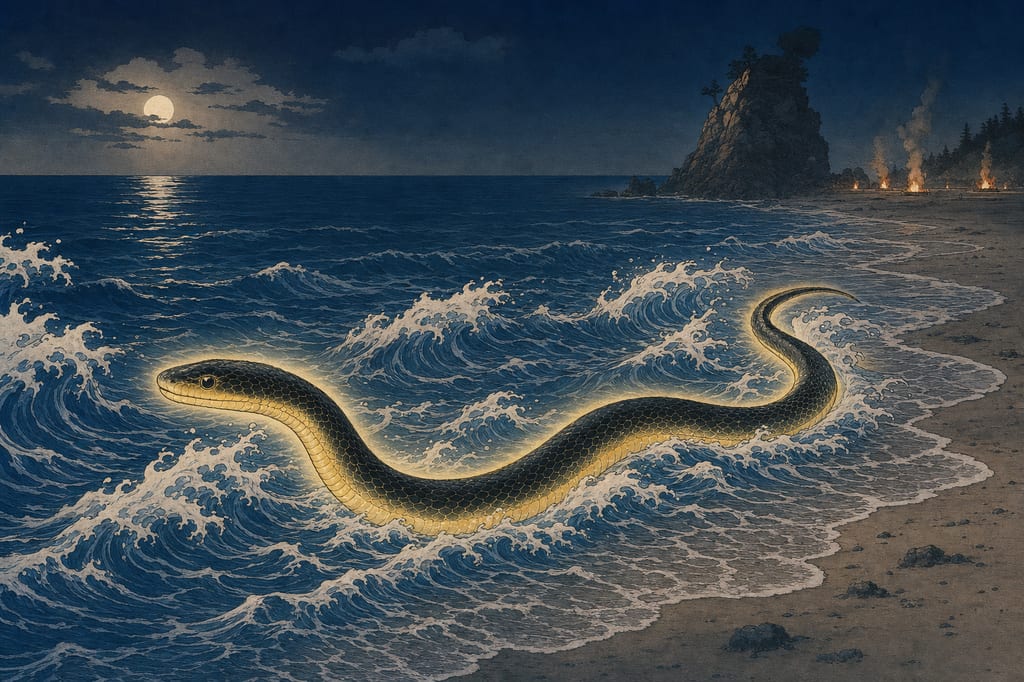
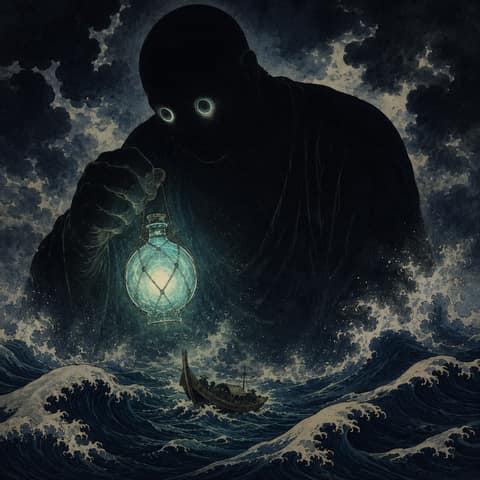
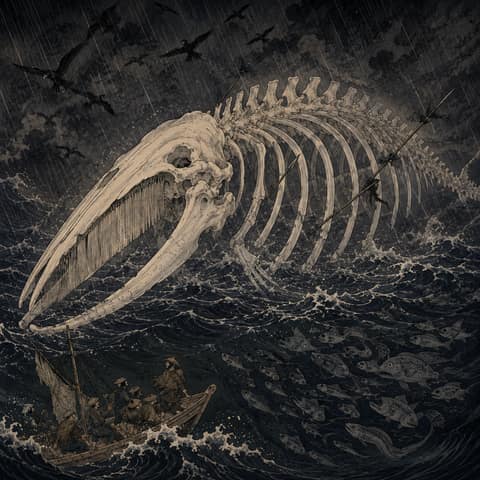
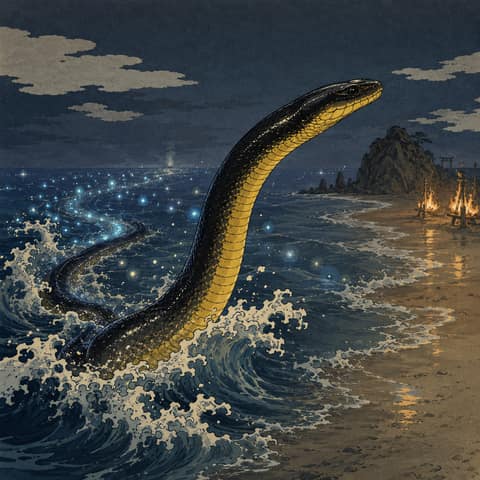
Aquatic SpiritsFishing villages and maritime loreUmi-bōzu is a yokai said to embody the fear and unease sailors feel at sea. Its form is not fixed, sometimes appearing as a mere black shadow, other times rising from the waves as a colossal monk-like figure. Tales tell of it approaching boats and whispering, “Lend me oil,” and if given, it ignites flames and sinks the vessel. In more recent lore, it is said to collect sunken boats and nets and stack them on the seafloor, and at times appears holding a glowing bottle or lantern. Both a frightener of humans and a symbol of the sea’s mystery, it is regarded with awe.

伝説 Ushi-oni
OO-shee OH-nee
Ushi-oni (Traditional Lore Form)
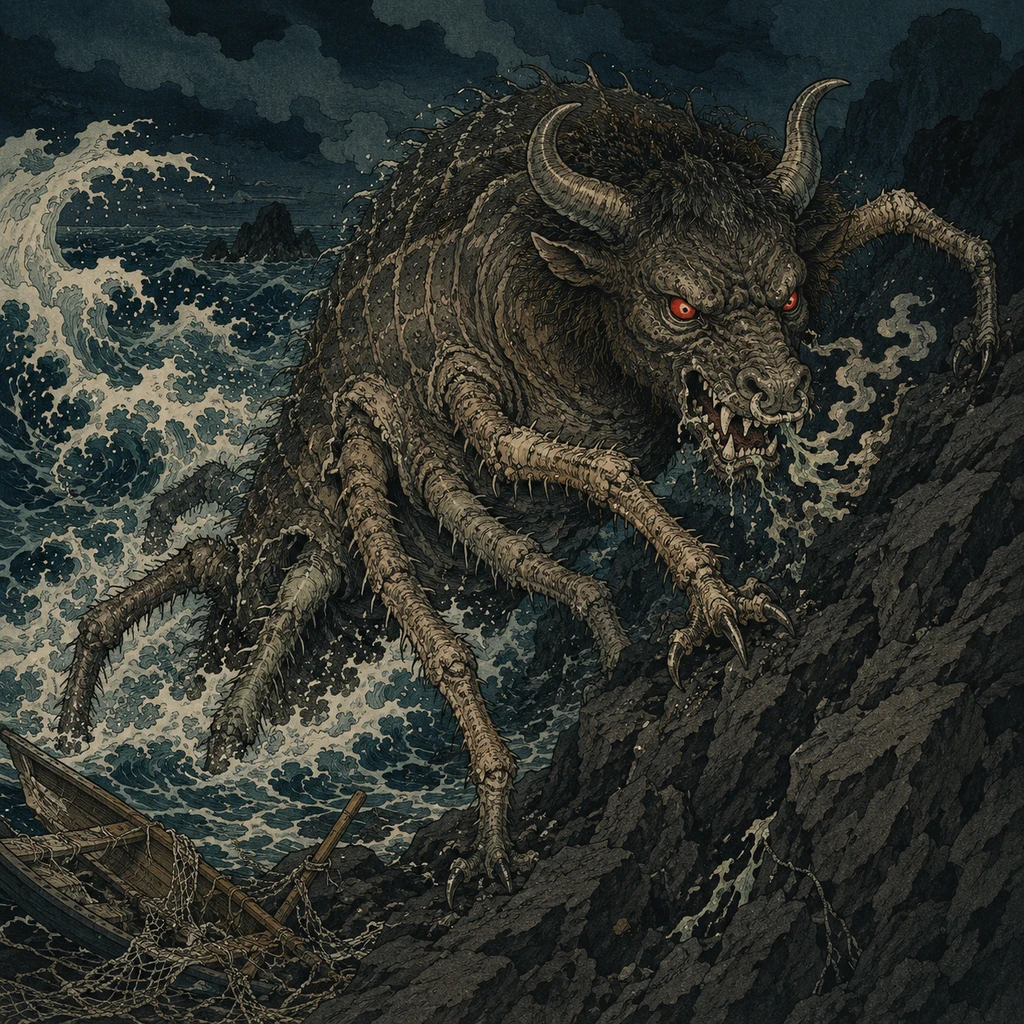
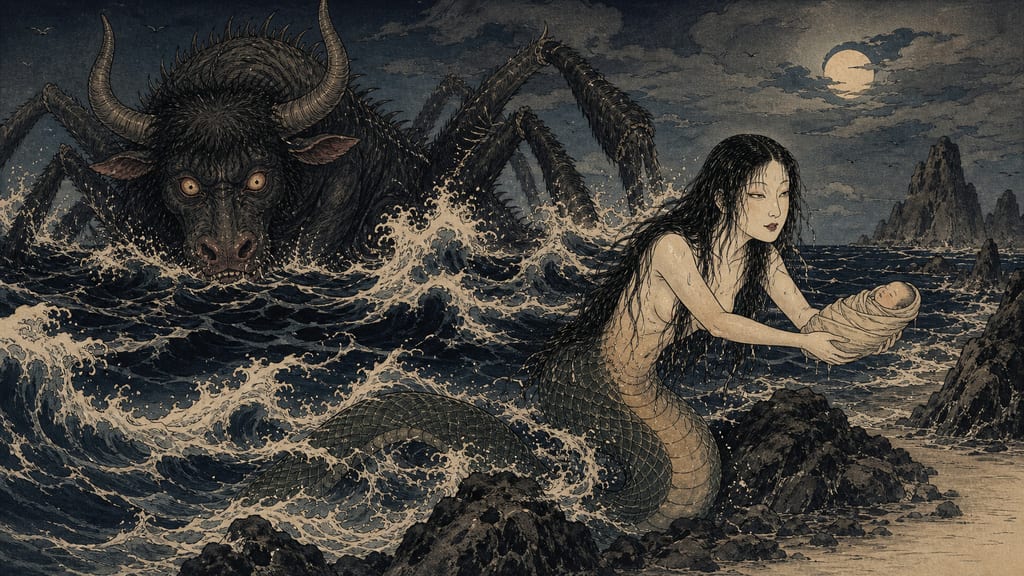
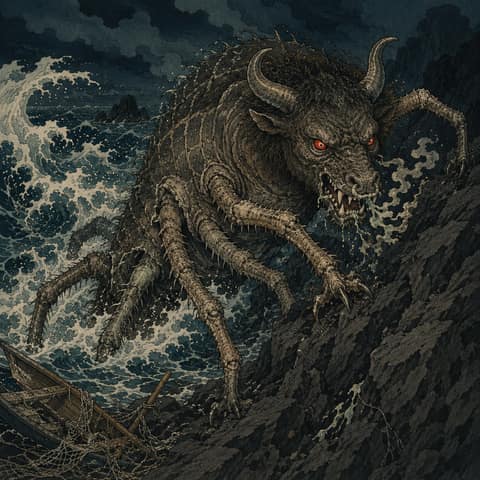
Animal ShapeshiftersCoasts of Shikoku and the Chugoku region (especially Ehime and Kochi along the Seto Inland Sea)The Ushi-oni’s appearance varies by region, yet it is consistently remembered as a symbol of terror. Emerging from the sea, it ambushes travelers and fishermen, inspiring fear, taboos, and appeasement rites. Legends tell that even when its head is severed it keeps rampaging, marking it as a top-tier yokai for persistence and monstrous strength.

伝説 Ebisu
えびす
Ebisu
Divine Spirit / DeityNishinomiya Shrine (present-day Nishinomiya, Hyogo; Hiruko tradition) / Miho Shrine (present-day Matsue, Shimane; Kotoshironushi tradition)"Ebisu" as an Ancient Japanese Belief in the Sea and the Otherworld. While the basic description touches upon the two major origin theories of Ebisu, a thorough analysis reveals the deep layers of "Ebisu" as an indigenous ancient Japanese belief in the sea and the otherworld. The fact that "ebisu" and "emishi" share the same etymology indicates that ancient Japanese collectively referred to beings arriving from "beyond, the otherworld, or boundaries" as "ebisu," finding abundance, fortune, and auspiciousness in them. As a representative example of the "visiting deity (Marebito)" belief systematized by Shinobu Orikuchi, it forms the core of widespread otherworldly and abundance beliefs in ancient Japan. The Hiruko Myth ── The Narrative Archetype of Deformity, Exile, and Rebirth. The Hiruko myth passed down in the *Kojiki* and *Nihon Shoki* (a deformed child set adrift in a reed boat who is reborn as a deity of abundance in a foreign land) is a representative example of the narrative archetype of "deformity, boundaries, and rebirth" in ancient Japan. The process by which Hiruko washed ashore in Nishinomiya and gained the reverence of fishermen to become Ebisu is the result of this universal religious motif uniquely developing in connection with Japan's indigenous marine and fishing culture. The Kotoshironushi Myth ── The Origin of Ebisu in the Land Transfer Myth. Kotoshironushi, the eldest son of Okuninushi, is a crucial deity who negotiated with Takemikazuchi on his father's behalf in the land transfer myth. The process of Kotoshironushi, who was fishing at Mihogasaki, hearing of the messenger's arrival and advising his father to accept the transfer is a religious expression of the political integration of the center (Amatsukami) and the regions (Kunitsukami) in ancient Japan. The concrete image of a fishing deity flowed directly into the later iconography of Ebisu holding a sea bream and a fishing rod. Coexistence of Two Major Origin Theories ── Hiruko and Kotoshironushi Lineages. The fact that the two major origin theories—Hiruko (Nishinomiya Shrine lineage) and Kotoshironushi (Miho Shrine lineage)—coexist and have been passed down without being completely unified demonstrates the flexibility and plurality of Japanese religious culture. The Edo period Seven Lucky Gods faith integrated both lineages under the common name "Ebisu-sama," and the common people affectionately embraced him as the "god who brings business prosperity and fortune" without strictly distinguishing between the two. Sea Bream, Fishing Rod, Smile ── Medieval and Early Modern Iconography. The modern image of Ebisu (sea bream, fishing rod, smile, ori-eboshi, kariginu) is a culmination of unique designs established in medieval and early modern Japan. (1) The sea bream is a symbol of ancient Japanese fishing, commerce, auspiciousness, and the color red. (2) The fishing rod is a symbol of ancient fishing, rituals, and the Kotoshironushi myth. (3) The smile (Ebisu face) is an expression of gentleness common to gods of fortune since the Middle Ages. (4) The ori-eboshi and kariginu visually emphasize Ebisu's uniqueness as a "fortune god unique to Japan." Toka Ebisu ── The Festival Culture of Edo Period Commoner Faith. The Toka Ebisu in Kansai (January 9-11) is a representative Ebisu festival established in the Edo period, held on a large scale at places like Imamiya Ebisu, Nishinomiya Shrine, and Kyoto Ebisu Shrine. The accompanying chant "Bring a bamboo branch for business prosperity" and the conferment of lucky charms like the fuku-zasa support the collective prosperity prayers of merchants, restaurants, and individual worshipers. Ebisu in the 21st Century ── Urban Culture and Modern Prosperity Prayers. Today, Ebisu is widely embraced as the principal deity for Japanese commerce, dining, fishing, navigation, and new business prayers. The place name "Ebisu" around Ebisu Station in Shibuya, Tokyo, originated from the YEBISU Beer factory in the Meiji era and enjoys nationwide fame as a symbolic name for modern urban culture and commercial districts. Repeatedly reshaped in subculture works, he represents a prime example of ancient marine and otherworldly beliefs transforming into a modern Japanese pop icon.

伝説 Susanoo
すさのお
Susanoo (Default)
kamiJapanese Mythology (Kojiki, Nihon Shoki), Izumo no Kuni Fudoki, Gion Beliefs / Gozu Tenno Beliefs, Izumo and Yasaka lineage shrinesThe Dramatic Transformation from 'Wild God' to 'Hero God'. While the basic description traced Susanoo's primary myths, this detailed explanation delves into his dramatic personality shift from 'wild god' to 'hero god'. The Susanoo of the Kojiki and Nihon Shoki possesses diverse characteristics, having three entirely different aspects: the childishness of weeping for his mother, the ferocity in Takamagahara, and the heroism, paternity, and wisdom in granting trials after descending to Izumo. Folklorist Teiji Yoshimura (1977) pointed out that 'the Susanoo of Takamagahara mythology and Izumo mythology have different personalities.' This can be interpreted as the result of multiple different mythological traditions being integrated into a single deity. Two lineages—the Takamagahara mythological sphere (Amatsu-kami lineage) and the Izumo mythological sphere (Kunitsu-kami lineage)—were converged into the single deity 'Susanoo' during the process of political and religious integration in ancient Japan, resulting in a unique deity with a multi-layered personality. Yearning for the 'Mother's Country' ── Ancient Motherhood Beliefs. Despite being entrusted with the rule of the sea plain by his father Izanagi, Susanoo continued to weep and howl in longing for the root country (Ne-no-Katasu-Kuni) of his deceased mother Izanami. This 'yearning for the Mother's Country (Hahanokuni)' is an important motif in ancient Japanese mythology, expressing the fundamental tension among patriarchy, matriarchy, and generational succession. Shinobu Orikuchi deciphered this motif comparatively as 'Tokoyo-no-Kuni belief' and 'Mother's Country belief'. The later tale of Okuninushi descending to Ne-no-Katasu-Kuni to undergo Susanoo's trials also reflects the structure of generational succession: 'deceased mother → father god (Susanoo himself) → son-in-law god (Okuninushi)'. It can be read as a multi-layered expression of ancient Japanese views on motherhood, fatherhood, and life and death, transcending a simple heroic myth. Soshimori in Silla and Ancient Japan-Korea Relations. The Kojiki's account that the banished Susanoo descended to Mount Torikami in Izumo via 'Soshimori in Silla (Shiragi Soshimori)' is extremely interesting as a rare 'tale via the continent' in ancient Japanese mythology. The specific location of Soshimori in the southeastern Korean Peninsula is debated, and it can be interpreted as a passage mythologizing ancient Japan's history of continental immigrant culture and exchanges with the Korean Peninsula. It has been pointed out that Shinto of the Izumo Kuni-no-Miyatsuko lineage likely developed within the maritime trade network with the Korean Peninsula and the continent since ancient times, and Susanoo's tale via Silla can be read as a memory layer mythologizing this history of maritime exchange. It serves as documentary evidence showing that ancient Japan was not an isolated cultural sphere but formed through close interaction with the continent and peninsula. Social Historical Interpretation of Slaying Yamata-no-Orochi. The tale of slaying Yamata-no-Orochi has been interpreted as a multi-layered story reflecting the socio-historical situation of ancient Japan, going beyond a simple heroic monster-slaying myth. The specific descriptions—'eight heads, eight tails, along the Hii River, blood flowing from the belly, an iron sword from the tail'—strongly support the 'iron-making origin theory' (proposed by Takeshi Matsumae, Shohei Mishina, etc.), which suggests that the ancient Izumo tatara iron-making, the iron content of the Hii River, river flooding, and the social organization of iron-making communities were mythologized. Susanoo's heroic tale was formed in intense dialogue with the iron culture of ancient Japan and the nature and society of the Hii River basin, re-evaluated not as a simple myth but containing valuable record layers of ancient social history. 'Eight Clouds Arise' ── Japan's Oldest Waka. The poem Susanoo composed when he built a palace in Suga, Izumo after slaying Yamata-no-Orochi—'Eight clouds arise, the eightfold fence of Izumo creates an eightfold fence to keep my wife in, oh that eightfold fence'—is positioned as the origin of the history of Japanese literature and waka. The basic format of the thirty-one syllables (5-7-5-7-7) was already established here, demonstrating the identification of the birth of songs with mythological heroism in ancient Japan. The fact that the starting point of the entire Japanese waka culture, leading to the Man'yoshu, Kokinshu, and Shin-Kokinshu, is attributed to the mythic hero-god Susanoo symbolizes the inseparability of poetry and mythology in Japanese culture. The opening phrase 'Eight clouds arise' remains a sacred cultural resource repeatedly cited in the world of waka and tanka today. Syncretism with Gozu Tenno and Medieval Gion Beliefs. From the Middle Ages onward, Susanoo syncretized with Gozu Tenno, derived from Buddhism, Taoism, and the Korean Peninsula, becoming the guardian deity of dispelling epidemics and warding off disasters as the principal deity of the Kyoto Gion Shrine (now Yasaka Shrine). Gozu Tenno is considered a plague god originating from Silla and the Korean Peninsula, and has a complex religious history where Chinese beliefs of the guardian deity of Jetavana Monastery and Japanese Susanoo beliefs syncretized in the Middle Ages. The history of the Gion Goryo-e, initiated in 869 (Jogan 11) to pray for the end of an epidemic spreading in the capital, exceeds a millennium, and was inherited as the largest religious festival for dispelling epidemics nationwide throughout the Edo period, early modern, and modern eras. It continues to be inherited in the 21st century as the Kyoto Gion Festival (a nationally designated Important Intangible Folk Cultural Property) and a UNESCO Intangible Cultural Heritage, showing that the multi-layered overlap of ancient myth and medieval Buddhism continues to exert a sustained influence on the religious life of modern Japan. Resurgence in Modern Culture. Susanoo has been repeatedly re-sculpted in post-war Japanese subculture works. He frequently appears as one of the strongest demons in the 'Megami Tensei' series, in the portrayal of Susanoo and Kushinadahime in the game 'Okami', as a motif like 'Sun Breathing' in the manga 'Demon Slayer', and in anime such as 'Nura: Rise of the Yokai Clan' and works like 'Touhou Project'. His multi-layered attributes as a 'wild god', hero, ancestor of poetry, and guardian deity against epidemics have high affinity with modern character creation. He is a symbolic figure of ancient mythology who continues to drive the mythological imagination of the Japanese people for over two thousand years.

伝説 Okuninushi no Kami
Okuninushi no Kami
Okuninushi no Kami, Lord of Izumo Myth and God of Matchmaking
Deity / divine spiritIzumo Province, present-day Izumo, Shimane Prefecture / Izumo TaishaThe many-named god and the gathering of local faith. The basic profile noted Okuninushi's many names; the deeper point is what such multiplicity means in religious history. Names such as Onamuchi, Okuninushi, Omononushi, Ashihara-shikoo, Yachihoko, Utsushi-kunitama, and Okunitama are often interpreted as traces of local land, agricultural, warrior, medical, and serpent cults absorbed into Okuninushi. When the Kojiki and Nihon Shoki were compiled in the early eighth century, the ritsuryo state needed a mythic structure that could relate central power to regional cults. The result was a paired mythology: the heavenly line of Takamagahara and Amaterasu, and the earthly line of Ashihara no Nakatsukuni and Okuninushi. The convergence of Izumo ritual lineages, Mount Miwa worship, and faiths from Inaba, Hoki, Koshi, Noto, Omi, and other regions makes Okuninushi a figure of religious, political, and geographic integration. The White Hare of Inaba as the origin of compassion and healing. The White Hare of Inaba is one of ancient Japan's most famous myths of compassion, medicine, and dialogue with animals. Washing the flayed hare in fresh water and applying cattail pollen can be read as a mythic form of herbal knowledge and ritual healing. The hare's prophecy that Yagamihime will choose Onamuchi rather than the powerful elder brothers presents an ethics of matchmaking: true connection comes not from force or appearance, but from inner compassion. This remains the ethical core of Izumo Taisha's matchmaking faith. Bonds are not random accidents; they are drawn by virtue. Trials in Ne no Katasukuni and the heroic descent to the underworld. Onamuchi survives Susanoo's trials in Ne no Katasukuni: the snake chamber, the chamber of centipedes and bees, and the field set on fire, all with Suseribime's help. In comparative mythology this belongs to the broad pattern of the hero's visit to the underworld, the overcoming of ordeals, and marriage to a woman from the other realm. Parallels are often drawn with heroic cycles such as Odysseus, Heracles, Sigurd, Nala, and Hou Yi. The Japanese version is especially striking because the trial comes from the father god, the marriage is with that god's daughter, and the hero leaves with both blessing and power, joining themes of patriarchy, generational succession, and otherworldly marriage. Land-making with Sukunabikona as a civilization myth. The joint work of Okuninushi and Sukunabikona forms a myth of civilization: medicine, agriculture, ritual healing, hot springs, and the techniques that make life possible. Sukunabikona is a tiny deity, said to be about the size of a thumb and clothed in a moth's skin, and he forms a sharp counterpart to the great land-lord Okuninushi. Myths of civilization around the world often pair figures of contrasting scale or character; they imagine culture as something born from cooperation. After Sukunabikona leaves for Tokoyo no Kuni, Omononushi appears and helps complete the land. The pattern suggests a world made not by one god alone, but through divine differentiation and collaboration. Kuniyuzuri as a religious expression of political integration. The yielding of the land translates the political integration of ancient central and regional powers into mythic form. Takamagahara presses its claim; Okuninushi consents; Izumo Taisha is built; he withdraws as lord of the unseen realm. This sequence is often read as a mythic reflection of the incorporation of Izumo's independent religious culture into the central ritsuryo order. The strength contest between Takemikazuchi and Takeminakata also links the story to Suwa worship and warrior-god traditions, showing how local cults were nested within the central mythic system. The legends of Izumo Taisha's immense ancient hall, forty-eight or ninety-six meters high, symbolize the extraordinary ritual compensation granted to Okuninushi after the yielding. Izumo Taisha and the faith of Kamiarizuki. Izumo Taisha, Kizuki Taisha, is one of ancient Shinto's great sacred centers, alongside Ise Jingu, and enshrines Okuninushi as its principal deity. The old tenth month is Kamiarizuki in Izumo, when the gods are present, and Kannazuki elsewhere, when the gods are absent. The belief that Japan's myriad gods gather in Izumo to discuss ties, destiny, and human affairs underlies the Kamiari Festival to this day. That ritual imagination supports Okuninushi's modern identity as god of matchmaking and fate. Even the contrast between "the month with gods" in Izumo and "the month without gods" elsewhere preserves an ancient religious geography in language itself. Daikokuten syncretism and Seven Lucky Gods worship. From the medieval period onward, Okuninushi merged with Daikokuten, the Buddhist Mahakala. The shared sound daikoku connected "great land" and "great black," allowing a land-making, healing, matchmaking deity to absorb the prosperity and mercantile power of early modern Daikokuten. As Seven Lucky Gods worship spread in the Edo period, Okuninushi entered popular life as Daikoku-sama, a god of flourishing trade, wealth, and harvest. Seen beside Benzaiten and the other lucky gods, he shows how ancient myth, early modern urban piety, and modern tourist religion remain linked across two millennia. Okuninushi in the twenty-first century: matchmaking and the Izumo brand. Today Okuninushi still draws enormous numbers of visitors as the principal deity of Izumo Taisha and as Japan's great god of relationships. His layers, matchmaking, healing, land-making, commerce, and fate, remain active in modern practices around marriage, life choices, business, divination, and travel. The "Izumo" image is built from all of these layers. Modern media, including games such as Okami and manga such as Demon Slayer, continue to reuse and reshape Izumo myth. Okuninushi is therefore a leading example of an ancient deity still narrated, visited, and consumed in contemporary culture.

伝説 Daikokuten
Daikokuten
Daikokuten, Fortune God of Two Thousand Years of Transformation
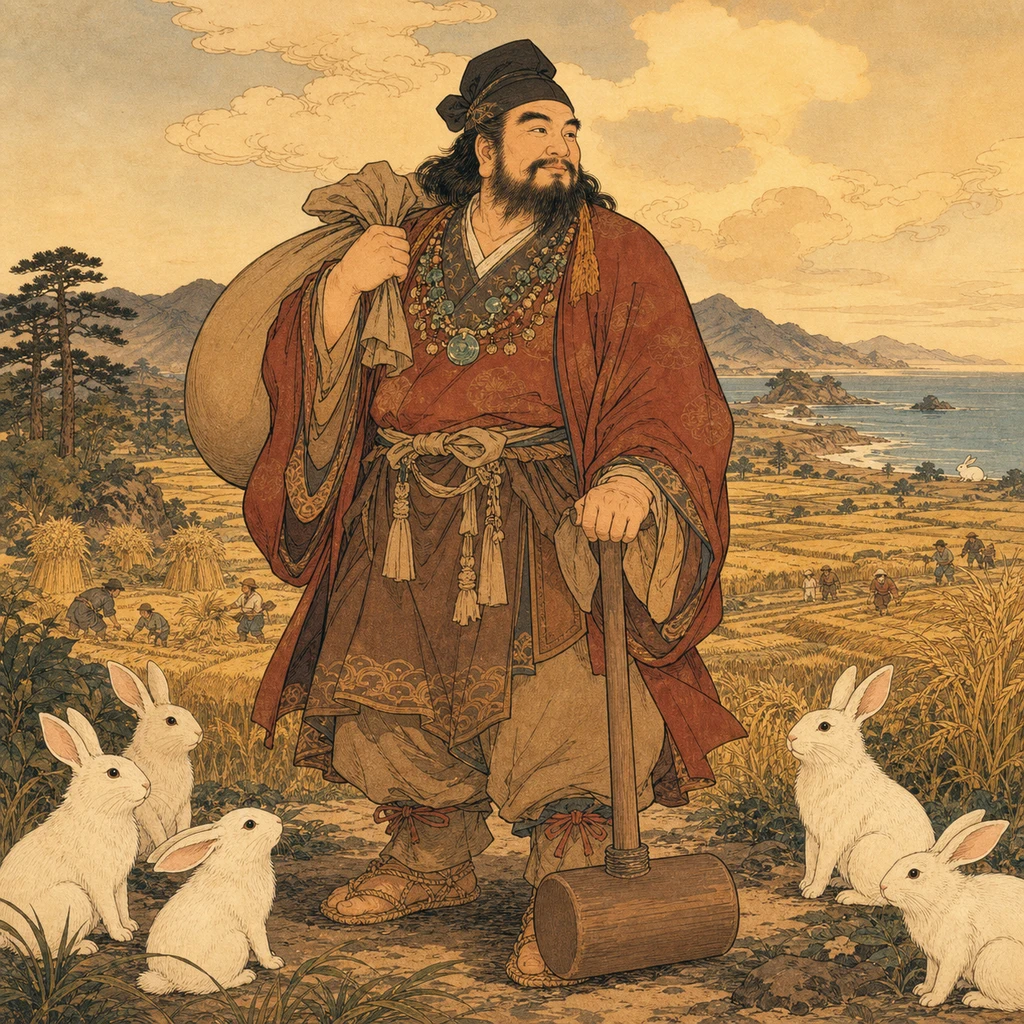
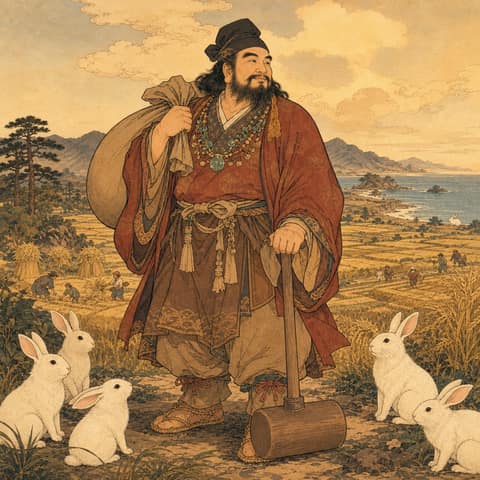
Deity / divine spiritAncient India, as Mahakala / Hieizan Enryakuji in Otsu, Shiga / Izumo Taisha as a center of syncretism with OkuninushiFrom Mahakala to Daikokuten: two thousand years of cultural transformation. The basic profile introduced Daikokuten's main attributes; the deeper story is the long transformation from ancient Indian Mahakala to modern Japanese Daikokuten. Mahakala is the wrathful, nocturnal, destructive aspect of Shiva, and in ancient Indian society he was associated with war, cemeteries, blackness, and fear. Once received into Buddhism, he became a Dharma guardian and moved through Central Asia, China, Korea, and Japan, taking on new meanings in each cultural sphere. In Japan especially, syncretism with Okuninushi, inclusion among the Seven Lucky Gods, and transformation into a wealth deity created a form so new that it almost amounts to rebirth. Daikokuten is a model case of how a foreign deity can be remade inside Japanese religion. Sanmen Daikokuten: Hieizan and Saicho's religious design. The Sanmen Daikokuten enshrined by Saicho at Hieizan Enryakuji, combining Daikokuten, Bishamonten, and Benzaiten into one three-faced deity, is one of the distinctive creations of Japanese Buddhist history. All three deities come from Indian Buddhist guardian traditions, but Saicho's placement of the combined figure as guardian of the temple kitchen and economy connected Buddhist ideals of compassion and protection with the practical realities of food, training, and institutional survival. Sanmen Daikokuten later spread through Hieizan, Tendai, Shingon, Zen, and related lineages, becoming an important symbol of Japanese Buddhism's ability to integrate practice and material support. The logic of syncretism through the sound daikoku. The merging of Daikokuten, the Indian-derived Buddhist deity, and Okuninushi, the Japanese Shinto deity, through their shared reading daikoku is a classic example of medieval Japanese religious syncretism through sound. The written forms, doctrines, and origins were unrelated, but the identical reading of "great black" and "great land" was enough to make them overlap. The new deity was not a simple addition of two figures; it gained new life in popular practice. The case reveals a flexible logic in Japanese religion, where sound, image, folk association, and practical benefit can matter more than strict doctrinal consistency. The civilizational meaning of the Seven Lucky Gods. The Seven Lucky Gods cult, shaped from the Muromachi and Azuchi-Momoyama periods into the Edo period, gathers Daikokuten, Ebisu, Bishamonten, Benzaiten, Fukurokuju, Jurojin, and Hotei around the shared wish for fortune, wealth, and prosperity. Its origins are deliberately mixed: Ebisu is native Japanese, Daikokuten, Bishamonten, and Benzaiten come from Indian religious worlds, and Fukurokuju, Jurojin, and Hotei come from Chinese Daoist, Buddhist, and popular traditions. Edo commoners did not demand a neat theory. They wanted luck, and that pragmatic wish created one of Japan's most inclusive religious combinations. Rice bales, mallet, and sack: medieval Japanese symbolism of fortune. Daikokuten's three main attributes, rice bales, the uchide no kozuchi mallet, and the great sack, compress medieval Japanese ideas of wealth. Rice bales symbolize harvest, food, land, and tax revenue in an agrarian society, entering Daikokuten through Okuninushi's agricultural layer. The mallet appears in classical tales such as the Konjaku Monogatari Shu and Uji Shui Monogatari as a magical tool that produces what one desires, a symbol of inexhaustible resources. The sack combines elements of Mahakala's treasure bag, Hotei's cloth sack, and Japan's seven-treasures imagery, holding gold, silver, lapis lazuli, tridacna shell, agate, pearl, and coral. These objects hold Indian, Chinese, and Japanese symbolism in a single image. Edo treasure-ship prints and collective wishes for prosperity. Treasure-ship prints became popular in the Edo period, showing the Seven Lucky Gods riding a ship of riches. Placing such a picture under the pillow on the second night of the New Year was believed to bring a lucky first dream. These images circulated widely as New Year charms for townspeople and merchants, and Daikokuten was often drawn near the center because he best embodied wealth, harvest, and thriving business. Through treasure-ship prints, Edo publishing, ukiyo-e, popular religion, and commercial culture converged. Even today, the motif survives in New Year decorations, greeting cards, and shop talismans. Daikokuten in the twenty-first century: a fortune god in a global age. Daikokuten remains a familiar god of wealth, business, and harvests. His image is used in New Year Seven Lucky Gods pilgrimages, first shrine visits, prayers for business success, and new-shop celebrations; merchants, restaurants, companies, and private homes still place him on altars. Even in an age of globalization, economic anxiety, and individualization, the desire for fortune, wealth, and prosperity remains universal. Daikokuten gathers that desire into one deity through a two-thousand-year chain linking ancient Indian Mahakala, medieval Sanmen Daikokuten, Edo Seven Lucky Gods worship, and the modern Japanese fortune god. He is one of the clearest symbols of cultural transformation in Japanese religion.

名妖 Thousand-Wolf Pack
SEHN-bee-kee OH-oh-kah-mee
Senbiki-Ōkami
Animal ShapeshiftersAcross Japan (Shikoku, Izumo, Echigo, etc.)The traditional image of the Senbiki-Ōkami portrays not a lone wolf but the terror of a pack moving under command. Tales begin on a nighttime pass where a survivor escapes up a tree. The pack gains height through leaps and coordinated boosts, and when they cannot reach, they summon a chieftain or outside entities such as an old cat, an ogress, or the Blacksmith’s Wife. Those summoned are linked to in-home impostors disguised as family, and by morning the world bears traces—bloodstains, missing household vessels, wounds, or memorial steles—that anchor the tale in reality. Though the wolves’ behavior is exaggerated, older interpretations align it with knowledge of nocturnal habits and pack movement, and prayers, edged tools, and daybreak commonly mark the turning point. Depending on region, the chieftain appears as a white-maned great wolf, an old cat, or an ogress, with names like the Blacksmith’s Wife, Koike Hag, or Yasaburō Hag, yet the core pattern of tree-bound escape and summoning remains. Folklorically, the story links calamity lurking at borders—mountain passes, the hour before dawn—to shapeshifters within the home, often accompanied by memorial towers and place-name lore.

名妖 Funayūrei (Boat Ghosts)
foo-nah-YOO-ray
Beggar of Teigo at Dan-no-ura
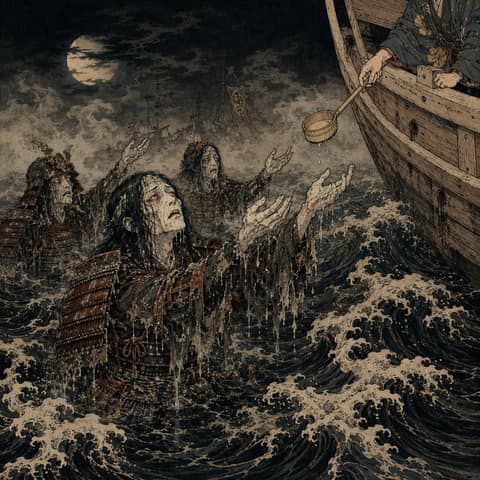
Aquatic SpiritsAcross Japan (coastal and island regions)An uncanny variant of the funayurei said to be the ruined shades of the Taira clan sunk at the Battle of Dan-no-ura. On nights of shifting tides and sea mist in the western straits, they draw alongside a boat, armor dripping, and beg, “Give us a teigo ladle.” Their faces are pale, eyes reddened by salt, voices hoarse yet mannered with samurai courtesy. Keeping the discipline of their former camp, they form ranks even at sea, a herald calls out, and many hands clutch the gunwale. If given a ladle with an intact bottom, they silently bail seawater into the boat until it founders. Those who know the old ways cross the sea with bowls and ladles whose bottoms are pierced, tied ready at the rail. When the ghosts accept them, water runs through and does not stay aboard, and only the weight of their rancor scatters on the tide. Priests sometimes hold services, and then the shadow of war hats melts into the mist, chains of armor return to the sound of waves. They do not drown people at random but approach those ignorant of sea rites or proud souls who scorn the ocean, marking their own downfall upon the world. On the sixteenth of Obon, on equinoctial days, and on battle anniversaries, their tread comes nearest when the sea is unnaturally still, and ghostly fires line the surface like beacons, mirroring the fleets of old. Offerings of ash, rice cakes, incense and flowers, and dumplings soothe their fixation; cast them from the bow and a wave like a shirabyōshi’s sleeve returns once and pushes the boat onward. A hard stare may make them withdraw, not by force of gaze but because the living truly behold the dead and the knotted ki loosens. As Yamaoka Genrin told, their true form is congealed rancor, soot-like grudge given shape upon the current; when winds shift, sutras resound, and offerings sink, the loosened ki disperses into the sea. Thus this version of funayurei can be stilled not only by fear but by memorial rites. Sometimes the outline of a child appears among their ranks, its voice thinner still, never asking for “water,” only hooking small fingers over the rail. If you hear the faint chime of armor bells, correct your helm, take the Hayatomo Rapids on the slant, and let a murmured nembutsu ride the wind. The slayers’ spirits drifting in the western dark yield only to proper forms and compassion.

名妖 Amanojaku
ah-mah-noh-JAH-koo
Traditional Iconography and Folktale
Demons & GiantsVarious regions of Japan (ancient strands linked to Yamato and Izumo mythic cycles)Amanojaku is understood as a fusion of the trampled demon in Buddhist iconography and the folk image of a small imp fond of mimicry and speaking in reversals. Many temple and shrine statues of the Four Heavenly Kings or Shukongōshin place a small demon underfoot, signifying the subjugation of worldly desires and wicked intent. In stories, Amanojaku habitually reads people’s hidden thoughts, balks at requests, and does the opposite of commands to sow confusion. In mountain lore it is told as a being of tremendous strength, with unfinished stone piles, bridge piers, and toppled boulders on peaks attributed to its failed feats. Interpreting echoes as the voice of Amanojaku is a personification of natural phenomena, overlapping regionally with names like kodama and yamabiko. In fairy tales such as Uriko-hime, it serves as a touchstone-like adversary that preys on carelessness or greed, carrying a moral lesson. Overall, Amanojaku lives across iconography, folktales, and dialect traditions as a mirror of human contrariness and the gaps in the heart.

珍しい Shidai-daka (Ever-Rising Tall One)
SHEE-dye-DAH-kah
Canonical Folkloric Type
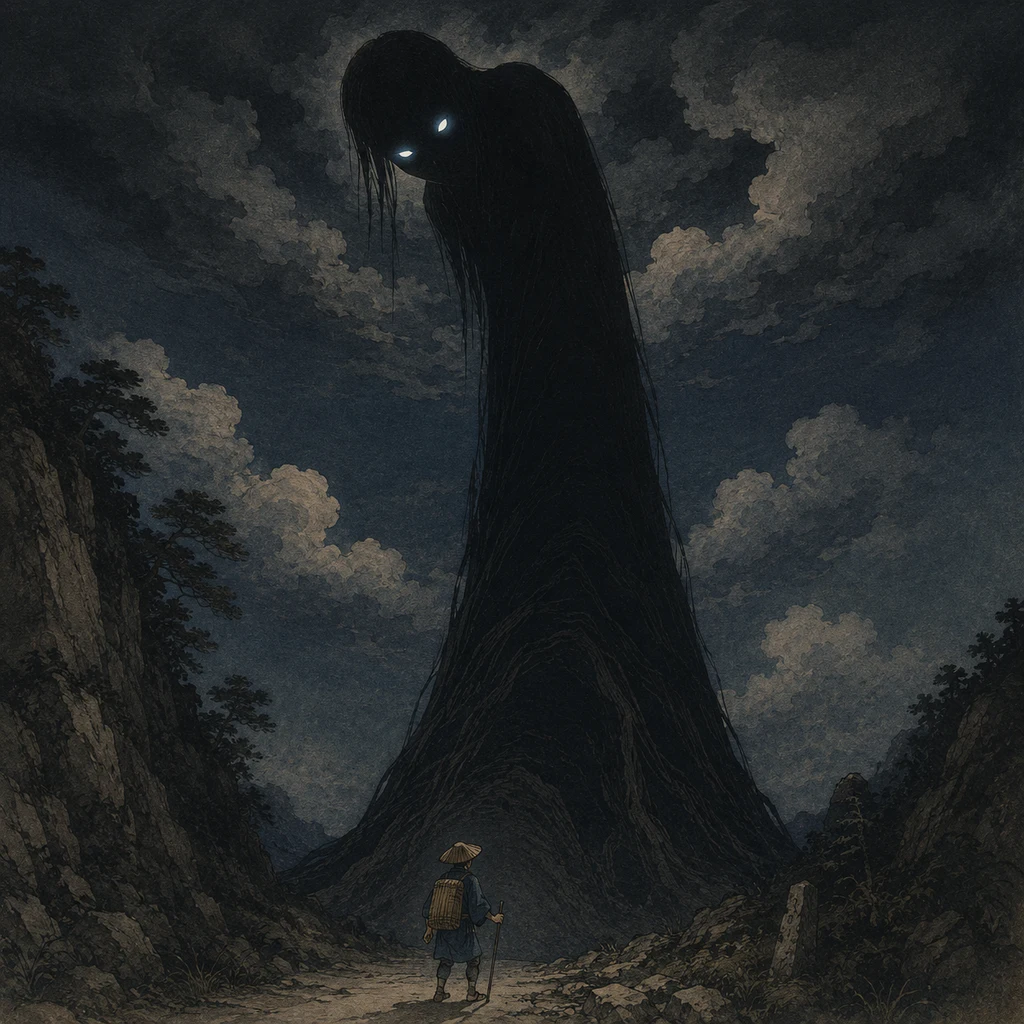
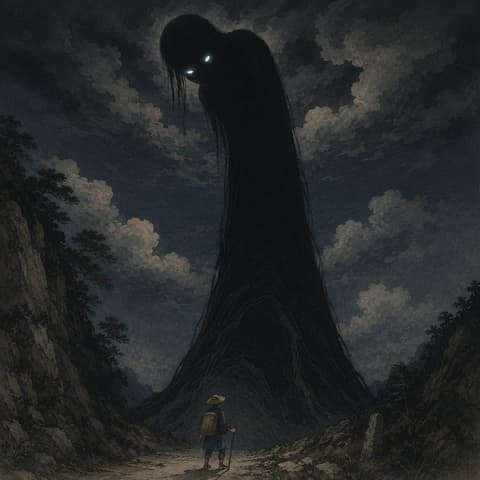
Mountain & Wilderness SpiritsChūgoku region (Shimane, Yamaguchi, Hiroshima, Okayama)A baseline profile of Shidaidaka as a roadside, look-up-type apparition recorded across the Chugoku region. It resembles a human silhouette with head and shoulders dissolving into darkness, and its height stretches or shrinks in response to one’s gaze. Harmfulness varies by tale, but fear intensifies through the act of looking up. Countermeasures include keeping your gaze lowered, watching the ground, or peering between your legs, which causes the figure to diminish and dissipate. It is linked to the Mikoshi-nyudo, and tales of the similarly named “Shidai-zaka” are viewed as slope or mountain-path variants. Hunter stories connect it with the nekomata, and identifications differ by locale. Creative embellishments are common, but the core taboo warns that one’s gaze amplifies the phenomenon.

珍しい Seven-Fathom Wife
NAH-nah-hee-roh NYOH-boh
Composite Folklore Edition
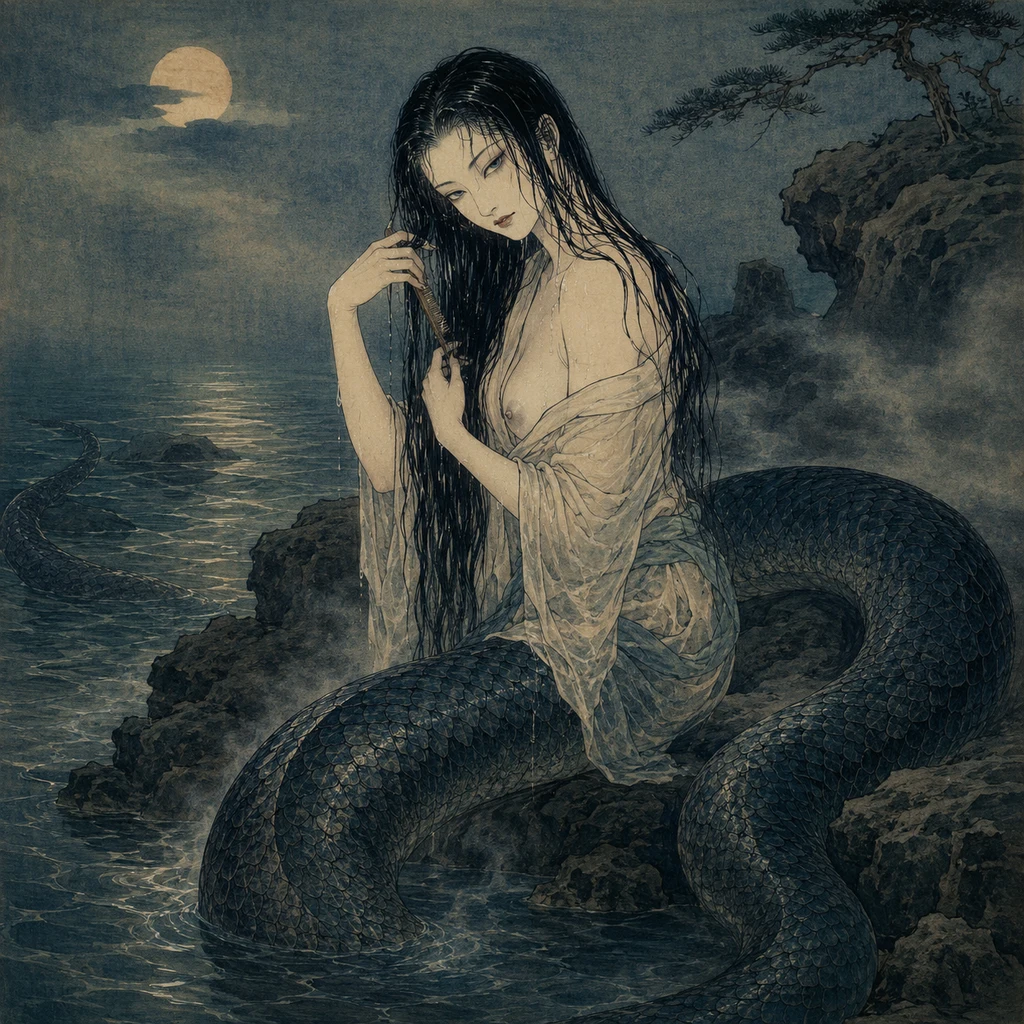
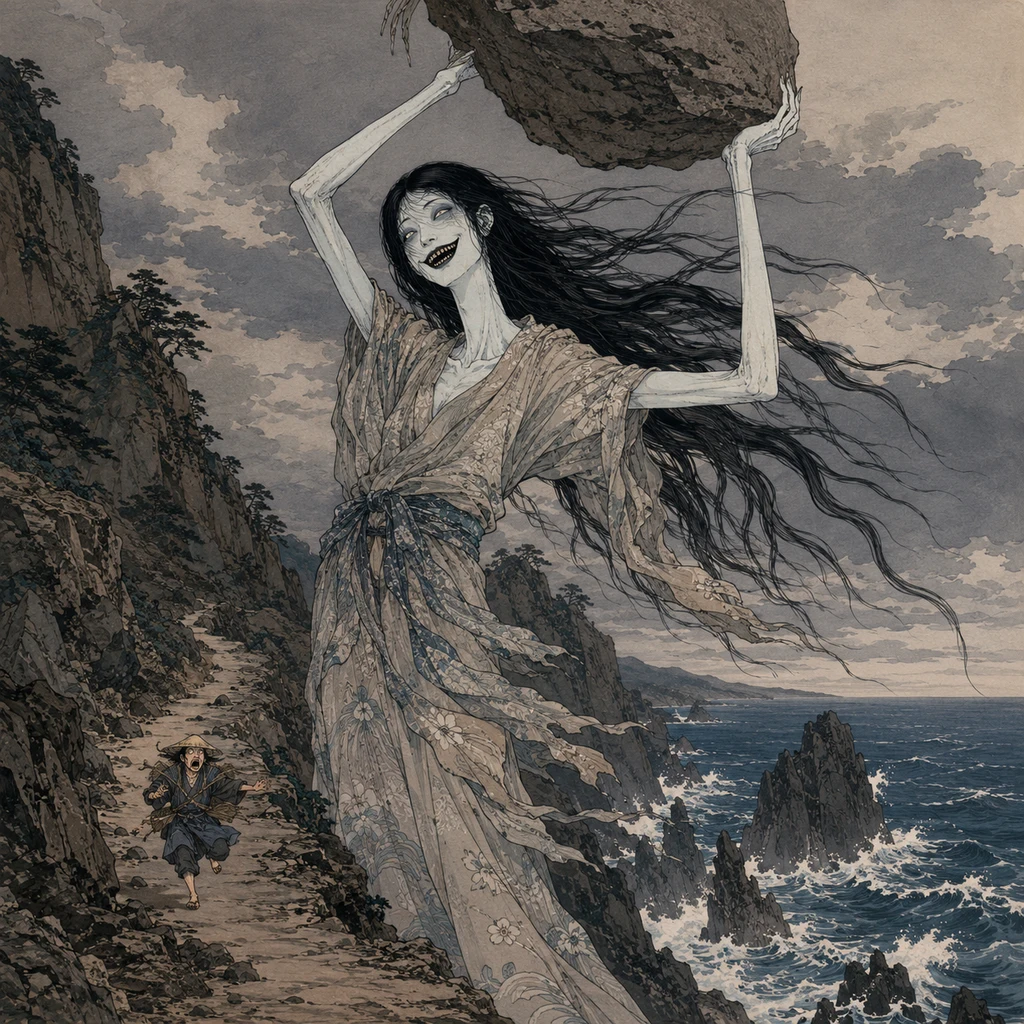
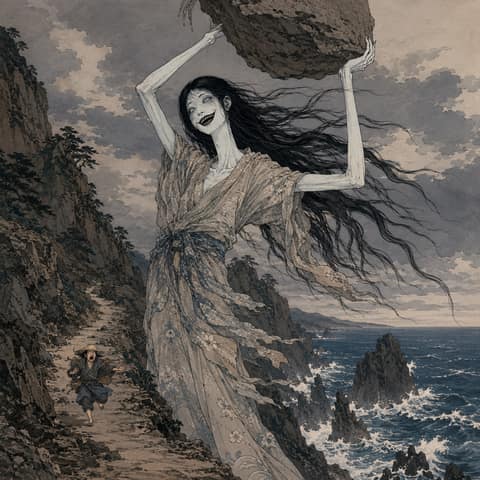
Half-Human BeingsIzumo region, Oki Islands, and Hōki region (western Japan)Shichihiro Nyōbō is a giant-woman tale widely told in Izumo, Oki, and Hōki, appearing at boundary places such as mountain paths, riverbanks, and shores. Her form shifts by locale: in Ama on Oki she is a wild-haired mocker who hurls stones, along the Shimane coast a sea-wind woman flashing blackened teeth, in Yasugi a beggar beauty trailing a long robe, and in Hōki a pallid grinder-woman who sharpens while singing grain songs. Common threads are excessive length of body or neck and the way laughter, gestures, or song serve as lures. In banishment tales, sword wounds link to petrification, with odd stones, mounds, or ancient trees named as origins, and some lineages claim heirloom swords or tack from these encounters. The cycle is not pure horror; beauty, begging for alms, and the humble fear tied to the sound of grinding grain mingle together, encoding folk lessons about handling boundary anxieties: do not meet the gaze, do not answer voices, avoid night roads. It is comparable to early modern long-faced demon-maidens, yet Shichihiro Nyōbō is marked by ties to local sacred landscapes of mountains and coasts.