天穂日命
あめのほひのみこと
出雲へ傾いた天つ穂霊・天穂日命
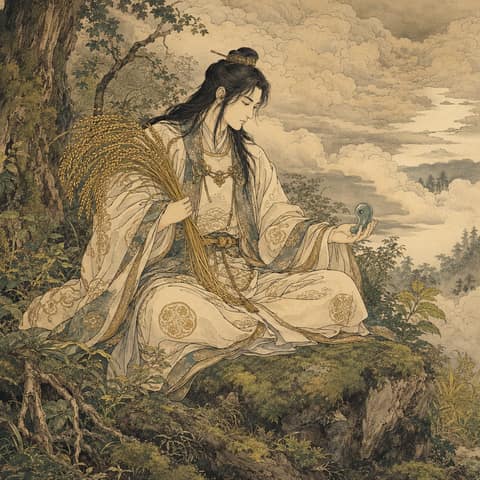
Ame-no-hohi carries an ambiguity of belonging from the very moment he was born through the 'ukehi' pledge. Ameno-hohi-no-Mikoto emerged from the breath of Susanoo-no-Mikoto, but because the source material was Amaterasu Omikami's jewel, he is considered a child of Amaterasu. This structure anticipates his entire life. The one who sets him in motion and the one to whom he belongs are different. The place where he receives his orders and the place his heart leans toward are different. Ame-no-hohi, despite being born into the lineage of heavenly deities, is a deity who deeply embeds himself into the earthly Izumo. The character of the "rice ear spirit" residing in his divine name is also crucial. Kokugakuin University annotations interpret 'Ho' as rice ear and 'Hi' as spirit, explaining Ame-no-hohi as the heavenly spirit of rice ears. Rice ears are not completed solely in heaven. They must descend to the paddy fields, endure the seasons, and ripen through the moisture of the land and human hands. It is no mere coincidence that Ame-no-hohi is dispatched to Ashihara-no-Nakatsukuni. He is the rice ear meant to transfer the heavenly order to the earth, while simultaneously being a spirit that cannot function unless it touches the earthly soil. During the pacification of Ashihara-no-Nakatsukuni, this character manifests dangerously. The myriad deities and Omoikane nominate Ame-no-hohi as the messenger to pacify the unruly earthly deities. However, he curries favor with Okuninushi and does not report back for three years. Reading this alone, Ame-no-hohi appears to be a deity who abandoned his mission. Yet, in the deeper layers of the myth, the very fact that he was absorbed by the earth is significant. When heaven's command reaches the earth, it does not achieve fruition exactly as commanded; it is transformed by the local deities, human rituals, and the memories of Izumo. Ame-no-hohi embodies this transformation physically. This single point of "not reporting back" elevates Ame-no-hohi from a mere agricultural deity to a pivotal juncture in the story. Reporting back (fukuso) is the words that return what was seen on earth to Takamagahara, closing the loop of command. Because he does not do this, heaven's command is suspended in midair, necessitating a new messenger. Silence is not a void; it is a rift created between heaven and earth. The deities of Izumo enter this rift, eventually opening the stage for the massive negotiation known as Kuni-yuzuri (the transfer of the land). The tradition of the "Izumo-no-Kuni-no-Miyatsuko-no-Kamuyogoto" illuminates this deity in a different light. According to Kokugakuin University annotations, the Kamuyogoto narrates that Ame-no-hohi went to observe the state of the earthly realm, and his son Ame-no-hinadori, along with Futsunushi, pacified the unruly deities. Here, silence is not disloyalty; it is the process of measuring the earth as the ancestral deity of the Izumo governors and establishing ritual legitimacy. Ame-no-hohi's "flattery" is read as political deviation in central mythology, but as an approach to pacify deities in Izumo's rituals. The same act transforms into either betrayal or mediation depending on the observer's position. This deity's power is not the power to submit opponents with a sword. He enters the opponent's side, delays his return, and postpones his words of report. In modern terms, Ame-no-hohi is a deity of the middle ground. From the perspective of those issuing commands, he is difficult to handle; from the perspective of the land, he is easy to accept. That is precisely why stronger messengers and war gods must appear after him. Ame-no-hohi's failure pushes the Kuni-yuzuri myth to its next stage. The sensation of praying to him is closer to re-establishing relationships than seeking victory or punishment. Leaning toward Izumo was a betrayal of orders, but simultaneously the result of listening too closely to earthly voices. Ame-no-hohi stands on the boundary between understanding the opponent and losing his original mission. Therefore, his protection is precarious. He softens people, but also makes them easily swayed. When dealing with the ties of family, community, or organizations, this deity does not say, "Return and report immediately." He prompts one to first enter the land, know the opponent's deities, and then question what words should be returned. For those who pray, Ame-no-hohi is not a deity who grants quick success. Rather, between conflicting worlds, he is a deity who asks how far one should empathize with the other and from where one should return to their original mission. Amidst negotiations and the complex ties of lineage, community, and organization, when simple righteousness alone cannot move things forward, the story of Ame-no-hohi offers profound assistance. Just as rice ears only ripen once they take root in the soil, the protection of this deity also begins with the resolve to set foot on the opponent's land.