YOKAI.JP

天穂日命

あめのほひのみこと

天穂日命

天穂日命

Their soul is listening — speak, and they will answer.

Basic Description

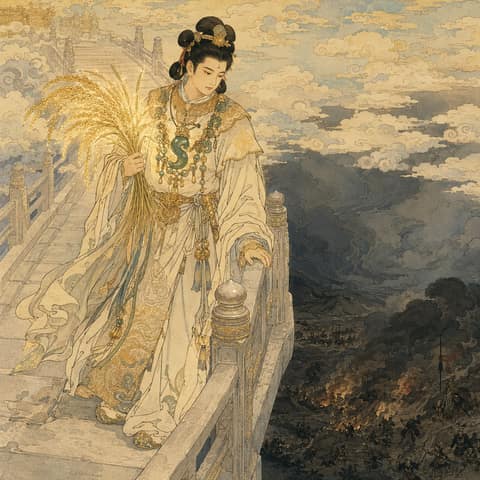
Ame-no-hohi is one of the five male deities born from the ukehi (pledge) between Amaterasu Omikami and Susanoo-no-Mikoto. Recorded in the Kojiki as Ameno-hohi-no-Mikoto or Ameno-hopi-no-Mikoto, he is described as a deity born from the breath of Susanoo-no-Mikoto, using Amaterasu Omikami's magatama beads as the 'monozane' (source material). Annotations in Kokugakuin University's "Kojiki Viewer" explain that 'Ho' in his name refers to rice ears and 'Hi' to spirit, making him the spirit of rice ears in the heavenly realm. His divinity is thus primarily linked to agricultural abundance and heavenly lineage. If among the five male deities, Ame-no-oshiho-mimi bears the direct light leading to the Tenson Korin (descent of the heavenly grandchild), Ame-no-hohi stands beside him, opening a horizontal circuit toward rice ears, the earthly realm, and Izumo. Straddling the celestial bloodline and the earthly world of rice cultivation is the defining characteristic of this deity.

However, his narrative soon takes a twist toward Izumo. During the pacification of Ashihara-no-Nakatsukuni (the Central Land of Reed Plains), the myriad deities and Omoikane nominate Ame-no-hohi as the first messenger, but he curried favor with Okuninushi and did not report back for three years. On the other hand, the same annotations point out that in the "Izumo-no-Kuni-no-Miyatsuko-no-Kamuyogoto" (Congratulatory Words of the Governor of Izumo), Ame-no-hohi is described as inspecting the earthly realm, with his son Ame-no-hinadori participating in the pacification. In other words, despite being a child of Amaterasu, Ame-no-hohi holds a dual position as the ancestral deity of Izumo. He is both a failed messenger and an intensely political and ritualistic boundary deity connecting the commands of the heavenly deities with the world of the earthly deities. He should be viewed not simply as a loyal retainer or a traitor, but as a deity standing where central mythology collides with the interpretation of Izumo rituals.

Folklore & Legends

Ame-no-hohi's origin lies in the 'ukehi' performed by Amaterasu Omikami and Susanoo-no-Mikoto across the Ame-no-Yasu-no-Kawa river. In the Kojiki, Amaterasu bites Susanoo's sword to produce the three Munakata goddesses, and Susanoo bites Amaterasu's jewels to produce five male deities. Appearing as the second of the male deities is Ameno-hohi-no-Mikoto. Although he appears through Susanoo's actions, because the source material was Amaterasu's jewel, he is considered a child of Amaterasu. Here lies the tension typical of ancient mythology, where the agent of birth and the lineage of belonging are separated. From the beginning, Ame-no-hohi cannot simply be confined to one camp.

The interpretation of his name also reflects his character. Kokugakuin University annotations interpret 'Ho' as rice ear and 'Hi' as spirit, defining Ame-no-hohi as the heavenly spirit of rice ears. Being born from Amaterasu's jewel implies the lineage of the sun goddess, while the title 'spirit of rice ears' hints at his role directed toward Ashihara-no-Nakatsukuni, the "land of abundant rice ears." He is not a god of war, but a deity who binds the earthly realm where rice ripens to the order of the heavenly deities. That is precisely why he is chosen as the first messenger to pacify Ashihara-no-Nakatsukuni.

During the pacification of Ashihara-no-Nakatsukuni, the evaluation of Ame-no-hohi suddenly clouds. When Ame-no-oshiho-mimi returns to Takamagahara upon seeing the turbulence of the earthly realm, Amaterasu and Takami-musubi gather the myriad deities to consult with Omoikane. The conclusion is that Ame-no-hohi should be sent, but he curries favor with Okuninushi and fails to report back for three years. The failure of "not reporting back" (fukuso) described here is not mere negligence. Receiving the command of the heavenly deity, descending to the earth, leaning toward the earthly deity, and failing to return words upward—this composition intensely reflects the political tension between Heaven and Izumo.

"Fukuso" (reporting back) is the act of completing the words of Heaven by returning results after receiving a command. Kokugakuin University annotations also explain that failing to report back indicates that the 'koto-muki' (intent) has not been accomplished. In other words, Ame-no-hohi is burdened with the role of intentionally halting the progress of the Kuni-yuzuri (transfer of the land) myth. Precisely because of his silence, Takamagahara selects the next messenger, and the story advances to the stages of Ame-no-wakahiko and Takemikazuchi. Failure is not a deficiency, but a necessary refraction in the mythological structure.

However, in the traditions of the Izumo side, the same deity shows a different face. According to Kokugakuin University annotations, in the "Izumo-no-Kuni-no-Miyatsuko-no-Kamuyogoto", Ame-no-hohi is sent to inspect the condition of the earthly realm, and later his son Ame-no-hinadori, accompanying Futsunushi, is described as pacifying the unruly earthly deities. Here, Ame-no-hohi is not a traitorous deity, but bears the ritualistic legitimacy connecting heavenly deities and Izumo as the distant ancestor of the Izumo Kuni-no-Miyatsuko (provincial governors) lineage. The political disloyalty in the Kojiki and the ritualistic achievements in the Kamuyogoto should be read as two sides of the same deity.

Because of this, Ame-no-hohi, who appears to be a peripheral male deity within Amaterasu's lineage, is actually the deity supporting the entrance to the Kuni-yuzuri myth. Had he immediately reported back to Takamagahara, the story might have ended in a different mediation before advancing to Takemikazuchi's sword or Okuninushi's surrender of the land. By remaining silent, leaning toward Izumo, and connecting to the Izumo Kuni-no-Miyatsuko through his descendants, Ame-no-hohi interrupts the linear victory narrative of the Tenson Korin with the weight of Izumo's memories and rituals. The three faces—spirit of the rice ear, messenger, and ancestral deity—create the depth of this deity.

Related Yokai

Yokai deeply tied to this one in legend.

Detailed Analysis

Ame-no-hohi carries an ambiguity of belonging from the very moment he was born through the 'ukehi' pledge. Ameno-hohi-no-Mikoto emerged from the breath of Susanoo-no-Mikoto, but because the source material was Amaterasu Omikami's jewel, he is considered a child of Amaterasu. This structure anticipates his entire life. The one who sets him in motion and the one to whom he belongs are different. The place where he receives his orders and the place his heart leans toward are different. Ame-no-hohi, despite being born into the lineage of heavenly deities, is a deity who deeply embeds himself into the earthly Izumo.

The character of the "rice ear spirit" residing in his divine name is also crucial. Kokugakuin University annotations interpret 'Ho' as rice ear and 'Hi' as spirit, explaining Ame-no-hohi as the heavenly spirit of rice ears. Rice ears are not completed solely in heaven. They must descend to the paddy fields, endure the seasons, and ripen through the moisture of the land and human hands. It is no mere coincidence that Ame-no-hohi is dispatched to Ashihara-no-Nakatsukuni. He is the rice ear meant to transfer the heavenly order to the earth, while simultaneously being a spirit that cannot function unless it touches the earthly soil.

During the pacification of Ashihara-no-Nakatsukuni, this character manifests dangerously. The myriad deities and Omoikane nominate Ame-no-hohi as the messenger to pacify the unruly earthly deities. However, he curries favor with Okuninushi and does not report back for three years. Reading this alone, Ame-no-hohi appears to be a deity who abandoned his mission. Yet, in the deeper layers of the myth, the very fact that he was absorbed by the earth is significant. When heaven's command reaches the earth, it does not achieve fruition exactly as commanded; it is transformed by the local deities, human rituals, and the memories of Izumo. Ame-no-hohi embodies this transformation physically.

This single point of "not reporting back" elevates Ame-no-hohi from a mere agricultural deity to a pivotal juncture in the story. Reporting back (fukuso) is the words that return what was seen on earth to Takamagahara, closing the loop of command. Because he does not do this, heaven's command is suspended in midair, necessitating a new messenger. Silence is not a void; it is a rift created between heaven and earth. The deities of Izumo enter this rift, eventually opening the stage for the massive negotiation known as Kuni-yuzuri (the transfer of the land).

The tradition of the "Izumo-no-Kuni-no-Miyatsuko-no-Kamuyogoto" illuminates this deity in a different light. According to Kokugakuin University annotations, the Kamuyogoto narrates that Ame-no-hohi went to observe the state of the earthly realm, and his son Ame-no-hinadori, along with Futsunushi, pacified the unruly deities. Here, silence is not disloyalty; it is the process of measuring the earth as the ancestral deity of the Izumo governors and establishing ritual legitimacy. Ame-no-hohi's "flattery" is read as political deviation in central mythology, but as an approach to pacify deities in Izumo's rituals. The same act transforms into either betrayal or mediation depending on the observer's position.

This deity's power is not the power to submit opponents with a sword. He enters the opponent's side, delays his return, and postpones his words of report. In modern terms, Ame-no-hohi is a deity of the middle ground. From the perspective of those issuing commands, he is difficult to handle; from the perspective of the land, he is easy to accept. That is precisely why stronger messengers and war gods must appear after him. Ame-no-hohi's failure pushes the Kuni-yuzuri myth to its next stage.

The sensation of praying to him is closer to re-establishing relationships than seeking victory or punishment. Leaning toward Izumo was a betrayal of orders, but simultaneously the result of listening too closely to earthly voices. Ame-no-hohi stands on the boundary between understanding the opponent and losing his original mission. Therefore, his protection is precarious. He softens people, but also makes them easily swayed. When dealing with the ties of family, community, or organizations, this deity does not say, "Return and report immediately." He prompts one to first enter the land, know the opponent's deities, and then question what words should be returned.

For those who pray, Ame-no-hohi is not a deity who grants quick success. Rather, between conflicting worlds, he is a deity who asks how far one should empathize with the other and from where one should return to their original mission. Amidst negotiations and the complex ties of lineage, community, and organization, when simple righteousness alone cannot move things forward, the story of Ame-no-hohi offers profound assistance. Just as rice ears only ripen once they take root in the soil, the protection of this deity also begins with the resolve to set foot on the opponent's land.

Character Profile

This section is our own creative profile for storytelling. It is not historical fact or scholarship.

Yokai Type
Kami
Rarity
Divine
Personality
A quiet and persistent deity who, rather than simply executing orders, deeply enters the side of the land. Remaining silent between loyalty and empathy, he will not report back lightly until he understands the opponent's world.
Compatibility
Highly compatible with those bridging conflicting positions, those who value the atmosphere of the site over rushed conclusions, and those who treat family or regional memories with care. Also suited for mediators or listeners.
Abilities
Birth via UkehiAbundance of the Rice Ear SpiritEarthly InspectionMediation with IzumoMediation through SilenceFormation of Ancestral LineageApproach to Earthly Deities
Weaknesses
His power dulls in situations demanding snap decisions, simple loyalty, or mechanical reporting of orders. If he leans too close to the opponent, he is easily read as disloyal for forgetting his mission.
Habitat
Takamagahara, Ashihara-no-Nakatsukuni, Izumo Province, and the ritual traditions of the Izumo Kuni-no-Miyatsuko.
For more detailed information and diagnosis results about 出雲へ傾いた天つ穂霊・天穂日命, please click here.

Sources & References

2
  1. 古事記ビューアー・うけひ(天之菩卑能命)國學院大學古典文化学事業(國學院大學) [古典注釈・研究資料]天照大御神と須佐之男命のうけひ、五男神の出生、天之菩卑能命の神名注釈、天穂日命の子建比良鳥命と出雲国造等の祖神関係を示す國學院大學の古事記注釈。
  2. 古事記ビューアー・葦原中国平定①(天菩比神)國學院大學古典文化学事業(國學院大學) [古典注釈・研究資料]葦原中国平定で天菩比神が最初の使者として遣わされ、大国主神に媚び附いて三年復奏しない本文と、出雲国造神賀詞との差異を解説する國學院大學の古事記注釈。

Interested in this type of yokai?

Discover the yokai most similar to your personality with our yokai diagnosis

Start Yokai Diagnosis

Meet your guardian yokai at the shrine

Draw an omikuji fortune and discover the yokai watching over you today.