YOKAI.JP

Ame-no-Oshihomimi

あめのおしほみみのみこと

Ame-no-Oshihomimi

Ame-no-Oshihomimi

Their soul is listening — speak, and they will answer.

Basic Description

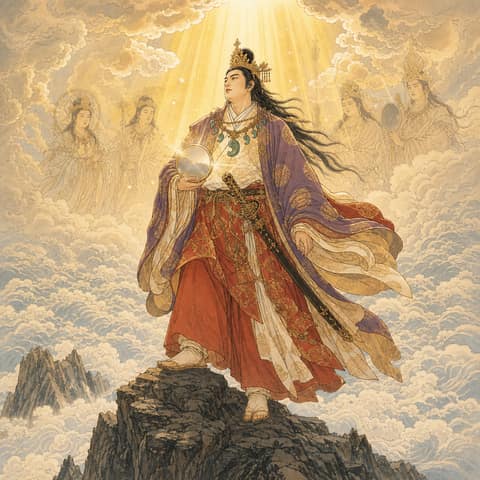
Ame-no-Oshihomimi is the principal deity among the five male gods born from the *ukehi* (pledge) between Amaterasu-Omikami and Susanoo-no-Mikoto, and the crown prince deity who stopped one step short of the Tenson Korin (the descent of the heavenly grandchild). In the *Kojiki* account of the *ukehi*, Susanoo takes the beads wrapped around Amaterasu's left hair bunch, washes them in the Heavenly True Well, crunches them, and blows them out. From the mist of his breath, Masakatsu-Akatsu-Katsuhayahi-Ame-no-Oshihomimi-no-Mikoto comes into being. Regarding the five male gods born afterward, Amaterasu declares that because the *monozane* (the seed objects) belonged to her, they are naturally her own children. The word "katsu" (victory), which appears three times in his name, is interpreted by the Kokugakuin University commentary as an issue related to the victory or defeat of the *ukehi*. In the first part of the Pacification of Ashihara-no-Nakatsukuni, Amaterasu intends to have him descend, declaring the "Land of Plentiful Reed Plains and Fresh Rice Ears of a Thousand Autumns and Five Hundred Autumns" to be the land ruled by my child, Masakatsu-Akatsu-Katsuhayahi-Ame-no-Oshihomimi-no-Mikoto. However, standing on the Floating Bridge of Heaven, Ame-no-Oshihomimi sees that the earth is exceedingly tumultuous and returns. In the first part of the Tenson Korin, after the pacification, he receives the order from Amaterasu and Takagi-no-Kami but suggests that they should send his newly born child, Ame-no-Nigishikuni-Nigishiamatsuhiko-Hikoho-no-Ninigi-no-Mikoto, who was born while he was preparing to descend. Hikosan Jingu enshrines Masakatsu-Akatsu-Katsuhayahi-Ame-no-Oshihomimi-no-Mikoto as its principal deity, and tradition holds that Mount Hiko was called the "Mountain of the Sun's Child" (Hikosan) because of this deity. Despite bearing a name of victory, Ame-no-Oshihomimi is a god who does not descend himself, but instead accurately gauges the right moment and passes the heavenly mission to the next generation.

Folklore & Legends

The story of Ame-no-Oshihomimi begins with a complex ritual called *ukehi*. Amaterasu-Omikami and Susanoo-no-Mikoto exchange their *monozane* (source objects) across the Heavenly River of Tranquility, giving birth to child deities from a sword and beads. Susanoo receives Amaterasu's beads, washes them in the Heavenly True Well, crunches them, and blows out a mist from which Masakatsu-Akatsu-Katsuhayahi-Ame-no-Oshihomimi-no-Mikoto is the first to emerge. The crucial point here is that even though the act was performed by Susanoo, Amaterasu claims him as "my child" because the *monozane* was her beads. From the moment of his birth, Ame-no-Oshihomimi is a deity surrounded by questions of belonging and legitimacy.

The resonance of victory is deeply engraved in his name. The Kokugakuin University commentary points out that the character for "victory" (*katsu*) is used three times in his name, and interprets it as a matter concerning the victory or defeat in the *ukehi*. Susanoo later boasts of his victory because he gave birth to female deities, proving his heart was pure. Yet, victory is also inscribed in the name of the leading male god, Ame-no-Oshihomimi. This twist creates the tension of the *ukehi* myth. He is Amaterasu's child born from her possession, while simultaneously being a deity brought into existence by Susanoo's actions.

At the beginning of the Pacification of Ashihara-no-Nakatsukuni, Ame-no-Oshihomimi steps forward as the heavenly successor. Amaterasu entrusts the Land of Plentiful Reed Plains and Fresh Rice Ears of a Thousand Autumns and Five Hundred Autumns to him as the land he is to rule. However, standing on the Floating Bridge of Heaven and looking down at the earth, Ame-no-Oshihomimi reports that it is terribly noisy and chaotic, and returns to seek counsel. This is not a mere refusal. By avoiding a perilous descent into an unpacified world, he initiates a council of the gods to pacify the earth, marking a turning point in the narrative.

Because of this return, Amaterasu and Takamimusubi assemble the myriad deities at the Heavenly River of Tranquility and have Omoikane devise a plan. The long process of pacifying Ashihara-no-Nakatsukuni—involving Ame-no-Hohi, Ame-no-Wakahiko, and Takemikazuchi—begins because Ame-no-Oshihomimi did not simply ignore the "tumult" he saw from the Floating Bridge of Heaven. He is not a god who pacifies by force himself, but the first to perceive that the earth is not yet ready for the heavenly grandchild's descent.

In the Tenson Korin, after the pacification is complete, Amaterasu and Takagi-no-Kami once again order Ame-no-Oshihomimi to descend. But Ame-no-Oshihomimi states that while he was preparing, a child was born to him, and suggests that this child should be sent down. That child is Ninigi-no-Mikoto. The text further notes that Ninigi was born to Takagi-no-Kami's daughter, Yorozuhata-Toyoakitsushi-Hime. Ame-no-Oshihomimi is the child of Amaterasu, takes the daughter of Takagi-no-Kami as his wife, and becomes the crucial node that produces Ninigi, who ultimately descends.

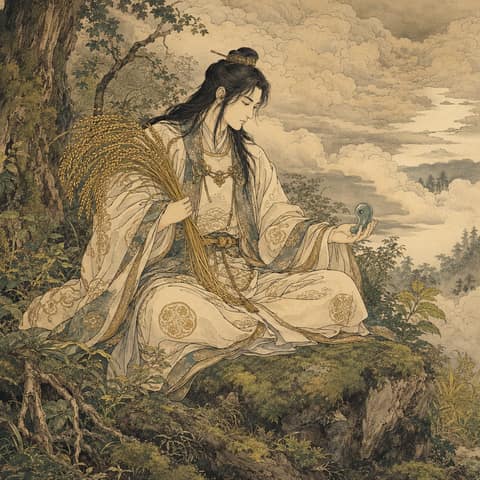
The faith at Hikosan Jingu sheds light on this deity's character from a different angle. The official history states that because the enshrined deity is Amaterasu's child, Ame-no-Oshihomimi-no-Mikoto, Mount Hiko was called "the Mountain of the Sun's Child". Furthermore, its divine virtues describe Ame-no-Oshihomimi as a god of rice ears and agriculture, revered for protecting agricultural production, the safety of mines and factories, and bringing victory. The deity who was once a candidate to rule the Land of Fresh Rice Ears in myth later became the center of mountain worship as a god of rice, production, and victory.

Detailed Analysis

Ame-no-Oshihomimi, who passes the mission to his child on the Floating Bridge of Heaven, is the deity who brings the Tenson Korin into reality precisely by "not descending" himself. In the *Kojiki* myth of the *ukehi*, Susanoo washes Amaterasu's beads in the Heavenly True Well, crunches them, and blows out a mist from which Masakatsu-Akatsu-Katsuhayahi-Ame-no-Oshihomimi-no-Mikoto is born. His very birth is situated within a ritual concerning objects, belonging, and victory. From the beginning, Ame-no-Oshihomimi is a deity questioned about "whose child he is" and "what he inherits."

Amaterasu claims the five male gods as her own children because the *monozane* (source objects) belonged to her. Through this passage, Ame-no-Oshihomimi enters the lineage of Takamagahara as Amaterasu's child. However, the character for "victory" engraved in his name is not a simple mark of triumph. Just as the Kokugakuin University commentary links it to the victory in the ukehi, Ame-no-Oshihomimi's name carries multiple meanings: Susanoo's boast of victory, his belonging as Amaterasu's child, and the emergence of male gods. Victory is not only bright but also requires defining where it belongs.

In the Pacification of Ashihara-no-Nakatsukuni, Ame-no-Oshihomimi becomes the first candidate to rule the earth. Amaterasu entrusts the Land of Fresh Rice Ears to him as the land ruled by my child, Masakatsu-Akatsu-Katsuhayahi-Ame-no-Oshihomimi-no-Mikoto. However, standing on the Floating Bridge of Heaven, he sees that the earth is "exceedingly tumultuous" and returns. To read this as a cowardly retreat is to overlook the structure of the myth. Ame-no-Oshihomimi is the first observer to report that the earth has not yet been pacified.

Without this report, the council for pacifying Ashihara-no-Nakatsukuni would never have begun. Amaterasu and Takamimusubi gather the gods at the Heavenly River of Tranquility, have Omoikane devise a strategy, and choose envoys. Ame-no-Oshihomimi's role was not to recklessly descend into a chaotic world and fail, but to clarify that the conditions for descent were not yet met. The Floating Bridge of Heaven is the boundary between Takamagahara and Ashihara-no-Nakatsukuni, and standing there, Ame-no-Oshihomimi measures the gap between heavenly commands and earthly realities.

After the pacification, Amaterasu and Takagi-no-Kami command Ame-no-Oshihomimi to descend and rule at last. Here, he states that a child was born to him while he was preparing, and suggests that this child should be sent down. This is not a second retreat, but a judgment of succession. By not descending himself and passing the mission to the next generation, Ame-no-Oshihomimi transforms the Tenson Korin into a much deeper story of lineage.

The fact that this child is Ninigi-no-Mikoto is highly significant. The *Kojiki* notes that Ninigi is the child born to Takagi-no-Kami's daughter, Yorozuhata-Toyoakitsushi-Hime. Ame-no-Oshihomimi is the child of Amaterasu, marries the daughter of Takagi-no-Kami, and fathers Ninigi. Amaterasu's light, Takamimusubi's generative power, and the Tenson Korin's earthly rule all converge around this single deity. He is not the protagonist of the descent, but the god who gives birth to the protagonist.

The history of Hikosan Jingu reconnects Ame-no-Oshihomimi to mountain worship. Its official website states that because the enshrined deity is Amaterasu's child, Mount Hiko was called "the Mountain of the Sun's Child". Furthermore, its divine virtues revere him as a god of rice ears and agriculture who arrived from the east in the form of a hawk, protecting agricultural production, mining, and factory safety, and bringing victory. The heavenly crown prince becomes the guardian of rice, production, and victory in the mountains.

The appeal of Ame-no-Oshihomimi lies not in a heroic finishing blow, but in the judgment of succession. Precisely because he bears a name of victory, he does not err in timing his descent just to win. He observes the earthly chaos from the Floating Bridge of Heaven, returns to prompt its pacification, and ultimately passes the mission to his child. This deity understands the value of "not acting." Rather than rushing into an unprepared field, he sets the stage and leaves it to the next generation. That quiet judgment drives the grand myth of the Tenson Korin.

Character Profile

This section is our own creative profile for storytelling. It is not historical fact or scholarship.

Yokai Type
Kami
Rarity
Divine
Personality
Despite bearing a name of victory, he does not descend by brute force. He accurately assesses the chaos on earth, waits for it to be pacified, and carefully passes the mission to the next generation.
Compatibility
Deeply compatible with choosing a successor, business succession, family enterprises, agriculture, production sites, mountain worship, competitions, and the work of assessing an unprepared situation to determine the next move.
Abilities
Principal Deity of the Five Ukehi Male GodsLegitimacy of Amaterasu's ChildInsight from the Floating Bridge of HeavenCandidate to Rule the Land of Fresh Rice EarsSuccession of the Descent MissionFather of Ninigi-no-MikotoGuardian of Rice Ears and AgricultureBringer of Victory
Weaknesses
He is not a god who forces his way into a chaotic situation with brute strength. If rushed while unprepared, his power manifests as a withdrawal or postponement.
Habitat
The Heavenly River of Tranquility and the Floating Bridge of Heaven in Takamagahara, the boundary overlooking Ashihara-no-Nakatsukuni, the command site of the Tenson Korin, and Hikosan Jingu.
For more detailed information and diagnosis results about Ame-no-Oshihomimi, the Crown Prince Deity Who Passes the Mission to His Child on the Floating Bridge of Heaven, please click here.

Sources & References

4
  1. 古事記ビューアー・うけひ國學院大學古典文化学事業(國學院大學) [古典文献]天照大御神と須佐之男命のうけひ、天忍穂耳命の誕生、五男神の帰属、神名の勝利性に関する古事記本文・注釈。
  2. 古事記ビューアー・葦原中国平定①國學院大學古典文化学事業(國學院大學) [古典文献]天照大御神が天忍穂耳命を葦原中国の統治者として言依さし、天忍穂耳命が天浮橋から地上の騒ぎを見て戻る場面。
  3. 古事記ビューアー・天孫降臨①國學院大學古典文化学事業(國學院大學) [古典文献]天照大御神・高木神が天忍穂耳命に降臨を命じ、天忍穂耳命が御子・瓊瓊杵命を降すべきだと申す場面。
  4. 英彦山神宮公式・御祭神と由緒英彦山神宮(英彦山神宮) [神社公式]正勝吾勝勝速日天之忍穂耳命を主神とし、英彦山の由緒、日の子の山、稲穂の神・農業神・勝運の神としての御神徳を確認する公式ページ。

Interested in this type of yokai?

Discover the yokai most similar to your personality with our yokai diagnosis

Start Yokai Diagnosis

Meet your guardian yokai at the shrine

Draw an omikuji fortune and discover the yokai watching over you today.