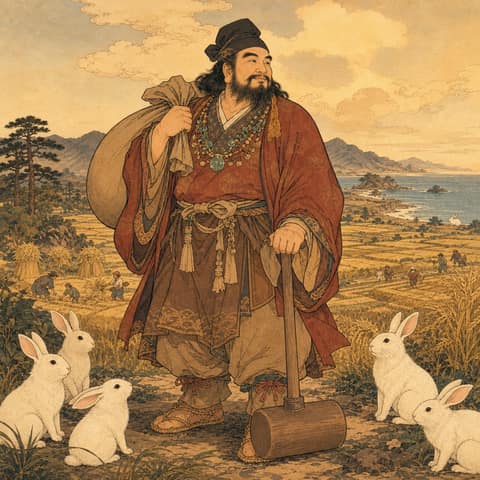
Hoakari of Harima is not so much a god of light descending from the sky as he is a child god who roughly births the names of the land. In the Shikama District section of the *Harima no Kuni Fudoki*, Hoakari is spoken of as the child of Onamuchi-no-Mikoto[3]. Because his nature was so fierce that it troubled his father, Onamuchi arrived at Mount Inedate[3] and set sail while he sent his son to fetch water. Returning with the water, Hoakari realized his father had left him behind and raised wind and waves in his anger.
In this scene of abandonment, the peaceful errand of "going to fetch water" becomes a stratagem hiding the rupture between father and son. Getting water in the mountains, setting sail on the sea, and the returning child finding his father on the ocean are all linked together, and Hoakari's anger erupts as a power straddling the mountains and the sea. In the place-name legends of the fudoki, the emotions of gods do not remain internal. Anger becomes weather, becomes waves, becomes the physical event of smashing a ship, preparing the future names of the land.
The power of this scene lies in the fact that the conflict between parent and child does not end as a mere anecdote. Hoakari's anger becomes a storm on the sea, smashing Onamuchi's ship and halting its progress. As the ship breaks and its loaded goods scatter, they transform into the names of the hills around Himeji. The place where the ship fell became Funaoka (Ship Hill), where the waves rose became Namioka (Wave Hill), the koto became Kotogamioka, the box Hako-oka, the winnowing basket Mikataoka, the jar Mikaoka, the rice Inamureoka, and the helmet Kabutooka. In this way, an instant of the stormy sea is fixed into a chain of place names. The repetition of the simple mechanism that names are born because items fell actually conveys the strength of ancient land memory.
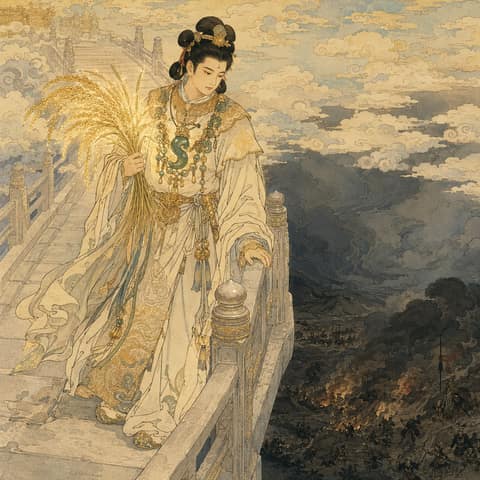
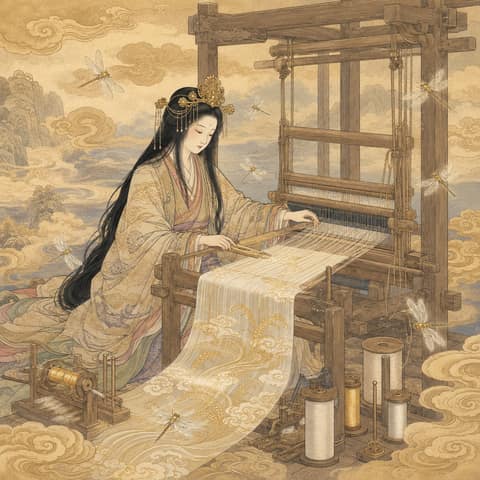
Among them, Himemichio-ka[3], where the silkworms fell, carries weight as the place connecting to the names Himeyama and further Himeji. Himeyama, where Himeji Castle stands, is known in later ages as the center of the castle fortifications and political city, but in the fudoki's imagination, it is first a hill bearing the memory of silkworms falling from a ship. While Tango's Hikohoakari is spoken of as the god who spread sericulture, Harima's Hoakari births Himemichio-ka through silkworms falling from a ship. In both traditions, the memory of Hoakari and silkworms, land, and pioneering remains in different forms.
The chain of the fourteen hills prevents Hoakari from being a mere storm god. The ship is broken by his anger, but its fragments and cargo are not scattered randomly; they are placed as the names of hills. Items of daily life, ritual, military gear, and animals—koto, box, winnowing basket, jar, rice, helmet, rope, deer, dog, and silkworms—sink into the land, becoming symbols for reading the landscape around Himeji. The more detailed the list of items becomes, the closer the story, while being a myth, gets to a topography that directs the reader's eyes to actual hills and roads. The fierce child's actions are destruction, but simultaneously a creation that carves meaning into the land.
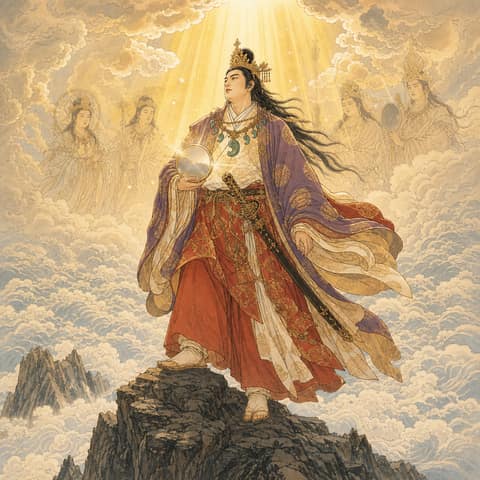
This fierce child is not a god who gently bestows order. Through the anger of being abandoned, the rebellion against his father, and the wind and waves that smash ships, he carves names into the land. Therefore, rather than a god of destruction, Hoakari of Harima is a god whose emotional explosion gives birth to topography and memory. If Hoakari of the Tenson lineage carries the light of heaven, Harima's Hoakari can be said to be the figure of that light raging on the earth and searing itself into hills and place names.
Character Profile
This section is our own creative profile for storytelling. It is not historical fact or scholarship.
Yokai Type - Kami
Category - Deities & Divine Spirits
Rarity - Divine
Personality - Strong and highly proud, he turns his anger into wind and waves the moment he realizes he has been deceived. While wounded by his father's scheme, he possesses both the intensity and the creative power to carve that rebellion into the names of the land.
Compatibility - Resonates with those who harbor anger from being unreasonably abandoned or the pain of being cut off from family and land. He is more likely to open up to those who can see through to the pride beneath his anger, rather than those who suppress emotions.
Abilities - Manifests anger as wind and waves, smashing shipsTransforms the traces of conflict into the origin of place namesCarves daily items like ship gear, rice, and silkworms into the memory of sacred sitesConnects the hills around Himeji into a single fudoki mythPossesses both the light of the Tenson lineage and the fierce power of regional fudoki
Weaknesses - Because of his intensity, he is easily caught in calm stratagems. Just as he fell for Onamuchi's trick of fetching water, in scenes where anger takes precedence, he overlooks the opponent's escape routes and traps.
Habitat - Takamagahara, around Kanmurijima and Kono Shrine in Tango, and from Mount Inedate to the fourteen hills of Himeji in Harima Province.