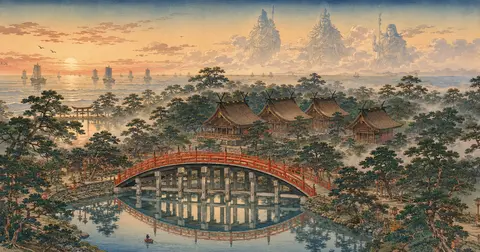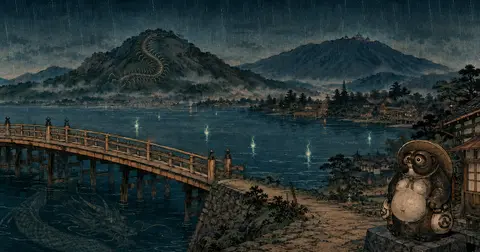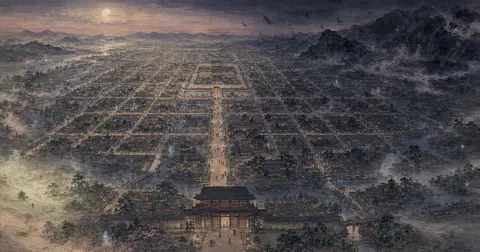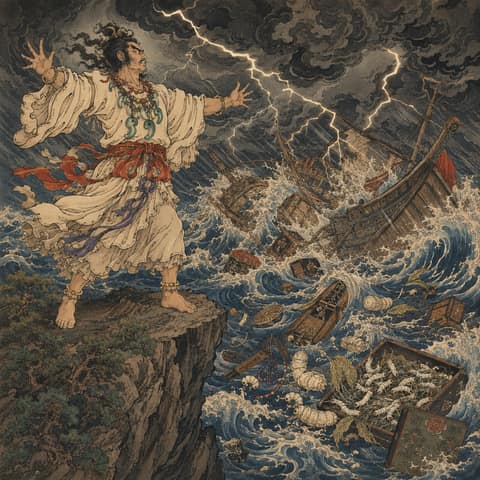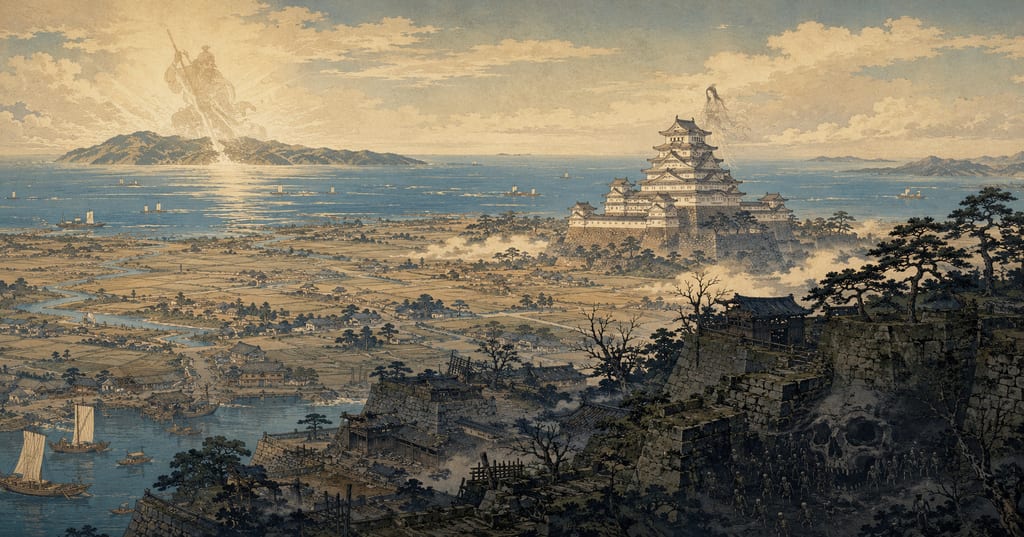
Hyogo Prefecture is a land that cannot be described with a single face. Tajima faces the Sea of Japan to the north, Awaji floats in the Seto Inland Sea to the south, the Harima Plain stretches to the west, and the ports of Settsu lie to the east—in terms of the *ritsuryo* provincial system, five old provinces (Settsu, Harima, Tajima, a portion of Tamba, and Awaji) are bundled into a single prefecture. Open to multiple seas, including the Seto Inland Sea, Osaka Bay, Harima Nada, and the Sea of Japan, it has remained a nexus connecting the Kinai region with San'in, Shikoku, and the Asian continent since ancient times. This geographical overlap gave rise directly to the overlap of its yokai and divine spirits.
Three great layers of memory lie dormant here. First is the creation myth etched into Awaji, the island where the country itself was born. Second is the memory of the women surrounding the keep and old well of Himeji Castle, known as the White Heron Castle. And the third is the glory and collapse of the Heike clan when Taira no Kiyomori moved the capital to Fukuhara. We wish to decipher Hyogo's yokai culture as a place where these three elements intertwine: the island where gods birthed the nation, Harima where a woman's malice filled the castle, and the Heike capital that trembled at the omens of a ruined state. While Kyoto binds its anomalies through the singular urbanity of Heian-kyo, Hyogo's yokai are scattered like a multi-cored constellation born from the distinct histories of its five old provinces. This is exactly why it is worth tracing the origins of each entity through their specific place names and literature.
Awaji,
the Island of Creation — The Creator Gods and the Prince Who Died in Indignation
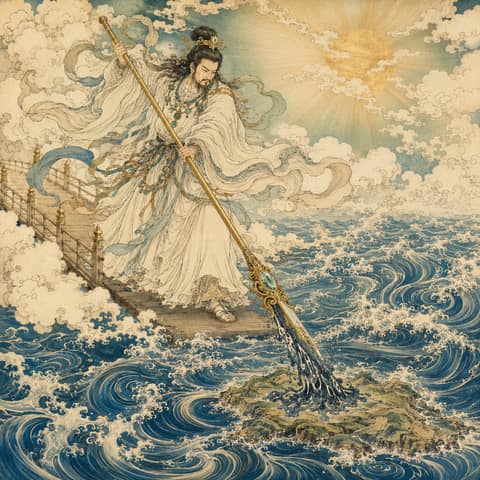
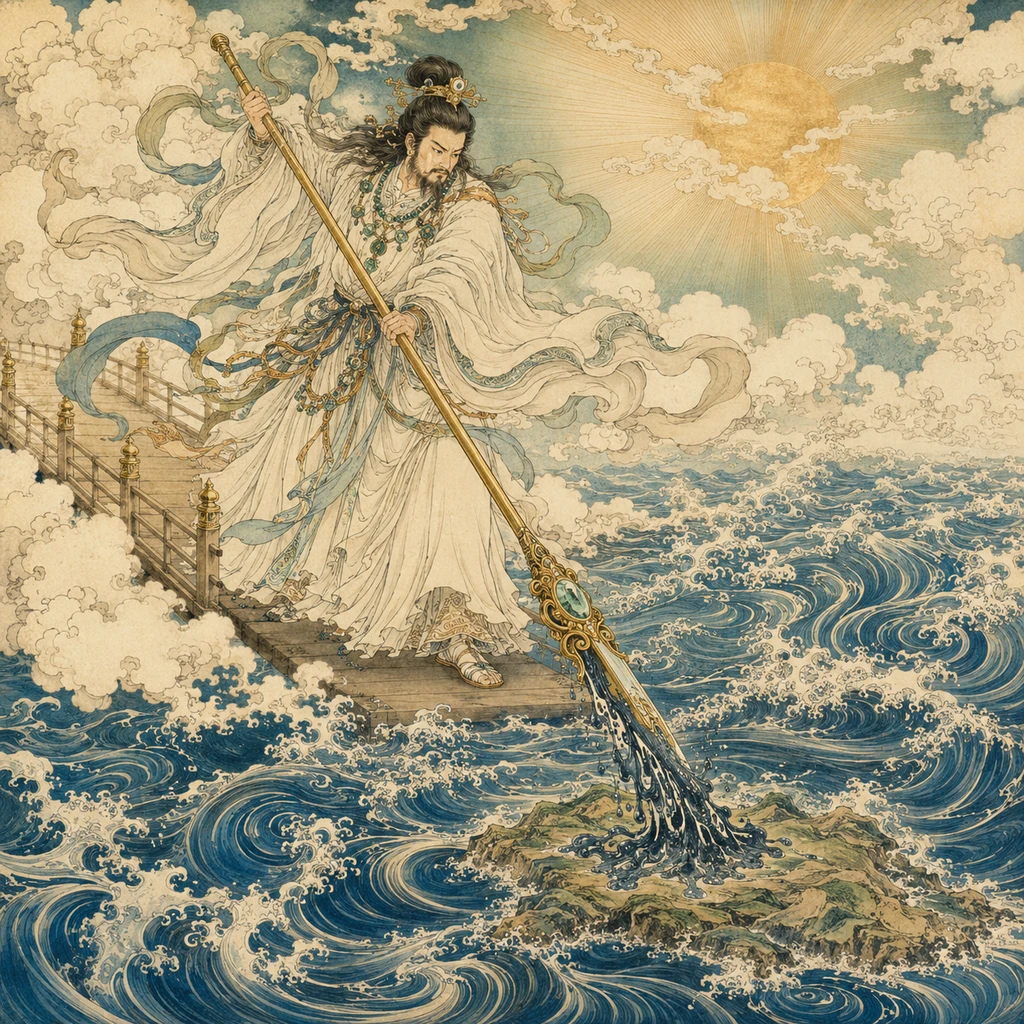
The starting point for discussing Hyogo's yokai culture lies with the "gods" that predate yokai. In the *kuniumi* (birth of the land) myth that adorns the beginning of the *Kojiki*[1] and *Nihon Shoki*[2], the two deities Izanagi-no-Mikoto and Izanami-no-Mikoto churned the sea with the Heavenly Jeweled Spear (*Ame-no-Nuboko*), and the very first island they gave birth to was Awaji Island (the first of the *Oyashima* or Great Eight Islands, born after Onogoro Island). The tradition that the starting point of the Japanese nation lies at the very southern tip of Hyogo carries profound weight. The "Awa" in Awaji has been interpreted as "the road to Awa Province," the island of "millet" (*awa*), or the island that first congealed from "foam" (*awa*). In any case, the fact remains that this island was recorded in the ancient chronicles as the very first fragment of the archipelago's birth.
Izanagi
Izanagi is a creator deity in Japan's oldest mythological records, the Kojiki of 712 and the Nihon Shoki of 720. The Kojiki writes his name as Izanagi no Kami or Izanagi no Mikoto, while the Nihon Shoki gives the form Izanagi no Mikoto. In the final generation of the Kamiyo Nanayo, the Seven Generations of the Age of the Gods, he appears with his wife Izanami. Ordered by the heavenly deities, the pair stand on the Floating Bridge of Heaven and stir the sea with the heavenly jeweled spear, Ame-no-nuboko, creating Onogoro Island. There they marry and give birth to the Oyashima, the great eight islands of Japan, along with many other deities. When Izanami dies after giving birth to the fire god Kagutsuchi, Izanagi follows her into Yomi, the land of the dead, but flees after seeing her decayed body. At Yomotsu Hirasaka he seals the boundary between the living and the dead with the Chibiki rock, then purifies himself at Awagihara. From that act of misogi are born the Three Precious Children: Amaterasu Omikami, Tsukuyomi no Mikoto, and Susanoo no Mikoto. Taga Taisha in Shiga, Izanagi Jingu on Awaji Island, and Eda Shrine in Miyazaki are among his major cult sites. As the ancestral deity of misogi and harae, Izanagi remains central to Shinto ideas of purification.
Read more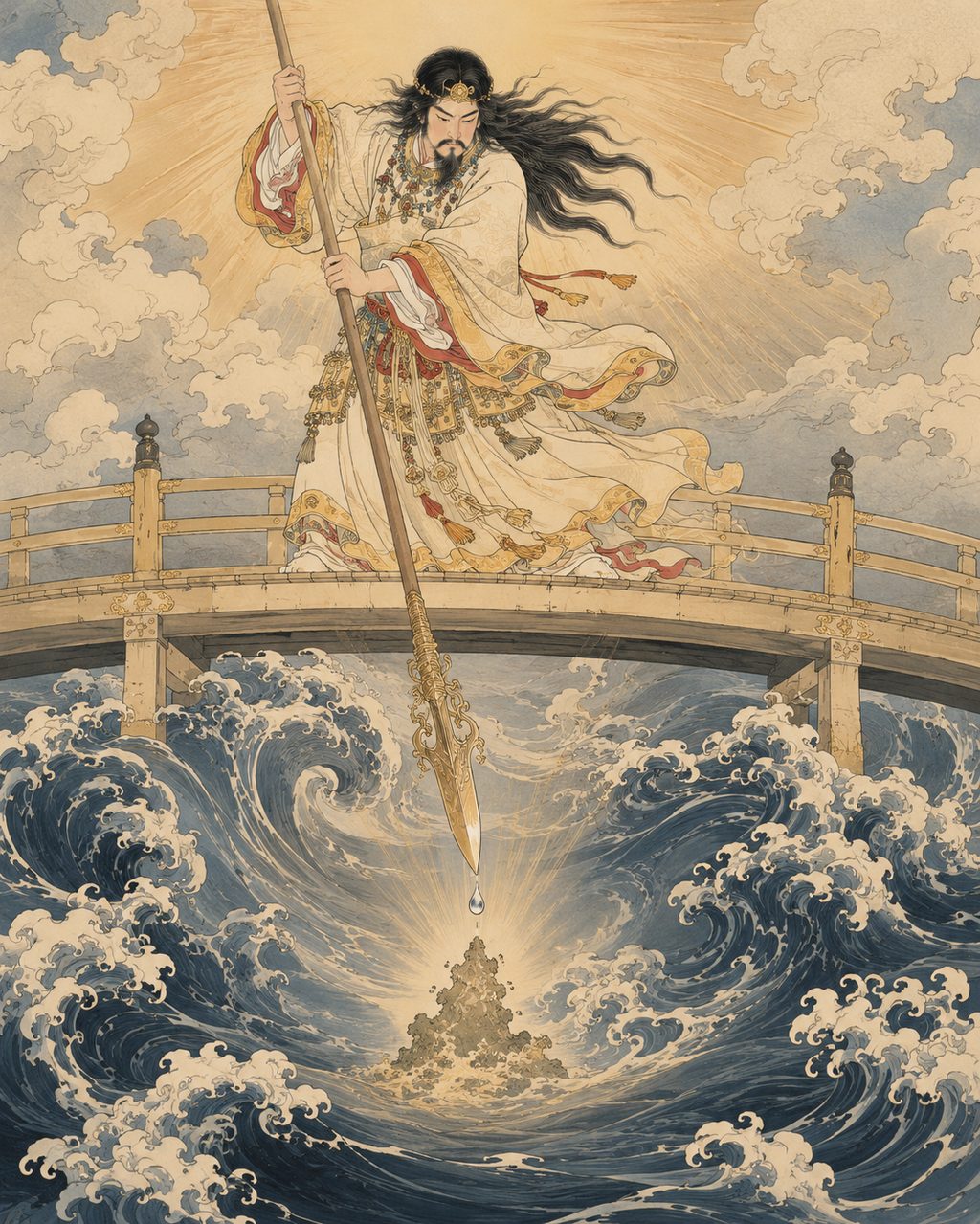
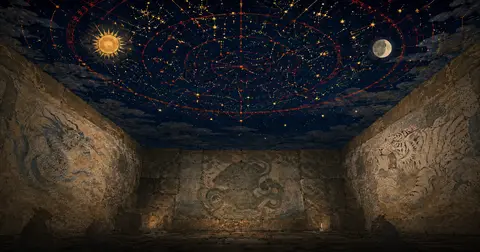
Having finished the birth of the land and the gods, Izanagi entrusted the rule to his child, Amaterasu-Omikami, and is said to have built a "Kakuri-no-miya" (hidden palace)[3] in the land of Taga in Awaji to spend the rest of his days, meeting his end there. The origin of this hidden palace is Izanagi Jingu Shrine, located in Taga, Awaji City—the *ichinomiya* (highest-ranking shrine) of Awaji Province and one of the oldest shrines in Japan. Regarding the location of the hidden palace, there is an alternate theory pointing to Taga Taisha in Omi (Shiga Prefecture), but since many manuscripts of the *Kojiki* write "Taga in Awaji," the Awaji theory is considered dominant in academic circles. Within the precincts is a stone monument called the "Guidepost of the Sun," which posits that with Izanagi Jingu at the center, the sun rises from Ise Jingu due east on the equinoxes, aligns with Suwa Taisha and Izumo Taisha on the summer solstice, and connects with Kumano Nachi Taisha and Takachiho Shrine on the winter solstice. The island of myth is positioned at the center of an axis of light that pierces through the sacred sites of the archipelago. Whether this "Guidepost of the Sun" was an intentional arrangement based on precise ancient astronomical observation or a coincidental alignment discovered by later generations is difficult to conclude; it is more reasonable to accept it as a kind of sacred geography that is simply "told to be so." However, the very imagination that seeks to place Awaji at the center of the world speaks to the strength of its memory as the island of creation. When Izanagi eventually returned from Yomi (the underworld), he gave birth to the three noble children—Amaterasu, Tsukuyomi, and Susanoo—through the *misogi* ritual of washing away his defilement. His character as the ancestral god of purification is also deeply fitting for the sea-surrounded land of Awaji.
This island of creation was simultaneously an "island of exile." In ancient times, Awaji was an isolated land both close to and far from the capital, serving as a destination for exiled nobles who had committed crimes. Among them, Prince Sawara casts a particularly deep shadow over the yokai history of Hyogo.
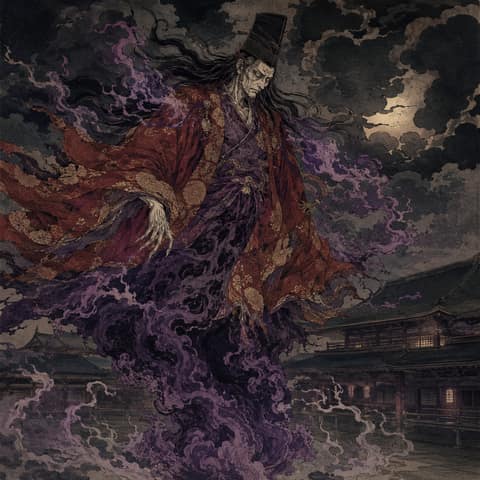
Prince Sawara
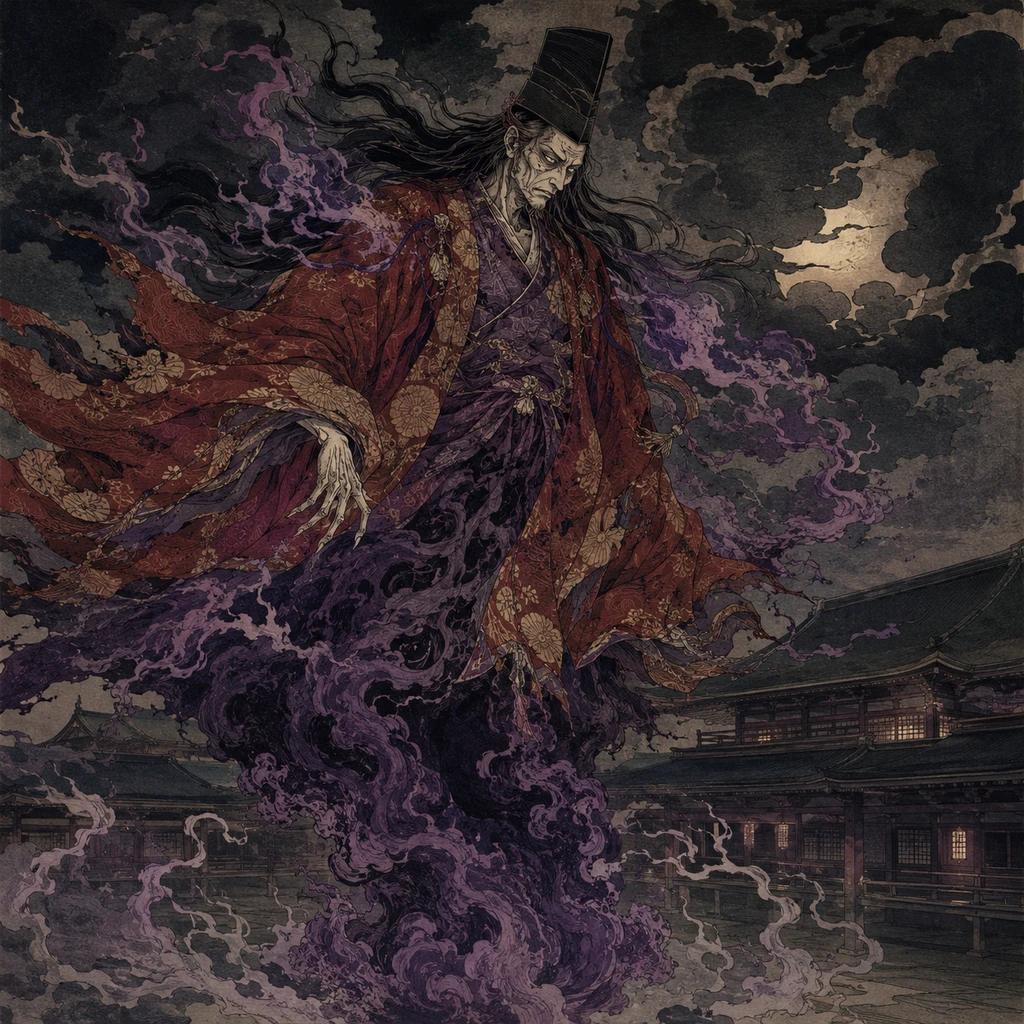
A royal prince from the late Nara to early Heian periods, son of Emperor Kōnin and full younger brother of Emperor Kanmu. Named crown prince, he was deposed as an alleged accomplice in the assassination of Fujiwara no Tanetsugu and exiled to Awaji. He died en route by self-imposed fasting. When epidemics, famine, and sudden deaths struck the court afterward, they were attributed to his vengeful spirit. To appease him, he was posthumously honored with the title Sudo Tennō, and he came to be revered and feared as a foremost figure in goryō (vengeful spirit) belief.
Read morePrince Sawara was the maternal younger brother of Emperor Kanmu and had once been established as the Crown Prince. However, when Fujiwara no Tanetsugu, who spearheaded the construction of Nagaoka-kyo, was assassinated in 785 (Enryaku 4), Emperor Kanmu suspected his brother's involvement and imprisoned Prince Sawara at Otokuni-dera Temple before exiling him to Awaji Province[4]. Pleading his innocence, the prince refused food and drink, and it is said he died of indignation en route to Awaji. Afterward, as Emperor Kanmu's close relatives died of illness one after another and plagues and floods occurred in succession, the people feared this was the prince's curse. In 800 (Enryaku 19), the imperial court posthumously granted the prince the title of "Emperor Sudo" in an attempt to pacify his spirit. Prince Sawara came to be remembered as the pinnacle of the Goryo (vengeful spirit) faith, later enshrined at Kyoto's Goryo Shrine—the figure who opened the history of vengeful spirits in Japan. The contrast that the island which birthed the nation was also the land that swallowed the very first great vengeful spirit feared by the state vividly illuminates the duality of Awaji as a place. The Goryo faith is an ancient Japanese belief system that posits the malice of high-ranking individuals who died tragic deaths brings about plague and natural disasters; by enshrining them respectfully, they are inversely transformed into guardian deities. Prince Sawara stands at the origin of this concept, and it is fair to say that the lineage of vengeful spirit pacification, which later leads to Sugawara no Michizane and Taira no Masakado, began with this exile to Awaji. The god of creation and the first vengeful spirit overlap on the same island—the fact that Hyogo's yokai culture is characterized by the "vast amplitude between divinity and malice" is already foreshadowed in this chapter on Awaji.
The Women of Himeji Castle — Okiku in the Well and Osakabe-hime in the Keep
Rising above the Harima Plain, Himeji Castle is also known as the White Heron Castle due to its graceful appearance, like an egret spreading its wings. Yet, few castles have harbored tales of female malice quite like this beautiful fortress. Let us look in turn at the two women associated with the castle: the spirit who counts plates from the bottom of the well, and the phantom princess who resides on the top floor of the keep.
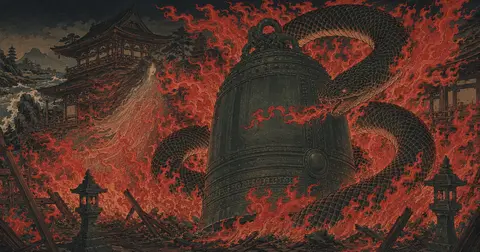
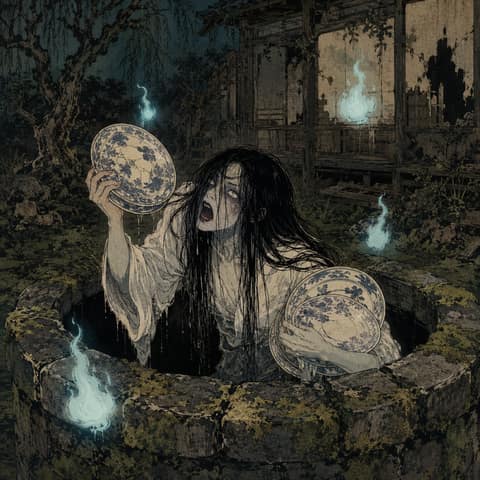
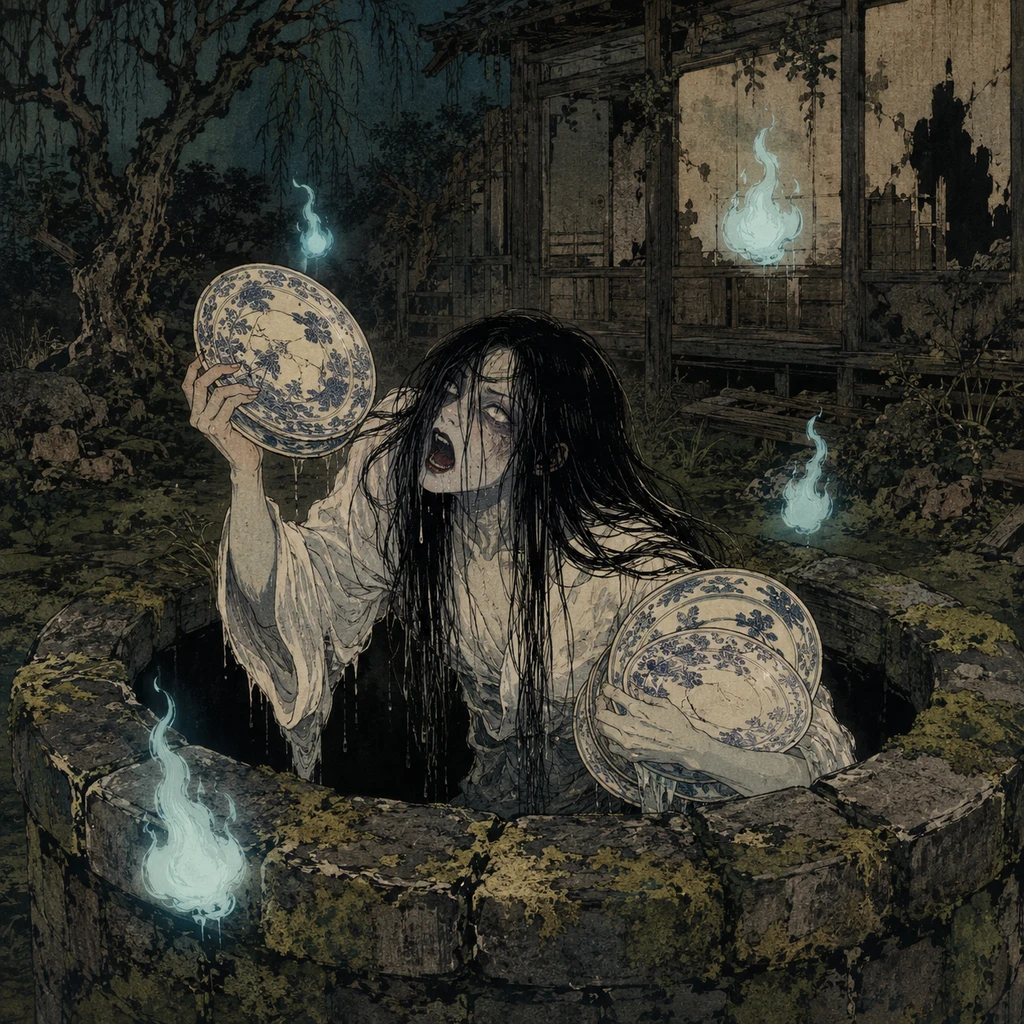
First is Okiku, the woman in the well. The Sarayashiki (Plate Mansion) legend is distributed nationwide, but one of its prominent origins is the "Banshu Sarayashiki" passed down in the Harima region. The skeletal framework of the story goes like this: The chief retainer Aoyama Tetsuzan plots to poison his lord, Kodera Norimoto, and take over the castle. Sensing this conspiracy, the loyal retainers send the maidservant Okiku to infiltrate the Aoyama household as a spy. However, the plot is exposed, and by the hands of a vassal whose illicit affections she rejected, one of the ten heirloom plates is hidden, and she is falsely accused of losing it. Tortured to death, Okiku is thrown into an old well. Ever since, night after night, a voice can be heard counting plates from the bottom of the well, "One... Two...," breaking down in tears at the ninth—or so the tale goes. The Sarayashiki narrative is known for its two representative lineages: "Bancho Sarayashiki" set in Edo's Bancho district, and "Banshu Sarayashiki" set in Harima, but the Banshu variant is older and deeply rooted in the land, placed against the backdrop of Himeji during the Eisho era (early 16th century). The repetitive motif of continuously counting a set short of one plate is a symbol of unfulfilled regret that will never find closure in this world, sending chills down the spines of all who listen.
Okiku
Okiku is the vengeful ghost of a woman who was drowned in a well over the suspected loss of a single heirloom plate, returning every night to the bottom of the well to count plates: "One... Two..." She features in two major lineages of legends: the *Banshu Sarayashiki* tradition set in Harima (Himeji), and the *Bancho Sarayashiki* tradition set in Bancho, Edo. Alongside Kasane and Oiwa, she is considered one of the most representative female vengeful spirits of early modern Japanese ghost stories. In the Banshu lineage, amid Aoyama Tetsuzan's conspiracy to usurp the Kodera (Hosokawa) clan during the Muromachi period, his retainer Machitsubo Danshiro hides one of ten heirloom Chinese plates, pins the blame on the maid Okiku, tortures her to death, and throws her into a well. In the Bancho lineage, Okiku is a maid in the mansion of the hatamoto Aoyama Shuzen who breaks a plate—or refuses her master's unwanted advances—and is slain and cast into a well. Both versions share the core motif of a cyclical haunting where she counts the incomplete set of plates, climaxing in an agonizing shriek when she reaches the missing piece. The Okiku Well still exists beneath the main keep of Himeji Castle, and the legend has taken deep root even in local place names, shrines, and the names of insects.
Read more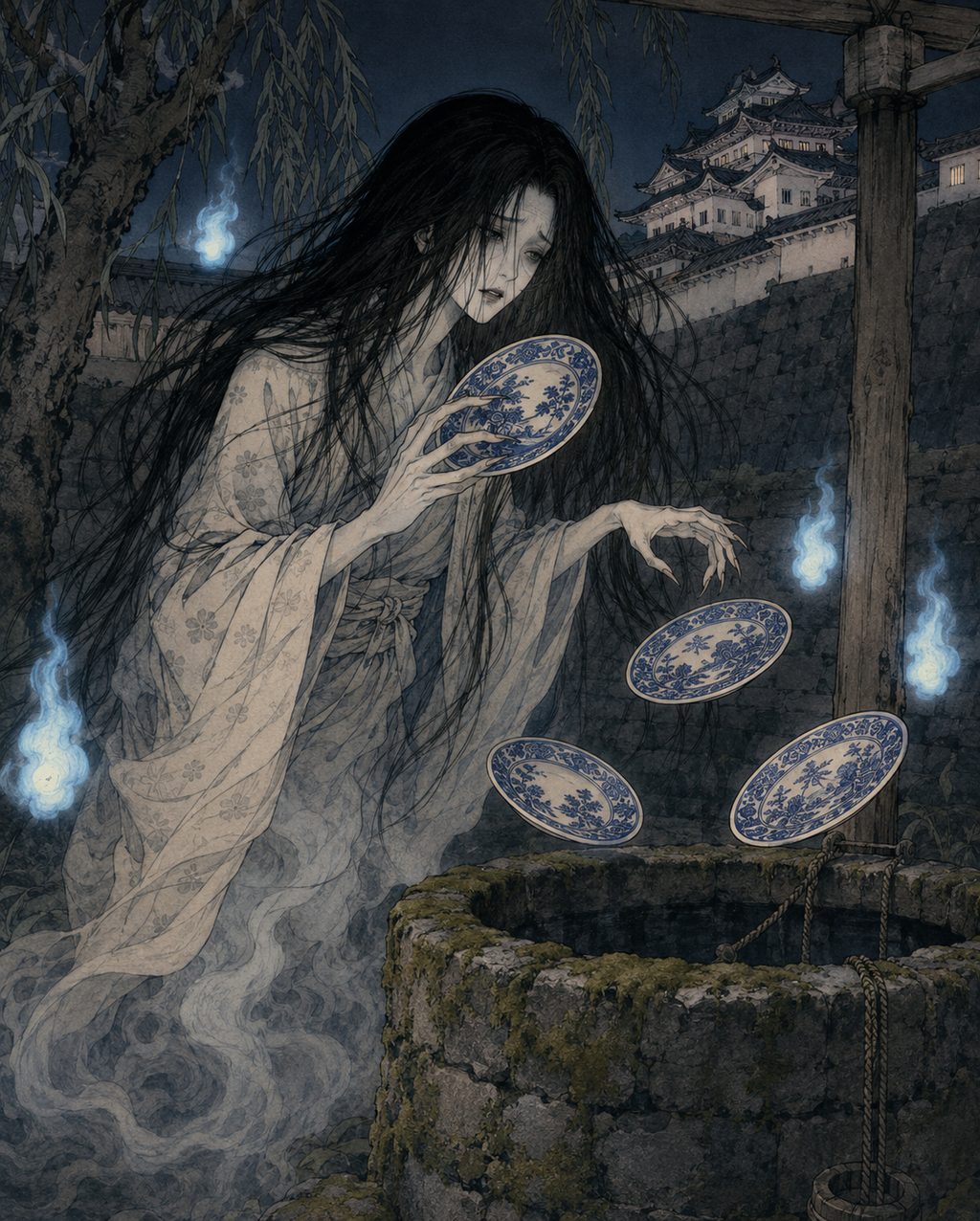
It was the puppet play *Banshu Sarayashiki*[5], first performed in Osaka in 1741 (Kanpo 1), that made this tradition a national phenomenon. The name Okiku, the ten plates, and the well are said to have been standardized as key props by this play. Meanwhile, according to historical legend set in the Eisho era (early 16th century), Okiku was a girl who frequented the Junisho Shrine[6], which enshrines the god of medicine, to pray for her lord's recovery. Deeply moved by her loyalty, Norimoto built a shrine dedicated to Okiku within the precincts of Junisho Shrine. This remains today as Okiku Shrine, where Okiku is enshrined as "Okiku Daimyojin." Furthermore, in the Ninomaru of Himeji Castle, an old well formerly known as the bucket-drawing well still exists under the name "Okiku's Well"—since this moniker became established around the early Taisho era when Himeji Castle was opened to the public, it serves as an excellent example of how legend and tourism can join hands to cultivate the memory of a place.
What added a bizarre color to the tradition was the "Okiku Bug." In 1795 (Kansei 7), pupae of the Chinese windmill butterfly (Byasa alcinous) appeared in massive numbers beneath Himeji Castle. The pupae resembled the figure of a woman bound with her hands behind her back[7], leading the townspeople to rumor that Okiku, sunk in the well, had returned to this world in the form of an insect to clear her grudge. This instance, where a ghost story merged with a natural phenomenon to birth a new anomaly, later even served as the connection for the butterfly's selection as the city butterfly of Himeji. It is a rare example of a ghost tale sublimating into a regional symbol. Note that the Okiku legend is not confined to Himeji; similar tales have spread to neighboring Amagasaki, and along with the karmic tie to the Chinese windmill butterfly, the story has been passed down across the borders of Settsu and Harima. A single vengeful spirit narrative branching out to multiple lands, tying itself to "traceable evidence" like wells, bugs, and shrines in each location—the spread of the Sarayashiki legend is a prime specimen demonstrating how ghost stories take root in physical places.
If there is a woman at the bottom of the well, there is also a woman at the summit of the keep. This is the phantom princess of Himeji Castle: Osakabe-hime (also known as Gyobu-hime).
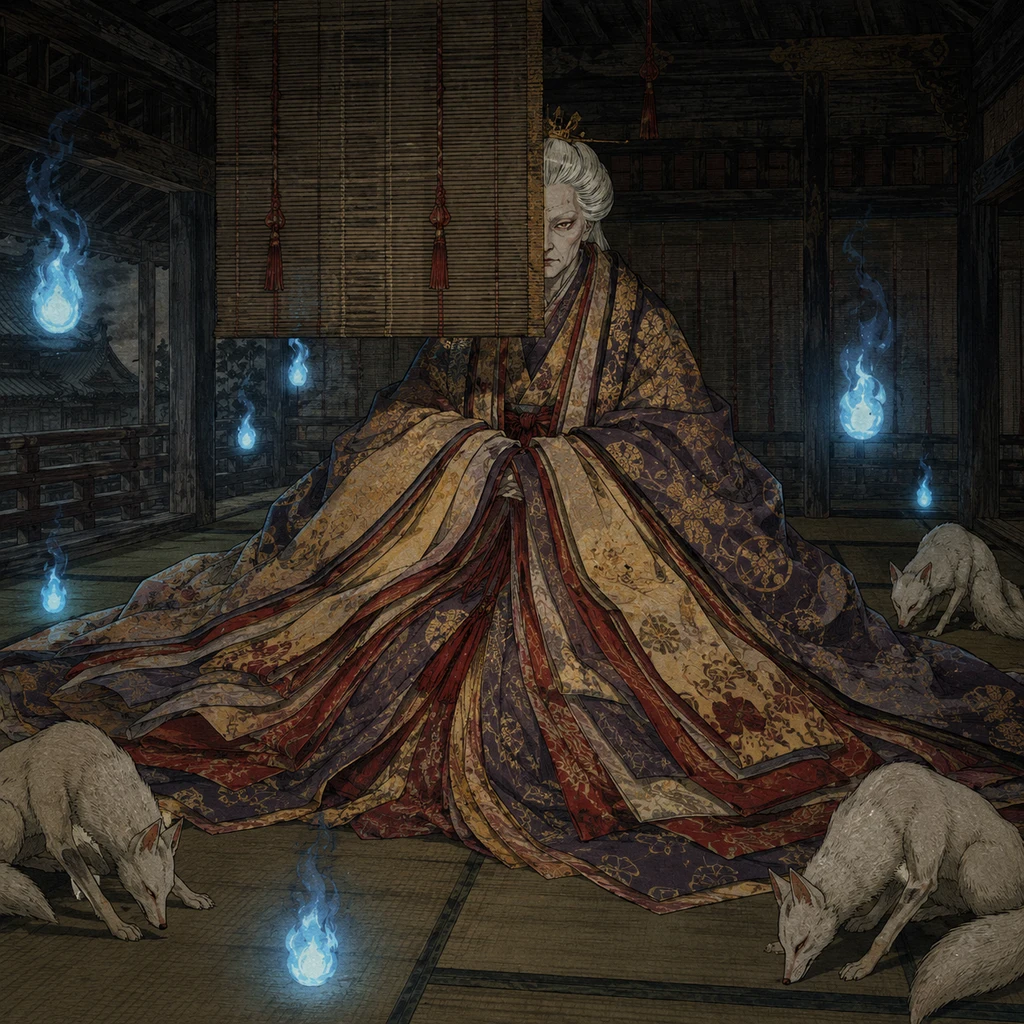
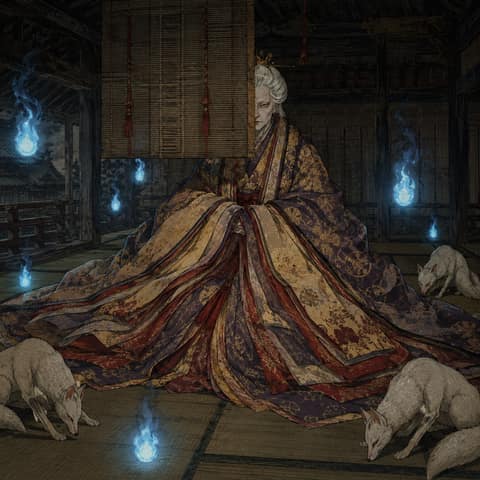
Osakabe-hime
A female yokai and castle deity said to dwell in the main keep of Himeji Castle. Early Edo怪談 depict it as a gender-shifting castle specter; later tradition fixed the image as a “princess.” Revered and feared as both guardian and avenger of the castle, bringing fortune or calamity according to the lord’s conduct. Its true nature varies by tale—an ancient fox, a castle god, a sacrificed woman, or the spirit of a long-departed noble lady. Also called Osakabe.
Read moreOsakabe-hime is a yokai said to reside on the top floor of Himeji Castle's keep, and she is deeply connected to Gyobu Myojin, the deity who was enshrined on Mount Hime before the castle was ever built. It is said that because the shrine was relocated during construction, the god transformed into an apparition and settled in the keep. She is a highly pedigreed yokai who appears in many ancient texts, including the Edo-period essay collection *Kasshi Yawa*[8] and the ghost story compilation *Shokoku Hyakumonogatari*[9]. She meets with the castle lord only once a year and otherwise never shows herself to humans—this secrecy transforms the keep of the White Heron Castle into an almost sanctuary-like space.
The passed-down episodes exhibit a duality typical of a castle yokai. On one hand, there is the terrifying tale that when the castle lord Ikeda Terumasa fell ill, she appeared before the *ajari* (high priest) who was continuing his prayers, urged him to stop, and when refused, turned into a demon and kicked him to death. On the other hand, there are stories of her testing humans: praising the courage of a page named Morita Zushonosuke who climbed the keep late at night as a test of nerve by granting him the *shikoro* (neck guard) of a helmet, or bestowing a masterfully crafted sword upon Miyamoto Musashi after he completed his night watch at Himeji Castle. She is a fearsome god of curses, yet she rewards courage—Osakabe-hime embodies the ambivalence of protection and curse that resides within the very vessel of power that is the castle. Regarding her true identity, there is a strong interpretation that she is the *jinushigami* (the original local deity) of Mount Hime who was displaced by the human endeavor of castle construction, degenerating into a phantom. The act of clearing land to build a symbol of power was also the act of pushing aside the gods who predated it—the story of Osakabe-hime crystallizes the universal themes of development and curse into the concrete architecture of the White Heron Castle. In modern times, the image of a solitary phantom princess living in the enclosed heights of a castle keep has grown popular, and she is frequently depicted in literature, manga, and games as a bewitching castle goddess. If Okiku in the well is malice from below, Osakabe-hime in the keep is majesty from above, and Himeji Castle stands caught between the powers of these two women. The stark contrast between the castle's elegance and the dark tales of the two women it harbors is precisely what makes Himeji Castle's yokai culture so unforgettable.
The Heike in Fukuhara — Kiyomori Glared at by Skulls and Severed Heads Dancing in Midair
Let us shift the era to the late Heian period. In 1180 (Jisho 4), Taira no Kiyomori moved the capital from Kyoto to Fukuhara in Settsu Province (around modern-day Hyogo Ward in Kobe). Here, boasting the port of Owada no Tomari, the hub of Japan-Song trade, Kiyomori built a villa known as the Yukimi Gosho and attempted to construct the absolute zenith of Heike prosperity. However, this very Fukuhara became the stage for anomalies that foreshadowed the clan's decline. The relocation of the capital collapsed in a mere six months, and the capital was returned to Kyoto—Fukuhara became a symbolic land for the Heike where the peak of glory and the omens of ruin coexisted. The reason the *Heike Monogatari* placed so many anomalies around Kiyomori was to make the supernatural serve the narrative logic that the arrogant Heike must eventually fall.
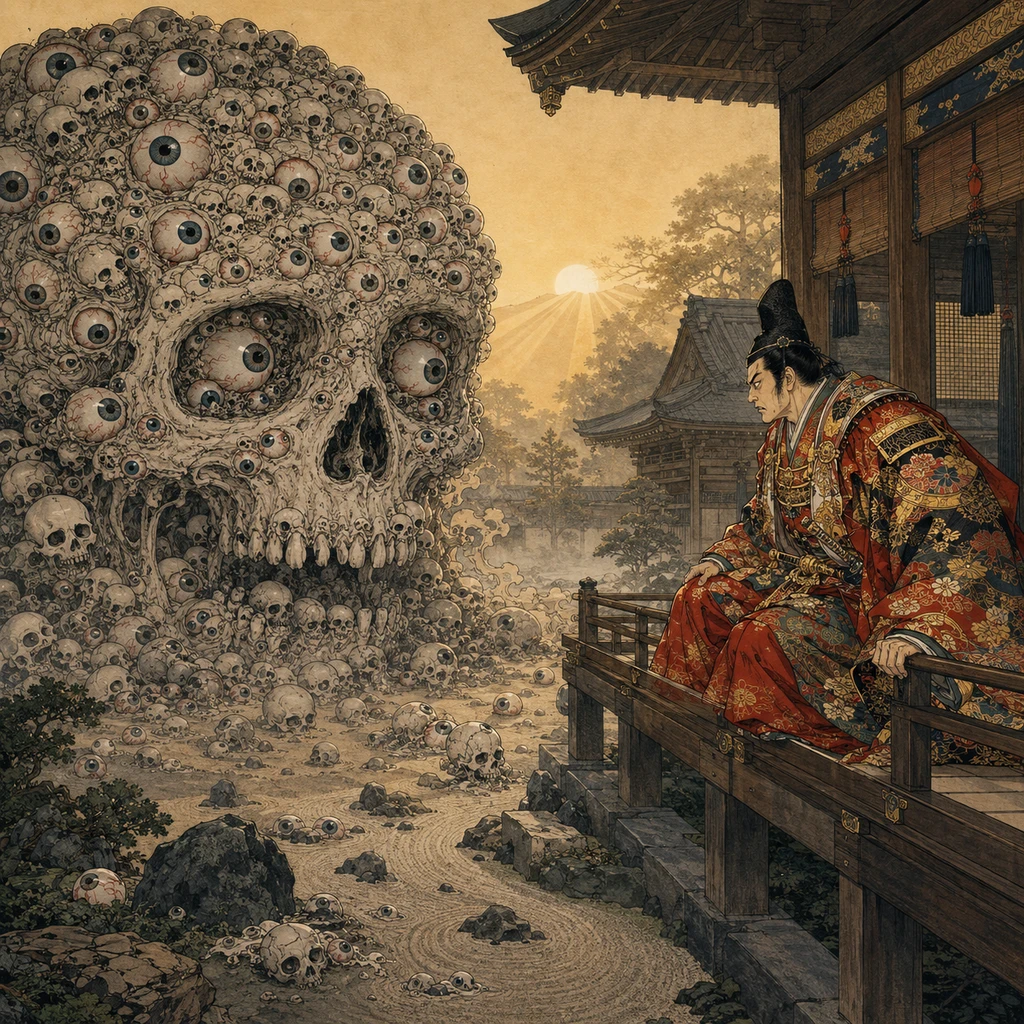
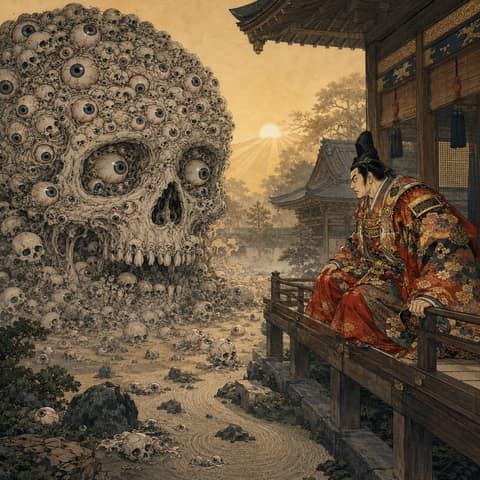
Eye Standoff
Eye Standoff is a yokai depicted by Toriyama Sekien in Konjaku Hyakki Shūi; the name itself is Sekien’s coinage. Its source is a tale in The Tale of the Heike (Book Five, “On Monsters and Portents”) describing a haunting at Taira no Kiyomori’s Fukuhara residence: countless skulls rolled about and gathered into one gigantic skull that glared at him. When Kiyomori glared back, the apparition vanished. It is often read as a mass vision of dead spirits manifesting as skulls.
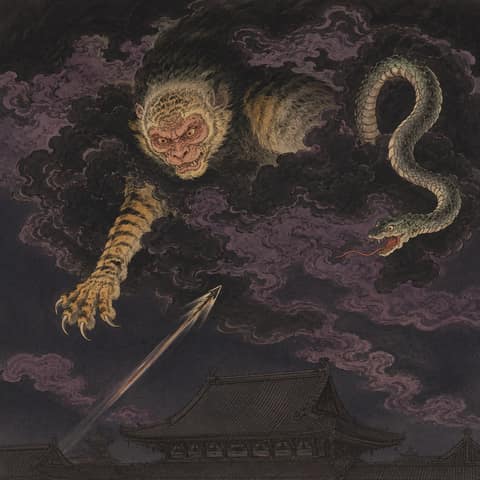
Read moreAs recounted in the "Mononoke no Sata" (Matters of Apparitions) section of the *Heike Monogatari*[10], one morning in Fukuhara, when Kiyomori looked out at the garden from his bedchamber, an enormous number of skulls were rolling about in every direction. Though he called for help, no one came. Eventually, the countless skulls merged into one, forming a massive skull fourteen or fifteen *jo* (over forty meters) tall, and glared menacingly at Kiyomori with countless eyes. When Kiyomori stood his ground and glared back, the skull melted away and vanished into the morning sun. A similar tale can be found in the *Genpei Josuiki*[11].
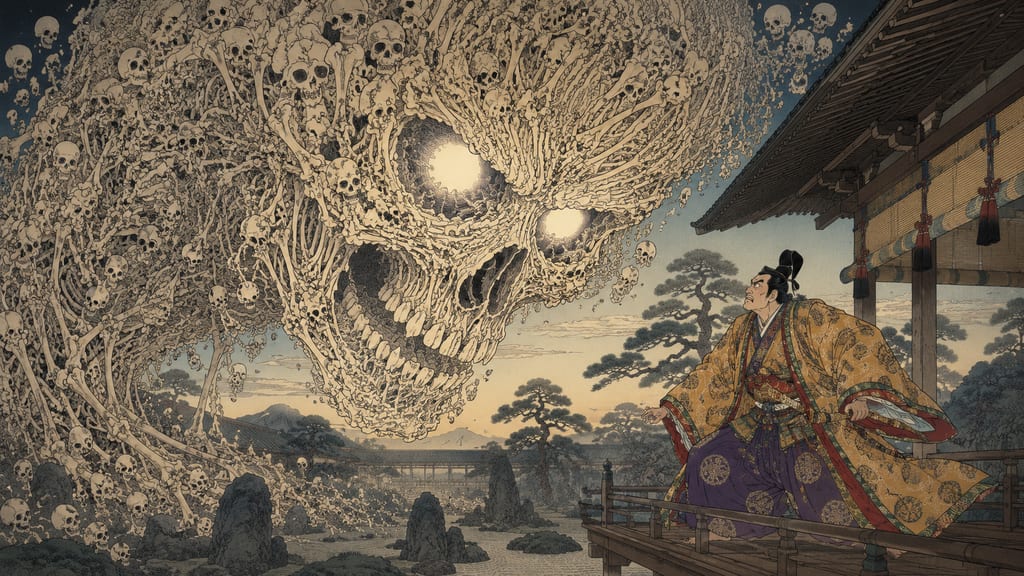
It was much later that this anomaly was given the name "Mekurabe"—by the Edo-period artist Toriyama Sekien in his *Konjaku Hyakki Shui*[12]. The naming is derived from the "staring contest" (mekurabe) between Kiyomori and the skull. Here we can see an important layer of Hyogo's yokai culture: an anomaly from the historical layer recorded in Heian war chronicles (the supernatural event in Fukuhara) was later given a retroactive name and iconography in Edo yokai illustrations, establishing the yokai Mekurabe—a two-stage process of folklore creation. The site of the Yukimi Gosho is now marked only by a monument in the northwest corner of the current Minatoyama Elementary School in Kobe, but the fact that the Heike capital once stood there and that Kiyomori was glared at by countless skulls has survived as the enduring memory of Fukuhara.
The anomalies of severed or floating heads have also been passed down in the Harima region. This is the Odorikubi (Dancing Head), a head of malice dancing in midair.

Dancing Head
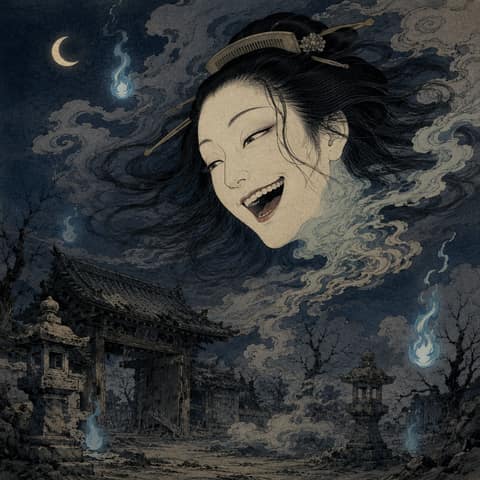
Odorikubi, the “dancing head,” is a type of revenant in which a human head drifts through the air detached from its body. Said to arise from warriors, women, or others who died bearing fierce grudges or obsessive love, the head may swell to enormous size and haunt old temples or desolate places, menacing the living. Early books and奇談 record fragments of the phenomenon: heads flitting across the night sky, laughing with gaping mouths, or groaning. Clear origins or a single canonical tale are rare.
Read moreOdorikubi is a yokai said to be the head of a person who died harboring intense malice or love and hate, which detaches from the body, grows to a massive size, and appears in places like old temples to frighten visitors. In the Genroku era, there is a recorded case that a large woman's head was witnessed in Sayo District, Harima Province (around modern-day Sayo Town, Hyogo Prefecture)[13]. Distinct from the "Maikubi" lineage passed down in Manazuru, Kanagawa Prefecture—where three heads continuously fight on the sea—the Odorikubi of Harima focuses on the theme of bodily separation, with the head alone dancing through the air. This anomaly, where the malice of a defeated warrior or a woman who suffered a tragic death congeals into the shape of a head, resonates with the lineage of "countless skulls" embodied by Fukuhara's Mekurabe. One could say that the lands of Settsu and Harima, layered with war and tragic deaths, attracted these head-related anomalies. The head is the part of the body where a person's consciousness, expressions, and voice reside; the anomaly of a head that dances, glares, and protests even after losing its torso gives the sharpest possible form to regret that cannot be extinguished by physical death. If the Mekurabe in Fukuhara is the anomaly of "countless heads gathering into one to glare," the Odorikubi of Harima is the anomaly of "a single head separating and dancing"—forming a pair of gathering and separation, both condensing the memories of war in Hyogo into the iconography of the head.
Ebisu and the Kugutsu — The God of Fortune and the Wandering Puppeteers
While Hyogo is thick with memories of malice and curses, on the other hand, it is also a land that produced "fortune" and distributed it throughout the nation. Enshrined by the sea in Nishinomiya is Nishinomiya Shrine—the head shrine of all Ebisu shrines in Japan.
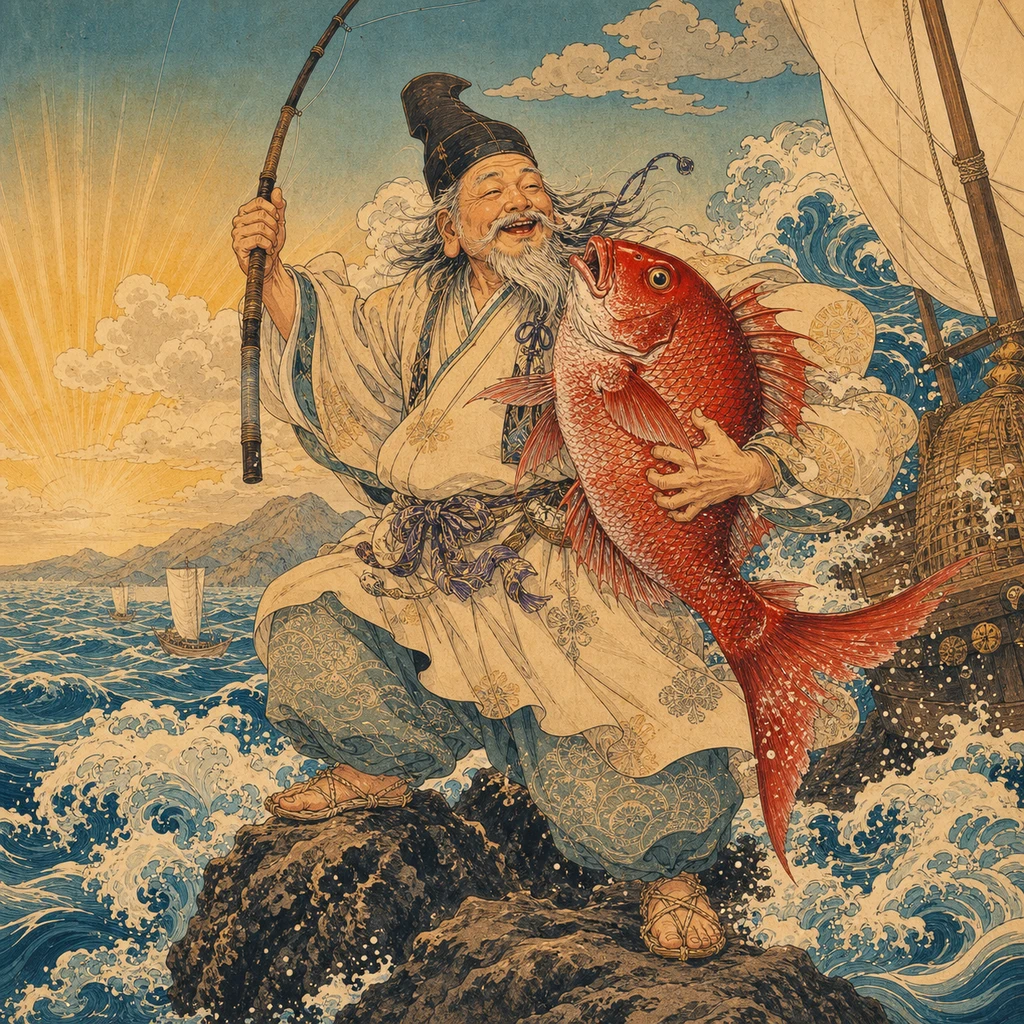
Ebisu
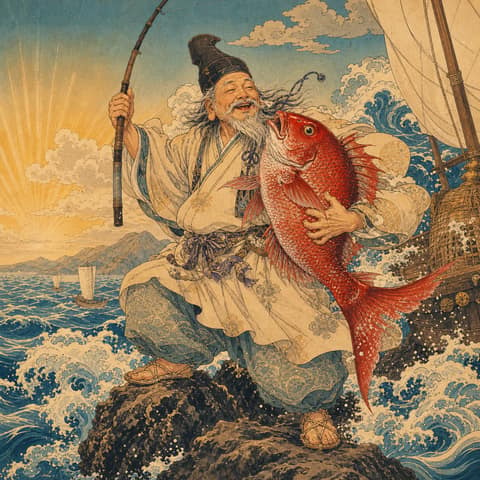
Ebisu is the only deity of Japanese origin among the Seven Lucky Gods (Ebisu, Daikoku, Bishamon, Benzaiten, Fukurokuju, Jurojin, Hotei). Depicted as a smiling old man holding a sea bream and a fishing rod, he is the god of business prosperity, fishing, and navigation. The term "ebisu" shares its etymology with "emishi" (barbarians), meaning "that which comes from afar or from beyond," and was originally a general term in ancient Japan for deities of abundance arriving from the sea or the otherworld. There are two major theories regarding his origin. (1) The Hiruko origin theory: The first child of Izanagi and Izanami in the *Kojiki* and *Nihon Shoki*, who was born deformed, set adrift in a reed boat, washed ashore in Nishinomiya, and brought good fortune, thus becoming enshrined as Ebisu. (2) The Kotoshironushi origin theory: The eldest son of Okuninushi, who was fishing during the mythological transfer of the land. The common elements of the sea, fishing, and fishing rods led to his syncretism with Ebisu. With two major head shrines—Nishinomiya Shrine (the head of over 3,500 Ebisu shrines, based on the Hiruko lineage) and Miho Shrine (the head of the Kotoshironushi lineage)—he is affectionately called "Ebessan" in the Kansai region, where the Toka Ebisu festival from January 9th to 11th is a major event. Incorporated into popular belief as a central figure of the Seven Lucky Gods during the Edo period, he remains widely revered nationwide as a guardian deity of business prosperity, fishing, and safe voyages.
Read moreEbisu is considered the only deity native to Japan among the Seven Lucky Gods; originally a god of fishing, he later became widely beloved among the populace as the god of commerce and good fortune. Regarding his origins, there are two theories: one states he is Hiruko-gami, the firstborn child of Izanagi and Izanami who was cast away, and the other claims he is Kotoshironushi-no-Kami, the child of Okuninushi. Following the former Hiruko-gami theory, Hiruko (leech child) was a deformed child who could not stand even at age three and was cast away in a reed boat. The abandoned child then returns from beyond the sea as Ebisu, a visiting deity bringing fortune—this structure, where the discarded one inverts into a god of fortune, is brimming with the imagination characteristic of coastal faiths. Tracing this Hiruko theory, Ebisu is also a figure connected to Awaji's creation myth, tying the island of genesis and the god of fortune with a single thread. The Ebisu faith, which welcomes guests from the otherworld drifting ashore from across the sea as harbingers of fortune, can be said to have been born directly from the very nature of the Nishinomiya port, open to the Seto Inland Sea and Osaka Bay.
At Nishinomiya Shrine[14], the Toka Ebisu festival is held every year from January 9 to 11, and the "Lucky Man Race" (Kaimon Shinji Fukuotoko Erabi) early on the morning of the 10th is renowned nationwide. The moment the main gate opens, worshippers waiting outside sprint en masse toward the main hall about 230 meters away to claim the title of the "First Lucky Man." Said to have arisen organically around the Edo period, this sacred ritual conveys the earnestness of the people when it comes to fortune even today.
And it was the *kugutsu*, wandering performers who served Nishinomiya Shrine, that carried this Ebisu faith throughout the country.
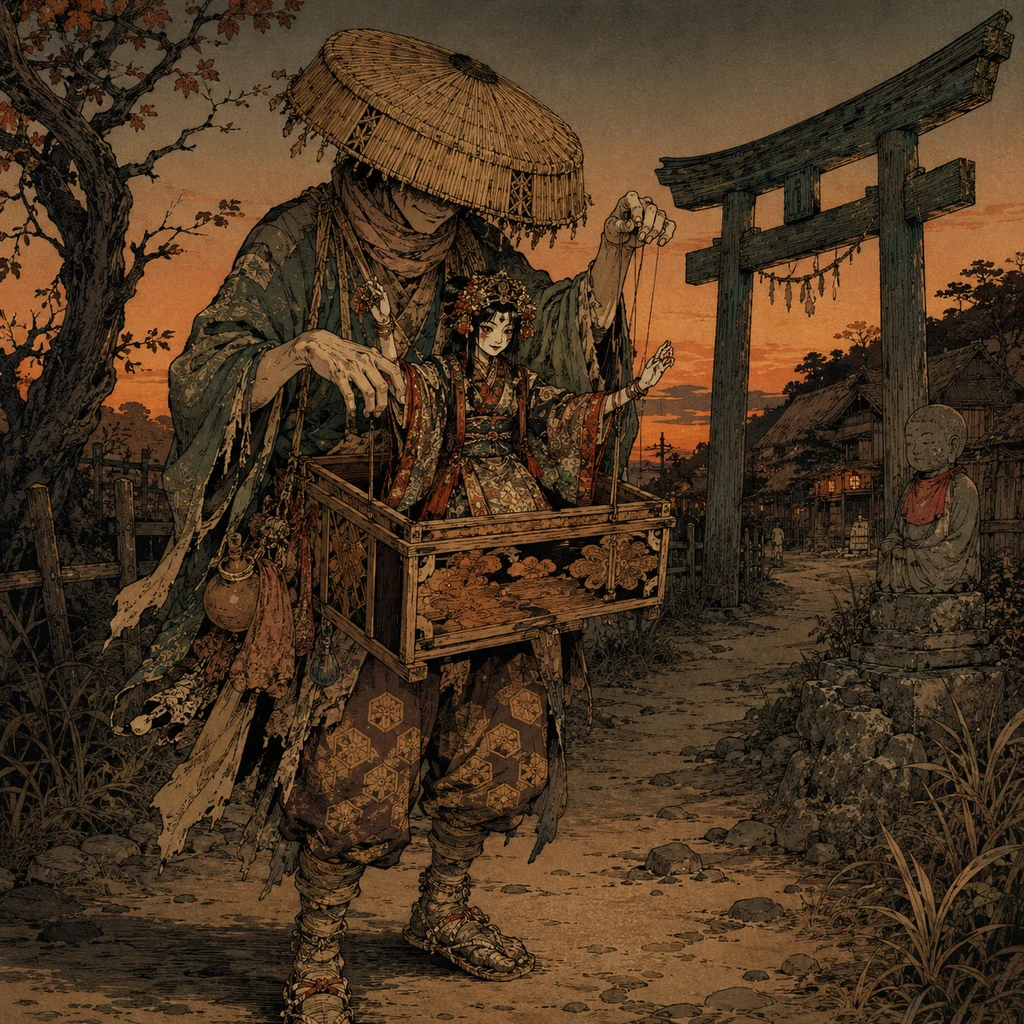
Kugutsushi (Puppet Troupers)
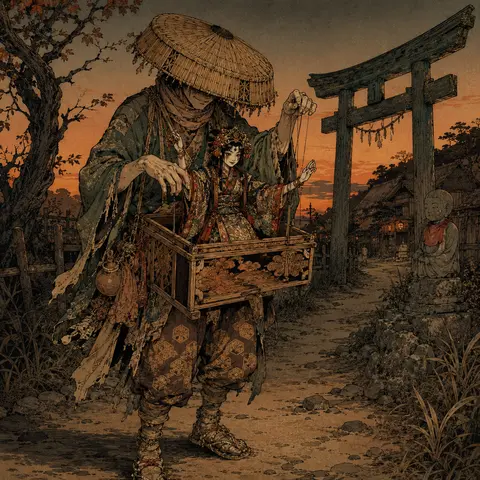
Kugutsushi were itinerant performance troupes who traveled the provinces with wooden puppets and variety acts. Recorded as early as the Heian period, they were skilled in archery and horsemanship, while women excelled in song and entertainment. Later, as temple- and shrine-affiliated outcaste performers, they appeared at rites and markets, shaping later arts such as puppet theater, sarugaku, and kagura. Female performers were called kugutsu-me (“kugutsu women”).
Read more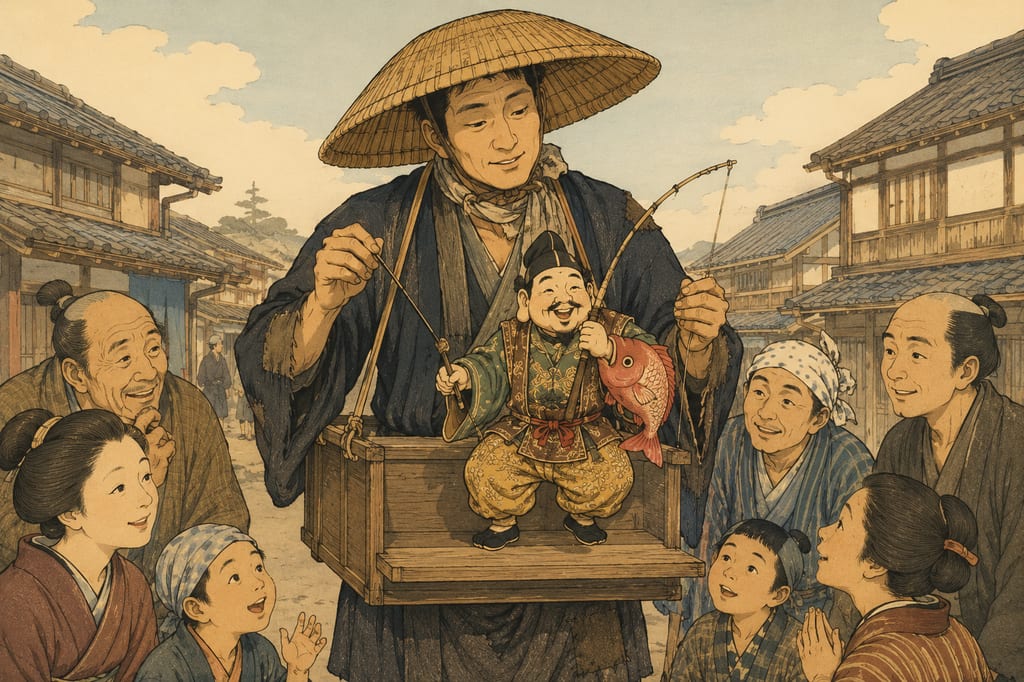
During the Muromachi period, puppeteers known as Kugutsu-shi[15] lived around Nishinomiya Shrine (near present-day Sansho-cho). They hung small boxes containing puppets from their necks and traveled across regions, preaching about fortune by manipulating Ebisu dolls. These puppet plays were called "Ebisu-kaki" or "Ebisu-mawashi," and from the Sengoku to early Edo periods, there are records of them being performed at the imperial court in Kyoto, earning the praise of emperors and retired emperors. In the medieval era, the *kugutsu* were wandering people placed on the margins of society; as "people of the road" distinct from settled peasants, they traveled the highways carrying both entertainment and faith. What they transported was not just puppets. They spread the very belief in Ebisu, the god of fortune, across the nation through the accessible medium of puppetry. The Kugutsu—who performed as non-humans, breathed souls into dolls, and belonged to shrines while never settling anywhere as drifters—lived on the boundaries between the divine and the secular, the sacred and the lowly. They were, in themselves, inherently yokai-like beings.
What is notable is that this Nishinomiya puppetry later combined with the shamisen and Joruri storytelling to evolve into Awaji Ningyo Joruri, and eventually Osaka's Bunraku. It is a prominent theory that at the end of the Muromachi period, a puppeteer named Hyakudayu who served Nishinomiya Shrine crossed over to Mihara District in Awaji and imparted the art of puppetry to the locals; Hyakudayu Shrine, which enshrines him, still remains within the Nishinomiya Shrine precincts today. Awaji, the island of creation; Nishinomiya, which enshrines the god of fortune, Ebisu; and the wandering *kugutsu* that connect the two—the southern half of Hyogo is a rare cultural sphere where myth and performing arts are woven into a single thread. When one considers that the very origins of the puppet plays that narrated the tale of Okiku of the Sarayashiki also lay in the hands of these *kugutsu*, it becomes clear that Hyogo's yokai have passed down the memories of this land while shifting fluidly between curses and fortune, malice and entertainment.
Conclusion — In a Land Where Five Provinces Overlap
Awaji, Izanagi's island of genesis; Harima, with Aoyama Tetsuzan's conspiracy and the women of the White Heron Castle; Fukuhara, where Taira no Kiyomori was glared at by skulls; and Nishinomiya, where Ebisu and the *kugutsu* brought forth fortune. In Hyogo, where five old provinces including Settsu, Harima, Tajima, and Awaji overlap within a single prefecture, beings of such vastly different lineages coexist on the same map—from the highly pedigreed divinities of creation myths to the female malice swirling in castles, the skull anomalies foreshadowing national ruin, heads dancing in the air, and the wandering performers preaching of good fortune.
The place where the gods birthed the nation was also the land of exile that swallowed the very first great vengeful spirit, as well as the port that dispatched the god of fortune across the country—this vast amplitude is the very core of Hyogo's yokai culture. The voice counting from the bottom of the well, the phantom princess at the keep's summit, the massive skull that vanished into the Fukuhara morning. They seem like separate tales, yet they are all patterns in a single great tapestry, woven from the memories of five provinces layered onto a single land.