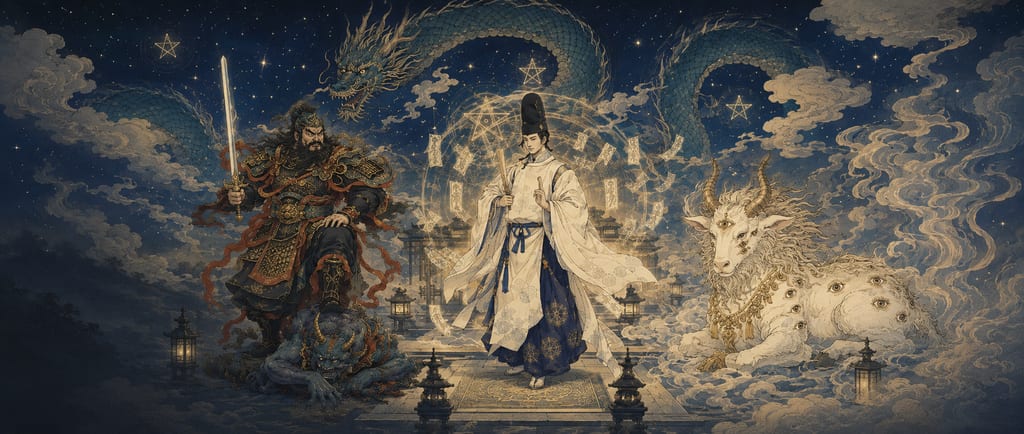
Ototen and Wakaten are two *Goho-doji* (Dharma-protecting youths) who are said to have constantly attended and protected Shoku Shonin (910–1007)[1], the founder of Engyoji Temple[1] on Mount Shosha in Harima Province. A *Goho-doji* is a fierce deity (*kishin*) in the form of a child who is subdued and commanded by highly virtuous ascetic practitioners of Shugendo or Esoteric Buddhism to protect them and carry out their will. Ototen and Wakaten are known as a representative pair of such beings. According to temple legend, Ototen is an incarnation of Fudo Myoo, and Wakaten is an incarnation of Bishamonten[1], and they attended Shoku Shonin on his left and right in the forms of a blue ogre and a red ogre, respectively. While Shoku undertook rigorous ascetic practices secluded deep in the mountains of Mount Shosha, they appeared like heavenly children to fetch firewood and water, repel external enemies, and were revered as beings embodying the holy man's spiritual power. Their nature is well expressed in their duality: despite being fierce ogre-deities, they submit to a holy monk and protect the Buddhist teachings—in other words, they are "ogres yet benevolent gods of Dharma protection."
Folklore & Legends
After abandoning the secular world and wandering through various provinces, Shoku Shonin entered Mount Shosha in Harima Province in 966 (the 3rd year of Kobo), built a thatched hut, and laid the foundation for Engyoji Temple[1], which would later become the 27th of the Saigoku Kannon Pilgrimage's 33 temples. Temple tradition says that it was the two youths, Ototen and Wakaten, who supported his grueling ascetic practices in the mountains. Since the Middle Ages, they have been deeply worshipped as attendants whose presence proved the holy man's high virtue. The two youths are said to have the original Buddhist essences of Fudo Myoo and Bishamonten[1], placing them in the lineage of *Goho-doji* statues like Kongara and Seitaka, the attendants of Fudo Myoo. Next to the Kaisando (Founder's Hall or Okunoin) of Engyoji Temple stand the Ototen Shrine and Wakaten Shrine of the Goho-do[1], Kasuga-style shrine buildings said to have been built in 1559 (the 2nd year of Eiroku). Both are designated Important Cultural Properties and enshrine the *Goho-doji* to this day. The widespread worship of *Goho-doji* was rooted in the religious worldview of medieval Japan—specifically, the mindset of mountain Buddhism, which held that subjugating and commanding fierce deities was proof of spiritual power. Ototen and Wakaten of Mount Shosha have been passed down as representative examples of this in Harima, alongside the miraculous tales from the biography of Shoku Shonin.
Ototen and Wakaten are a pair of *Goho-doji* (Dharma-protecting youths) who attended Shoku Shonin, the founder of Engyoji Temple on Mount Shosha. Ototen is said to be an incarnation of Fudo Myoo and Wakaten an incarnation of Bishamonten. In the forms of a blue ogre and a red ogre respectively, they protected the holy man on his left and right, fetching firewood and water and repelling enemies during his mountain asceticism. They embody the inherent duality of *Goho-doji*—fierce ogre-deities who nevertheless submit to a holy monk and protect the Buddhist teachings—within the context of Harima's mountain Buddhism. They are still enshrined today in the Ototen Shrine and Wakaten Shrine (built in 1559, Important Cultural Properties) next to the Okunoin of Engyoji Temple. Subjugating fierce power and turning it toward good—these child-formed ogre-deities commanded by highly virtuous ascetics reflect the religious imagination of medieval Japan.
Character Profile
This section is our own creative profile for storytelling. It is not historical fact or scholarship.
Possesses both absolute loyalty to the holy monk and the fierce valor unique to ogre-deities. Ototen is indomitable like Fudo Myoo, and Wakaten is majestic and martial like Bishamonten. Though fierce, they are selfless, working entirely for what they must protect.
Protection by attending their master and repelling enemiesAssisting the ascetic physically by fetching firewood and waterSubjugation power imbued with the majesty of Fudo Myoo and Bishamonten
Weaknesses
Ultimately subordinate beings commanded by an ascetic; they do not wield power independently. Their existence relies on the virtue and spiritual power of the holy monk they serve.
Habitat
Deep in the mountains of Mount Shosha (present-day Shosha, Himeji City) in Harima Province; specifically at the Okunoin and Goho-do of Engyoji Temple.
The diagram below is a diagnostic evaluation chart for The Two Youths Protecting Shoku Shonin: Ototen and Wakaten. The higher the value of each item, the stronger that characteristic is expressed.