Minamoto no Yorimitsu
minamoto-no-yorimitsu
Commander of the Four Heavenly Kings, Demon Slayer Minamoto no Yorimitsu
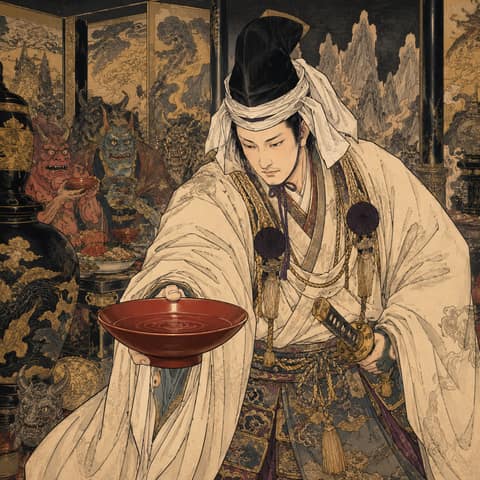
In this version, we read Minamoto no Yorimitsu as the "commander of oni extermination who unites the Four Heavenly Kings." What must not be overlooked in the Yorimitsu tales is that he is not a solitary master swordsman, but the center of a team. He bundles the strength of his Four Heavenly Kings—Watanabe no Tsuna, Sakata no Kintoki, Urabe no Suetake, and Usui Sadamitsu—receives divine protection, and uses disguises and poisonous sake to enter the oni's castle. Oni extermination is a story of organization and strategy, not just brute force. In the subjugation of Shuten-doji at Mt. Ooe, Yorimitsu does not assault the oni's castle head-on. Disguised as mountain ascetics, they infiltrate the banquet as traveling practitioners and force the oni to drink sake. This procedure resembles a ritual for human order to penetrate the otherworld. For a samurai to defeat an oni, he needs more than a sword; he must change his appearance, blend into the setting, and use poisonous sake granted by the gods. Yorimitsu's heroism is placed on the boundary between the capital and the mountains. Shuten-doji barricades himself outside the capital at Mt. Ooe, the Tsuchigumo appears inside the capital as illness and grotesquerie, and the Oni of Rashomon stands at the capital's gate. Yorimitsu goes to each boundary and pulls the anomalies back into human stories. Thus, despite not being a yokai himself, he is indispensable for understanding the structure of the yokai world. His relationship with the Four Heavenly Kings further broadens the reading of this version. Watanabe no Tsuna bears the individual valor of severing the oni's arm, while Sakata no Kintoki brings mountain-bred superhuman strength to the human side. Yorimitsu organizes their abilities into a single subjugation story. In placing this collection of martial prowess within the framework of imperial commands and faith, Yorimitsu is not an individual powerhouse, but the political center of anomaly subjugation. In this version, while Yorimitsu protects the capital by defeating oni, he simultaneously preserves the oni's charm as a story. Shuten-doji becomes famous by being slain, and Tsuna and Kintoki are remembered through oni extermination. Yorimitsu's victory does not merely erase anomalies; it fixes them into a form that is passed down. Therein lies the paradox of the exterminating hero in yokai literature. Yorimitsu's nature as a commander is highlighted by the distinct personalities of the Four Heavenly Kings. Precisely because Tsuna's strong sword, Kintoki's immense strength, and the actions of Suetake and Sadamitsu are all different, Yorimitsu appears not merely as a strong man, but as the center uniting disparate powers. Yokai extermination is not an individual sport, but a strategized operation with divided roles. Furthermore, there is a political nature to the Yorimitsu tales. Slaying an oni who abducts princesses is an act of restoring the women and order of the capital, and Yorimitsu, acting under imperial command, behaves as the court's apparatus of violence. The oni is both an enemy from the otherworld and a peripheral force beyond the capital's rule. In this version, Yorimitsu's victory is not reduced to simple poetic justice. The more he slays oni, the more beautifully and strongly the oni's story remains. Extermination is not oblivion, but also preservation. Yorimitsu is a hero who erased yokai, and simultaneously a narrative device that pushed yokai to the center of folklore. Reading Yorimitsu this way reveals that yokai extermination is not just violence, but the editing of stories. Who to bring, which god's help to obtain, in what scene to reveal their true identities. Yorimitsu sits at the center of this editing, rearranging the world of oni into a form humans can narrate.