Minamoto no Yorimitsu

minamoto-no-yorimitsu

Minamoto no Yorimitsu

Minamoto no Yorimitsu

Their soul is listening — speak, and they will answer.

Basic Description

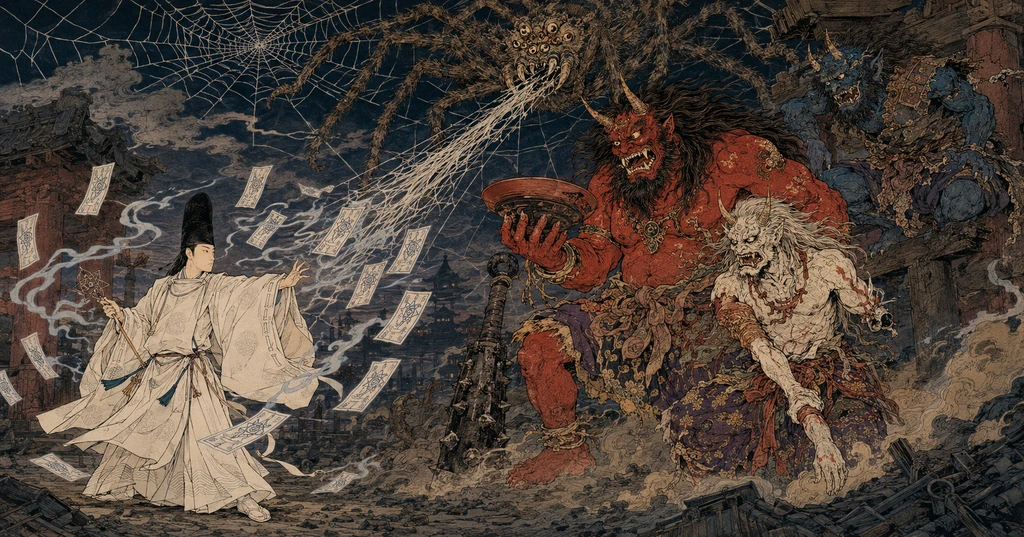
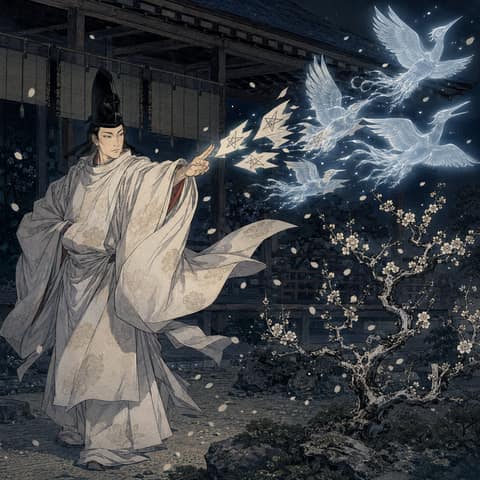
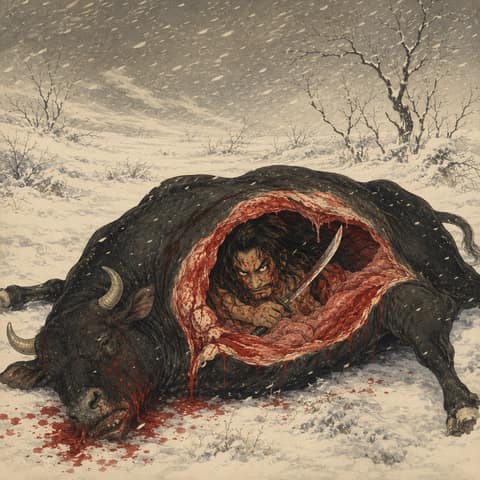
Minamoto no Yorimitsu (often read as "Raikou" in later tales) was an actual military commander of the Seiwa Genji clan during the mid-Heian period, whose figure was greatly expanded as an oni-slaying hero in later legends. While the historical Yorimitsu was a military aristocrat serving Fujiwara no Michinaga, in the world of folklore, he leads the "Four Heavenly Kings" (Shitenno)—Watanabe no Tsuna, Sakata no Kintoki, Urabe no Suetake, and Usui Sadamitsu—becoming the central figure who slays anomalies appearing on the boundaries of the capital and the wild, such as Shuten-doji, the Tsuchigumo (Earth Spider), and the Oni of Rashomon. "Oeyama Ekotoba" is a representative picture scroll depicting Yorimitsu's party infiltrating the oni's castle disguised as mountain ascetics (yamabushi) and getting Shuten-doji drunk with divine poisonous sake (Jinbenkidokushu) to slay him[1].

While Yorimitsu is not a yokai himself, in the YOKAI.JP encyclopedia, he is the largest intersection on the human side stepping into the yokai world. In the Otogizoshi "Shuten-doji," imperial commands, divine assistance, disguises, poisonous sake, and the valor of the Four Heavenly Kings combine, making the oni extermination not just a test of strength, but a story of the capital's order invading the otherworldly banquet[2]. Yorimitsu's role is not merely the wielder of the oni-slaying blade, but the commander who organizes the monster-hunting team, bundling faith, strategy, and martial prowess.

The significance of placing Yorimitsu in a yokai encyclopedia is that the figures on the slaying side shape the yokai tales themselves. Both Shuten-doji and the Tsuchigumo find their narrative resolution because of the slayer Yorimitsu. Anomalies alone rarely form enduring legends; it is only when they are met with human institutions, military force, and faith that they become grand epics.

Folklore & Legends

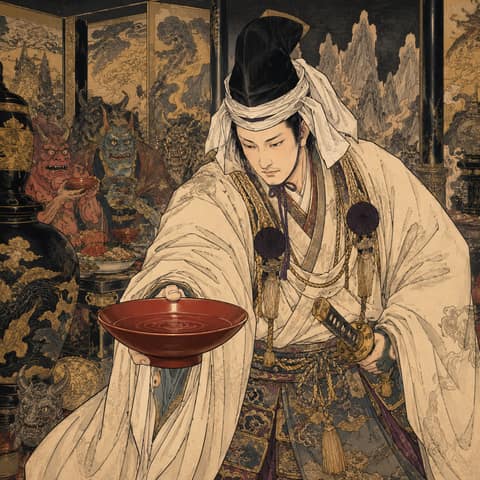
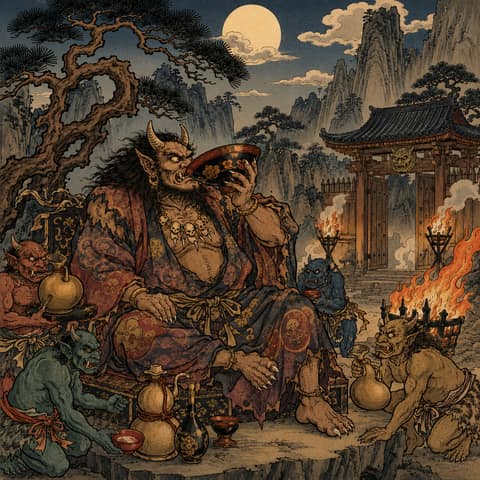
The most widely known of Yorimitsu's oni-slaying tales is the subjugation of Shuten-doji at Mt. Ooe. When princesses are abducted from the capital, Yorimitsu receives an imperial command and heads to Mt. Ooe with his Four Heavenly Kings. Receiving divine aid along the way, the party disguises themselves as mountain ascetics, mingles into the banquet at the oni's castle, and makes Shuten-doji sleep by serving him the divine poisonous sake[2]. In the end, they sever his head, but the head still attempts to bite Yorimitsu. This scene overlaps the oni's immortality, the samurai's valor, divine protection, and the wisdom of disguise into one.

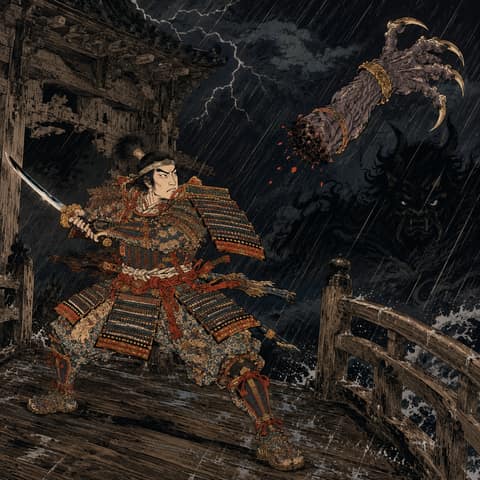
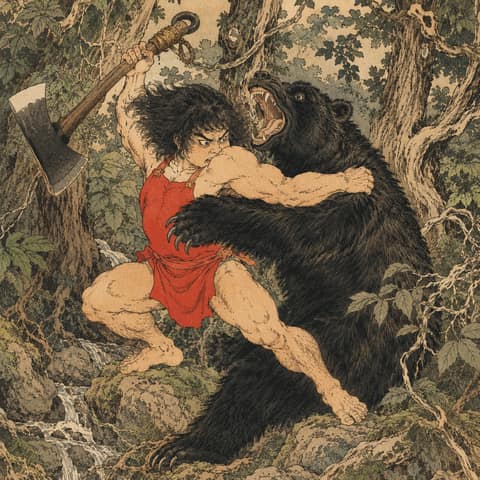
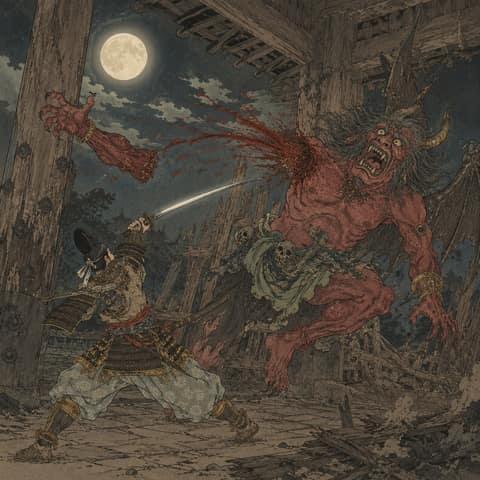
Picture scrolls like "Oeyama Ekotoba" transformed the Yorimitsu tales into visual yokai literature[1]. The oni's castle, the banquet, the princesses, the warriors dressed as ascetics, and the beheading scene are stories to be seen as much as read. Although Yorimitsu stands at the center, the charm of the story is not his solitary bravery. Tsuna's severing of the oni's arm, Kintoki's superhuman strength, divine protection, the grotesque forms of the oni, and the tragedy of the abducted women interweave to thickly illustrate the otherworld outside the capital.

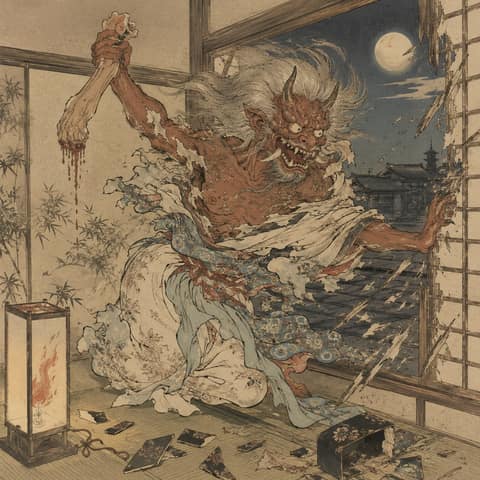
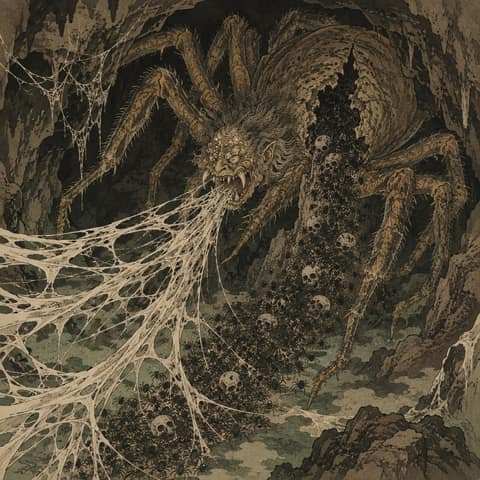
Including the subjugation of the Tsuchigumo and the Oni of Rashomon, Yorimitsu becomes a hero confronting anomalies both inside and outside Heian-kyo. The Tsuchigumo attacking the sickbed, the oni appearing at the capital's gate, and Shuten-doji holed up in Mt. Ooe threaten the order from different places. The Yorimitsu tales can be said to be a retelling of the anxieties of an era when the military power of the samurai was still being positioned within aristocratic society, framed as oni exterminations.

In the Yorimitsu tales, divine assistance always supplements martial power. The party heading to Mt. Ooe does not win simply because they are strong. They receive sake from gods on the way, borrow the guise of ascetics, and enter the oni's banquet. This shows that slaying anomalies cannot be completed by human bravery alone; it requires religious legitimacy.

Furthermore, Yorimitsu's stories convert the anxieties of Heian-kyo into samurai heroic epics. There are oni outside the capital, Tsuchigumo lurking inside, and oni appearing at the gates. The capital, the center of aristocratic society, is actually surrounded by peripheral anomalies. By venturing out to face these anxieties and slaying them, Yorimitsu narrativized the raison d'être of the samurai.

Moreover, through later picture scrolls and Otogizoshi, Yorimitsu was cultivated away from historical fact into the "center of anomaly subjugation." While his image as a historical military commander does not entirely vanish, within the stories, the mere mention of his name causes the oni, spiders, gates, mountains, and the Four Heavenly Kings to rise as a single system.

Detailed Analysis

In this version, we read Minamoto no Yorimitsu as the "commander of oni extermination who unites the Four Heavenly Kings." What must not be overlooked in the Yorimitsu tales is that he is not a solitary master swordsman, but the center of a team. He bundles the strength of his Four Heavenly Kings—Watanabe no Tsuna, Sakata no Kintoki, Urabe no Suetake, and Usui Sadamitsu—receives divine protection, and uses disguises and poisonous sake to enter the oni's castle[2]. Oni extermination is a story of organization and strategy, not just brute force.

In the subjugation of Shuten-doji at Mt. Ooe, Yorimitsu does not assault the oni's castle head-on. Disguised as mountain ascetics, they infiltrate the banquet as traveling practitioners and force the oni to drink sake. This procedure resembles a ritual for human order to penetrate the otherworld[1]. For a samurai to defeat an oni, he needs more than a sword; he must change his appearance, blend into the setting, and use poisonous sake granted by the gods.

Yorimitsu's heroism is placed on the boundary between the capital and the mountains. Shuten-doji barricades himself outside the capital at Mt. Ooe, the Tsuchigumo appears inside the capital as illness and grotesquerie, and the Oni of Rashomon stands at the capital's gate. Yorimitsu goes to each boundary and pulls the anomalies back into human stories. Thus, despite not being a yokai himself, he is indispensable for understanding the structure of the yokai world.

His relationship with the Four Heavenly Kings further broadens the reading of this version. Watanabe no Tsuna bears the individual valor of severing the oni's arm, while Sakata no Kintoki brings mountain-bred superhuman strength to the human side. Yorimitsu organizes their abilities into a single subjugation story. In placing this collection of martial prowess within the framework of imperial commands and faith, Yorimitsu is not an individual powerhouse, but the political center of anomaly subjugation.

In this version, while Yorimitsu protects the capital by defeating oni, he simultaneously preserves the oni's charm as a story. Shuten-doji becomes famous by being slain, and Tsuna and Kintoki are remembered through oni extermination. Yorimitsu's victory does not merely erase anomalies; it fixes them into a form that is passed down. Therein lies the paradox of the exterminating hero in yokai literature.

Yorimitsu's nature as a commander is highlighted by the distinct personalities of the Four Heavenly Kings. Precisely because Tsuna's strong sword, Kintoki's immense strength, and the actions of Suetake and Sadamitsu are all different, Yorimitsu appears not merely as a strong man, but as the center uniting disparate powers. Yokai extermination is not an individual sport, but a strategized operation with divided roles.

Furthermore, there is a political nature to the Yorimitsu tales. Slaying an oni who abducts princesses is an act of restoring the women and order of the capital, and Yorimitsu, acting under imperial command, behaves as the court's apparatus of violence. The oni is both an enemy from the otherworld and a peripheral force beyond the capital's rule.

In this version, Yorimitsu's victory is not reduced to simple poetic justice. The more he slays oni, the more beautifully and strongly the oni's story remains. Extermination is not oblivion, but also preservation. Yorimitsu is a hero who erased yokai, and simultaneously a narrative device that pushed yokai to the center of folklore.

Reading Yorimitsu this way reveals that yokai extermination is not just violence, but the editing of stories. Who to bring, which god's help to obtain, in what scene to reveal their true identities. Yorimitsu sits at the center of this editing, rearranging the world of oni into a form humans can narrate.

Character Profile

This section is our own creative profile for storytelling. It is not historical fact or scholarship.

Rarity
Epic
Personality
Calm and possessing strong leadership, he steps into the otherworld by combining divine assistance, his retainers' martial prowess, and strategy. His organizational skills stand out more than his individual bravery.
Compatibility
仲間を率いて混沌へ向かう物語、鬼退治、武家説話、境界を越える作戦に惹かれる人と相性がよい。
Abilities
Command of the Four Heavenly KingsOni exterminationAscetic disguiseUtilization of divine poisonous sakeAcceptance of divine protectionRestoration of capital orderOrganization of anomaly subjugation
Weaknesses
His heroic image in stories is overwhelmingly large; confusing this with the historical Yorimitsu as a military aristocrat leads to a rough reading. His essence is hard to grasp through individual martial valor alone.
Habitat
Heian-kyo, Mt. Ooe, Rashomon, Tsuchigumo Mound, the oni extermination world of Otogizoshi and picture scrolls, the folklore sphere of Minamoto no Yorimitsu's Four Heavenly Kings
For more detailed information and diagnosis results about Commander of the Four Heavenly Kings, Demon Slayer Minamoto no Yorimitsu, please click here.

Sources & References

2
  1. 大江山絵詞(大江山酒天童子絵巻・香取本)(詞書・絵、作者未詳)(逸翁美術館蔵(旧下総香取神社大宮司家蔵), 南北朝末-室町初期(14世紀後半)) [絵巻] Reference現存最古の酒呑童子説話を伝える絵巻。源頼光と四天王が山伏に扮し大江山へ入り、神便鬼毒酒で酒呑童子を酩酊させて討つ筋を描く。
  2. 御伽草子『酒呑童子』(作者未詳)((御伽草子・古活字本ほか), 室町-江戸期) [古典文献] Reference丹波大江山の鬼の首領・酒呑童子を源頼光と四天王が討つ説話。人を攫う大鬼の典型像を広めた。

Interested in this type of yokai?

Discover the yokai most similar to your personality with our yokai diagnosis

Start Yokai Diagnosis

Meet your guardian yokai at the shrine

Draw an omikuji fortune and discover the yokai watching over you today.