Yokai Encyclopedia

Encyclopedia of Japanese Yokai

51 Yokai|14 Category|Page 1 of 3
Localization in Progress - More content available in Japanese version
View Japanese
Sort by: NameAscending
人妖・半人半妖
  • Aburabō (Oil Wraith)

    Aburabō (Oil Wraith)

    Uncommon

    ah-boo-rah-BOH

    Abura-bō (Traditional Form)

    Half-Human BeingsShiga

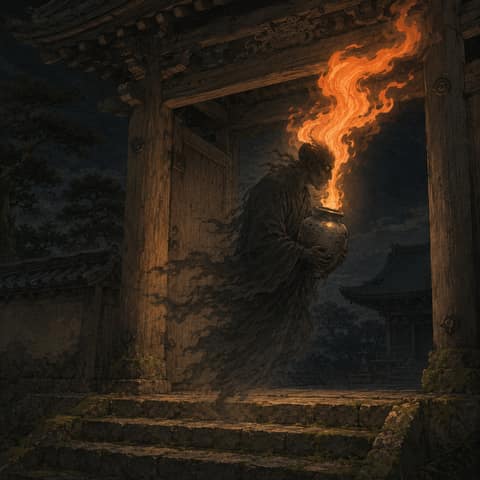
    At the core of Abura-bō is the guilt of misappropriating oil meant for temple and shrine lamps, manifesting as a spirit flame. Early modern records and local lore place its appearances around the foothills of Mount Hiei and temple precincts across Ōmi, most often from dusk to midnight in late spring through early summer. It takes the form of a small orange to yellow fireball, or the shadow of a monk cradling an oil jar, following a set course over gates, halls, and pond embankments before vanishing. Its voice is uncertain, though some regional tales mention indistinct murmurings. Names vary by area—“Abura-bō,” “Oil Thief,” “Oil Returned”—all carrying a folk warning about taboos surrounding oil and the need for proper rites. Specific individuals or temple names differ across sources, but the strict management of lamp oil in temple society likely fostered these tales. Methods to calm it include sutra chanting, burial of offerings, and restoring lamp offerings, though no fixed formula is known.

  • Amabie

    Amabie

    Legendary

    ah-mah-BEE-eh

    Kawara

    Half-Human BeingsKumamoto

    Based on a broadsheet believed published in Koka 3 (1846), this version reconstructs a figure that appeared at sea, shone with light, and delivered prophecies to officials. Because the text states “as in the illustration,” appearance relies on the image; thus we avoid later Amabiko traits and confusions, noting only the referenced depiction such as a scaled body, long hair, a beaklike mouth, and three leglike appendages. The emphasis is on prophecy and dissemination of its image, with no explicit claim of directly suppressing epidemics. It foretells six years of abundant harvest alongside epidemic outbreaks, and presenting its portrait was accepted as a popular apotropaic act. Though said to originate in Higo Province, related tales appear nationwide with differing names and details.

  • Amazake Hag

    Amazake Hag

    Epic

    ah-mah-ZAH-keh BAH-bah

    Traditional Folklore Aligned

    Half-Human BeingsNagano

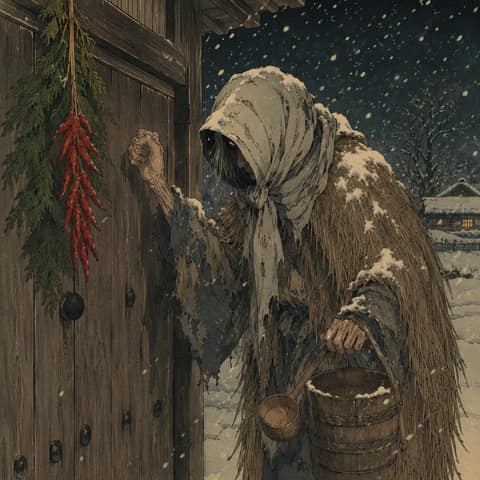
    Amazake-babaa was told as a visitor who heralds the arrival of epidemics. She knocks at midnight and asks whether there is sweet sake; the very act is a test of taboo, and answering is understood as a conduit for misfortune. People hung apotropaic symbols—cedar sprigs, nandina, and chili peppers—at their gates and avoided replying. Across Edo, people visited images of an old woman said to calm coughs, linking petitions to folk belief. The tradition overlaps memories of smallpox outbreaks; some view her as a guise of the smallpox deity, while others absorbed the image of a peddler woman on cold nights, creating regional variation. The yokai is transmitted with the taboo structure of “answer and you fall ill,” accompanied by threshold-warding rites, and is positioned as a portent tale that signals the presence of disease.

  • Amenosagume

    Amenosagume

    Epic

    ah-meh-noh-sah-GOO-meh

    Amanosagume

    Half-Human BeingsOsaka

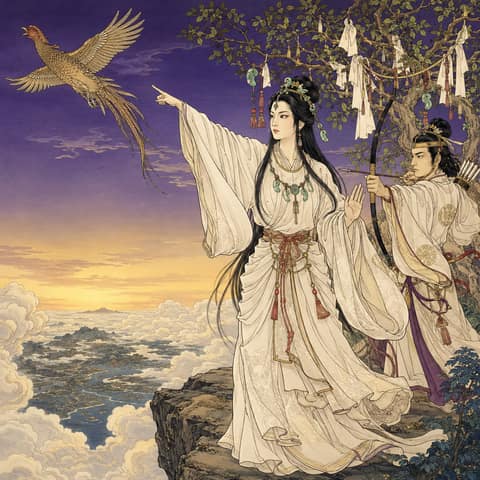
    Amanosagume is a priestess-like goddess named in the Kojiki and Nihon Shoki whose pronouncements of fortune and ill omen can overturn situations. Said to have accompanied Ame-no-Wakahiko, she once declared a singing woman’s voice inauspicious, reflecting an older stratum where divine intent and spoken proclamation tied closely to political ritual. The Kojiki writes her as Amasagume, while the Nihon Shoki uses Amanosagume. Fragments of the Settsu Fudoki and Man’yō poetry tell that she moored in Takatsu aboard the Heavenly Rock Boat, linking her to the toponym lore of Naniwa. Whether she is counted among heavenly or earthly deities varies by source, and honorifics applied to her are inconsistent. Folklore studies sometimes view her as a prototype of the contrary amanojaku, though others stop short of a direct syncretism. Few rites to her survive today: at Hirama Shrine in Wakayama she is revered as Amasagume-no-Mikoto, and at Shoten Shrine in Sagami she is remembered as a goddess who seeks bonds. Avoiding creative additions, her character within the sources can be summarized as a goddess who moves events through divination and declarative speech.

  • Ashinaga Tenaga (Long-Legs and Long-Arms)

    Ashinaga Tenaga (Long-Legs and Long-Arms)

    Rare

    ah-shee-NAH-gah teh-NAH-gah

    Wakan Zu-e Lineage: Long-Leg and Long-Arm Pair

    Half-Human BeingsUncertain (ancient foreign lands as reported in early geography)

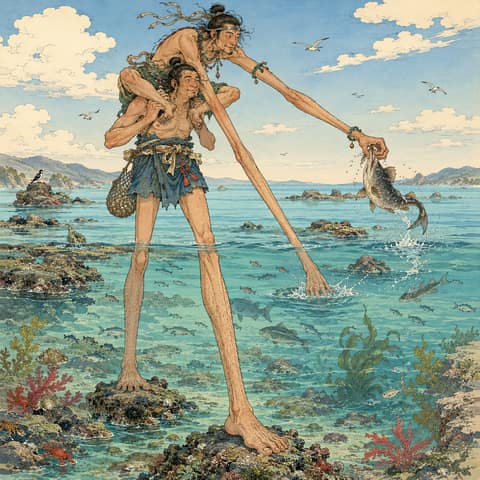
    Grounded in the accounts of Sancai Tuhui and the Wakan Sansaizue, this depiction centers on the paired action of the Long-Leg (Ashinaga) and Long-Arm (Tenaga). The Long-Leg wades far into shallow seas, straddling reefs between waves to provide stable footing, while the Long-Arm extends his reach beneath the surface to gather fish and shellfish and to handle nets and baskets. They are recorded as foreign peoples, unattached to specific locales or clans. Dimensions are often given as legs three jo and arms two jo, though sources vary and no single physique is fixed. In Japan they appear in palace screen paintings, caricatures, and kusazoshi, where a set piece of the two cooperating against rough seas became standard. Religiously, they are sometimes placed in Dragon Palace tales as orderly retainers of the sea deity. As folklore, they symbolize otherworldly labor and the extension of reach across distance, and were consumed as images for maritime safety and plentiful catches. Reports of a solitary “Long-Leg” appearing as a weather portent are a separate tradition borrowing the name and should be distinguished from this paired form with Long-Arm.

  • Blue Lady-in-Waiting

    Blue Lady-in-Waiting

    Rare

    AH-oh NYOH-boh

    Emaki and Sekien Lineage Iconography

    Half-Human BeingsJapanese folklore

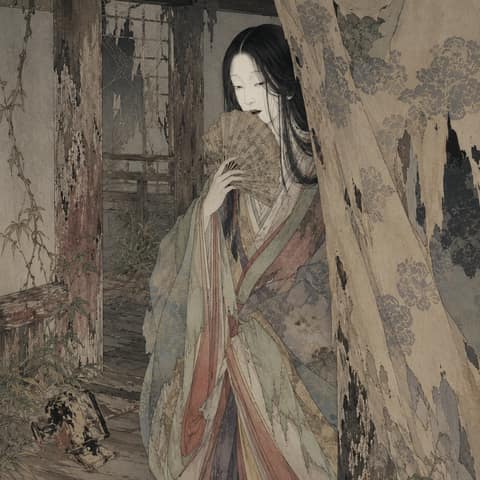
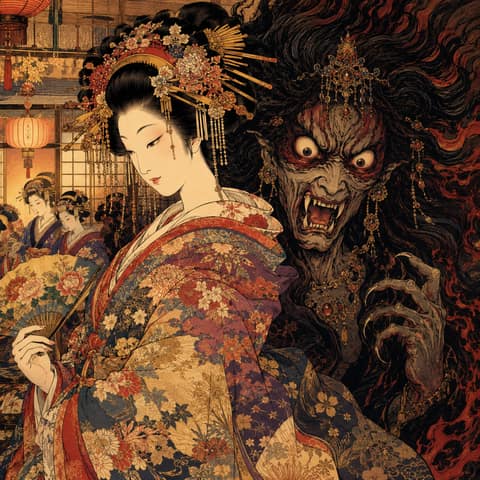
    Aonyōbō here is less a creature of a fixed tale than a court lady’s image turned uncanny and circulated as iconography. Sekien paints her as a lady-in-waiting haunting a ruined old palace, exaggerating obsolete rites and cosmetics—ohaguro and painted brows—to give her a ghostly air. In Night Parade scrolls she often appears with ladies’ accoutrements such as curtains, mirrors, and fans, quietly following the procession. The name derives from the social title aonyo (young lady-in-waiting), making the yokai label largely retrospective. While a record of an “aonyo” exists in the Azuma Kagami, identification is cautious, sharing only the appearance of a young court woman. Local lore offers few concrete episodes, and the setting is typically a decayed palace or the parlor of an old house. Despite its creative coloring, this is a leading example of a pictorial yokai that renders the afterimage of court culture as the uncanny.

  • Bone Woman

    Bone Woman

    Rare

    HOH-neh-ON-nah

    Bone Woman (after Sekien Toriyama)

    Half-Human BeingsEdo period (print tradition)

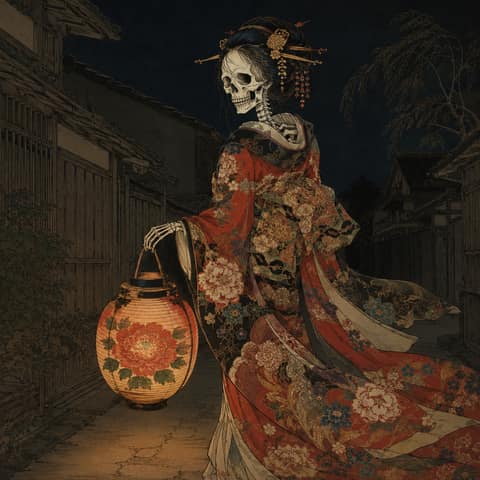
    This version is based on the Bone Woman image in Toriyama Sekien’s Konjaku Gazu Zoku Hyakki. She is a skeletal woman who carries a peony-patterned lantern and visits the home of her beloved in the late night. The source is the ghost tale “Peony Lantern” in Asai Ryōi’s Otogi-bōko. Sekien visualized its core motifs—the inversion of a lovely face and a skeletal body, and the link between lamplight and erotic affection. Rooted in Edo-period notions of vengeful fixation and shifting appearances common to yomihon and kaidan, the figure is an iconographic type rather than a legend tied to specific locales or persons: not a land deity or beast, but a visualization of a passion-bound revenant. Peonies, lanterns, and night roads are its key nodes. While later lore speaks broadly of walking skeletons, this image stresses appearances born of yearning and nocturnal trysts.

  • Cat Maiden

    Cat Maiden

    Uncommon

    NEH-koh-moo-SOO-meh

    Cat-Girl of Early Modern Sideshow and Eyewitness Reports

    Half-Human BeingsTokyoTokushima

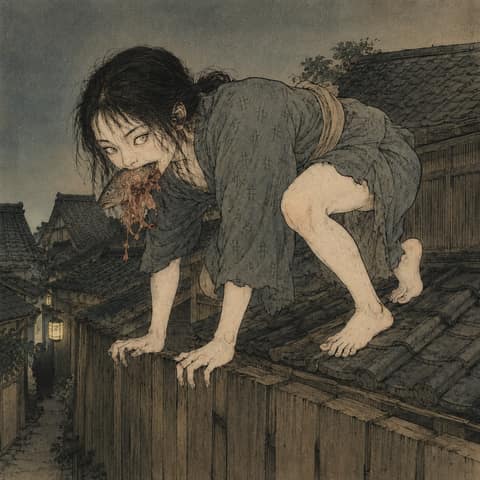
    The cat-girl refers to accounts of human oddities in early modern urban sideshows and reportage, describing feline tastes (fondness for fish entrails, chasing rats), movements (traversing walls and rooftops), and mannerisms (likened to a rough, tongue-like texture). In the Horyaku and Meiwa eras, she was occasionally billed in Asakusa and similar venues, but her fame was short-lived, and even amid the An’ei and Tenmei vogue she never became a major headline act. In yomihon and kyoka collections she appears as a curiosity under labels like “cat-girl” or “licking woman,” not as a transforming yokai. Late Edo miscellanies include an anecdote of a girl near Ushigome praised for catching rats, material that reflects community responses to rodent damage, a taste for spectacle, and the gaze cast upon the strange.

  • Crab Monk

    Crab Monk

    Epic

    KAH-nee-BOH-zoo

    Crab Monk (Chogenji Tradition, Classical Version)

    Half-Human BeingsYamanashi

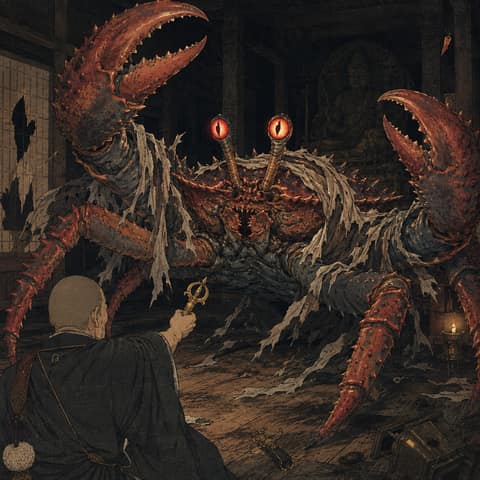
    A figure centered on the monstrous crab legend of Chogenji at Manriki in Kai Province. Disguised as an itinerant monk, it comes to the temple at midnight and borrows Zen phrases, tossing hints like “freely side-walking” and “two legs eight legs” to suggest a crab while testing its counterpart’s wit. It retains human form until its identity is pierced, but when pressed with ritual implements or mantras it reveals its carapace and flees, said to span a two-ken square or reach four meters across. Local lore preserves place names like Crab-Chasing Slope and Crab Marsh, a holed “claw-mark” stone, and tales of thrown stones. Across regions the same tale type shares an empty temple, late night, Q and A, exposure of the true form, and retreat or slaying, with the kyogen play “Crab Yamabushi” often cited as an influence. Devotional aftertales may stress the ritual implements used in subduing it—vajra pestles or iron fans—and devotion to Kannon, though details vary. The version told from the Kyoho era onward forms today’s backbone, and a Meiji hanging scroll attests to the tale’s settlement. Stripped of later embellishment, it is a moral tale of a shape-shifting crab that tests a monk and yields to sacred power.

  • Dodomeki

    Dodomeki

    Epic

    DOH-doh-MEH-kee

    Sekien Iconography Standard

    Half-Human BeingsTokyoTochigi

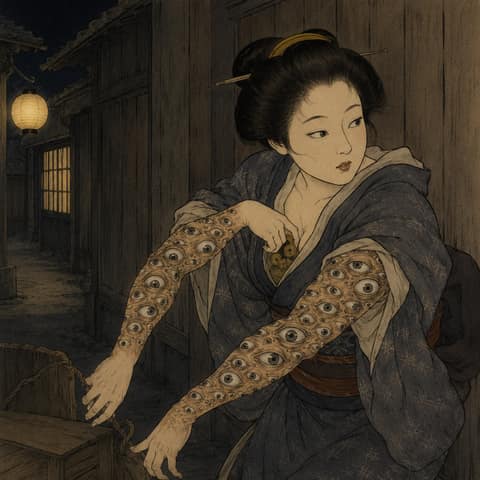
    Following Toriyama Sekien’s note, this version centers on a moralizing motif warning against theft. The many eyes along the arm relate to a pun likening the holes of copper coins to birds’ eyes, externalizing the habit of hands reaching to steal. The source Sekien cites, “Kankangai-shi,” is of uncertain reality; his wordplay on Hakone as a boundary and his own remark calling it a curious book suggest the citation itself is part of the artistic conceit. The Dodomeki’s image concentrates on a female form, yet no concrete personal names, family lines, or local legends are preserved, pointing to an urban allegory where image and wordplay outweigh regional lore. Postwar explanations vary in reading and interpretation, but the archetype is traced to Sekien’s original.

  • Echo-Worm

    Echo-Worm

    Uncommon

    OHH-seh-ee-choo (ohh-OH-seh-ee-choo)

    Edo Essays and Anecdotes Edition

    Half-Human BeingsIntroduced from China; recorded across Japan

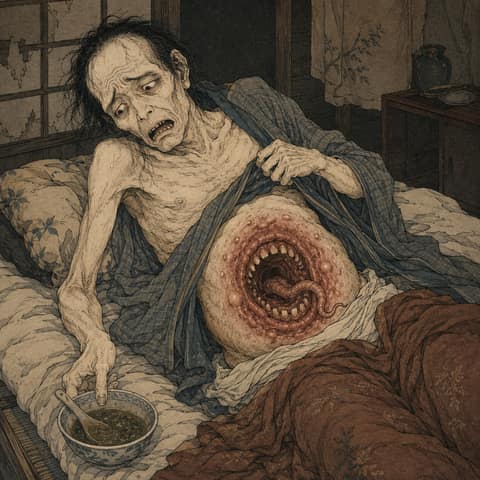
    A portrait of the Echo-Answering Worm from Edo-period essays and tales. Marked by high fever and a sore like a mouth on the abdomen, its voice echoes the host’s words and at times spews curses. It craves food and drink, and refusal is said to raise the fever. Cures attempted include prayers and decoctions, especially a method of selecting and combining drugs it dislikes, then administering them so the creature weakens and later exits the body. Some accounts describe a lizard-like form with horns, though appearances vary widely. Chinese lore of the echoing parasite merged with Japan’s notion of the human-faced sore, emphasizing a mouth opening in the belly. Attempts to exhibit the illness for profit were recorded, though families often refused for shame. Its origins span materia medica and storytelling, long understood as a disorder set at the boundary of medicine and the uncanny.

  • Fire-Quenching Crone

    Fire-Quenching Crone

    Rare

    hee-KEH-shee-bah-bah

    Sekien Iconography Edition

    Half-Human BeingsEdo

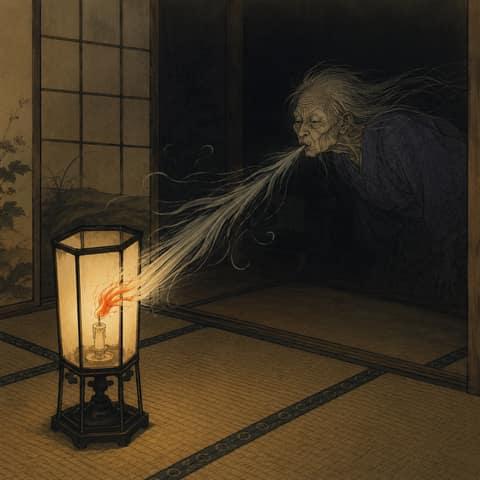
    Anchored in Toriyama Sekien’s depiction of an old woman, this reading frames her as a being that bears Edo-period anxieties about fire use and the terrors of night. Fire was believed to purge impurity with a yang nature, yet accidental blazes became great calamities, so lamplight was strictly managed. The Fire-Dousing Crone personifies an “invisible hand” that presses upon daily vigilance. When a lamp at a banquet or in an inn’s parlor goes out, the event is narrated not as neglect or misfortune but as yokai intervention, symbolically restraining the vigor of flame. Sources vary on the name—“Fukkeshi,” “Fukikesh(i)”—all deriving from the act of blowing out a light. No tutelary deity or local origin tale is attached; references are mostly secondary, and in folklore taxonomy she sits as a variant of “lamp-light apparitions” or “parlor-room ghosts.”

  • Futakuchi-onna (Two-Mouthed Woman)

    Futakuchi-onna (Two-Mouthed Woman)

    Epic

    foo-tah-KOO-chee OHN-nah

    Futakuchi-onna

    Half-Human BeingsChibaTokyo

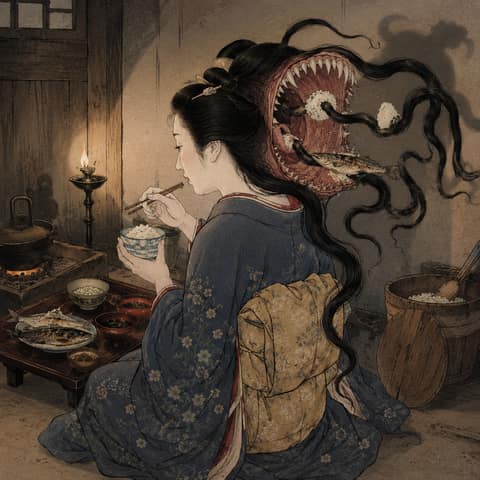
    Aligned with Edo-period strange tales, this type’s true hunger is amplified by a mouth on the back of the head. The front mouth feigns daintiness, while the rear mouth manipulates the hair to pull dishes close. It secretly devours nearby food, sowing domestic discord and appearing in stories about household budgets and shame. In art, a fanged mouth peeks from between coiffed hair. Said to be keen to sounds and smells, it hides its nature deftly in public.

  • Great Zato (The Blind Masseur Yokai)

    Great Zato (The Blind Masseur Yokai)

    Epic

    OH-zah-TOH

    Sekien Zue Version

    人妖・半人半妖Edo period

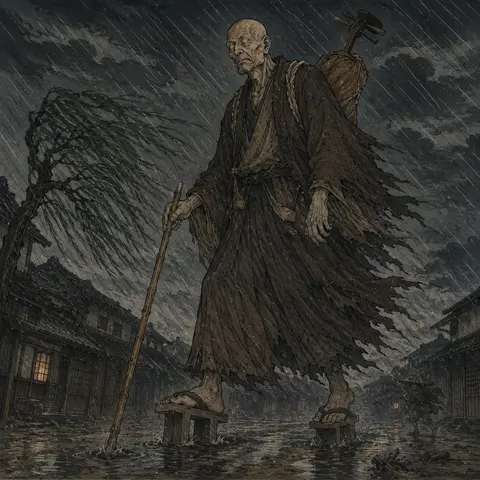
    An interpretive version based on one plate from Toriyama Sekien’s Konjaku Hyakki Shūi. It depicts a blind lute-priest in tattered hakama and wooden clogs, staff in hand, traveling the roads on stormy nights. A marginal note mentions plucking the shamisen in brothels, reflecting ties between early modern urban pleasure quarters and performing guilds. Folklorically, it blends visual othering with social satire, presenting a visage of the age more than a tale of uncanny powers. Kenji Murakami notes the othered image of the nocturnal zatō, while Katsumi Tada reads a “demonic” aura of enforcement from their shogunal protection and involvement in finance. Neither grants concrete supernatural powers, emphasizing a presence that appears on rainy nights and overawes the heart.

  • Hashihime (Bridge Princess)

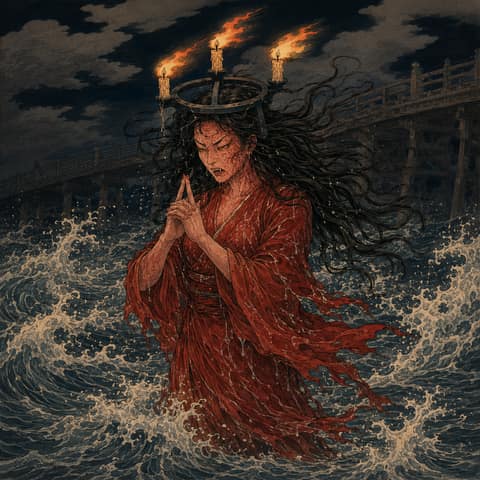
    Hashihime (Bridge Princess)

    Epic

    HAH-shee-HEE-meh

    Hashihime of Uji (Traditional Form)

    Half-Human BeingsKyoto

    An integrated portrayal of Hashihime as a local divinity of Uji Bridge on the Uji River and as the jealous demon-woman of medieval war tales and Noh. As a local deity she was venerated at the bridgehead as a water and land guardian, protecting crossings and safe passage. Traditions forbid praising other regions or singing lines that stir jealousy upon the bridge, reflecting the belief that local gods dislike talk that exalts elsewhere. In the later tale, a woman visits Kifune, undergoes purificatory austerities in the Uji River, becomes a demon, and encounters a warrior at Ichijō Modori-bashi. Toriyama Sekien noted the shrine at Uji Bridge, and the Noh play Kanawa fixed the image of a demon-woman crowned with an iron trivet. Folklorically, bridges are liminal spaces, linked to water deities, female divinities, and warnings against jealousy, so ritual and storytelling long coexisted. While invented details vary by source, devotion to Uji Bridge, the Modori-bashi encounter, and the dual nature of taboo and protection form the core.

  • Hienma

    Hienma

    Rare

    hee-EN-mah

    Didactic Tale, Classical Iconography Adherent

    Half-Human BeingsEdo period

    Rather than a concrete monster, the Hienma is a name that visualizes ruin born of lust. It belongs to the lineage of religious admonitions found in early modern yomihon and kaidan, and is often depicted in two aspects, bodhisattva-like and yaksha-like. More than appearing directly before a person, the original usage names incidents in which demonic hindrance intrudes upon human bonds. Later ages sometimes conflated it with vampiric or life-draining femme fatales, but in classical sources the moral lesson is central, and few fixed tales tie it to specific places or persons. Here it is framed within the classical scope as a symbolic presence that triggers a chain of temptation, delusion, and the decline of household fortunes.

  • Hyakume (Hundred-Eyed Demon)

    Hyakume (Hundred-Eyed Demon)

    Rare

    HYAH-koo-meh

    Iconographic Origin, Modern Interpretation

    Half-Human BeingsJapanese folklore

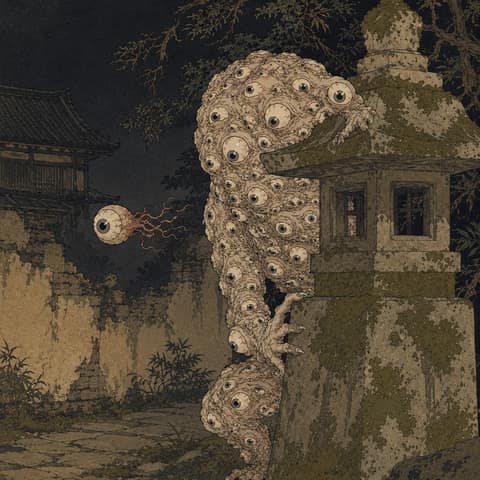
    Rooted in multi-eyed demon images circulated from late Edo to Meiji, this form was given traits by modern yokai compendia. It shuns bright light and hides in night’s cover, avoiding notice. When it senses people, it is said to detach a single eye to probe its surroundings, while the indeterminate mouth only heightens its eeriness. With no fixed locale of tradition, it is treated as a conceptual being known nationwide through the spread of its imagery.

  • Ibaraki-dōji

    Ibaraki-dōji

    Legendary

    ee-bah-RAH-kee DOH-jee

    Ibaraki-dōji

    Half-Human BeingsOsakaNiigata

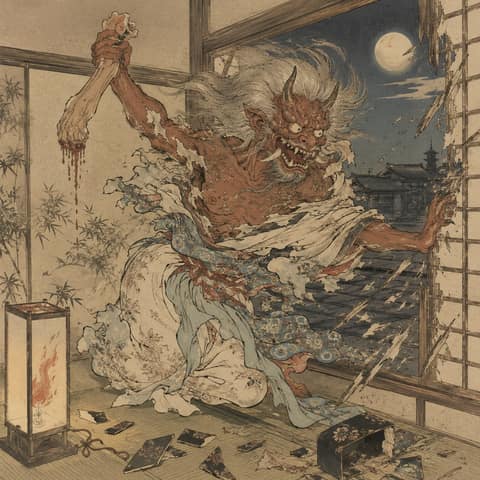
    An interpretation shaped by medieval war tales, otogizōshi storybooks, and early modern theater. As Shuten-dōji’s foremost lieutenant, Ibaraki-dōji held Mount Ōe and was routed by Raikō’s ruse. Later tales tell of Watanabe no Tsuna cutting off and reclaiming an arm at Ichijō Modoribashi or at Rashōmon. Accounts vary on birthplace and even gender, with traces in Settsu and Echigo traditions. This version follows the most widely circulated storyline in the sources and avoids embellishment.

  • Issun-boshi

    Issun-boshi

    Legendary

    EE-soon BOH-shee

    Issun-boshi of the Needle-Sword and Schemes

    Human-Yokai / Half-Human Half-YokaiOsakaKyoto

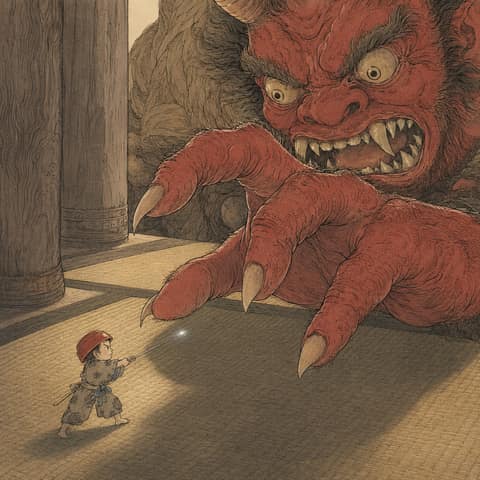
    This interpretation shatters the illusion of the "innocent and brave little person" sanitized by later children's literature, restoring his true nature as the "extremely ambitious and cunning trickster" depicted in the original Muromachi *Otogizoushi*. This version of Issun-boshi carves out his destiny not through martial force, but through advanced psychological manipulation (off-board tactics) and amoral scheming. His greatest defining trait is his abnormal "upward mobility." Burdened with the supreme handicap in human society—a height of merely one sun (about 3 cm)—he never abandons his ambition to take a powerful man's daughter as his wife and achieve worldly success. His method of framing the princess using the "rice grain scheme," having her disowned by her father to socially isolate her, and creating a state of complete dependence on him, displays a cold-blooded Machiavellianism that puts modern psychopaths and con artists to shame. Even in his battle with the oni, he does not fight fair and square. He turns the desperate situation of being swallowed whole to his advantage, executing a gruesome internal destruction (assassination technique) by continuously stabbing the oni's internal organs from the safety of its body (stomach and eyeballs) with his needle-sword. Finally, he robs the oni of its treasure, the "Miracle Mallet," using it to rapidly grow his body and ultimately obtain the ultimate social status of a "perfect human man." He represents the darkest and most realistic rags-to-riches hero in Japanese literary history, overturning his inherent, irrational handicaps entirely through intellect, lies, and the plunder of otherworldly power (the oni's treasure).

  • Jami (Evil Miasma Spirit)

    Jami (Evil Miasma Spirit)

    Rare

    JAH-mee

    Iconographic Interpretation Version

    Half-Human BeingsChina

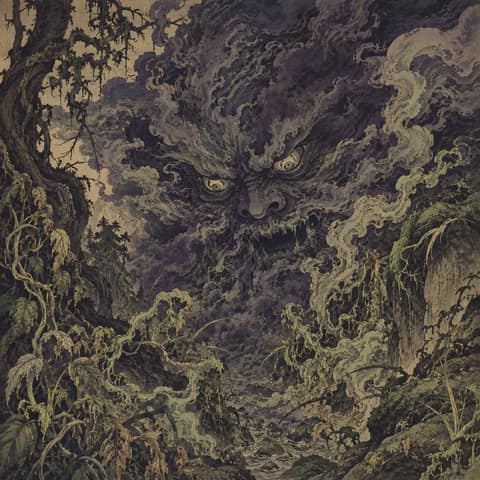
    This version organizes the image of the Jami as an example of Sekien aligning a Chinese-origin demonic concept within Japan’s yokai system. Its original sense is “pernicious enchantment,” classed among chimi, a noxious presence born from the gloom of mountains and wastelands that harms body and mind. Its form is not fixed in classical texts, and images function more as visualizations of an idea. The effects fall between illness and invisible curse—fever, hallucination, frenzy—sometimes triggered by contact with resentment or defilement. Countermeasures include bans, talismans, and wards; traditions speak of drawing a prison on the ground to summon and seal, binding it by asking its name, or transferring it into a vessel. In Japan it rarely became an object of distinct cult, often treated as a generic term alongside more-ryo. In folk terms it is distinguished from miasma, mononoke, and tsukumogami, a high-abstraction yokai appearing where the chill of wild places intersects with human grudge.

  • Kazutsumi Dōji (Number Block)

    Kazutsumi Dōji (Number Block)

    Common

    kah-zoo-TSOO-mee DOH-jee

    Modern Edition

    Half-Human BeingsUrban preschools; beneath living room floors

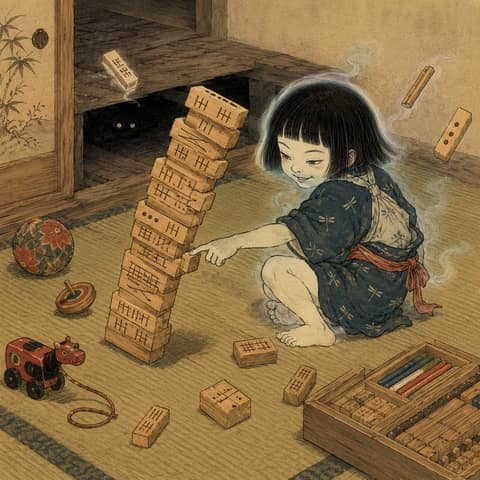
    The more learning tilts toward tablets, the more often it appears, turning problems into tangible forms to restore a sense of touch. It subtly shifts difficulty to let safe failures stack up. When the block tower holds steady at the peak, understanding sets in, and if it falls, it offers a new angle. For parents and teachers, it rings like a wind chime to cue the right rhythm of guidance.

  • Kiyohime

    Kiyohime

    Legendary

    きよひめ

    Kiyohime, the Serpent Woman Who Burned Dojoji

    Human-Yokai / Half-Human Half-YokaiWakayama

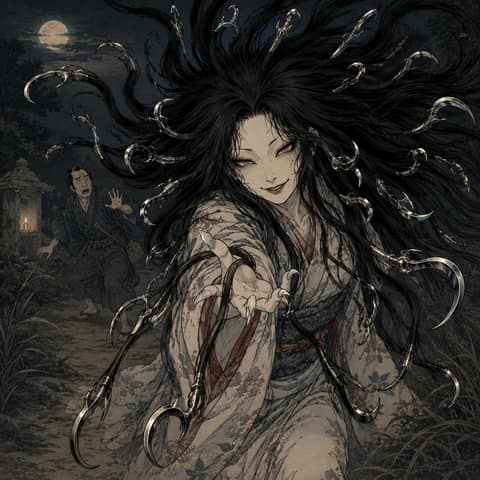
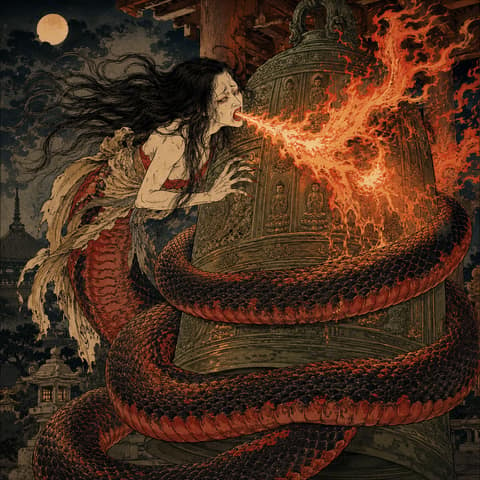
    This version places Kiyohime's personal nature at the forefront of the Dojoji legend. She is not merely a serpentine monster. Four layers overlap within her: the woman who confessed her love, the woman who was fled from, the woman who crossed the river, and the serpent woman who burned the bell. Dojoji Temple conveys the story through picture scroll storytelling (etoki), and in the Noh play *Dojoji*, the shirabyoshi dancer from the sequel tale disappears under the bell, only to reappear as a serpentine demoness . In other words, the terror of Kiyohime lies in the fact that the incident of the past is never truly over, being continually actualized on the stage of performing arts. In terms of yokai classification, Kiyohime is simultaneously a "serpent woman" and a "woman turning into a Hannya." She gathers within a single human body the anger and sorrow carved into the Hannya mask, the jealousy Hashihime left at the bridge and river, and the serpentine calamity mythologically displayed by Yamata no Orochi. The temple bell should have been a safe hiding place, but upon touching Kiyohime's obsession, it becomes a furnace instead of a refuge. This is where the symbolic nature of the Dojoji legend lies. The Buddhist temple, the Kumano pilgrimage route, the water of the Hidaka River, the metallic sound of the bell, and the fire of a woman collide at a single point, changing a romance tale into a yokai tale.

  • Koga Saburo

    Koga Saburo

    Legendary

    Koga Saburo

    Koga Saburo, the Serpent Deity of the Underworld

    Half-Human / Half-YokaiNaganoShiga

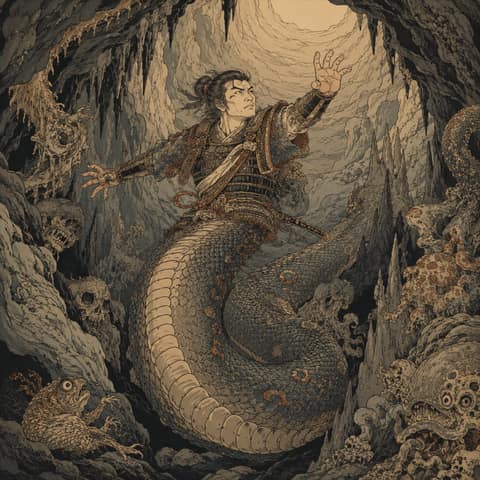
    The fascination of the Koga Saburo legend lies not merely in its heroic epic, but in how it explains the origins of Suwa Myojin as "the return of a mortal who fell underground." Unlike Takeminakata-no-Kami from the Kojiki, who retreats to Suwa as the defeated figure in the myth of the transfer of the land, Koga Saburo travels from Omi to Shinano, falls into the underworld through a cave on Mount Tateshina, and returns as a serpent. The deity of Suwa does not simply descend from the heavens, nor does it merely arrive from central mythology; it manifests by passing through mountain caves, subterranean kingdoms, and the body of a snake. This narrative beautifully weaves together the elements of Suwa worship—water, mountains, dragons, serpents, hunting, and the syncretism of Shinto and Buddhism—into a single tale. This is precisely why it is meaningful to establish Koga Saburo as a distinct figure alongside the official enshrined deity Takeminakata.

  • Kuchisake-onna

    Kuchisake-onna

    Legendary

    くちさけおんな

    Woman in the Red Mask / The 1979 Kuchisake-onna

    Human Yokai / Half-Human Half-YokaiModern urban legend originating in Gifu in 1978, no specific sacred site

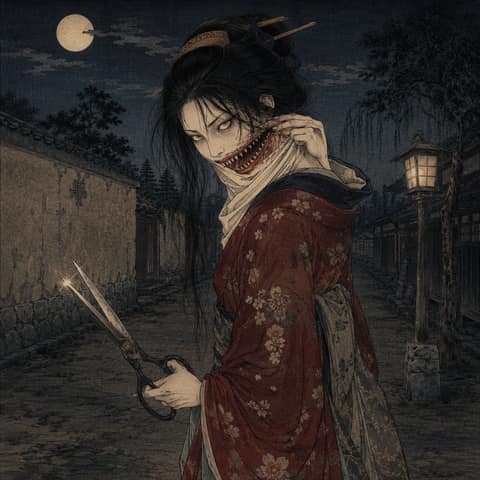
    Reconstructing the 1979 phenomenon's outbreak timeline. The general overview of this entry outlined the 7-month progression, but here we delve into a finer timeline. Early December 1978: A farmer's elderly woman's toilet sighting in Shinsei-cho, Motosu-gun, Gifu Prefecture -> January 26, 1979: Gifu Nichinichi Shimbun "Editor's Notes" (written by editorial writer Mutsumi Murase) notes "According to rumors among Gifu children, a beautiful woman resembling an actress," forming the oldest layer as a local paper before national papers -> March 23 issue: Shukan Asahi's "The Tokaido Trek of the Kuchisake-onna Legend" by Teruo Kanauchi et al. marks the first national magazine appearance -> April-May: Nationwide strengthening of school commute patrols -> June 29 issue: Shukan Asahi's large feature by Etsuro Hiraizumi peaks the event -> June 21: A 25-year-old woman in Himeji City, Hyogo Prefecture, arrested for violating the Swords and Firearms Control Law while wandering around carrying a kitchen knife dressed as Kuchisake-onna (first copycat) -> July: Shukan Josei and Josei Jishin follow up -> August: Rapid subsidence with the start of summer vacation. This 7-month progression can be accurately tracked through newspapers, weekly magazines, and police records. Concurrently, police cars were dispatched in Koriyama City, Fukushima Prefecture and Hiratsuka City, Kanagawa Prefecture, group dismissals were implemented in Kushiro City, Hokkaido and Niiza City, Saitama Prefecture, and hostesses in Ginza started services asking customers "Am I pretty?", showing ripples into the adult world. These precise timeline trackings are theoretically impossible for Edo-period oral yokai, demonstrating a unique case of the undulation structure where a yokai of the post-war mass media age "conquers the country in a short period and disappears in a short period". The dual mechanism of cram schools and national magazines: Yoshiyuki Iikura's point. Yoshiyuki Iikura of Kokugakuin University (oral literature, modern folklore) points out that post-war cram schools served as the medium for the spread of Kuchisake-onna. Pre-war children's rumors were basically confined within school districts, but post-war cram schools created places where children gathered across school districts, acting as a catalyst for cross-district word-of-mouth diffusion before mass media. This, combined with national magazine features from March 1979 onwards, established a diffusion mechanism where word-of-mouth and print mutually amplified each other. Edo-period yokai basically spread through oral media alone (although ukiyo-e and picture books intervened, the mutual amplification of children's daily word-of-mouth and print did not occur), and modern folklore collections were recorded solely by researchers' investigations. In contrast, Kuchisake-onna covered the country in half a year through a three-layer structure of cram school word-of-mouth + national magazine print + television wide shows. This is a form of yokai generation born from the urban space of 1970s Japan, unique to the post-war mass media age. The condensation of modern social symbols: "Mask + Plastic Surgery + City". The standardization of Kuchisake-onna's image as a "beautiful woman covering her lower face with a mask" is highly valuable for sociological decoding. The 1970s Japanese cosmetic surgery boom—a social background where cosmetic surgery clinics rapidly increased in Tokyo and Osaka, and double-eyelid surgeries and nose jobs became common—created a complex fear of "beautiful women who had plastic surgery," establishing the association of mouth hidden by mask = plastic surgery scars. One of the origin theories, the "botched plastic surgery theory," retroactively narrativized this association, becoming widespread during the resurgence of Kuchisake-onna in the 1990s. Furthermore, post-war nuclear families + dual-income households + women's social advancement created anxiety in children left alone at home without their mothers, destabilization of "mother" and "female" representations, and wariness of "unknown women encountered on night streets", all of which were projected onto the image of Kuchisake-onna. In other words, Kuchisake-onna is a symbol condensing the "anxieties of 1970s Japan concerning the city, family, and body" into a single yokai figure. This has a yokai function unique to a post-war individualized society, distinct from the Edo-period yokai's role of maintaining the order of the local community (lessons for children, moral warnings). Distance from the Edo-period Kuchisake-onna prehistory: Continuum or independent occurrence? The Edo-period tales of "women with slit mouths" mentioned in the general overview—the umbrella man tale in Okubo Hyakunincho from "Kaidan Oi no Tsue", the Yoshiwara tayu tale in "Ehon Sayo Shigure", the tale of Nakabashi's Takano Shozaemon's wife in "Shin Chomonju", and the Meiji-era real-life example of Otsuya in Shigaraki, Shiga Prefecture—certainly form the archetype of the "woman whose mouth is slit to her ears" motif, but a direct lineage with the 1979 phenomenon has not been academically confirmed. Toru Joko's "School Ghost Stories" and Yoshiyuki Iikura adopt the position of reading the 1979 Kuchisake-onna not as a continuum from the Edo period but as an independently occurred post-war phenomenon, with the Edo-period archetype merely waiting in the ancient layer and not having a direct parental relationship. This is an important distinction in yokai research: emphasizing "continuity" tends to be the inclination of local tourism materials (local histories of Gifu, Izumo, etc.), while emphasizing "independence" is the inclination of folklore and modern sociology. It is academically honest to introduce the Edo-period archetype as an ancient motif while positioning the 1979 incident as an independent phenomenon that re-occurred under post-war specific conditions. Modern reception: Incorporation into yokai dictionaries and cross-East Asian re-creation. The fact that Shigeru Mizuki's "Illustrated Encyclopedia of Japanese Yokai" (1991) included Kuchisake-onna as an item in the yokai dictionary is often pointed out as a symbolic moment when "modern bizarre phenomena were formally incorporated into the framework of yokai." With this, the urban legends originating from post-war mass media were formally incorporated into the "yokai" framework alongside Edo-period tsukumogami and modern folklore collections. Film adaptations are represented by Koji Shiraishi's "Carved: The Slit-Mouthed Woman" (2007), produced as a post-war horror film that tackled the 1979 phenomenon head-on. The Korean version, "Ghost Mask: Scar" (2019, directed by Go Sone), was a Japan-South Korea co-production that combined Korea's plastic surgery culture with Kuchisake-onna, demonstrating the vitality of cross-East Asian modern bizarre phenomena. In manga, Episode 31 of Shou Makura and Takeshi Okano's "Hell Teacher Nube" is a representative sympathetic re-creation, rewriting it as a story where a woman branded a "yokai" has an animal spirit possessing her exorcised by Nube, returning to her beautiful self—a story of recovery rather than exclusion. This indicates that post-war yokai culture embodies modern ethics (individual dignity, representation of minorities) distinct from the Edo period. The very fact that modern yokai born in the 1970s continue to maintain their vitality in yokai culture even in the 2020s, 50 years later, proves the enduring power of post-war mass media-generated yokai.
Showing 1 - 24 of 51 yokai