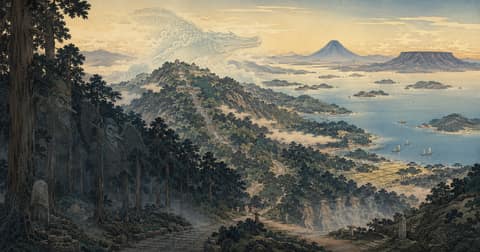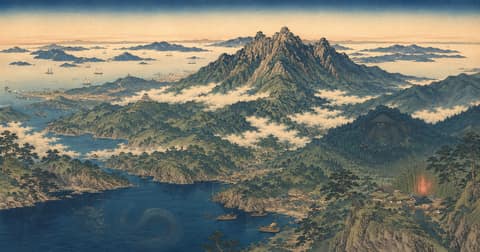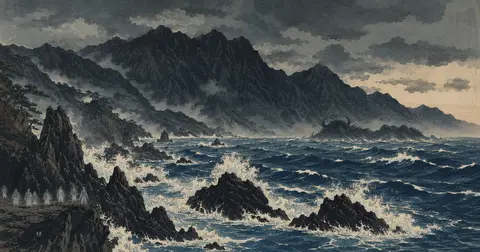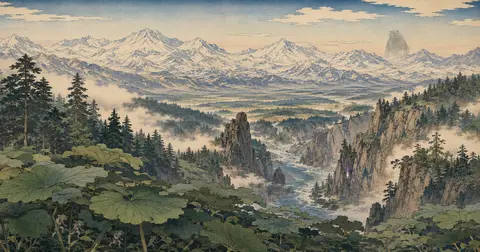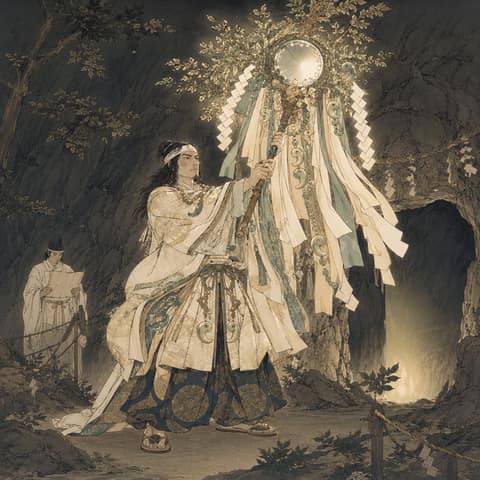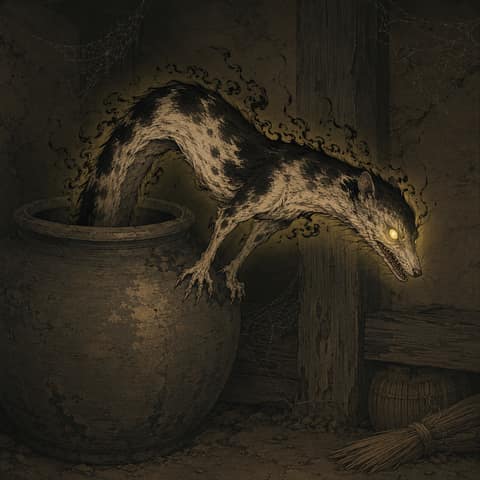
If the yokai tales of the mainland are filled with stories of people being bewitched by foxes, Shikoku's Awa is undeniably the "Country of Tanuki." Here, it is the tanuki rather than the fox that tricks humans, competes for rank, and sometimes even attains divinity to be worshipped as a great deity (Daimyojin).
Why are there so many tanuki in Awa? Legend has it that Kobo Daishi, angered by the mischief of Shikoku's foxes, drove them away, forbidding them to return until a bridge of iron connected Honshu and Shikoku a thousand years later. Because of this, there are almost no tales of foxes on this island, and the role of the trickster was entirely assumed by the tanuki. In his classic study of tanuki, *Tanuki to Sono Sekai* (Tanuki and Their World), Sadao Nakamura also discusses the particular prominence of tanuki tales in Shikoku[1]. While it is not entirely accurate to claim that "there are no foxes in Shikoku," it is certain that since the early modern period, traditions of tanuki have been richly recorded on this island above all others. Enriched by the cultivation of indigo, Awa was home both to prosperous villages where humans and beasts lived side by side, and to rugged mountains that easily repelled human intrusion. In the threshold between those villages and the mountains, tanuki transcended being mere monsters; they lived in "another society" where they exchanged obligations with humans, led armies in battle, and ascended to godhood. With the tanuki as our protagonist, let us explore the world of Awa's mysteries.
The Awa Tanuki War — A Tanuki's Battle for Honor
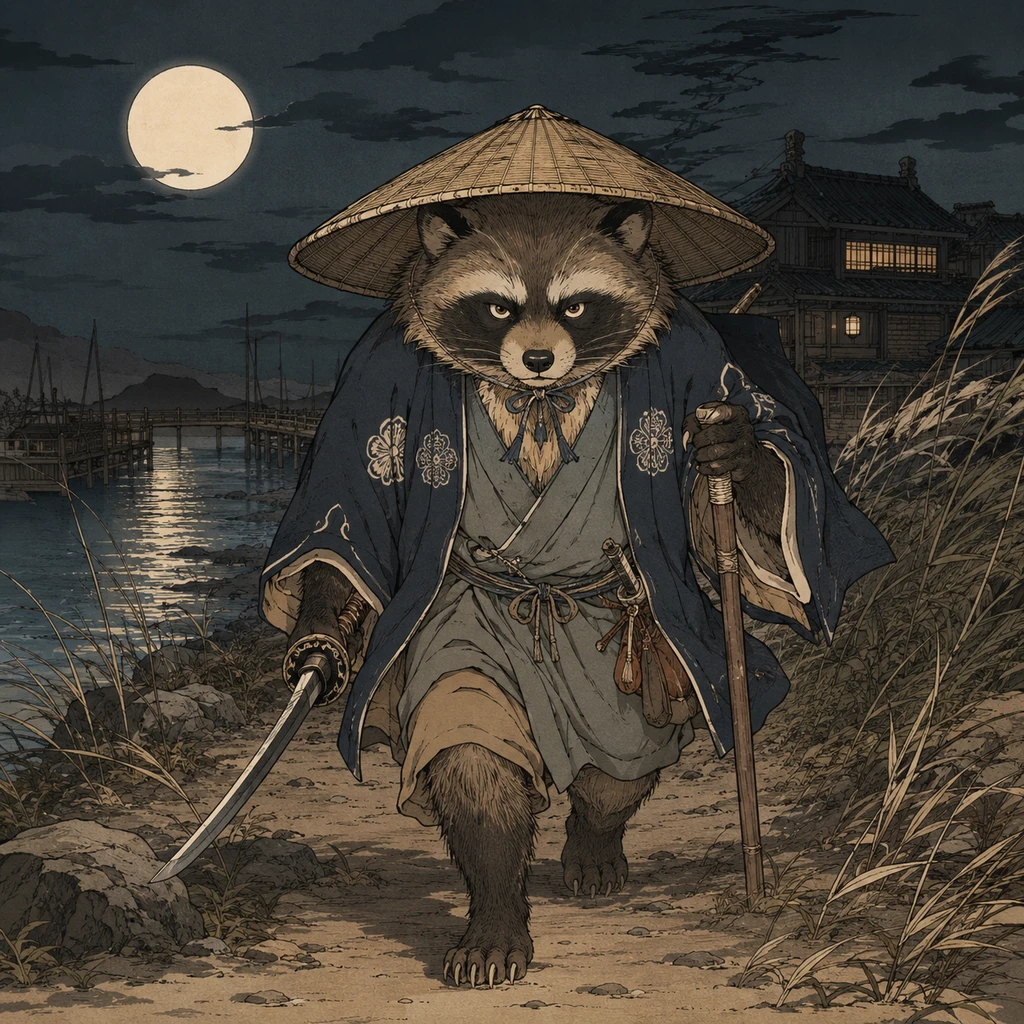
Kincho
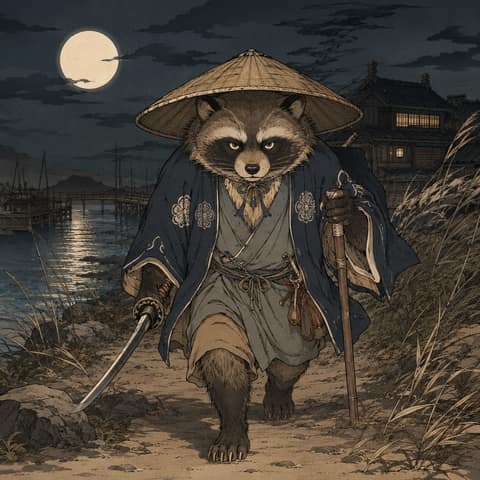
Kincho is a legendary bake-danuki (shapeshifting raccoon dog) from Awa Province (Tokushima Prefecture) and one of the central figures in the famous "Awa Tanuki War." Originally rescued by Moemon, a worker at the Yamatoya dye shop in Hikaino (present-day Komatsushima City), Kincho devoted himself to protecting the shop out of gratitude. Recognized for his outstanding talent, he was sent to train under Rokuemon, the supreme commander of the Awa tanuki in Tsuda-ura. However, when Kincho refused Rokuemon's offer to marry his daughter and become his successor, it sparked the earth-shattering Awa Tanuki War. A deeply loyal and dutiful figure who fiercely loved the man who saved him, Kincho was said to possess the divine power to possess people and bring immense prosperity to businesses. After his death, he was deified as Kincho Myojin and remains enshrined today at Kincho Shrine in Komatsushima City, worshipped as a deity of business prosperity and victory.
Read moreAround the Tenpo era, Moemon of the Yamatoya, a dyeing merchant in Higaino (present-day Komatsushima City), is said to have paid money to save a single tanuki that was about to be smoked out of a large pine tree. This was an old tanuki named Kincho, who claimed to be 206 years old. Before long, Yamatoya's business flourished, and Kincho possessed an apprentice named Mankichi to reveal his identity, becoming the shop's guardian spirit. A tanuki, nearly killed by smoke, is saved by a merchant's compassion and ultimately lays down his life aiming for a divine rank to repay that debt — at the root of Kincho's story runs the strong ethic of *giri* (obligation), highly valued by the people of the early modern period, which dictates that a debt of gratitude must be repaid with one's life.
The rank of "Shoichii" (Senior First Rank) that the tanuki sought was originally the highest rank bestowed by the imperial court upon gods and subjects. Just as the god Inari is often crowned with Shoichii, for a tanuki it meant achieving the same honor as the pinnacle of human society — that is, ascending from a mere beast to a deity worshipped by humans. Seeking this divine rank, Kincho went to train under Rokuemon of Tsuda (present-day Tsuda, Tokushima City), the leader of the tanuki in Shikoku. Rokuemon, impressed by Kincho's rapid rise to prominence, tried to bring him into the family as a son-in-law through marriage to his daughter. However, unable to abandon his debt of gratitude to Moemon, Kincho refused the offer and attempted to return to his hometown — and from here, a great war began that divided the tanuki of all Awa into two factions.
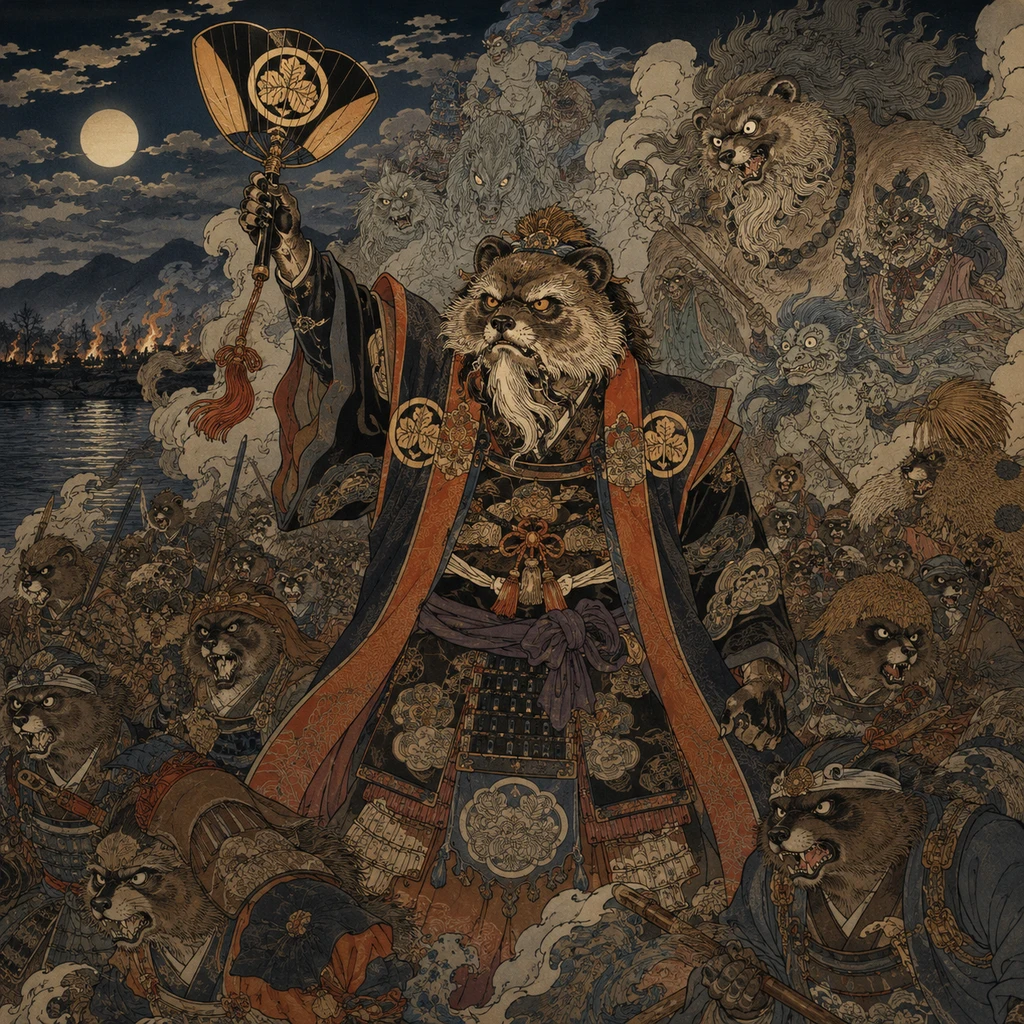 RokuemonRokuemon
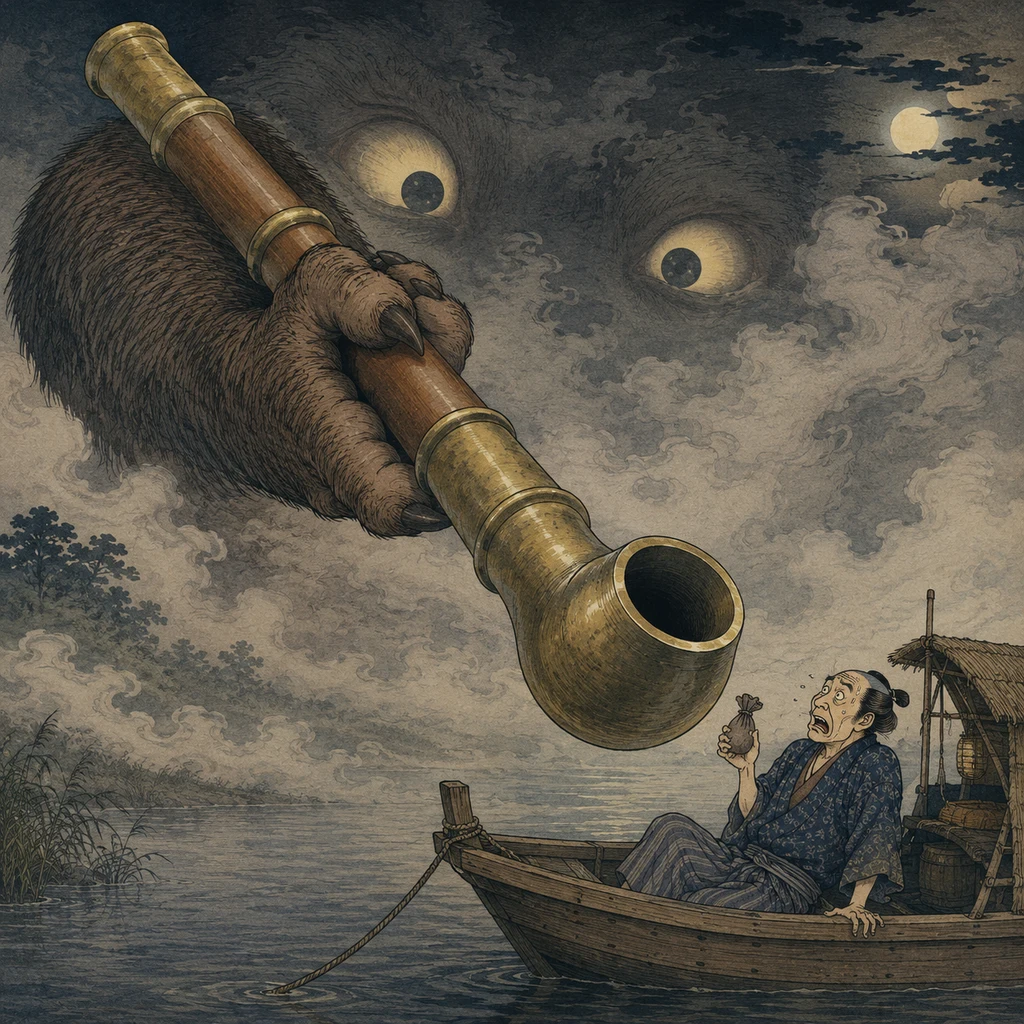 The Great Kiseruoh-oh-gee-SEH-roo
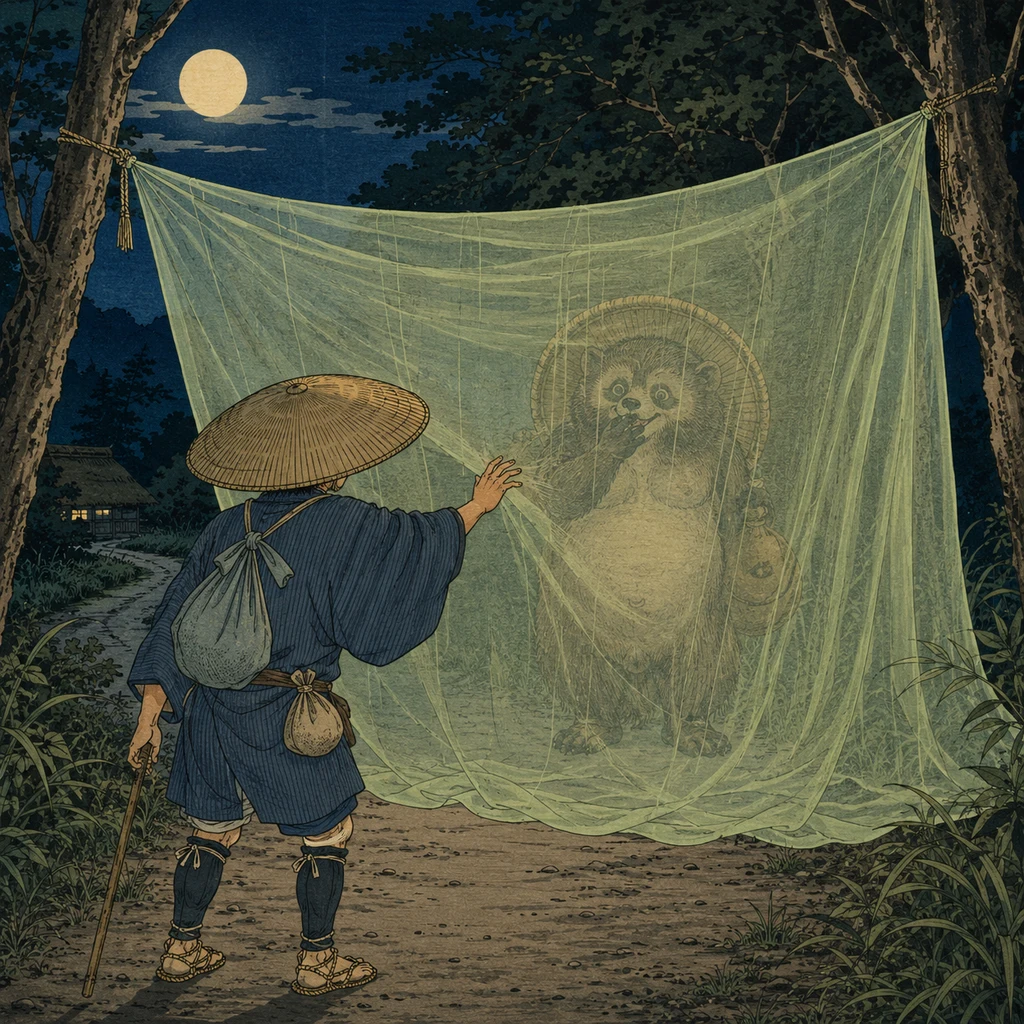 Mosquito-Net-Hanging Tanukikah-yah-TSOO-ree dah-NOO-kee
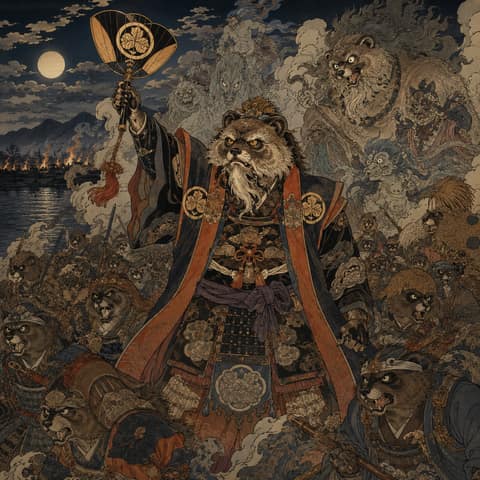
In the area along the Katsuura River, the tanuki armies of Kincho's and Rokuemon's factions clashed. Later *kodan* (traditional oral storytelling) dramatically recounts that "armies of over 600 tanuki fought for three days and three nights," but such numbers and detailed tactics are embellishments not found in the original texts. Kincho finally defeated Rokuemon, but he too suffered severe wounds; it is said that he returned to Higaino, thanked Moemon, and then his strength gave out. Moemon traveled to the Yoshida Shinto administrative office in Kyoto and had the divine rank of Shoichii bestowed upon Kincho. A tanuki who risked his life for honor and became a god after death — this is the story of the Kincho Tanuki, still worshipped today as Kincho Daimyojin at the Kincho Shrine in Komatsushima City[2]. Yamatoya Moemon is considered a historical figure, and it is said that his descendants continue to serve as priests of the Kincho Shrine to this day. Variant legends add several colorful episodes, such as the tragic romance between Rokuemon's daughter Koyasuhime and Kincho, or the fierce fighting of Taka-danuki (Hawk Tanuki), who fought as Kincho's right-hand man. This war tale, in which tanuki enact dramas of obligation, compassion, loyalty, and betrayal, is a microcosm of human society itself. The people of Awa have told these stories by projecting their own ways of living onto the world of tanuki.
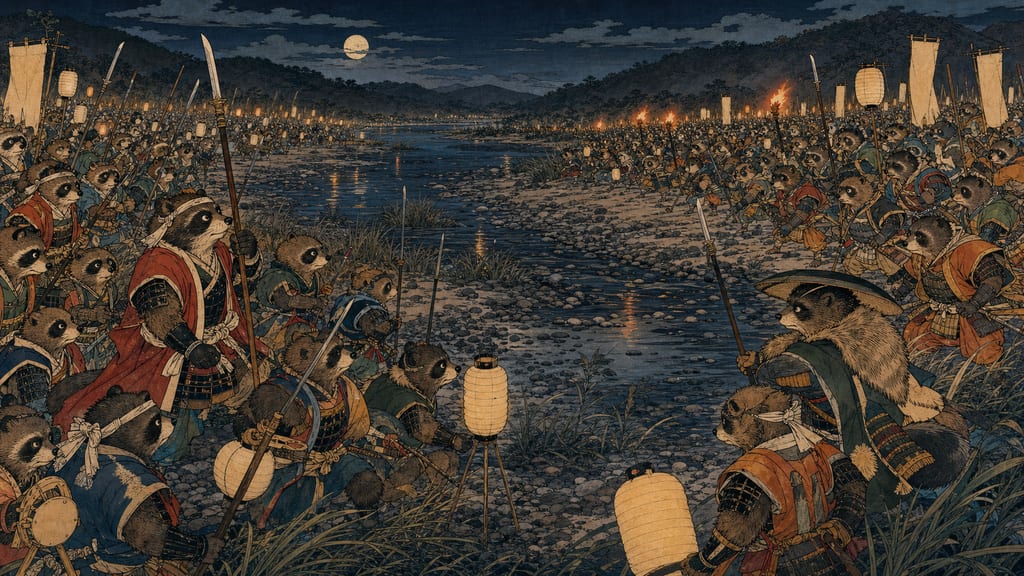
This story became widely known in 1910 when the storyteller Kanda Hakuryu adapted it into a three-part *kodan* book series, including *Shikoku Kidan Jissetsu Furudanuki Gassen* (True Account of Shikoku's Strange Tales: The Old Tanuki War). Hakuryu himself noted that parts differed from the original text, and much of the dramatic imagery of the battle passed down today is a layer of creation shaped through this storytelling. In 1939, the film *Awa Tanuki Gassen* became a massive hit, establishing the name "Awa Tanuki War" and supposedly saving a struggling film studio. It is said that Masaichi Nagata, the president of Daiei Film, donated the extraordinary sum of one million yen to the Kincho Shrine, which was built in the wake of the film's success. Furthermore, in director Isao Takahata's 1994 Studio Ghibli film the "Sixth Generation Kincho" appears as an elder tanuki of Shikoku in the film Pom Poko[3] — alongside Tasaburo Hage-danuki of Sanuki (Kagawa) and Kizaemon Tanuki of Iyo (Ehime), Kincho is counted among the Three Great Tanuki of Shikoku.
The Kincho Shrine itself was officially established in Chuden-cho, Komatsushima City, in 1957. The magnificent old shrine building, constructed during the height of the film's popularity, has now aged and stands alongside a newer shrine — as if the rise and fall of the tanuki's fortunes are etched into the very appearance of the shrine. Even so, faith in Kincho Daimyojin never ceases, and people praying for business prosperity and career success visit the tanuki who died for honor to this day. The battle between Kincho and Rokuemon is told against the backdrop of the very familiar lives of the common people of early modern Awa, touching on the rise and fall of dye merchants, apprenticeships, training, and marriage. The tanuki enact the dramas of duty and calculation found in human society itself. Though a tale of the supernatural, it clearly bears the worldview of the commoners of Awa who lived through the Tenpo era. The story of the Awa tanuki who becomes a god by laying down his life for duty continues to be passed down today, changing form from *kodan* to film, and then to animation.
Old Tanuki with Names — The Art of Bewitchment Collected by Shinya Kasai
That Awa is the country of tanuki is not solely due to the story of Kincho. The folklorist Shinya Kasai — a scholar from Tokushima also known as a proponent of the Yamato theory of Yamataikoku — was asked to collect the legends of Awa at the end of the Taisho era. After consulting with Kunio Yanagita, he published *Awa no Tanuki no Hanashi* (Tales of the Tanuki of Awa) in 1927[4]. This single volume, which later served as a sourcebook for films and manga, records countless old tanuki with names and their arts of bewitchment.
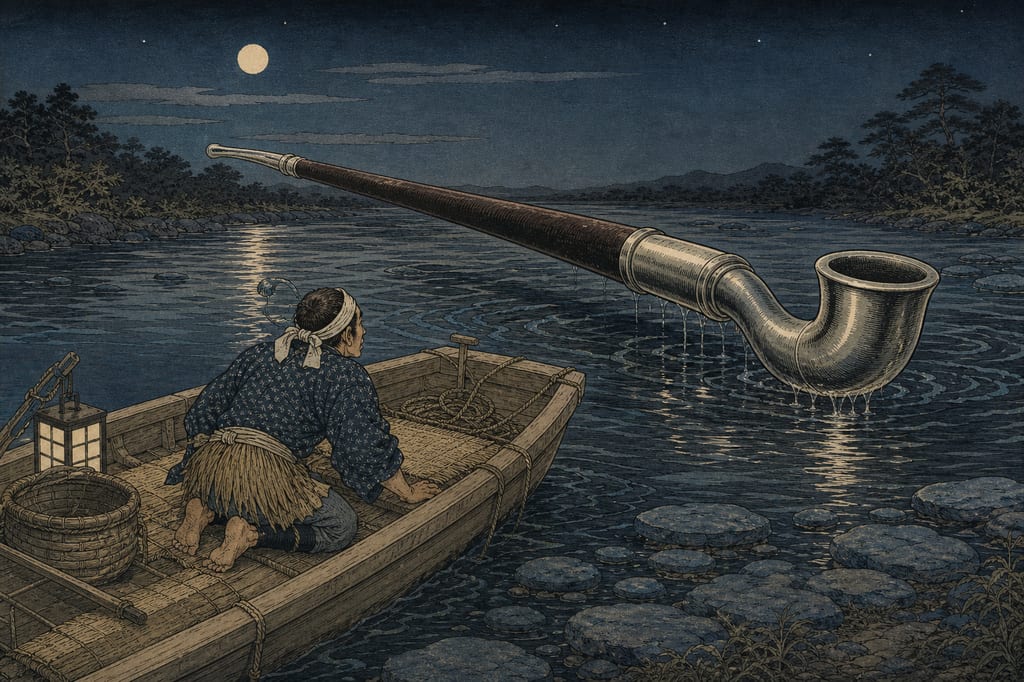
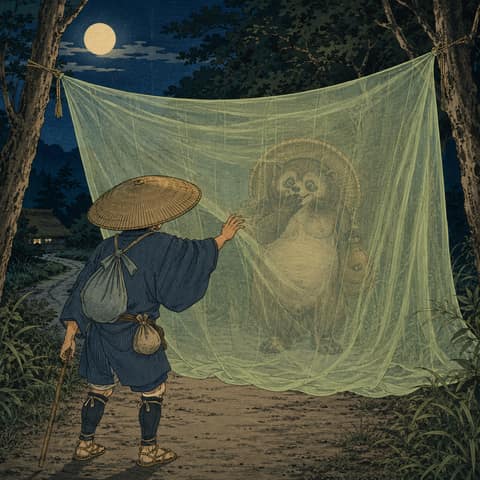
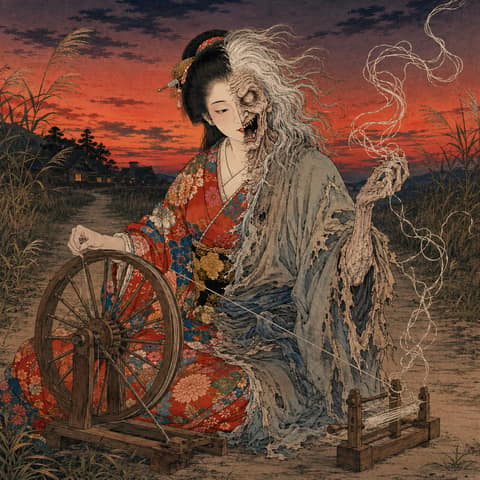
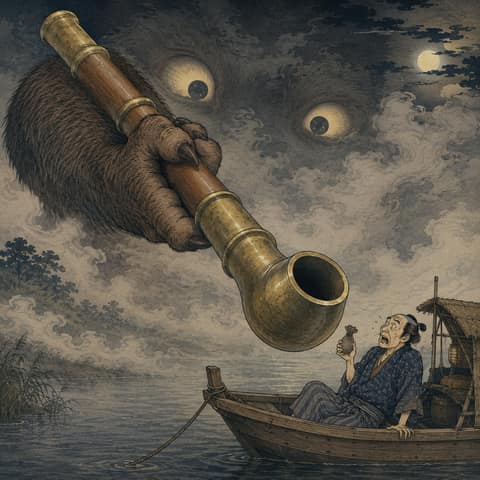
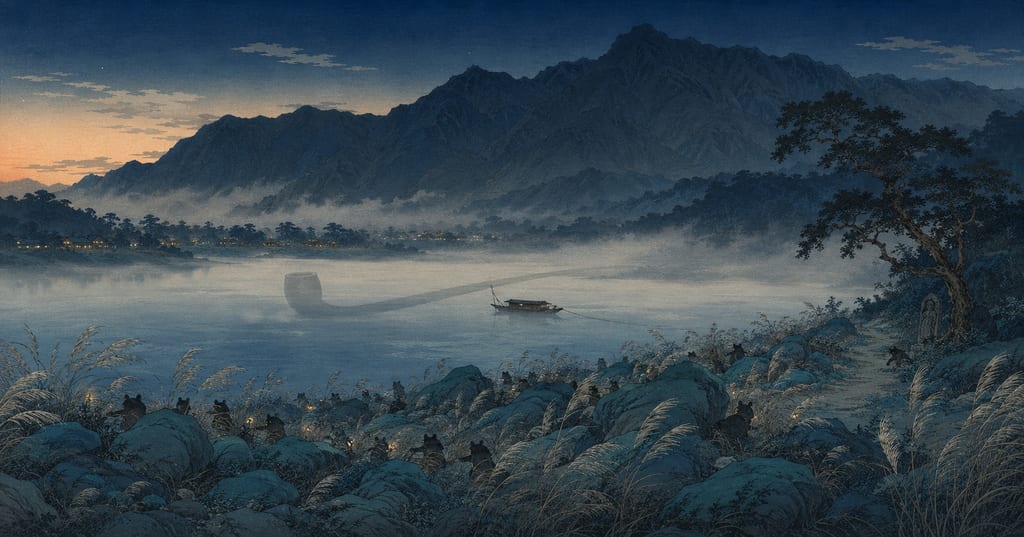
Among them, the tanuki mentioned above are particularly famous. The Kayatsuri-danuki (Mosquito Net-Hanging Tanuki) that appears at Mitsushima in Mima shows a suspended mosquito net on a night road; when lifted, there is another net inside, and another behind that — continuing endlessly, making the traveler walk all night until exhausted. At the Aoishise rapids of the Yoshino River in Miyoshi County, the Oogiseru thrusts a giant smoking pipe before a boatman who has stopped his night boat, demanding tobacco. It is said that no matter how much tobacco is stuffed in, it is never enough, and if the demand cannot be met, it overturns the boat. On the roadside in Horie Village, Itano County (present-day Naruto City), if one is captivated by the Itohiki-musume (Thread-Spinning Girl) spinning beautiful threads, the girl suddenly transforms into a white-haired hag, startling the person with a loud laugh.
The Kozo-danuki (Acolyte Tanuki) who transforms into an errand boy at a storefront to steal goods, the Kasa-sashi-danuki (Umbrella-Holding Tanuki) who offers an umbrella on a night road, the Shiro-dokkuri (White Flask) that transforms into a white sake flask and rolls around, the Aka-denchu (Red Coat) — Kasai wrote down each one, appending its location and name. What is fascinating is that these tanuki are all tied to specific place names like Mima, Miyoshi, Itano, and Komatsushima. The tanuki were spoken of not as "a monster of some mountain," but as "that one individual with a name from that village, from that deep pool." The very proper nouns rooted in the land are proof of the richness of Awa's tanuki culture. Even in the armies of the Kincho War, these old tanuki were listed by name. It is told that the famous tanuki of Awa, including the Taka-danuki brothers based at Fujinoki Temple, divided into the Kincho and Rokuemon factions and fought — the tales of trickery and the tales of war were contiguous with one another. The tanuki, given names and villages one by one, were another set of residents living in the darkness of Awa. While the bewitchment of foxes is clad in a cold malice that ruins people, the tricks of the Awa tanuki are somewhat goofy and charming. Even those who are tricked retell it as a funny story the next morning — the back-and-forth with the tanuki was also an entertainment for the locals that added color to the harsh life in the mountain villages. That is why in Awa, tanuki were not enemies to be exterminated, but neighbors living alongside humans, bestowed with so many names.
Beasts That Transform — Cats and Otters
It is not only tanuki that transform. Beasts that have lived for many years also assume human forms and stand in the darkness of Awa. Since ancient times, it has been believed that beasts living a long time gain spiritual power and transform; it was told that when a cat surpasses ten years of age, its tail splits and it becomes a *nekomata*, understanding human speech and dancing. An aged cat was not merely a pet, but an object of awe that one never knew when it might turn into a monster. In Awa, the foremost of these transforming beasts alongside the tanuki were the cat and the river otter.
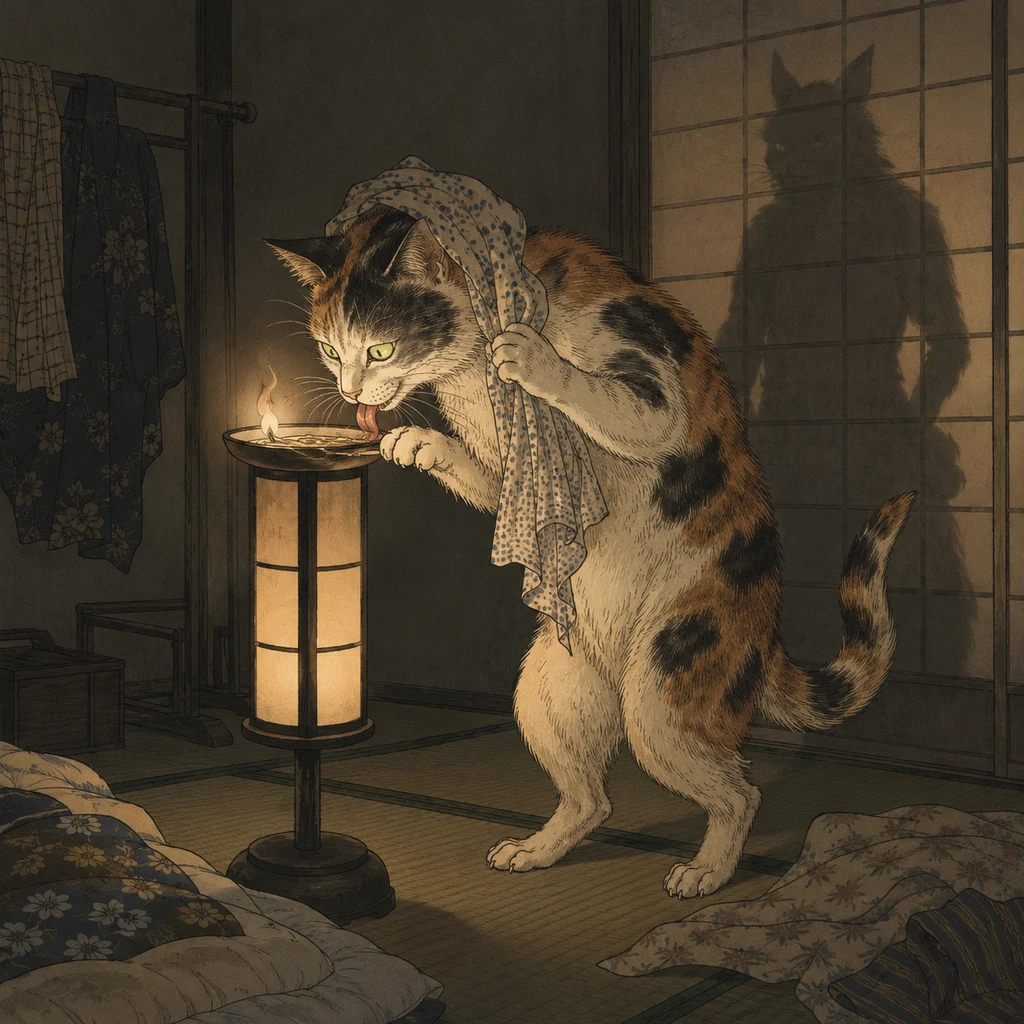
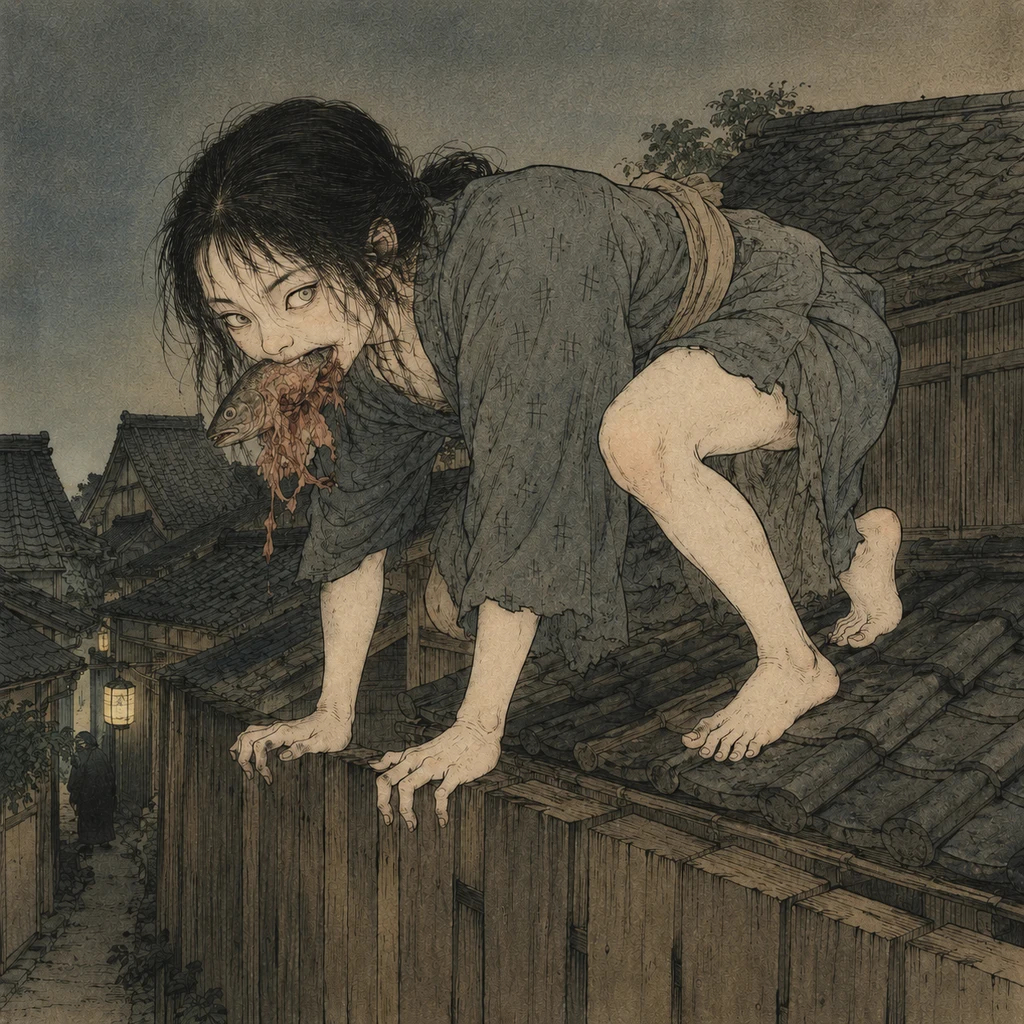
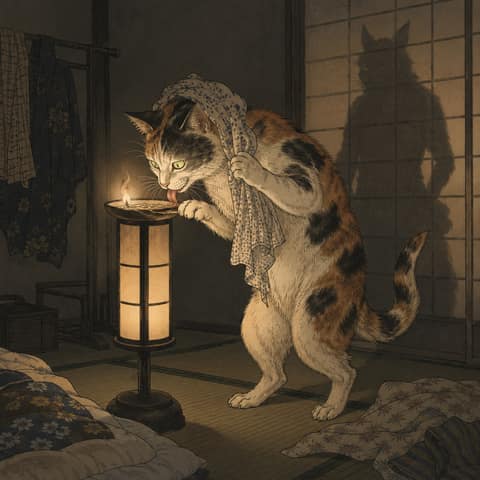
Omatsu Daigongen in Kamo-cho, Anan City, is a site of a bakeneko (monster cat) legend. During the Jokyo era in the early Edo period, the village headman of Kamo Village was falsely accused of a debt and died of illness; his wife, Omatsu, was executed for directly petitioning the domain lord. It is said that their remaining calico cat became a bakeneko, avenged Omatsu's grudge, and ruined the houses of the wealthy adversary and the magistrate one after another. The regret of Omatsu, who lost her husband to an unjust crime and lost her own life for appealing it, could not be avenged by human hands. The narrative structure that it was a single pet cat who cleared that grudge exudes the common people's sympathy, entrusting the resentment of the powerless to a beast. Omatsu Daigongen is counted as one of the "Three Great Monster Cat Legends of Japan," alongside the bakeneko of Nabeshima in Saga and the cat disturbance in Aizu. To avenge the regret of those who died unreasonable deaths on their behalf — at the core of the bakeneko tales lies sympathy for the resentment of the weak. The people of Awa did not punish the cat of resentment, but enshrined it as a god and prayed for good fortune. Today, Omatsu Daigongen gathers faith as "Nekogami-san" (Mr. Cat God); it is said that 10,000 beckoning cats (*maneki-neko*) are dedicated within the precincts, and it is loved as a god of competition and examinations — the bakeneko of a grudge eventually transformed into a guardian deity that brings victory. Tales of Neko-musume (Cat Girls), where an aged cat transforms into a beautiful maiden, are also passed down in the villages of Awa.
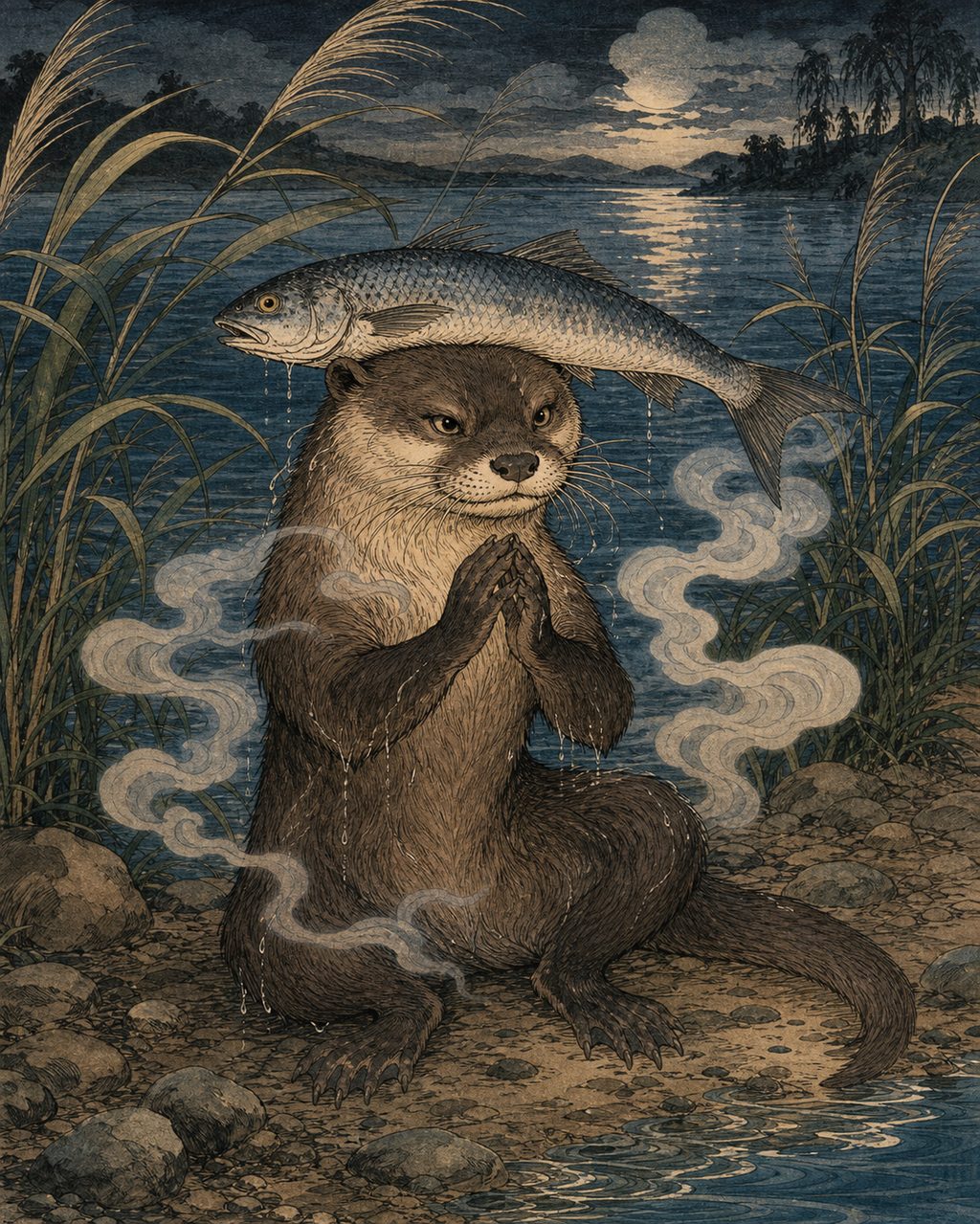
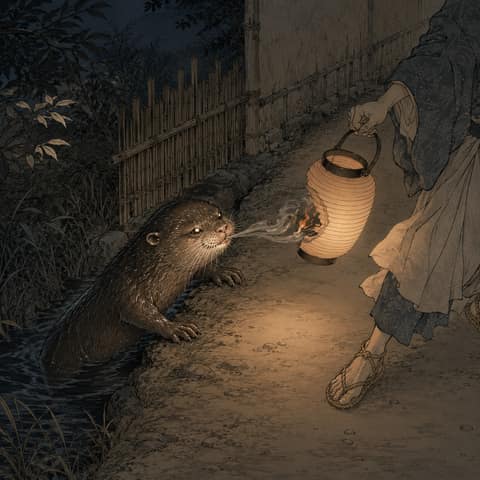
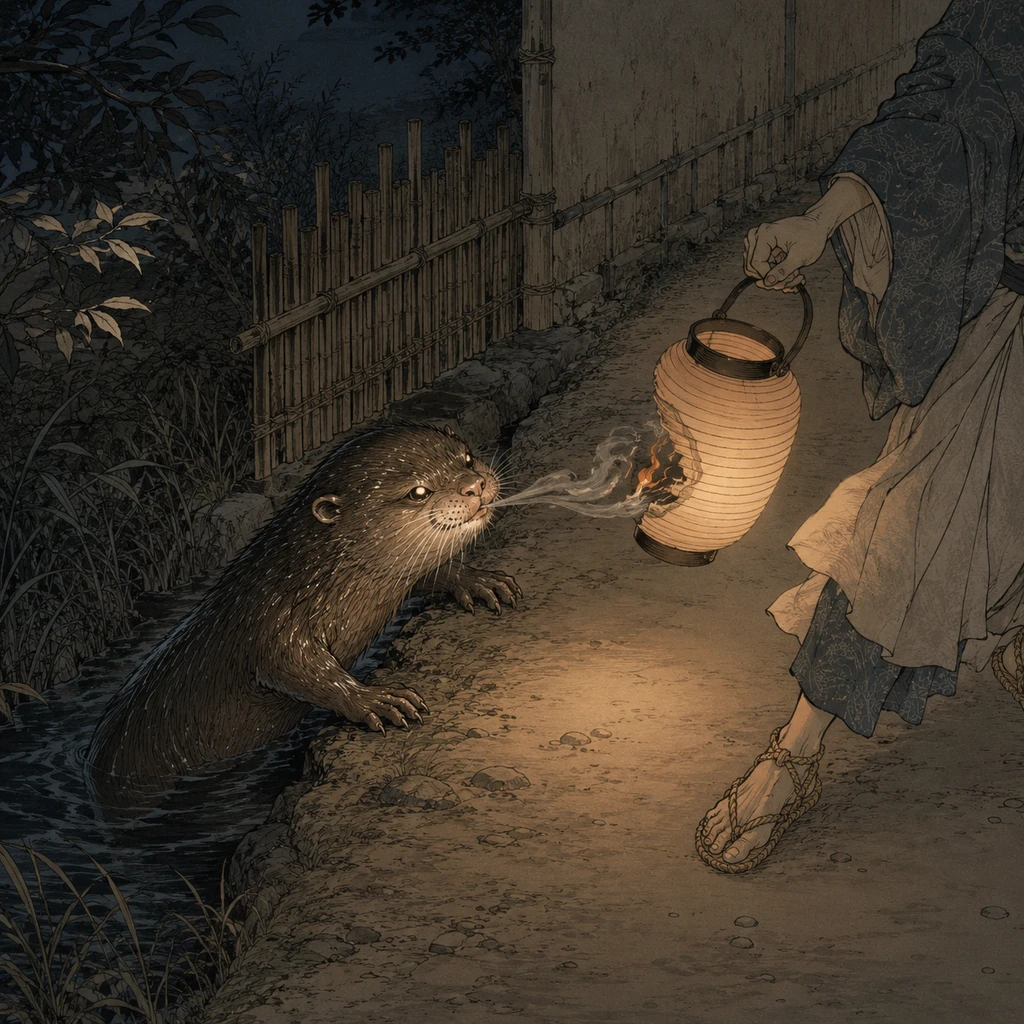
River otters lurk by the riversides. In the rivers of Awa, including the Yoshino River, it is said that river otters transformed into monks or beautiful women and tricked people on night roads — they could be considered the foxes and tanuki of the water's edge. It is said they would place caught fish on their heads to transform into children and call out to passersby. Shikoku is also the island of the pilgrimage visiting the 88 sacred sites associated with Kobo Daishi. The reason stories of tanuki and river otters transforming into pilgrims to test people were so popular is likely because devout travelers constantly walked the roads of this island. Japanese river otters once inhabited the rivers of Shikoku in great numbers, and for the people of Awa, the otter was a familiar neighbor. However, due to overhunting and environmental changes, their numbers plummeted; they disappeared after being sighted in Kochi Prefecture in 1979, and were declared extinct in 2012. The beast feared for transforming and deceiving humans has now become a phantom — the yokai tales of the river otter are the final memories conveying the lost richness of Shikoku's rivers.
Mysteries Raised by the Mountains — Iya,
Tsurugi,
and Kenmi

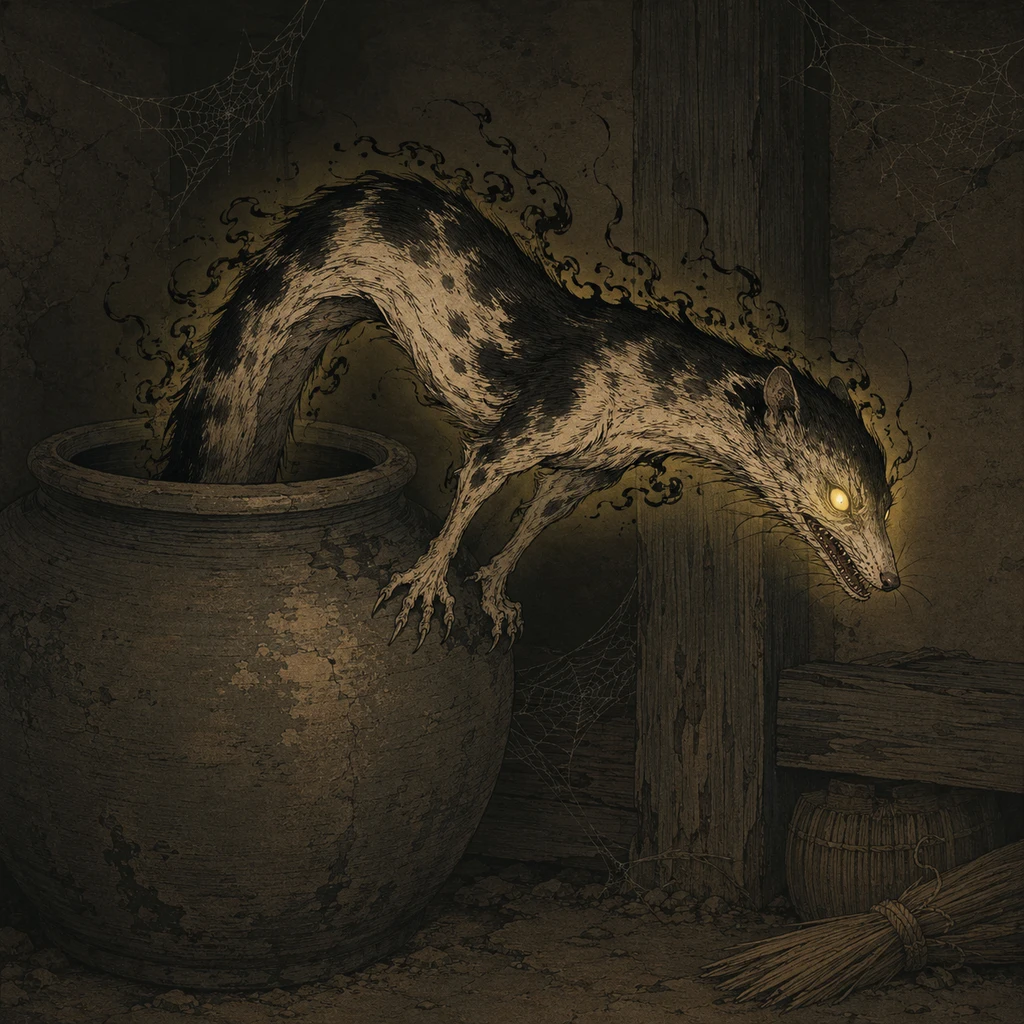
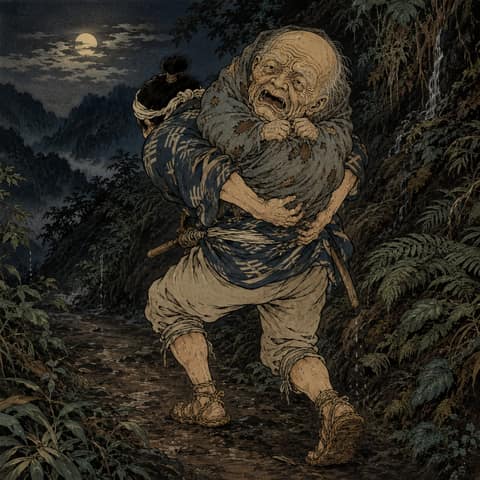
The deep mountain villages of Oboke and Iya (present-day Miyoshi City) upstream on the Yoshino River are the legendary home of the Konaki Jiji (Crying Old Man). In its original form, as recorded in the magazine *Minkan Densho* (Folklore) in 1938[5] by folklorist Akira Takeda, it was merely a mystery that raised a cry like a baby on mountain paths. The original location reported by Takeda was the settlement of Taira in Minna Village, Miyoshi County — a hamlet in a deep valley. The voice of a baby echoing on a dark mountain road might have been a lonely traveler mishearing the sound of the wind blowing through the valley or the cries of birds and beasts. The imagination of the people who faced the darkness of the mountains crystallized this into the figure of a single monster called "Konaki Jiji." The motif of weight increasing, such as "when picked up, it becomes heavy as a stone and crushes a person," is a pattern introduced by Kunio Yanagita as being similar to the *ubume* (birthing woman ghost), and it was Shigeru Mizuki's *GeGeGe no Kitaro* that popularized it nationwide as a benevolent character. The original lore and later creations are stacked in multiple layers upon the Konaki Jiji.
In Yamashiro-cho, Miyoshi City, it is said that 60 types of legends involving yokai and possessing spirits are passed down across 190 locations, many of which are tied to warnings to keep people away from dangerous places prone to rockfalls and landslides. In 2001, local volunteers erected a stone statue of Konaki Jiji; the inscription "Konaki Jiji" on the pedestal is said to be the handwriting of Shigeru Mizuki, and the adjacent monument bears the handwriting of Natsuhiko Kyogoku. In 2008, it was certified as a "Yokai Heritage" site by the World Yokai Association, and a Yokai Village was established at the Roadside Station Oboke, where a yokai festival is still held today. The mysteries protect life in the mountain villages and have also become a resource that attracts people. The gorges of Oboke and Koboke, where emerald rapids carve through rock, exude an atmosphere of non-human presence through their rugged landscapes alone. The canyon where sightseeing boats now descend was once a perilous spot that travelers crossed while trembling in fear of the unknown.
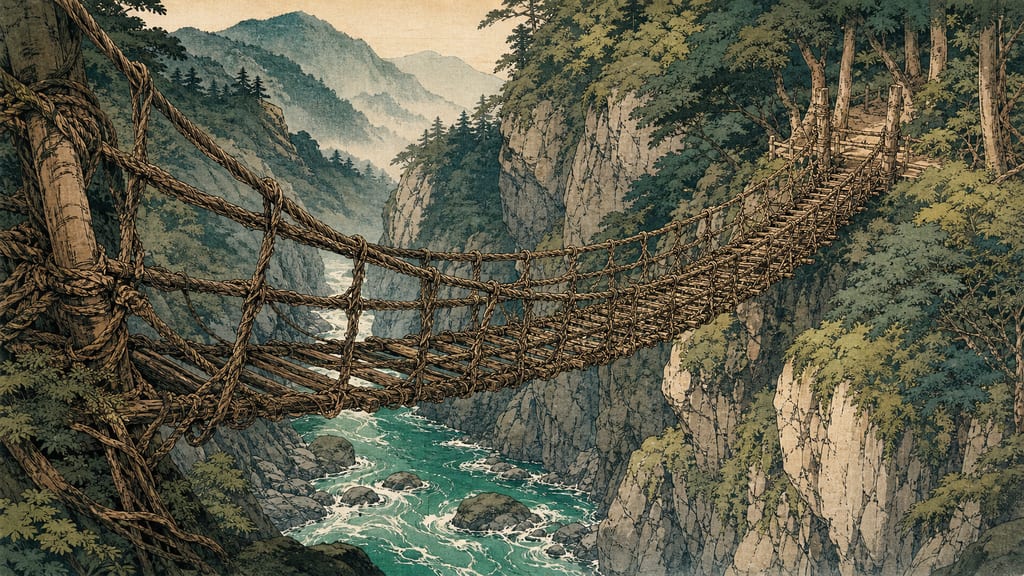
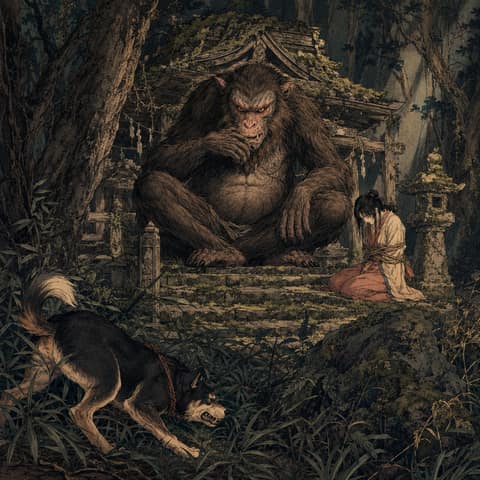
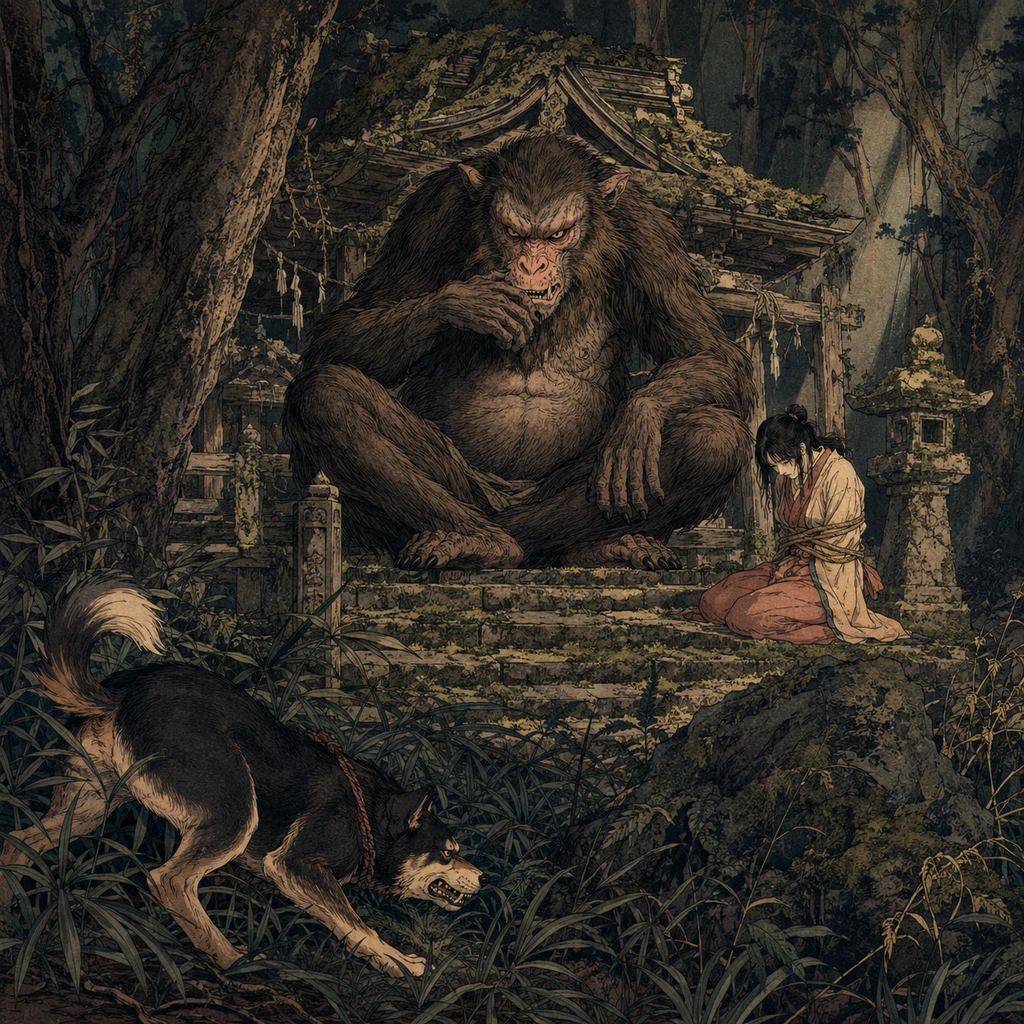
Iya is one of Japan's three major hidden regions, known for legends of Heike fugitives and the Kazurabashi (vine bridge), while Mount Tsurugi is a sacred peak of mountain worship embracing legends associated with Emperor Antoku. The legend that Emperor Antoku, who supposedly drowned at Dannoura, secretly escaped to this land and enshrined a divine sword at the summit is also told as the origin of the name Tsurugi (sword). In Iya, people believed to be descendants of the fugitives built settlements on steep slopes, and red banners of the Heike and old houses tied to the fugitives still remain today. It is precisely because it is a valley flowing with time separated from the outside world that tales of mysteries like Konaki Jiji have been passed down without fading. The famous Kazurabashi, woven from vines and suspended over the valley, is said to have been built with vines so that it could be cut down at any time when fugitives were fleeing pursuers. The view of the blue rapids rushing beneath the swaying floorboards makes one feel as if they are crossing the boundary between this world and the otherworld. The very steepness of Iya was a vessel that housed the supernatural. The awe of the mountain gods sometimes turned into beliefs that held monkeys as gods — however, the famous tales of monkey-god extermination demanding maidens as sacrifices are from Mimasaka and Hida in the *Konjaku Monogatarishu*, and cannot be verified as indigenous sacrifice tales of Awa. The vague awe brought about by the deep mountains, before crystallizing into specific folktales, was the very womb of the mountain mysteries of Awa.
That awe took its most visceral form in the possessing spirits prevalent in Shikoku — the Inugami (Dog God). Tokushima and Kochi are known as the center of the *inugami-suji* (dog god lineages); the inugami is a small spirit kept in a bamboo tube or similar vessel, and it was told that for the sake of its master's house, it would possess others, bring illness, bring wealth, or eventually ruin the family. Lineages believed to manipulate this spiritual power were treated with both fear and discrimination, and marriage with them was avoided. Like the fox-keepers of Izumo, its true nature is a psychology of exclusion born from jealousy and the uneven distribution of wealth within village society; it is not the glamour of a ghost story, but the raw social history long harbored by the community. Kenmi Shrine in Terano, Yamashiro-cho, Miyoshi City, has gathered worshippers not only from Shikoku but also from Kinki and Kyushu as Japan's foremost shrine for exorcising inugami possession. Enshrining Susanoo-no-Mikoto and Emperor Ojin as deities, it is said that 20,000 people a year visit this mountain shrine to rid themselves of possessing spirits. For the invisible disaster of possession, people needed a tangible place like a shrine. The mountain that births mysteries is at the same time a place that appeases them — the mountains of Awa harbor both.
Hair Extending from a Hemp Tub — A Yokai of Divine Wrath

Hair in the Hemp Bucket
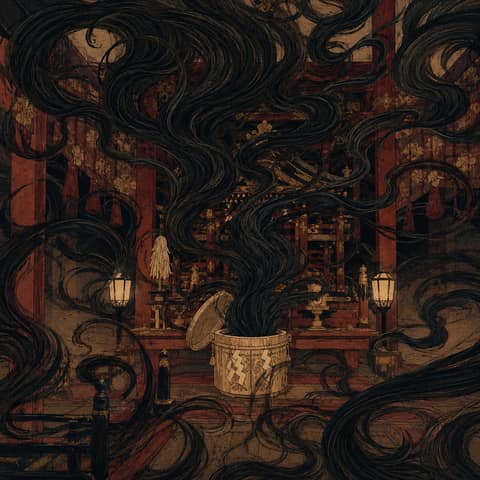
A strange phenomenon preserved at a shrine in Kamo Village, Awa Province. The entity is said to be hair kept as a sacred object inside a hemp bucket. When the deity’s heart is unsettled, the hair lengthens, pushes up the lid, and emerges. It can coil around people and squeeze with crushing force. Villagers reportedly warded it off by conducting proper rites to soothe the deity. The chief source is the old text Ashū Kiji Zatsuwa.
Read moreThere is a bizarre yokai unique to Awa that is neither a tanuki, a cat, nor a river otter. It is the Asaoke-no-ke (Hair of the Hemp Tub). This mystery, depicted in the artist Toriyama Sekien's *Konjaku Hyakki Shui*, takes root in the land of Awa if traced back to its origins. At Yatsuhime Shrine in Kamo Village, Miyoshi County (present-day Miyoshi City), hair was placed inside a tub used for storing hemp as the object of worship (*shintai*). It is said that when the god's heart is not calm, that hair extends out from the tub and attacks people. The hair, normally completely still inside the tub, smoothly extends and wraps around people as if sensing the god's displeasure — this yokai, eerie just to imagine, perfectly embodies the paradox that the most sacred object of worship can turn into the most terrifying monster.
The old Tokushima book *Ashu Kiji Zatsuwa* records the terrifying actions this hair displayed[6] — it is said that when bandits broke into the shrine's small hall and were dividing their stolen goods, the hair extended from the tub, split into the number of bandits, wrapped around each of them, and squeezed them tight. The divine will delivering punishment manifests in the form of hair. Toriyama Sekien drew this mystery as "Asaokeke" in a picture, preserving the way the spiritual authority residing in the sacred object sometimes acts violently. The sacred protects when revered, and curses when insulted — the Asaoke-no-ke is a yokai that gives form to that sense of awe using the familiar yet eerie material of hair. Hemp, along with indigo, was a special product of Awa. Because it was a land of indigo dyeing and hemp weaving, this mystery, where divine wrath dwells in an everyday utensil like a hemp tub, was born — the Asaoke-no-ke is a yokai unique to the land, formed by the intertwining of Awa's livelihood and faith. Awa was a major indigo-producing area where the indigo grown in the Yoshino River basin was known nationwide as "Awa Indigo," and hemp was also woven there since ancient times. The hemp tub, which stores clean fibers offered to the gods, was itself a sacred vessel. The spirit residing in that vessel judges those who commit injustice — the Asaoke-no-ke is the greatest proof that the livelihoods and faith of Awa were inextricably linked.
The Island Where Tanuki Become Gods
Not foxes but tanuki, and cats, river otters, mountain gods, and even the hair of utensils take the lead role — the yokai of Awa are a family that looks exactly like the mountains, rivers, and livelihoods of Shikoku given a face. The tanuki lays down his life for duty and becomes a Daimyojin, the bakeneko clears her grudge and later becomes a god that invites fortune, and the Asaoke-no-ke acts as an agent of divine wrath. There is no sharp boundary between monster and god, and the feared entity is eventually enshrined — therein lies the way the people of Awa interact with the supernatural. They do not cut them down as enemies, but laugh with them as neighbors, and sometimes revere them as gods — this generous distance between mystery and human is exactly what makes the yokai culture of Awa exceptionally friendly and lively, even among the rest of the nation.
In the "Awa no Tanuki Matsuri" (Awa Tanuki Festival) that began in Tokushima City in 1978, people dressed as tanuki still parade to this day, and travelers visit the Yokai Village in Yamashiro-cho, Miyoshi City to see the Konaki Jiji. The climate of rich storytelling and performing arts, such as *ningyo joruri* (puppet theater) and the Awa Odori dance, was likely also the soil that nurtured these mysteries. Fond of talking, deeply dutiful, and living side by side with beasts while tricking and being tricked — the very temperament of the people of Awa is reflected in the tales of the tanuki. These monsters of the island, strong in duty and humanity and somehow endearing, have become gods, become tourism, and still breathe in the mountains and rivers of Awa. The island where tanuki become gods — that is the true face of Tokushima's yokai culture.