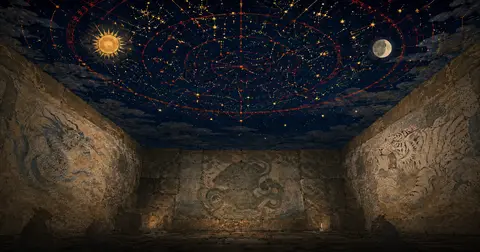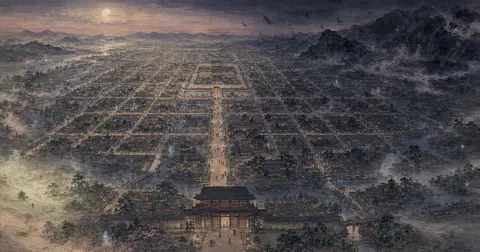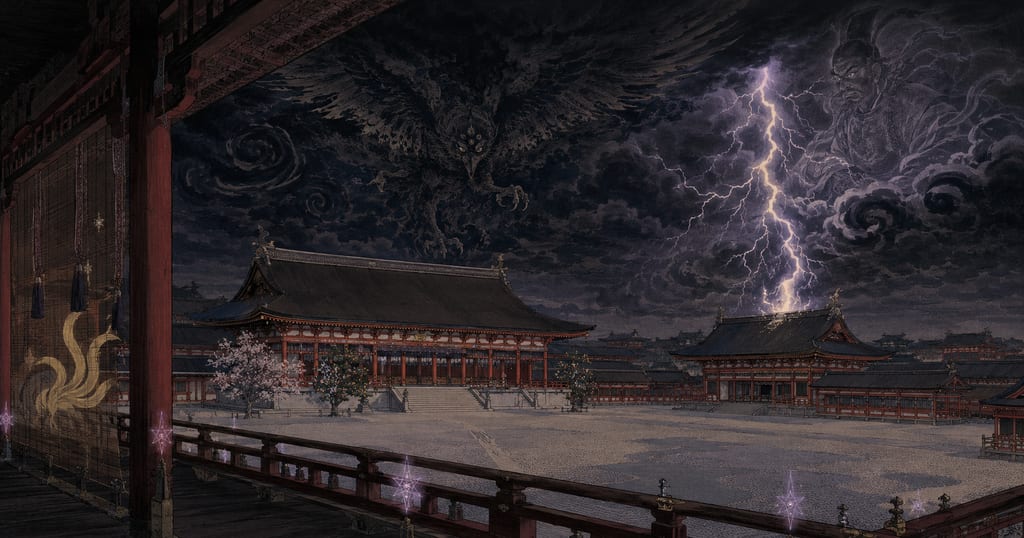
平安京の中央北辺、朱雀大路を真北に詰めた先に、都の心臓があった。官庁街である大内裏(平安宮)に囲まれ、その中核に天皇の私的な御座所たる内裏が置かれる。即位や朝賀を行う大極殿、政務と儀礼の正殿である紫宸殿(南殿)、帝が日常を過ごす清涼殿 ── これらの殿舎は、律令国家が築いた最も神聖で、最も厳重に守られた空間だった。だからこそ、ここに現れた怪異は格が違う。山野に出る河童や山姥とは異なり、王権の核そのものに食い込む妖異だけが、この舞台に立つことを許された。
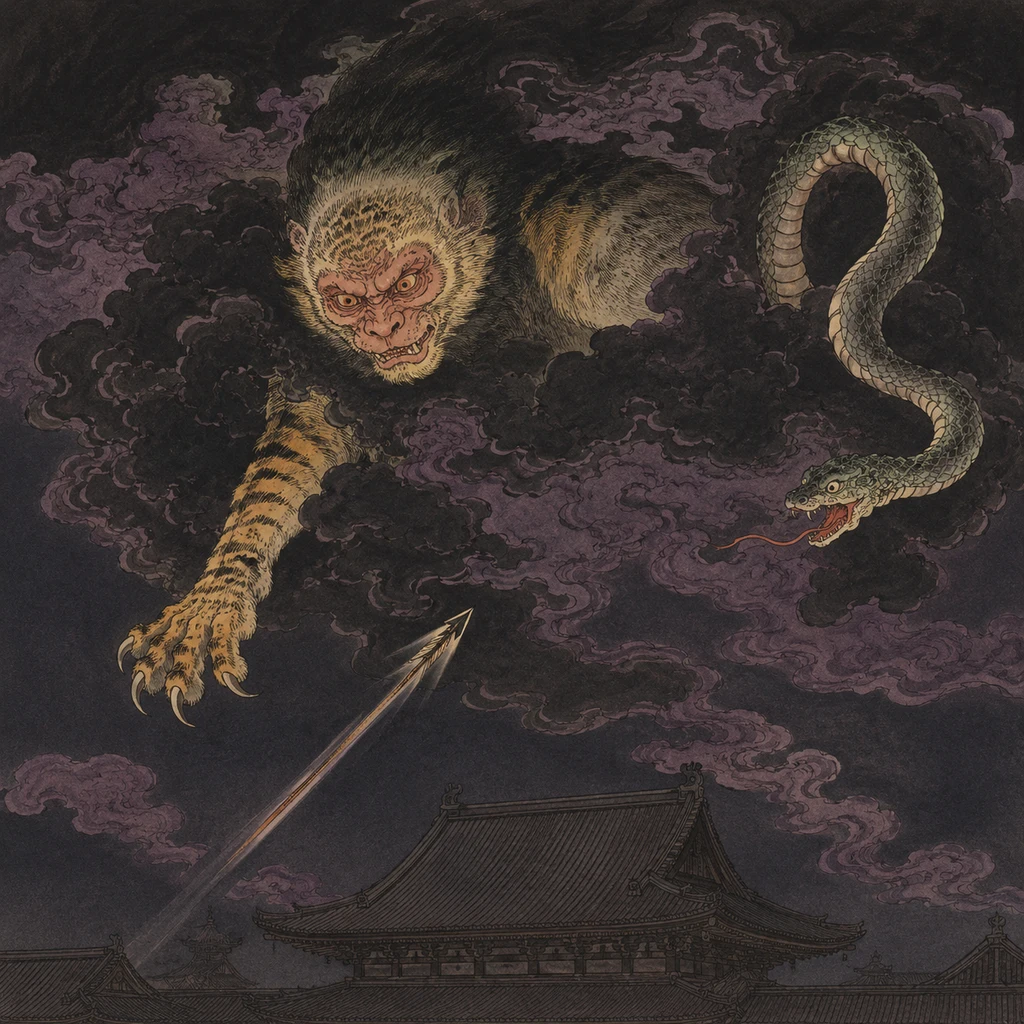
Nue
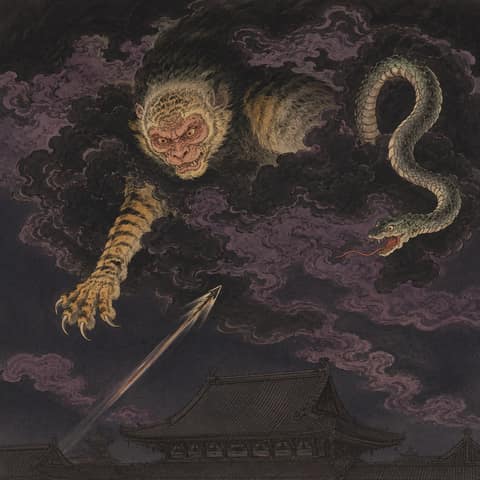
The Nue is a figure shaped by the overlap of an ancient bird name, medieval courtly marvels and warrior tales, and later Noh drama and yōkai art. It is now best known as the monster with a monkey’s head, a tanuki’s body, tiger’s limbs, and a snake’s tail, which emerges from a black cloud over the palace at night and is brought down by Minamoto no Yorimasa. That familiar image, however, cannot be treated as the Nue’s one original form. The combination of body parts varies among textual traditions, and the word nue itself predates the monster: it first named a calling bird. The Yachihoko-no-kami song in Book One of the Kojiki, which includes the line “On the green mountain, the nue cries,” shows that nue was a bird name at least as early as antiquity. The passage is not describing the later composite monster. Modern dictionaries often identify the bird with White’s thrush, but it is more useful to begin by recognizing it as an old bird name than to force a poetic term into a one-to-one modern biological classification. In medieval tales, the Nue as a bird and the Nue as a strange monster appear alongside one another rather than in a simple earlier-and-later sequence. In the Yorimasa story in section 10-56 of Book Ten of Jikkinshō, “Matters in Which One Should Aspire to Accomplishment,” Yorimasa shoots at a Nue calling from the palace hall on a rainy night, judging it to be “a small bird even by day.” By contrast, National Archives material comparing Yorimasaki with an undated printed edition of The Tale of the Heike preserves accounts that describe the creature falling from a black cloud through a combination of monkey, tanuki, tiger, snake, and other animals. From an early period, Nue has been a marvel in which a bird name, an uncanny bird, and a composite beast converge. Later receptions deepened that convergence. In the Noh play Nue, the monster slain in the tale appears at Ashiya as the Nue’s departed spirit. It recounts the misfortune of being set adrift in a hollow boat and asks a monk to perform rites for it. From the late Edo period onward, yōkai paintings and warrior prints repeatedly reimagined Yorimasa, the black cloud, and the composite body. Nue is best read not as a single fixed creature, but as a name that has continued to gather together different texts, performing arts, images, and local traditions.
Read more京都全体の妖怪文化 ── 結界都市の地理、御霊信仰、付喪神、葬送地の怪火まで ── は京都府の妖怪事典で宏観に辿った。本記事はそこから一歩踏み込み、内裏・大内裏というただ一つの舞台装置に焦点を絞る。紫宸殿の屋根に降りた怪鳥、清涼殿で正体を露わにした妖狐と雷神、大内裏に結界を張った陰陽師、朱雀門の楼上で笛を吹いた鬼 ── 帝の御座所で何が起きたと語り継がれたのか、殿舎ごとに見ていく。
都の心臓 ── 内裏という結界
まず舞台の構造を押さえておきたい。「大内裏」と「内裏」はしばしば混同されるが、別物である。大内裏(平安宮)とは、二官八省の官庁・朝堂院・豊楽院などを大垣で囲い込んだ区画全体を指す。その北寄りに置かれた天皇の住まいが内裏で、紫宸殿・清涼殿・後宮の殿舎群からなる。即位や元日朝賀のような国家儀礼は、本来は朝堂院の正殿たる大極殿で行われた。
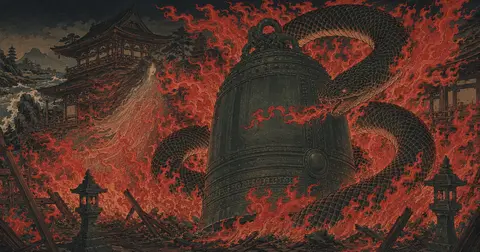
ところが大極殿は火に弱かった。貞観十八年(876)、天喜六年(1058)と焼亡を重ね、安元三年(1177)の安元の大火で三たび炎上した後はついに再建されなかった。儀礼の機能は内裏の紫宸殿へ移り、紫宸殿が事実上の正殿となる。内裏自体も天徳四年(960)に初めて全焼して以来、幾度も焼け、平安中期からは天皇が貴族の邸宅を仮御所とする里内裏が常態化していった。つまり ── 王朝怪異の舞台となった内裏は、史実においては焼けては再建され、やがて空洞化していく不安定な空間だった。最も荘厳であるべき場所が、たえず崩壊の危機に晒されていた。怪異がここに集まるのは、偶然ではない。
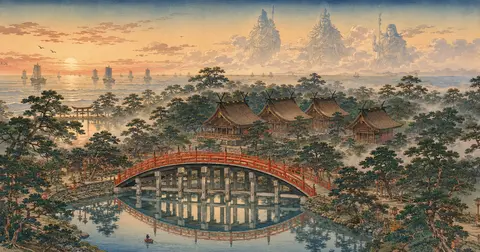
その不安定さを制度として補強したのが陰陽寮であり、御霊会であり、鬼門の結界だった。怪を生む内裏と、それを鎮める装置とが、同じ城域の中で背中合わせに稼働していた。都を疫病から守る御霊会(神泉苑)[1]が、貞観五年(863)に大内裏のすぐ南東の禁苑・神泉苑で初めて公式に営まれたのも、けっして偶然ではない。怪異がもっとも濃く湧くと考えられた王権の中枢に、鎮魂の儀礼もまた最短距離で配置されたのである。
紫宸殿に降りた怪鳥 ── 鵺と以津真天
内裏の正殿・紫宸殿(南殿)は、王朝怪異のなかでも特に「怪鳥」が降り立つ場所として記憶された。空から舞い降りる異形が、帝の真上の屋根に取りつく ── この垂直の構図が、紫宸殿という舞台に固有の恐怖を与えている。
Nue
The Nue is a figure shaped by the overlap of an ancient bird name, medieval courtly marvels and warrior tales, and later Noh drama and yōkai art. It is now best known as the monster with a monkey’s head, a tanuki’s body, tiger’s limbs, and a snake’s tail, which emerges from a black cloud over the palace at night and is brought down by Minamoto no Yorimasa. That familiar image, however, cannot be treated as the Nue’s one original form. The combination of body parts varies among textual traditions, and the word nue itself predates the monster: it first named a calling bird. The Yachihoko-no-kami song in Book One of the Kojiki, which includes the line “On the green mountain, the nue cries,” shows that nue was a bird name at least as early as antiquity. The passage is not describing the later composite monster. Modern dictionaries often identify the bird with White’s thrush, but it is more useful to begin by recognizing it as an old bird name than to force a poetic term into a one-to-one modern biological classification. In medieval tales, the Nue as a bird and the Nue as a strange monster appear alongside one another rather than in a simple earlier-and-later sequence. In the Yorimasa story in section 10-56 of Book Ten of Jikkinshō, “Matters in Which One Should Aspire to Accomplishment,” Yorimasa shoots at a Nue calling from the palace hall on a rainy night, judging it to be “a small bird even by day.” By contrast, National Archives material comparing Yorimasaki with an undated printed edition of The Tale of the Heike preserves accounts that describe the creature falling from a black cloud through a combination of monkey, tanuki, tiger, snake, and other animals. From an early period, Nue has been a marvel in which a bird name, an uncanny bird, and a composite beast converge. Later receptions deepened that convergence. In the Noh play Nue, the monster slain in the tale appears at Ashiya as the Nue’s departed spirit. It recounts the misfortune of being set adrift in a hollow boat and asks a monk to perform rites for it. From the late Edo period onward, yōkai paintings and warrior prints repeatedly reimagined Yorimasa, the black cloud, and the composite body. Nue is best read not as a single fixed creature, but as a name that has continued to gather together different texts, performing arts, images, and local traditions.
Read more『平家物語』巻第四「鵺」[2]によれば、近衛天皇の御代、仁平年間(1151-1154)のこと、毎夜丑の刻になると東三条の森から黒雲が立ちのぼって御殿を覆い、帝は原因不明の御悩(病)に苦しんだ。召し出された弓の名手・源頼政が、山鳥の尾で矧いだ尖矢を黒雲めがけて放つと、頭は猿・胴は狸・手足は虎・尾は蛇という異形が墜ち、郎党の猪早太が刀でとどめを刺した。注目すべきは、原典で討たれたのは本来「名もなき怪物」であり、「鵺(トラツグミ)のように気味悪く鳴く」と形容されていたにすぎない点だ。後世、その鳴き声の主の名が怪物そのものの名へと転化し、合成獣のイメージが固定した。音の怪異が視覚的な妖怪へ変容する過程を、紫宸殿という具体的な現場が刻印している。
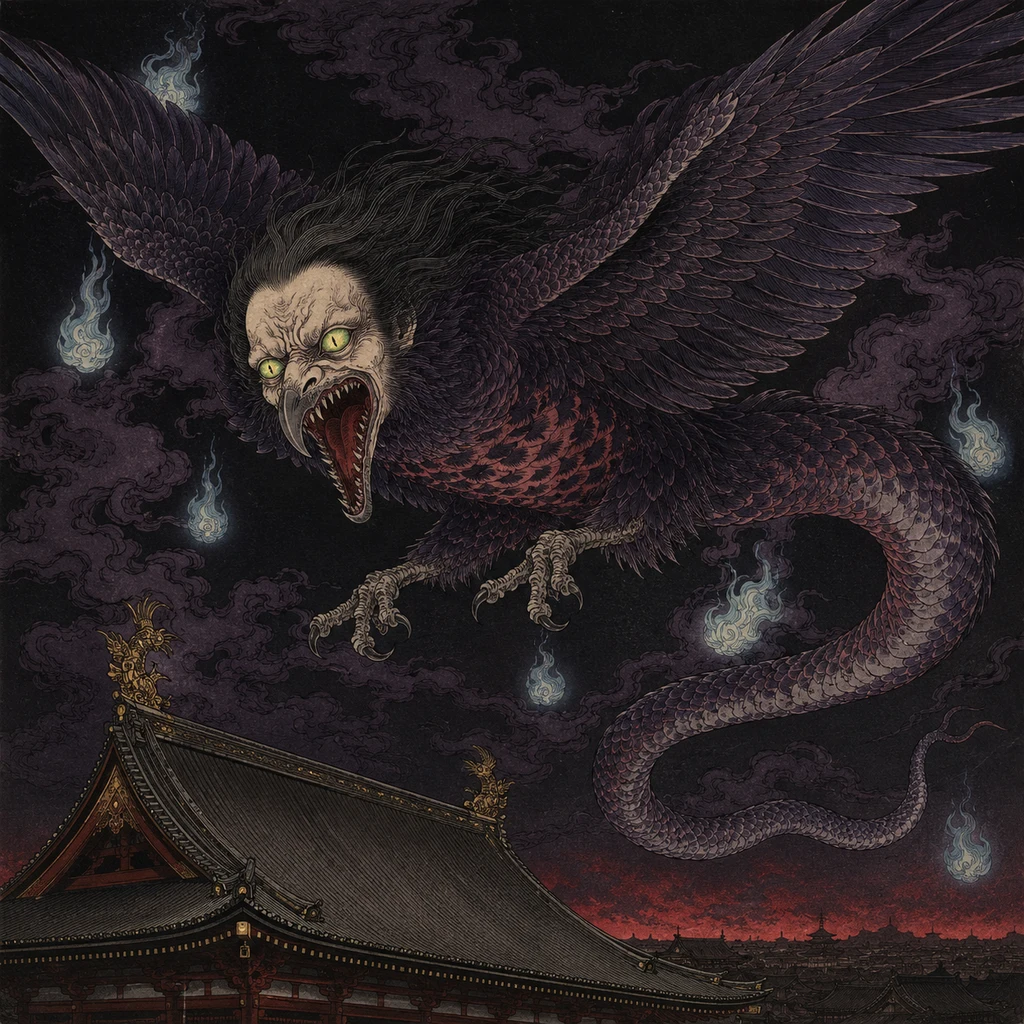
Itsumade
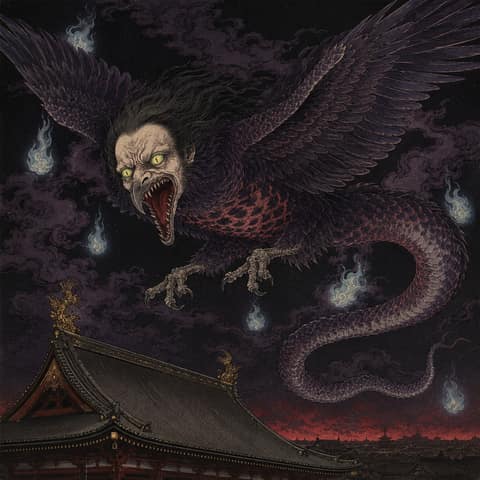
The Itsumade (以津真天) is a gigantic monster bird with a human-like face, a curved beak lined with saw-like teeth, a long serpentine body, and sharp sword-like spurs on its legs. Said to possess a wingspan of up to one *jō* six *shaku* (approximately 4.8 meters), it terrifies people by echoing its eerie cry of "Itsumade, itsumade" ("Until when? Until when?") from the night sky. The primary source of this yokai is an anecdote about an unnamed "monster bird" recorded in Volume 12, "The Matter of Hiroari Shooting the Monster Bird," of the pinnacle of war chronicles, the *Taiheiki* (established in the 14th century). According to the legend, in the autumn of the first year of the Kenmu era (1334), as an epidemic ravaged Heian-kyō (Kyoto) and claimed countless lives, this creature flew above the Shishinden (the Kyoto Imperial Palace) every night, letting out its ominous cry until it was brilliantly shot down by the master archer Oki no Jirōzaemon Hiroari. Crucially, in classical texts, this bird was consistently referred to only as a "monster bird" and lacked a specific proper name. It wasn't until the Edo period that the painter Toriyama Sekien included it in his *Konjaku Gazu Zoku Hyakki* (1779), applying the kanji "以津真天" (Itsumade) to its cry, that it crystallized as a distinct named yokai for the first time. In modern yokai encyclopedias, it is often explained that it "appears beside corpses left abandoned due to war or famine, crying out in protest, 'Until when (will you leave them exposed to the elements)?'" However, this direct connection to "corpses" is absent from medieval and early modern literature; it is a later interpretation added in modern times that logically reinterprets the *Taiheiki*'s backdrop of a rampant epidemic.
Read moreそれから約二百年後、同じ紫宸殿の上空に、もう一羽の怪鳥が現れる。『太平記』巻第十二「広有射怪鳥事」[3]が伝える建武元年(1334)秋の事件である。疫病が蔓延して死者の絶えない都で、毎夜紫宸殿の上に飛来して「いつまで、いつまで」と鳴く怪鳥があった。公卿たちはかつて頼政が鵺を射た故事に倣い弓の達人を探し、隠岐次郎左衛門広有が雁股の鏑矢でこれを射落とす。落ちた鳥は、人のような頭、鋸状の歯を備えた曲がった嘴、蛇のごとき胴、剣のように鋭い蹴爪を持っていた。古典では一貫して「怪鳥」としか呼ばれず、以津真天の名は、江戸期に鳥山石燕がその鳴き声に漢字を当てて初めて与えたものである。広有が頼政の先例を範としたという『太平記』の語り口こそ、紫宸殿が「怪鳥退治の舞台」として様式化していたことの何よりの証左だろう。なお、現代の図鑑が説く「放置された死体の傍で鳴く」という解釈は、『太平記』の疫病という背景を近代に再構成した後付けで、中世の原典には見えない。
帝を悩ませた妖狐 ── 清涼殿の玉藻前
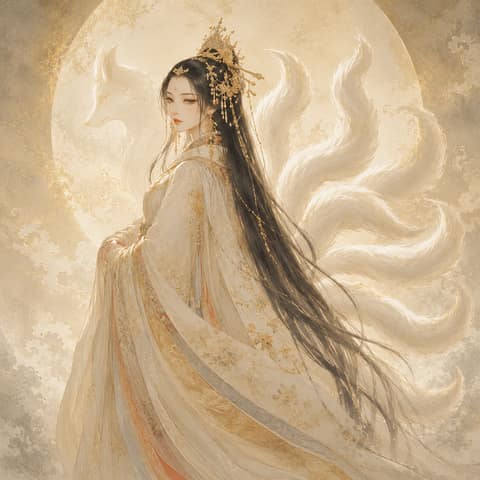
紫宸殿が儀礼の表舞台なら、清涼殿は帝が日常を過ごす私的な御殿である。その奥深い空間に、絶世の美女の姿で入り込んだ妖が玉藻前だった。

Tamamo-no-Mae
Tamamo-no-Mae is a beauty of unrivaled grace who, in the late Heian period, is said to have served the retired Emperor Toba. Her true form is held to be a nine-tailed fox, yet as a human, Tamamo-no-Mae has above all been remembered as a court lady of rare beauty and deep learning. Poetry and music were a given, but from Buddhist scripture to the old tales of India and China, she answered any question without hesitation, astonishing all at court. The name “Tamamo-no-Mae” carries a story of its own. One night, amid a banquet of poetry and music at the Seiryōden, a gust of wind snuffed out the lamps; in the darkness a dazzling light streamed from her body and lit the hall as bright as day. From this she came to be called “Tamamo-no-Mae,” meaning the lady of the jewel-like, glowing waterweed . Before that, it is said, she had been called Mikuzume. In time she drew all the emperor’s affection to herself, but when he fell ill from an unknown cause, her true nature began to be doubted.
Read more鳥羽上皇に仕えた玉藻前は、和歌・管弦から『玉藻の草子』[4]の説く天竺・震旦の故事まで、どんな問いにもよどみなく答える才媛として宮廷の人々を驚かせた。その名の由来も清涼殿に結びつく。ある夜、清涼殿での詩歌管弦の宴のさなか、一陣の風が灯火を吹き消すと、暗闇の中で彼女の身からまばゆい光が放たれ、あたりを昼のように照らした ── 玉のように光る藻、で「玉藻前」と呼ばれるようになったという。しかし上皇が原因不明の病に倒れると、寵姫の正体が疑われていく。
ここで重要な史実と物語の区別を一つ。正体を見破ったのは陰陽師・安倍泰成(物語によっては泰親とも)であり、後述の安倍晴明その人ではない。泰成は晴明の直系子孫にあたる陰陽師で、多くの作品で晴明本人は登場しない ── 「晴明が玉藻前を退治した」という俗説はしばしば見かけるが、原拠に照らせば誤りである。泰成の祓いによって変身を解かれた九尾の狐は宮中を脱して下野国那須野へ逃れ、討たれた後に殺生石となった。なお、いま広く知られる「インド・中国・日本の三国を渡った九尾の狐」という壮大な前世譚は最初からあったものではなく、室町の御伽草子では尾が二つの古狐にすぎず、九尾の物語にまとまるのは江戸後期の読本においてである。清涼殿という帝の最も近い場所に妖が忍び込んだという構図こそが、この物語の核心にある。
雷神となった怨霊 ── 清涼殿落雷と道真
同じ清涼殿は、もう一つ別の、しかし史実に裏打ちされた怪異の現場でもある。妖狐が忍び込んだ御殿に、今度は天が雷を落とした。
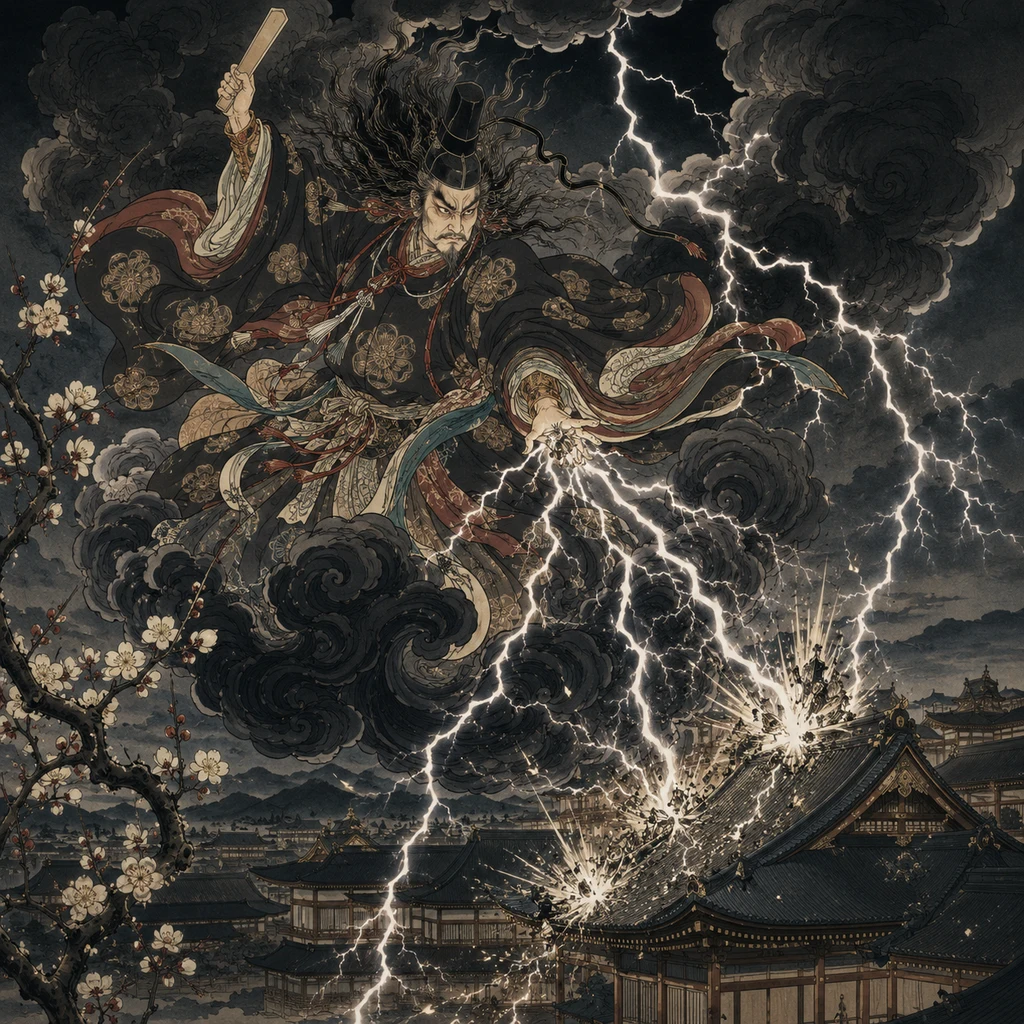
Sugawara no Michizane
Sugawara no Michizane was a Heian-period scholar and composer of Chinese verse who rose to the office of Minister of the Right; after his death he came to be counted among the most dreaded vengeful spirits in Japan, and was in time enshrined nationwide as Tenman-Tenjin, the god of learning. Born into the scholarly Sugawara house, he was favored under the two reigns of Uda and Daigo, but in the fourth year of Shōtai (901), slandered by the Minister of the Left Fujiwara no Tokihira, he was demoted to Dazaifu, where he died in despair in the third year of Engi (903). After his death, the capital saw a succession of deaths among his political enemies, beginning with Tokihira, followed by plague and drought, all whispered to be the curse of Michizane, who had been sunk by a false charge. Above all, the lightning strike on the palace's Seiryōden in the eighth year of Enchō (930), which killed and wounded many nobles, fixed the conception of Michizane as Karai-Tenjin, the thunder-wielding "Fire-and-Thunder Heavenly Deity." To pacify that raging spirit, the court enshrined him as a god, and the cult of Tenjin spread outward from Kitano Tenmangū in Kyoto and Dazaifu Tenmangū, built over his grave. Feared at first as a curse-bringing deity, Tenjin gradually changed in character—on account of Michizane's own outstanding learning in life—into a guardian of scholarship and letters; and in the early-modern era, as terakoya schools spread, he became beloved even among commoners as the god who grants success in study and clears false accusations. The plum he loved so dearly in life, and the thunder he wielded as a vengeful spirit, survive to this day as his emblems.
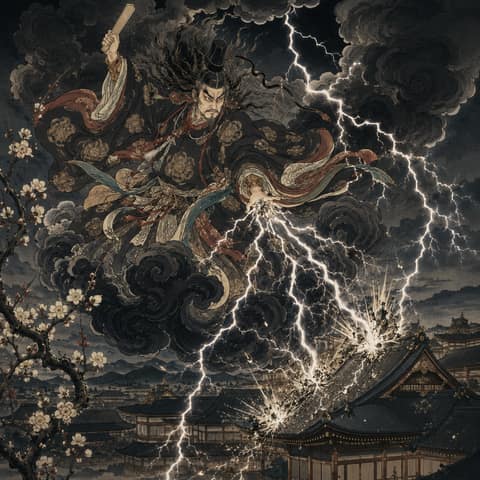
Read more昌泰四年(901)、右大臣菅原道真は左大臣藤原時平の讒言により大宰府へ左遷され、延喜三年(903)に失意のうちに没した。その後、都では時平ら政敵の相次ぐ死や疫病・旱魃が続き、道真の祟りと噂される。そして延長八年(930)、雨乞いを議すため醍醐天皇が臨席した清涼殿への落雷[5]で、道真を大宰府で監視していたとされる大納言藤原清貫が胸を裂かれて即死、右中弁平希世も顔を焼かれて落命した。惨状を目にした醍醐天皇は病に臥し、三月のうちに崩じる。この一事が、道真を雷を操る「火雷天神」とみなす信仰を決定づけた。雷神と化した道真が都に臨み清涼殿を撃つさまは、鎌倉期の『北野天神縁起絵巻』[6]に鮮やかに描かれている。
鵺や玉藻前が物語の怪であるのに対し、清涼殿落雷は『日本紀略』ほかの史書[7]に記録された実際の落雷事故である点を強調しておきたい。多数の死傷者を出した宮中の惨事という史実があり、その上に怨霊と雷神の信仰が築かれた。朝廷はこの荒ぶる霊を鎮めるため天暦元年(947)に北野天満宮を営み、祟り神を国家公認の神へと反転させた。怪を生む内裏と、それを鎮める装置とが背中合わせに稼働するという都の構造が、ここに最も劇的な形で現れている。道真は平将門・崇徳天皇とともに「日本三大怨霊」に数えられるが、この三者を一括りにする呼称自体は江戸期に広まった近世の枠組みである。
結界を守る陰陽師 ── 大内裏と安倍晴明
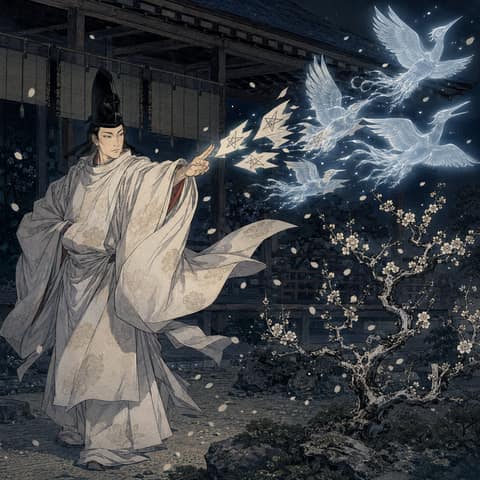
怪を鎮める側の中枢が、大内裏に置かれた陰陽寮であり、その象徴的人物が安倍晴明だった。
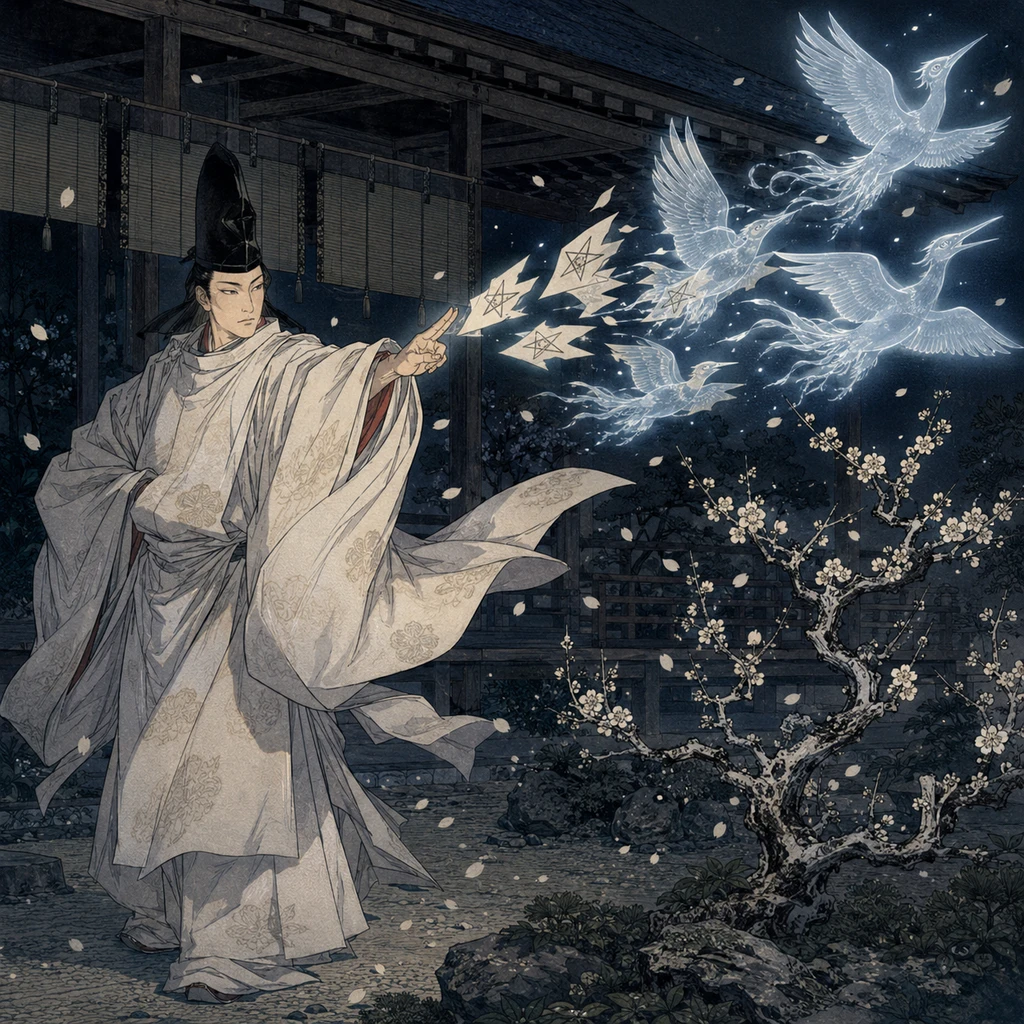
Abe no Seimei
A historical onmyoji (court diviner) of the mid-Heian period recorded in official sources. Trained under the Kamo lineage in astronomy, calendrics, and divination, he performed purifications and ritual steps (heihaku/henbai) at court. Diaries note the trust he gained from Emperors Kazan and Ichijo and from Fujiwara no Michinaga. He later also held the post of Astronomer-in-Chief, paving the way for the Abe (Tsuchimikado) lineage to codify Onmyodo as a hereditary tradition. Over time his legend grew, and he came to embody the archetype of the sorcerer who subdues yokai and commands shikigami.
Read more晴明は平安中期に実在した陰陽師である。賀茂忠行・保憲父子に天文道・陰陽道を学び、宮廷で天文・暦・卜占を司り、祓や反閇を奉仕したと史料に記される。花山・一条両天皇や藤原道長の信を得た記事が日記類に残る ── ここまでは史実だ。重要なのは、陰陽寮が呪術の役所ではなく、天文・暦・占筮を司る正式な律令官庁であり、大内裏の一画を占めていたという事実である。その官庁が宮中の中枢にあり、実在の晴明が権力者の信任を得ていた ── この骨格があったからこそ、説話は際限なく育つ余地を持った。
『今昔物語集』巻二十四[8]には、少年期に師の供をして百鬼夜行に出会い難を察した話、播磨の陰陽師の式神を逆に隠して降参させた話、草の葉で蛙を呪殺してみせた話などが載り、式神使いの名手として晴明を描く。『大鏡』[9]は花山天皇出家の夜、晴明が天変を見て式神を内裏へ遣わそうとした件を伝え、史的文脈にもその名を残す。晴明邸跡(堀川一条)に寛弘四年(1007)創建された晴明神社[10]の近く、一条戻橋の下には十二神将(式神)が隠されていたという伝説も、こうした説話の累積から生まれた。晴明撰と伝える『簠簋内伝』[11]が後世の仮託であることも、伝説化の過程をよく示している。前章の玉藻前の正体を見破ったのが晴明本人ではなくその子孫の泰成だった点と合わせて読むと、「内裏の怪を祓う陰陽師」という像が、実在の晴明を核に何代もかけて結晶していったことが見えてくる。
朱雀門と都の四方 ── 南を守る朱雀
最後に、内裏から朱雀大路を真南へ下った先、大内裏の正門である朱雀門に目を向けたい。門は内と外の境界であり、境界には怪が宿る。
朱雀門にまつわる怪異で名高いのが、笛の名手・源博雅と鬼の物語である。『十訓抄』[12]によれば、博雅が月の夜に朱雀門のあたりで笛を吹いていると、同じく見事に笛を吹く者が現れ、互いに言葉を交わさぬまま笛を取り換えた。後にその笛が名笛「葉二(はふたつ)」であったと判明する。博雅の死後、帝が笛の名手・浄蔵に朱雀門でこれを吹かせたところ、楼上から「なほ逸物かな(やはり名器よ)」という声が響き、その笛がもともと朱雀門の鬼の持ち物だったことが初めて知れたという。羅城門の鬼が死体と恐怖の象徴であったのに対し、朱雀門の鬼は風流を解する存在として語られる ── 同じ都の南北の門でも、宿る怪の性格が対照をなしている点が面白い。都の正門たる羅城門の楼上が、『今昔物語集』巻二十九[13]では死体の捨て場と化していたと記されるのと比べれば、朱雀門に月夜の笛を吹く鬼を置いた感性は、いかにも王朝らしい優雅さをまとっている。境界に宿る怪を、恐怖としても、風雅としても語り分けられる ── そこに都人の想像力の幅があった。
その「朱雀」という名そのものが、都の方位を司る守護神に由来する。
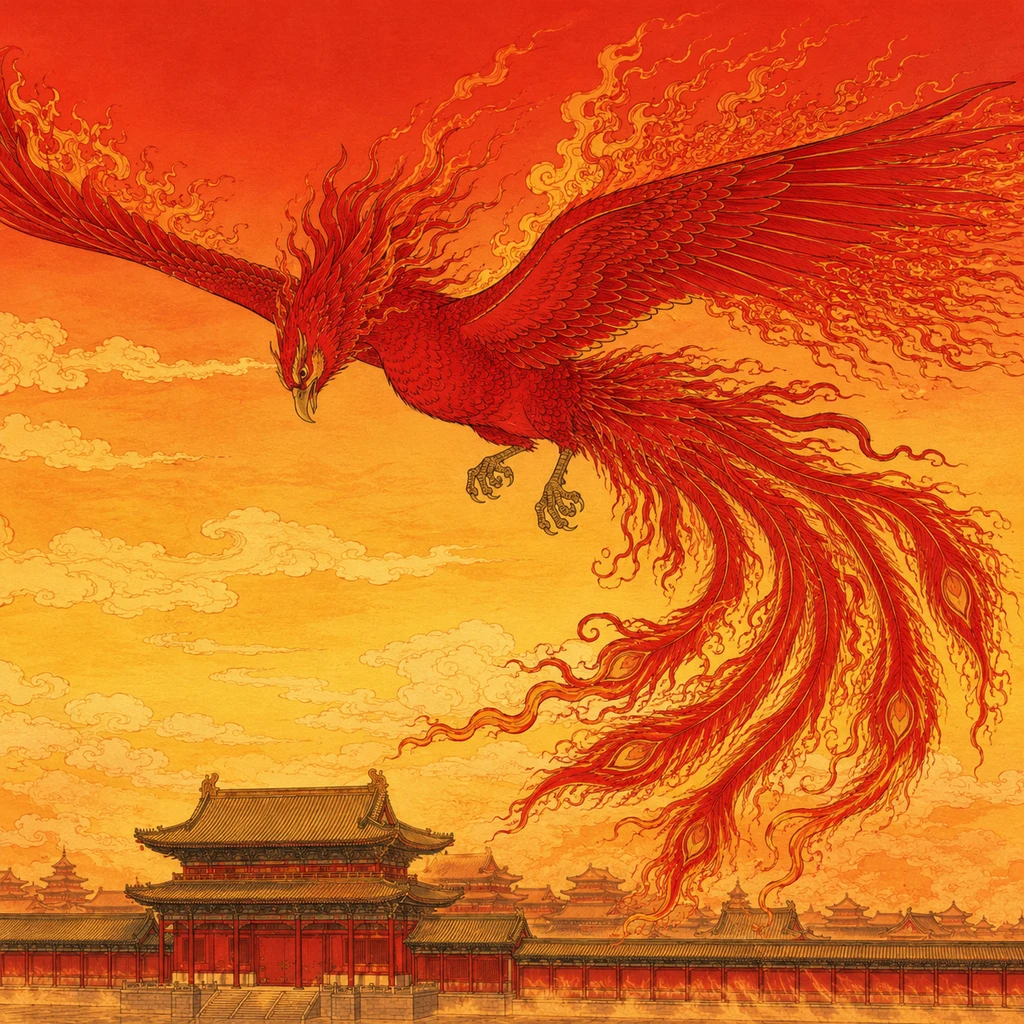
Suzaku (Vermilion Bird)
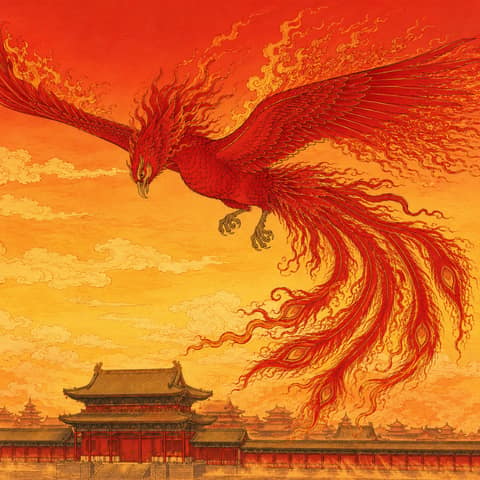
Suzaku, the Vermilion Bird, is one of the Four Symbols that guard the south, the numinous bird that shapes the seven southern lunar mansions of the heavens into the form of a bird. In the Five Phases it is assigned to Fire, in the five colors to vermilion (red), and in the seasons to summer. In the classics it is often written "Vermilion Sparrow," and the "Qu Li" chapter of the Book of Rites makes the Four Symbols markers of direction—"the Vermilion Bird in front, the Black Tortoise behind." Received into ancient Japan together with the Chinese thought of direction and the Five Phases, its name remains in the Suzaku Avenue and Suzaku Gate of Heian-kyō.
Read more朱雀は、南方を守護する四神の一にして、天の南方七宿を鳥の形に象った霊鳥である。五行では火、五色では朱(赤)、季節では夏に配され、『礼記』曲礼[14]は「前朱鳥にして後玄武」と四神を方位の標とした。中国に成立した方位・五行の思想とともに古代日本へ受容され、平安京の都市設計にそのまま刻み込まれた。都の中央を南北に貫く大路は朱雀大路と名づけられ、その北端で大内裏に接する正門が朱雀門、南端の都の正門が羅城門である。鬼が笛を吹いた朱雀門も、頼政が射た鵺も、雷が落ちた清涼殿も ── 内裏という心臓と、それを取り巻く四方の守りという都市の幾何学のなかに、すべてが配置されていた。北東に鬼門の比叡山、南に朱雀の守り、中心に天皇。平安京の妖怪は、この座標系の上で語られたのである。
結び ── 消えた御殿、
残った物語
ここまで殿舎ごとに辿ってきた怪異には、一つの逆説が貫いている。舞台となった建物の多くは、もはや現存しない。大極殿は安元の大火(1177)を最後に再建されず、内裏は天徳四年(960)以来くりかえし焼け、やがて天皇は里内裏へ移った。紫宸殿も清涼殿も朱雀門も、いま京都市街にその実物を見ることはできない ── 大内裏の故地はおおむね住宅地と化し、わずかな石標と地名(千本通・大宮通など)が往時の区画をしのばせるにすぎない。
それでも鵺は射られ続け、玉藻前は正体を露わにし続け、雷は清涼殿を撃ち続け、鬼は朱雀門で笛を吹き続ける。建物が灰になっても、そこで起きたと語られた怪異は、能の『鵺』に、御伽草子に、石燕の絵図に、現代のゲームや漫画へと転生し、いまも生き延びている。平安京内裏は、物理的にはとうに失われ、物語のなかでだけ稼働し続ける舞台装置である。 京都という都市が千二百年にわたって妖怪を可視化してきた営みの、最も古く最も格高い震源地が、この帝の御座所だった。より広い京都の妖怪世界 ── 大江山の鬼、宇治の橋姫、四方の山の天狗、室町の付喪神 ── については、京都府の妖怪事典で続きを辿ってほしい。