Suzaku, the Vermilion Bird, is one of the Four Symbols that guard the south, the numinous bird that shapes the seven southern lunar mansions of the heavens into the form of a bird. In the Five Phases it is assigned to Fire, in the five colors to vermilion (red), and in the seasons to summer. In the classics it is often written "Vermilion Sparrow," and the "Qu Li" chapter of the Book of Rites[1] makes the Four Symbols markers of direction—"the Vermilion Bird in front, the Black Tortoise behind." Received into ancient Japan together with the Chinese thought of direction and the Five Phases, its name remains in the Suzaku Avenue and Suzaku Gate of Heian-kyō.
Suzaku is often identified with the phoenix (hōō), but the two belong, in truth, to separate lineages. Suzaku is one of the Four Symbols (directional deities) arising from the twenty-eight mansions, whereas the phoenix is one of the Four Auspicious Beasts (alongside the qilin, the numinous tortoise, and the responding dragon). Because their images closely resemble each other they have long been confused, but their differing origins must not be overlooked.
In Japan, with the reception of Four Symbols thought, Suzaku was placed as the symbol guarding the southern face. The avenue running north–south through the center of Heian-kyō was named Suzaku Avenue, and its southern gate was called the Suzaku Gate—the notion of south = Suzaku was carved into the structure of the capital. As for iconography, the Four Symbols were painted in the Takamatsuzuka Tomb[4] in Asuka, but the Suzaku of the southern wall was lost to grave-robbing. The Four Symbols survive complete on all four sides only in the Kitora Tomb[5], where Suzaku keeps its form on the southern wall.
Yokai Cards4
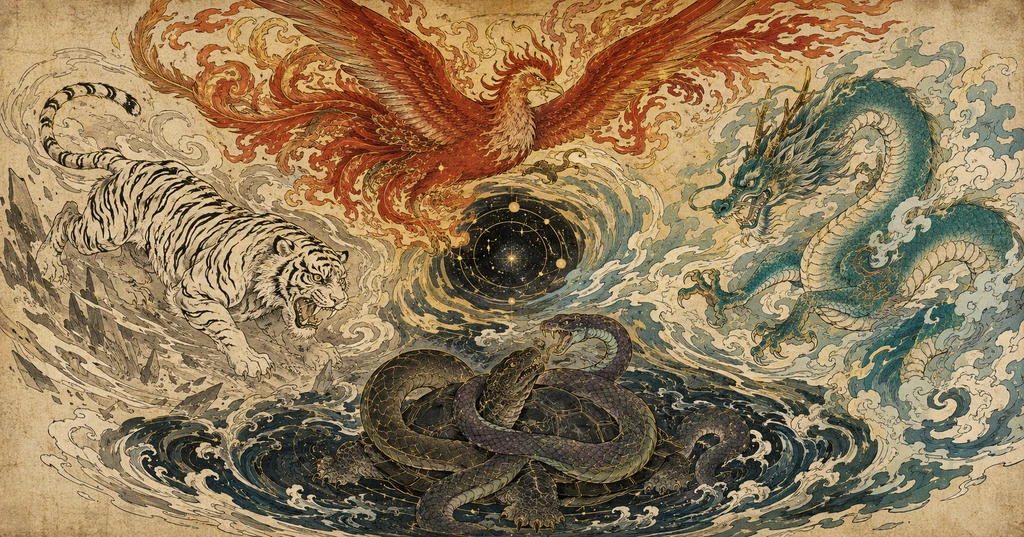
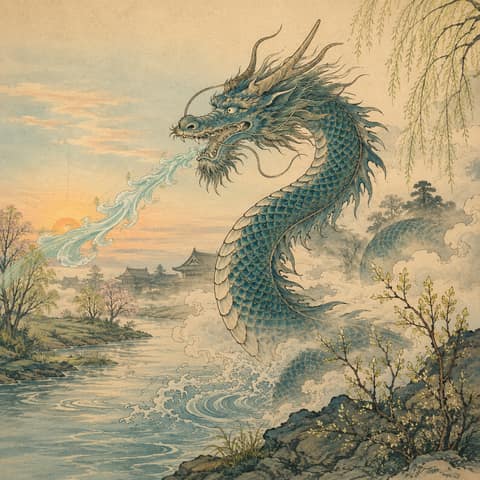
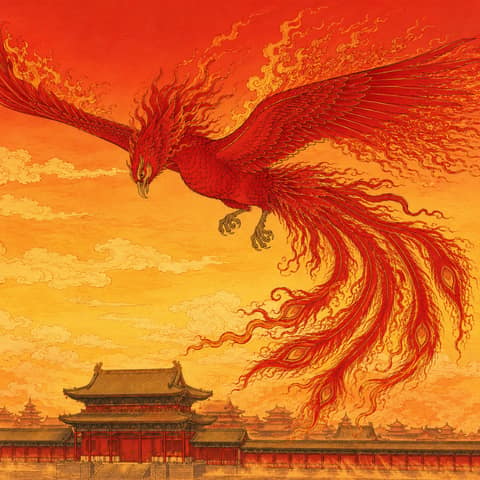
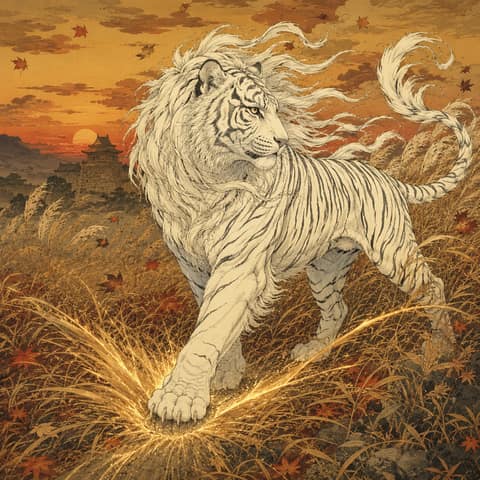
Suzaku (Vermilion Bird) across multiple art-style decks
The key to reading Suzaku lies in its directional symbolism as "the fire bird of the south" and in its subtle distinction from the phoenix.
Its origin is in the stars of heaven. Chinese astronomy likened the chain of the seven southern mansions (Well, Ghost, Willow, Star, Extended Net, Wings, Chariot) to a bird form, and made this the Vermilion Bird. The Huainanzi's "Treatise on the Patterns of Heaven"[3] makes the emperor of the south the Flame Emperor and its beast the Vermilion Bird, assigning it to Fire, summer, and the color vermilion. The "Vermilion Bird in front, Black Tortoise behind" of the Book of Rites' "Qu Li"[1] and the southern-palace Vermilion Bird of the Records of the Grand Historian' "Treatise on the Celestial Offices"[2] stand in the same system. The vermilion of Suzaku is the color of the Fire phase, figuring the blazing southern sky of summer.
The relationship between Suzaku and the phoenix requires care. Because their images and auspicious connotations closely resemble each other the two tend to be identified, but Suzaku belongs to the Four Symbols (of astronomical, directional origin) and the phoenix to the Four Auspicious Beasts (the numinous beasts alongside the qilin, the numinous tortoise, and the responding dragon)—they are numinous birds of originally different categories. Rather than declaring "Suzaku = phoenix," it is more accurate to grasp that they have been spoken of as overlapping because of their close resemblance.
In Japan, the notion of south = Suzaku was carved into the capital. The Suzaku Avenue and Suzaku Gate of Heian-kyō are its traces. As for surviving iconography, there were the Four Symbols murals of the Takamatsuzuka Tomb[4], but the Suzaku of the southern wall was lost to grave-robbing, and four-direction completeness is limited to the Kitora Tomb[5]. The fire bird of the south, so easily lost, still spreads its wings in the stone chamber of Asuka.
Character Profile
This section is our own creative profile for storytelling. It is not historical fact or scholarship.
Guarding the southern domainMaintaining purity and proprietyBringing auspicious omens related to fire and summerStrengthening wards and quelling ill events
Weaknesses
Detests defilement and conduct that fails in propriety; disharmony with floods and damp impurity
Habitat
Symbol of the southern domain of the capital, the solemn and decorative patterns of shrines and temples, the directional charts and ritual spaces of Onmyōdō
The diagram below is a diagnostic evaluation chart for Suzaku, the Vermilion Bird, Guardian of the South. The higher the value of each item, the stronger that characteristic is expressed.