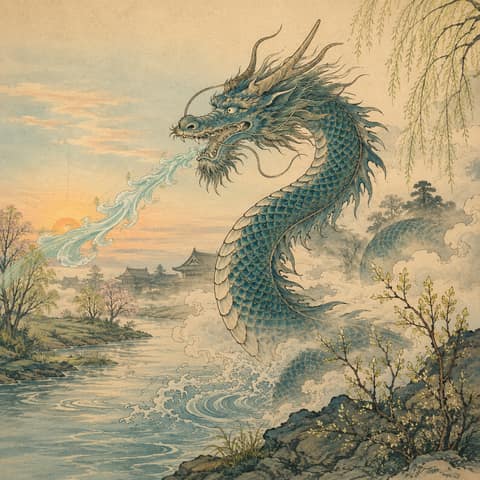
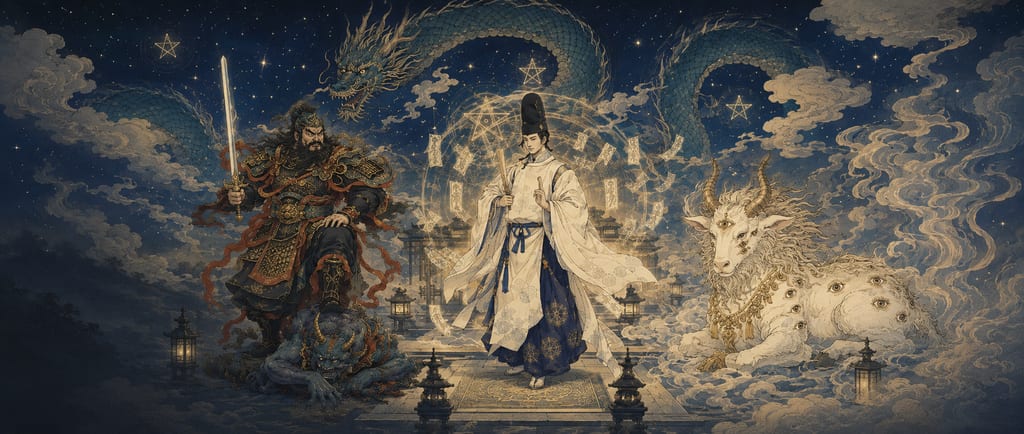
Seiryū is not a dragon standing alone, but a numinous beast that takes on meaning only within the directional system of the Four Symbols. This edition traces its astronomical origin and its reception in Japan.
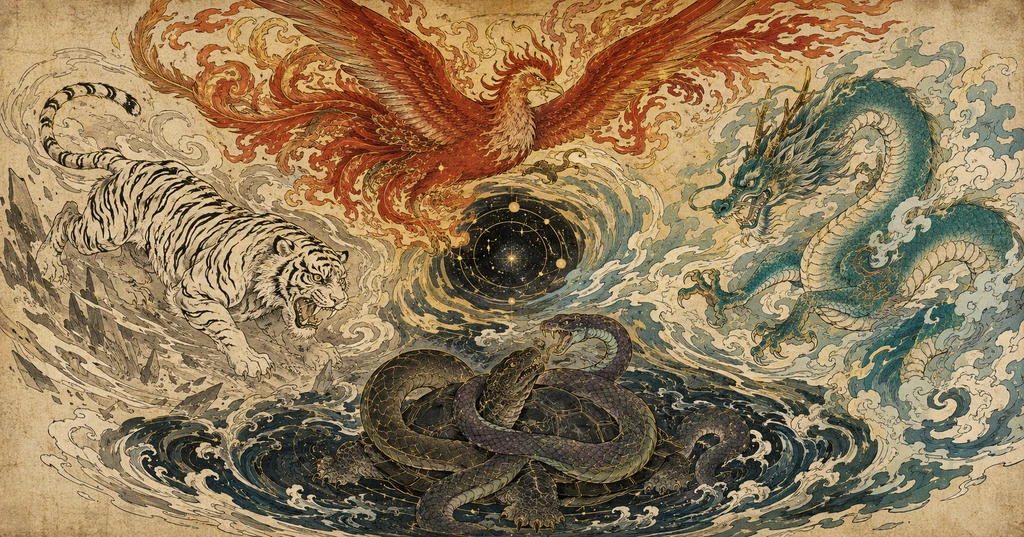
The origin lies in the heavens. Chinese astronomy distributed the twenty-eight lunar mansions across the four quarters, seven to each, and likened the chain of stars of the seven eastern mansions (Horn, Neck, Root, Room, Heart, Tail, Winnowing Basket) to a single dragon. This is Seiryū. The Huainanzi's "Treatise on the Patterns of Heaven"[1] makes the emperor of the east Taihao and its beast the Azure Dragon, assigning it to the Wood phase and spring, weaving the five directions, five colors, five seasons, and Five Phases into a single cosmology. The "Treatise on the Celestial Offices" of the Records of the Grand Historian[4] likewise makes the eastern palace of heaven the Azure Dragon, binding constellation to numinous beast. The azure of Seiryū is the color of the Wood phase, figuring the rising life-force of spring in the east.
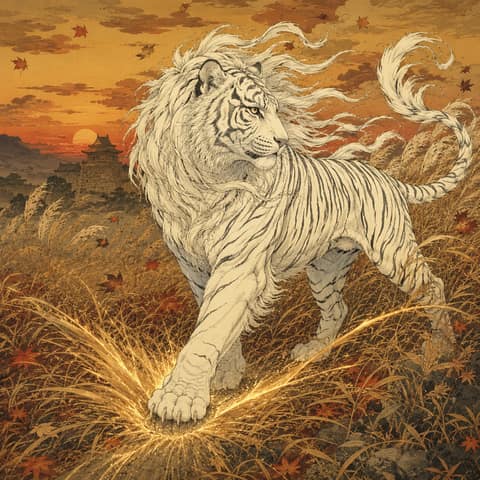
Its deep layer is engraved in relics. The lacquer garment chest from the tomb of Marquis Yi of Zeng[2] (c. 433 BCE), the oldest astronomical relic to bear the names of the twenty-eight mansions, depicts the Azure Dragon and White Tiger as a pair. In the Han period, the patterns of the Four Symbols adorned roof tiles, bronze mirrors, and pictorial stones, becoming emblems that warded off evil and summoned fortune.
In Japan, the Four Symbols were received as a theory of astronomy, tomb-building, and capital planning. The Four Symbols' banners of the first year of Taihō (701) in the Shoku Nihongi[5] are the certain literary first appearance, and in iconography the Azure Dragon on the eastern wall of the Kitora Tomb[6] in Asuka survives as one wing of a four-direction-complete mural of the Four Symbols. Thus Seiryū was placed between star and terrain, as the guardian beast that governs the east and brings the spring.
Character Profile
This section is our own creative profile for storytelling. It is not historical fact or scholarship.
Yokai Type - Traditional Yokai
Category - Animal Shapeshifters
Rarity - Divine
Personality - Solemn and protective, a guardian spirit of quiet dignity.
Compatibility - In harmony with those who honor water veins and trees
Abilities - Protection of the direction (the east)Strengthening the Wood phase and ordering the environmentShowing auspicious omens and warding off calamityBecoming the sign that announces the onset of spring
Weaknesses - Unknown (as a symbolic being, no concrete weakness is transmitted)
Habitat - Wall paintings and ritual-implement designs of shrines and temples, within the wards and terrain-readings of directional belief, in the iconography of old mirrors, tiles, and folding screens