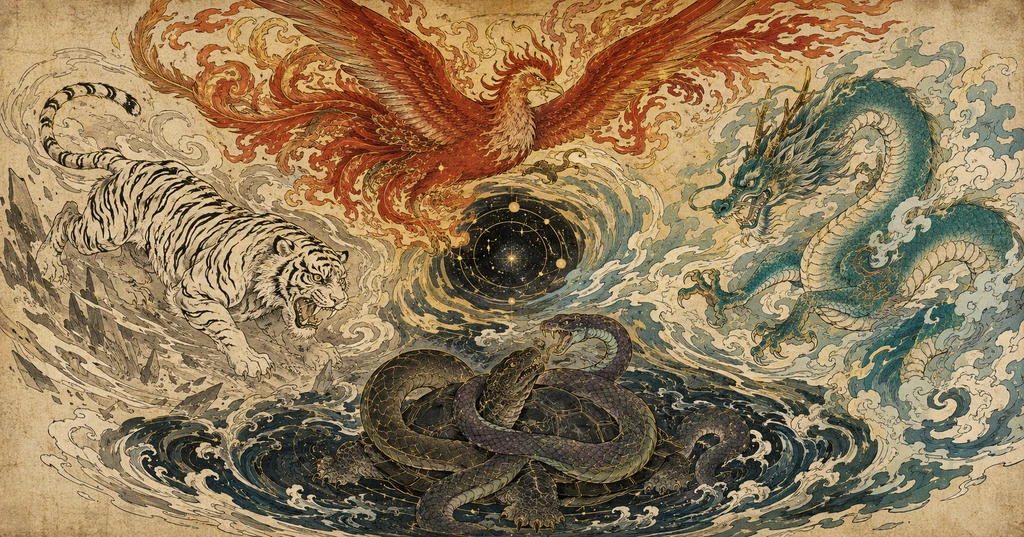
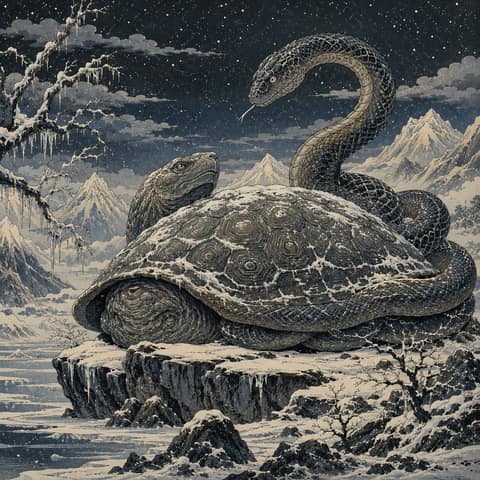
Genbu, the Black Tortoise, is one of the Four Symbols that guard the north, the numinous beast that figures the seven northern lunar mansions of the heavens. It is often represented as a tortoise entwined with a snake (tortoise-and-snake intertwined), and is assigned to Water in the Five Phases, to dark (black) in the five colors, and to winter in the seasons. Arising from Chinese astral belief, the Huainanzi's "Treatise on the Patterns of Heaven"[1] makes the beast of the north the Black Tortoise. After it was received into ancient Japan, it was spoken of together with the notion of "land matching the Four Symbols," which holds that terrain backed by a mountain to the rear—the "Genbu" position—is auspicious.
Folklore & Legends
Genbu is the numinous beast that embodies the direction north, the Water phase, and winter. The chain of stars of the seven northern mansions (Dipper, Ox, Girl, Emptiness, Rooftop, Encampment, Wall) likened to a tortoise wrapped by a snake is the origin of its distinctive iconography. The Huainanzi's "Treatise on the Patterns of Heaven"[1] makes the emperor of the north Zhuanxu and its beast Genbu, assigning it to Water, winter, and the dark (black). The "Vermilion Bird in front, Black Tortoise behind" of the Book of Rites' "Qu Li"[2] also places Genbu in the north.
As for Genbu's tortoise-and-snake, the Later Han Cantong qi (Token for the Agreement of the Three) of Wei Boyang[3] states, "Genbu is tortoise and snake; coiling, they aid each other, thereby making clear the female and the male," seeing the entwined form of tortoise and snake as a symbol of the harmony of yin and yang, of female and male. Yet this is a symbolic interpretation later overlaid on Genbu's original sense (the figure of the seven northern mansions); the two belong to different strata. Genbu, moreover, developed in Daoism into the anthropomorphic deity "Xuantian Shangdi (Zhenwu Dadi)," but this is a belief of a separate lineage from the Japanese Four Symbols (directional guardians).
In Japan, Genbu was spoken of most concretely within the notion of "land matching the Four Symbols," which holds terrain backed by mountains or hills to the rear to be auspicious. In the New Year's audience rite of the first year of Taihō (701) in the Shoku Nihongi[4], the banner of Genbu was raised as the guard of the north. As iconography, the tortoise-and-snake-intertwined Genbu survives on the northern wall of the Kitora Tomb[5] in Asuka as one wing of the Four Symbols.
Yokai Cards3
Genbu (Black Tortoise) across multiple art-style decks
Genbu is the numinous beast of the north, Water, and winter, bearing the most singular form among the Four Symbols—the entwined form of tortoise and snake. This edition traces the meaning of that iconography and the notion of "land matching the Four Symbols" in Japan.
Its origin is in the stars of heaven. The chain of the seven northern mansions (Dipper, Ox, Girl, Emptiness, Rooftop, Encampment, Wall) likened to a tortoise wrapped by a snake is Genbu. The Huainanzi's "Treatise on the Patterns of Heaven"[1] makes the emperor of the north Zhuanxu and its beast Genbu, assigning it to Water, winter, and the dark (black). The dark is the color of the Water phase, figuring the northern winter sky into which all things withdraw.
Two meanings overlay the tortoise-and-snake form. The first is the original sense—the figure of the stars of the seven northern mansions. The second is the symbol expounded by the Later Han Cantong qi[3], which sees the entwined form of tortoise (longevity) and snake (procreation) as the harmony of yin and yang, female and male. The latter is an interpretation overlaid on the original sense, and the two must not be confused. Genbu, too, was anthropomorphized in Daoism into "Xuantian Shangdi (Zhenwu Dadi)," but this is a development of a separate lineage from the directional-guardian Four Symbols of Japan.
Taciturn and serene, wholly devoted to protection.
Compatibility
In harmony with the north, winter, and the virtue of Water
Abilities
Directional protection (the north)The symbolic power of dispelling calamity and warding off directionsThe protection of firmness and enduranceA calming figure against cold and water-peril
Weaknesses
It is scarcely characterized as actively doing harm; concrete deity-descent rites vary greatly by region and are not uniform
Habitat
The terrain-reading posited to the north of capitals and castles, the iconographic spaces of shrines' and temples' Four Symbols charts, ceiling paintings, and mandalas
The diagram below is a diagnostic evaluation chart for Genbu, the Black Tortoise, Guardian of the North. The higher the value of each item, the stronger that characteristic is expressed.