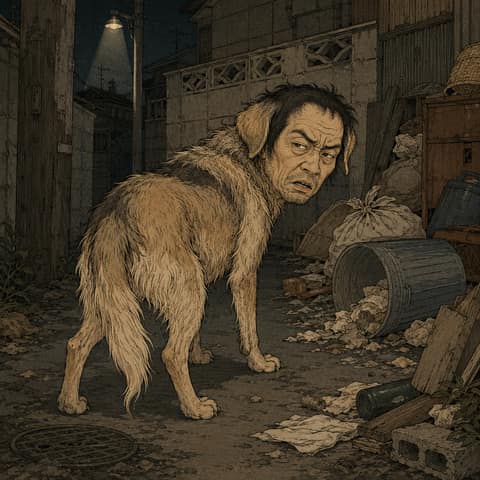
In this version, we read the Jinmenken as a "road urban legend" born from the city during the late Showa era. The Jinmenken is not a yokai that appears fully formed in classical texts; rather, it is an entity where the rumor ran ahead, and magazines and television later gave it a contour. Because of this, its details are never fixed. Where it was seen, what it said, and whose face it resembled shift depending on the teller, and this malleability served as the fuel for its popularity[2].
The stage of the "road" underpins the eeriness of the Jinmenken. On a night road, animal carcasses, lost dogs, the optical illusions of headlights, and suddenly crossing shadows are everyday occurrences. When an easily recognizable component like a "human face" is mixed in, the witness feels that "perhaps it wasn't a dog." The speed of vehicular society robs people of the time to verify. Passing by without being able to confirm whether it was a misperception or an anomaly strengthens the rumor.
The Jinmenken's dialogue elevates this anomaly from a mere composite animal to an urban legend. Words like "Leave me alone" or "What are you looking at?" are closer to rejection than horror. The monster is not attacking; it hates your gaze. This sensation closely resembles the awkwardness of witnessing someone's bizarre behavior on a city street. The one who sees the yokai is slightly blamed as the rude interloper.
In the realm of modern folktales handled by Miyoko Matsutani, modern vehicles and urban infrastructure become the sources of new ghost stories[1]. The Jinmenken is positioned perfectly within this current. Instead of emerging from the old natural environment like fox-fire or a mountain witch, it appears from late-night stores, national highways, housing complexes, and the roads home from school. This dog clearly demonstrates how the stage of yokai has shifted in accordance with changes in lifestyle.
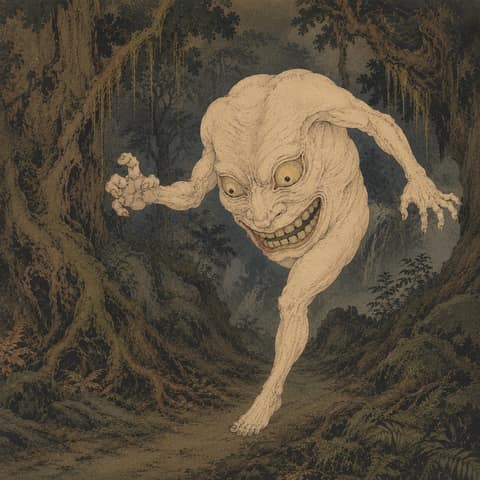
This version of the Jinmenken is a yokai of incomplete transformation. The dog did not turn into a person; it remains a dog but merely possesses a human face. That incompleteness becomes both a joke and a nightmare. Children found it amusing as a rumor, and adults consumed it as a media phenomenon, but at the bottom of it all lies the lingering anxiety that "somewhere in the city, you might encounter something that cannot be classified." The Jinmenken is the form of that anxiety running at its lightest and fastest.
Through the media, this version of the Jinmenken became a monster that "everyone knows, even though no one has seen it." Most people have never actually encountered it. Even so, anyone can instantly imagine the scene of a dog with a human face speaking. The rumor distributes the image before the sighting, and that image in turn generates new eyewitness accounts.
The choice of a "dog" is also sharp. A dog is close to the human sphere of living, considered a loyal and familiar animal. When a human face is pasted onto it, that familiarity is shattered instantly. If it were a complete monster, you could keep your distance; but because it is a dog, you momentarily approach it. That delay establishes the ghost story of the Jinmenken.
The Jinmenken also carries the burden of urban loneliness. Even though it can speak human language, it doesn't seek conversation; instead, it rejects it with "Leave me alone." This is remarkably similar to the sensation of city life, where people are densely packed yet do not interact with one another. The anomaly doesn't attack humans, but finds the very gaze of humans to be a nuisance. Within that lies its coldness as a modern yokai.
Character Profile
This section is our own creative profile for storytelling. It is not historical fact or scholarship.
Yokai Type - Modern Kaii
Category - Animal Shapeshifters
Rarity - Epic
Personality - Grumpy and averse to being looked at. Rather than scaring people, it tends to reject those who have seen it, running away into the hidden backside of the city.
Compatibility - 都市伝説、深夜の道路、見間違いと噂の境界に惹かれる人と相性がよい。古典妖怪より現代怪談の手触りを求める人にも向く。
Abilities - Human face manifestationHuman speechHigh-speed runningUrban rumor proliferationGaze rejectionRoad ghost story generation
Weaknesses - It relies heavily on its freshness as a rumor; once people stop talking about it, its outline rapidly fades. It has no classical divinity or fixed lineage.
Habitat - Roads, service areas, garbage dumps, back alleys of housing complexes, late-night entertainment districts, and within urban legends told at schools from the late Showa to early Heisei eras.