YOKAI.JP

Kashima Reiko

Kashima Reiko

Kashima Reiko

Kashima Reiko

Their soul is listening — speak, and they will answer.

Basic Description

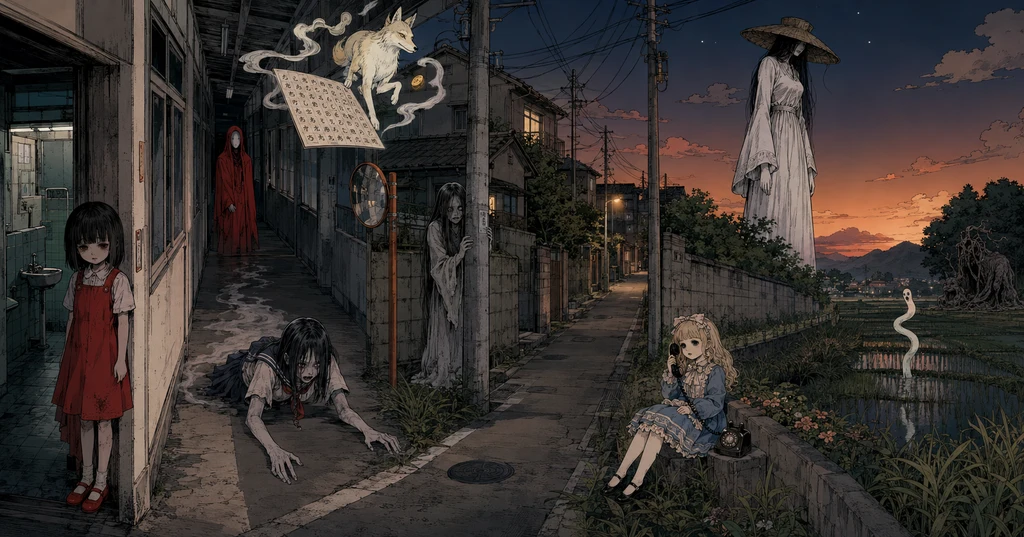
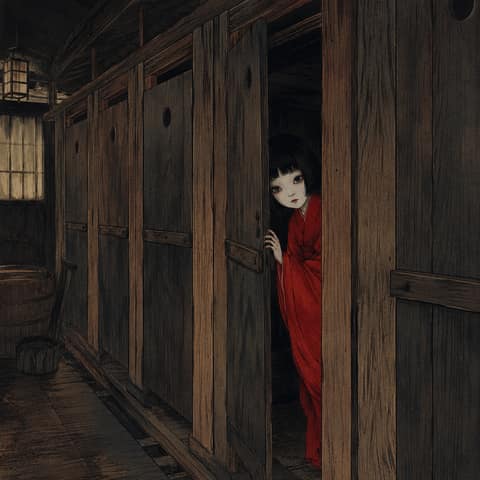
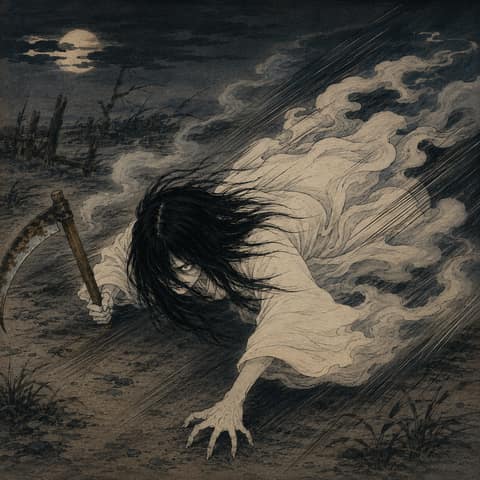
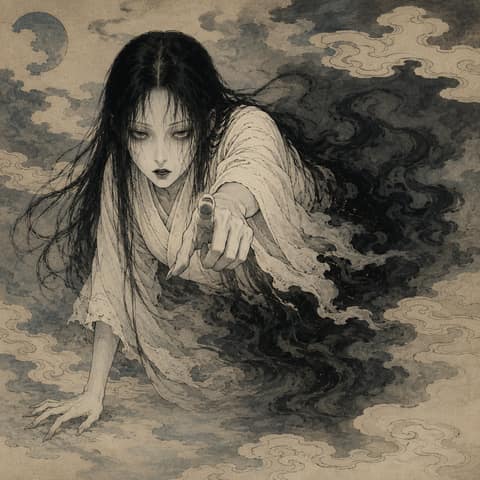
Kashima Reiko is a Japanese urban legend that has circulated since the 1970s: a female vengeful spirit also known as Kashima-san, Kashima Daimyōjin, Kashima-sama, or by the ominous ateji name 仮死魔霊子. Her defining feature is the legend's contagious curse. Anyone who hears the story of Kashima-san will, within three days, be questioned either by telephone or in a dream. If they cannot answer correctly, part of their body is taken and they die. Subculture researcher Kenichi Hatsumi notes that the story may have spread as an offshoot of the nationwide Kuchisake-onna boom of 1978, and records that children at the time repeated the rumor that "Kuchisake-onna's real name is Kashima Reiko." The most widespread identity theory says that she is the ghost of a local woman named Reiko Kashima, twenty-three years old, who was raped and shot by an American soldier near Kakogawa Station in Hyōgo during the U.S. occupation of Japan in 1948. There is no confirmed historical evidence for that incident, so it should be read as an explanatory framework inside the legend. Kashima Reiko is one of the representative urban legends examined in a reportorial style by Hiroshi Matsuyama's Noroi no toshi densetsu: Kashima-san o ou (R's Publishing, 2004).

Folklore & Legends

Origins in the 1970s and the "second-brew" theory. Kashima Reiko is generally placed in the 1970s, though no definitive first appearance has been identified. Subculture researcher Kenichi Hatsumi records his own childhood memory that, after the Kuchisake-onna legend from Gifu Prefecture spread among schoolchildren nationwide in 1978, a rumor followed claiming that "Kuchisake-onna's real name is Kashima Reiko." On that basis, Kashima Reiko may have been a "second-brew" kaidan that arose immediately after the Kuchisake-onna boom, in or after 1978. Even so, Kashima Reiko's central motifs, the missing lower body, the telephone, the question, and the contagious story, form a combination distinct from Kuchisake-onna. Rather than a simple derivative, the legend appears to have taken shape independently while cross-referencing other urban kaidan of the same period, including Teketeke and Hanako-san of the Toilet.

How the name "Kashima Reiko" is explained. Within the legend, the name Kashima Reiko is sometimes broken down like a spell: ka from kamen, "mask," or kaji, "fire"; shi from shi, "death"; ma from ma, "demon"; rei from rei, "spirit"; and ko from jiko, "accident." Each syllable is reinterpreted as a sign of disaster, death, or demonic force. In another line of transmission, she is treated as a person named Reiko Kashima, written 鹿島礼子, while the quasi-divine alias Kashima Daimyōjin also circulates. These parallel explanations, the postwar American-soldier incident, a Shinto-style divine identity, and a syllabic curse formula, coexist inside the same legend. That coexistence is a classic example of how urban legends generate multiple origin stories at once.

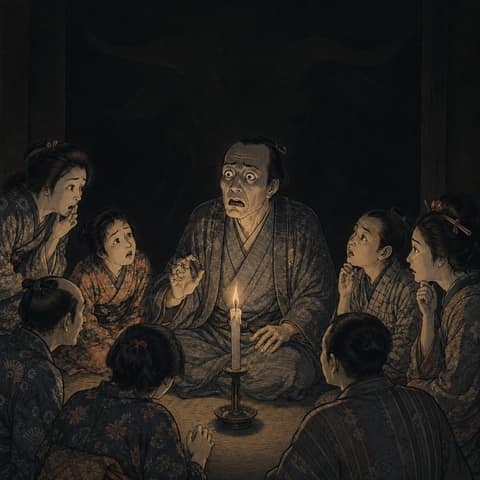
The structure of a contagious curse. Kashima Reiko's most distinctive feature is that the curse spreads to anyone who hears the story. Children passed down the warning that "within three days, whoever hears this tale will be asked by phone or in a dream, 'Does Kashima-san have legs?' or something similar. A wrong answer means death, but a correct reply such as 'Kamashi' or 'Kashima Reiko' will save you." This brings into modern form an older magical idea, found since the medieval period, that curses and spells can travel through hearsay. Structurally, it also resembles the chain-letter phenomenon of the same era, including messages that threatened death unless passed on.

Identity theory: the 1948 Kakogawa incident. Hiroshi Matsuyama's Noroi no toshi densetsu: Kashima-san o ou (R's Publishing, November 2004) investigated the most widely circulated theory of Kashima Reiko's identity: a beautiful local woman named Reiko Kashima, twenty-three years old, who was raped and shot by an American soldier near Kakogawa Station in Hyōgo during the postwar U.S. occupation in 1948. Matsuyama conducted interviews around Kakogawa and Takasago, but found no historical incident that directly matched the story. There are, however, records of assaults against Japanese women by American soldiers in postwar-occupied Hyōgo, so the social ground beneath the legend did exist. Folklore and urban-legend studies treat Kashima Reiko as a case in which social memory of harm suffered by women under postwar U.S.-Japan relations was transformed into a specific name and incident inside a ghost story.

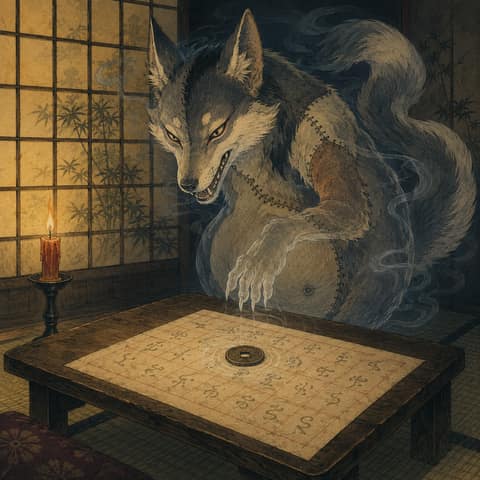
A sisterly relationship with Teketeke. Kashima Reiko shares the motif of a missing lower body with Teketeke, and the two legends have long been linked as sister stories. Oral variations say that "Teketeke's true identity is Kashima Reiko," or that "Kashima Reiko protects people from Teketeke." The 1948 Kakogawa Station origin theory was also adopted in some screen versions of Teketeke, especially Kōji Shiraishi's 2009 films Teketeke and Teketeke 2, where Kashima Reiko, written as 樫間玲子, Kashima Reiko, and Teketeke are folded into one composite figure. Whether the two beings merge into a single source image or run in parallel as separate traditions changes by narrator, region, and period. That instability shows the fluid ecology of urban kaidan. In recent years, Yukinobu Tatsu's Dandadan, serialized in Shueisha's Shonen Jump+ from 2021, has reshaped Kashima Reiko as a major supernatural presence and brought her back to the attention of Generation Z.

Yokai Cards1

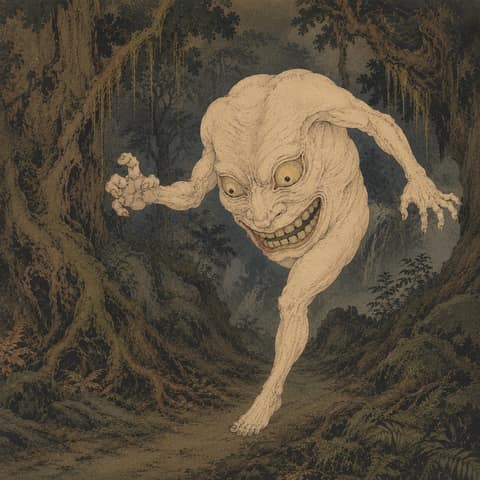
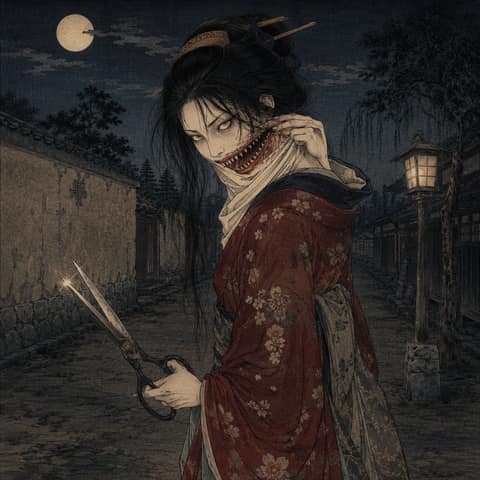
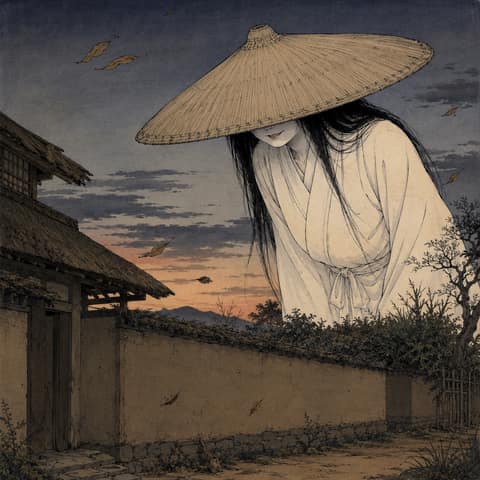
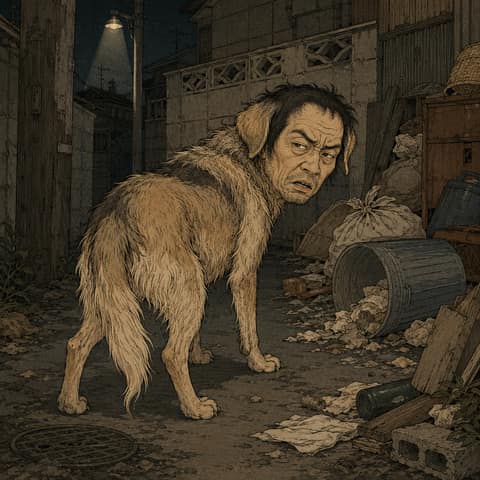
Kashima Reiko across multiple art-style decks

Card gallery

Detailed Analysis

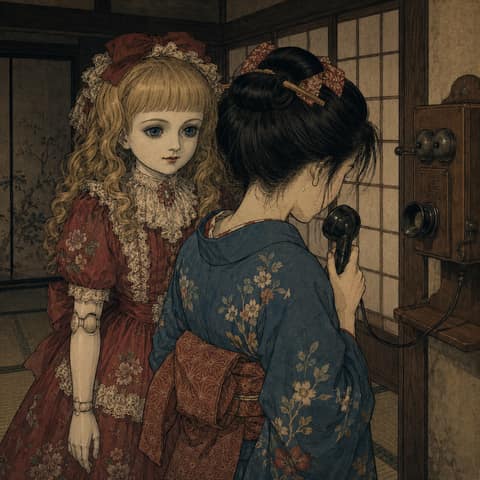
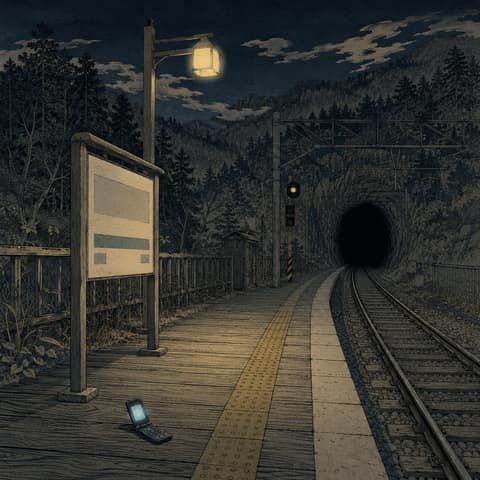
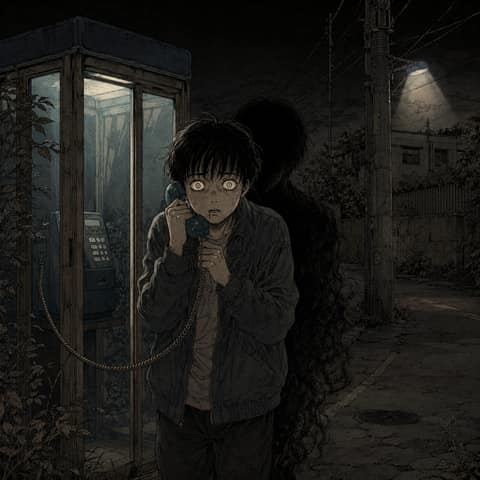
The telephone as postwar infrastructure and kaidan device. The basic entry covers the contagious structure of Kashima Reiko's curse; this fuller explanation looks more closely at the medium that carries it: the telephone. In Japan, the spread of black rotary phones into ordinary households rose sharply in the postwar decades, from about 8 percent in 1965 to about 80 percent in 1975. It is unlikely to be a coincidence that a legend emerging in the 1970s chose the device of "a question coming by telephone." The anxiety of a new infrastructure entering the home became part of the legend's core machinery. Where prewar Aka Manto belongs to alleys and night roads, and Hanako-san of the 1980s belongs to the school toilet, Kashima Reiko is distinctive because she violates the postwar private space of the household telephone. From the 1990s onward, the setting expanded into text media such as email and LINE, keeping pace with the evolution of postwar communication infrastructure.

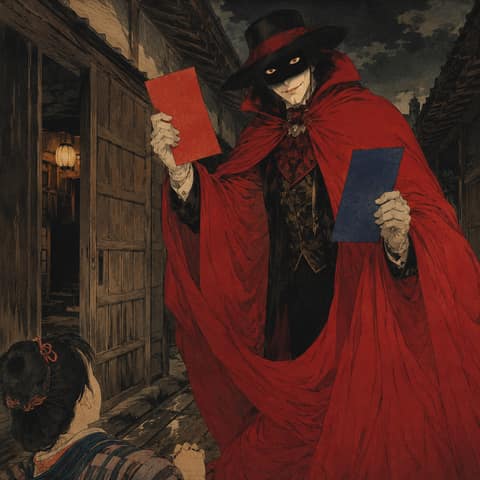
The structure of the "Where are your legs?" question. At the center of the Kashima Reiko legend is a question: "Does Kashima-san have legs?" "Where are her legs?" and similar variants. A wrong answer is fatal, but correct replies such as "Kamashi," "Kashima Reiko," "above the waist," or "from above the waist downward" are said to save the listener. Like Aka Manto's "red paper or blue paper" and Kokkuri-san's yes-or-no exchanges, this is a no-win question structure common in children's oral ghost stories. At the same time, it offers an escape route: correct knowledge can save you. Folklorist Noboru Miyata, in Yōkai no minzokugaku (Iwanami Shoten, 1985), argued that question-based children's kaidan satisfy a childhood desire for intellectual advantage, the feeling that those who know the answer survive.

The transformation of postwar social memory into ghost story. The theory that Kashima Reiko began with the "1948 Kakogawa American-soldier incident" has not been historically confirmed. Even so, it preserves in ghost-story form a social memory of sexual violence suffered by Japanese women under the U.S. occupation. Postwar U.S.-Japan relations, defeat, occupation, and the security order, left many experiences insufficiently spoken in official discourse. Such unspoken harm can settle into the underground layer of urban legend and surface in the 1970s as a supernatural presence. Folklorist Norio Murakami has discussed this mechanism of social memory turning into kaii, noting that experiences excluded from public memory can remain in the form of ghost stories and spirit possession. Kashima Reiko is a representative example.

Contagious curses in the internet age. Kashima Reiko's structure, in which hearing the story makes one part of the curse, became a foundation for the chain-mail culture, internet curses, and creepypasta of the 2000s and beyond. "Forward this email to X people or you will be cursed," "anyone who sees this URL will be cursed": these online curse formulas have their prototype in Kashima Reiko's instantly contagious oral kaidan. Internet-era kaidan such as Kunekune (2003) and Hasshaku-sama (2008) inherit the same device, turning the reader into a participant in the curse. Kashima Reiko therefore played an important mediating role between 1970s oral kaidan and 2000s internet horror.

The ecology of Teketeke and Kuchisake-onna. Postwar Japanese children's oral kaidan do not exist as isolated beings. They form an ecology of mutual reference, merger, and branching. Kuchisake-onna (1978), Kashima Reiko (late 1970s), and Teketeke (1980s) follow one another chronologically and share motifs: a damaged female body, a question structure, and a curse aimed at children. In Tōru Tsunemitsu's Gakkō no kaidan (Kodansha KK Bunko, 1990), these stories were gathered under the category of "school kaidan," helping establish them as a single folkloric genre worthy of study.

Dandadan and modern transmission. In Yukinobu Tatsu's Dandadan, serialized in Shueisha's Shonen Jump+ from 2021 and adapted for television anime in 2024, Kashima Reiko was reshaped as a major supernatural figure and became familiar again to Generation Z. The adaptation keeps the key elements of the source tradition, the missing lower body, the telephone, and the contagion of the curse, while recasting them in the character language of contemporary shonen manga. From children's oral legend in the postwar 1970s to manga and anime of the 2020s, Kashima Reiko has become a rare urban kaidan transmitted across nearly half a century.

Character Profile

This section is our own creative profile for storytelling. It is not historical fact or scholarship.

Yokai Type
Modern Kaii
Rarity
Epic
Personality
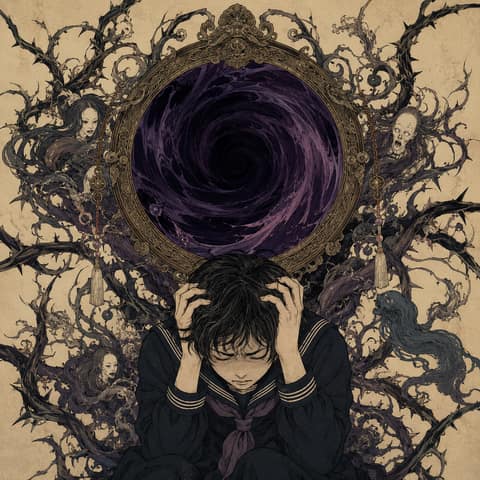
She questions those who have heard her story within three days, and takes the lives of those who answer incorrectly.
Compatibility
She is compatible with those who know the accepted replies, such as "Kamashi" or "Kashima Reiko," and curses those who hear the story without knowing how to respond.
Abilities
Her curse spreads to anyone who hears the story within three daysQuestions appear by telephone or in dreams, such as "Does Kashima-san have legs?"She takes part of the body from those who answer incorrectlyShe has several forms, including a missing lower body, keloid scars, and an old Japanese soldier appearanceShe cross-references Teketeke, sometimes merging with her and sometimes opposing her
Weaknesses
Accepted replies such as "Kamashi," "Kashima Reiko," or "above the waist"; prayers and rites to Buddhist deities or kami.
Habitat
Postwar homes with telephones, schools, hospitals, and the Kakogawa-Takasago area of Hyōgo Prefecture.
🔮Yokai Compatibility Test

For more detailed information and diagnosis results about The Woman Who Asks from the Other End of the Phone: Kashima Reiko, please click here.

Sources & References

2
  1. 呪いの都市伝説·カシマさんを追う松山ひろし(アールズ出版, 2004 年 11 月) [ルポルタージュ]カシマレイコ怪谈をルポルタージュ的に取材·検証した専門書。 1948 年加古川駅米兵事件起源説など複数の正体説を現地取材で追跡したが、 直接対応する史実は確認できないと整理。
  2. 昭和こどもオカルト回顧録 (関連エッセイ群)初見健一(web ムー (ワン·パブリッシング『ムー』 公式 web)·書籍, 2010 年代) [回顧·考察]昭和サブカルチャー研究者の初見健一が、 自身の児童期 (1970-80 年代) に経験したオカルト·都市怪谈ブームを回顧·考察するエッセイ群。 「口裂け女の本名はカシマレイコ」 流言の個人記録を含み、 カシマレイコ発祥時期の証言史料として参照される。

Interested in this type of yokai?

Discover the yokai most similar to your personality with our yokai diagnosis

Start Yokai Diagnosis

Meet your guardian yokai at the shrine

Draw an omikuji fortune and discover the yokai watching over you today.