YOKAI.JP

Mary-san's Phone Call

めりーさんのでんわ

Mary-san's Phone Call

Mary-san's Phone Call

Their soul is listening — speak, and they will answer.

Basic Description

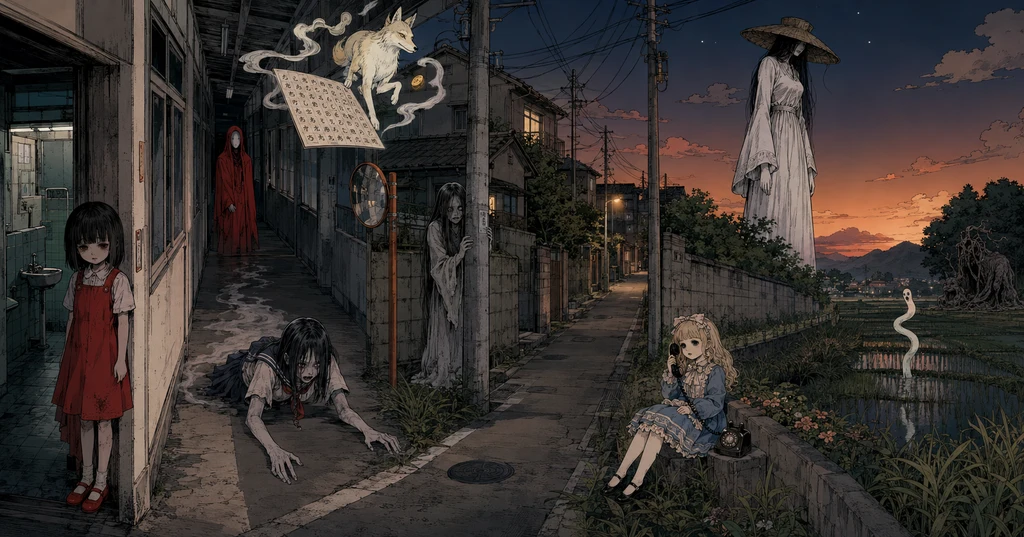
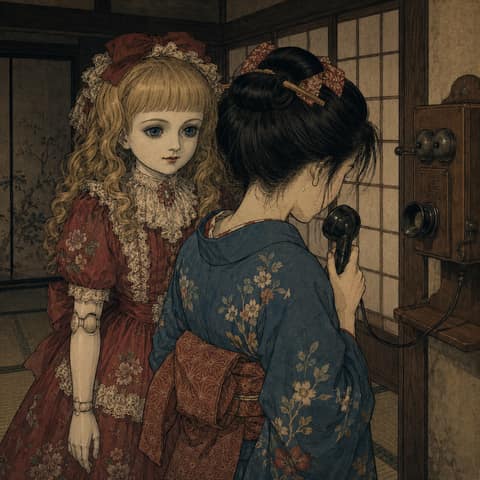
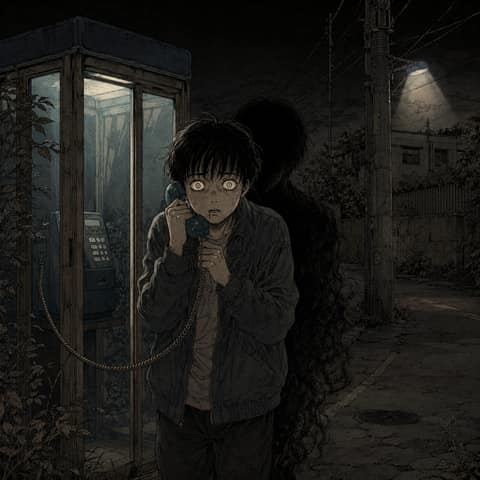
Mary-san's Phone Call is a representative Japanese phone-based urban legend that became firmly established during the Heisei era. The story generally follows this framework: a young girl throws away an old foreign doll named "Mary", and shortly after, she receives a phone call from the very same doll. The doll repeatedly calls, stating, "I am Mary-san, I am currently at [Location]," steadily closing the distance with each call. In the final call, the doll announces, "I am right behind you," and appears directly behind the girl. It is considered one of the most structurally complete urban legends featuring a repetitive phrasing format. As documented by Hiroshi Matsuyama, the legend evolved from creepy rumors surrounding the "Licca-chan Phone" (an automated response service launched in 1968). It spread among children by word of mouth from the late 1970s and, to avoid trademark issues, the subject was gradually replaced by a "Mary-san doll". In 2003, it was included as a featured story in *Toshi no Ana* (Holes of the City) by Hirokatsu Kihara and others, having already circulated nationwide as a "school ghost story" and "urban legend" by the 1990s. Following a 2011 live-action film adaptation (directed by Mitsuhiro Mihara), it has cemented its status as the quintessential modern phone and doll ghost story.

Folklore & Legends

Narrative Structure and the Three-Stage Repetition Model. Mary-san's Phone Call features a highly refined repetitive phrasing structure rare among urban legends. The framework—a girl discards an old foreign doll, receives a call from an unknown number a few days later, and hears, "I am Mary-san, I am currently at [Location]"—repeats as the spatial distance gradually shrinks: "the park," "in front of the store," "in front of your house," "the entryway," and "the bottom of the stairs." In the final phrase, the voice announces, "I am Mary-san, I am right behind you," and when the girl turns around, the doll is standing there. This spatial compression from "far to near, and finally behind" has drawn attention from folklore scholars as a classic distance-reduction structure in modern ghost stories.

Origins and the "Licca-chan Phone" Urban Legend. According to Hiroshi Matsuyama's *The Three-Legged Licca-chan Doll: Midnight Urban Legends* (East Press, 2003), the story's origins trace back to spooky rumors surrounding the "Licca-chan Phone" introduced by Takara (now Takara Tomy) in 1968, an automated service where callers could listen to Licca-chan's voice. Initially, it circulated in the 1970s as tales of "hearing a strange voice if you call the Licca-chan Phone at midnight" or "Licca-chan calling you back." Eventually, out of consideration for trademark rights and corporate image, children's oral traditions substituted the "Mary-san doll," giving rise to the modern iteration. The exact year and location of its inception remain unconfirmed, though the prevailing theory suggests it originated and spread from the Kanto region (possibly Suginami Ward).

1990s Systematization and Integration into "School Ghost Stories". Triggered by the publication of Toru Tsunemitsu's *Gakkou no Kaidan* (School Ghost Stories) in 1990 (Kodansha KK Bunko), the story was repeatedly featured in children's magazines, TV ghost story programs, and urban legend books throughout the 1990s, achieving nationwide circulation. In the 2003 book *Toshi no Ana* by Hirokatsu Kihara, Masaaki Okajima, and Hajime Ichigaya (Futabasha), it was compiled as part of the modern urban ghost story collection. Along with Matsuyama's work that same year, the mid-Heisei urban legend boom saw the story systematically documented from both academic and editorial perspectives.

Screen Adaptations and Influence on "One Missed Call" Horror. The 1998 film *One Missed Call* (directed by Takashi Miike, continuing the J-Horror lineage of Hideo Nakata's scripts) is often noted for having Mary-san's Phone Call as its direct motif, despite altering the structure from a doll calling to receiving a voicemail of one's own future death. In 2011, Mitsuhiro Mihara directed the theatrical film *Mary-san's Phone Call*, a high school horror film centering on a karate club student, representing a direct screen adaptation of the urban legend itself. The story continues to be endlessly reproduced on Niconico and YouTube ghost story reading channels, effectively passing the legend down to the Heisei generation.

The Three Axes: Object, Medium, and Distance. Mary-san's Phone Call is evaluated as the most complete form of modern ghost story, built on three axes: "the discarded object (doll)," "the medium (phone)," and "the gradually closing distance." In Hiroshi Matsuyama's *Terrifying Urban Legends* (East Press, 2013), "Night 28: Thirteen Steps," the structural similarities in repetitive phrasing with stair-based ghost stories are pointed out. Within Japanese storytelling traditions, it is a tale that fuses the Tsukumogami trope—where an abandoned object becomes a vengeful spirit—with the modern eeriness of the telephone, reflecting the rapid economic growth and mass-produced toy culture of post-1970s Japan.

Yokai Cards1

Mary-san's Phone Call across multiple art-style decks

Card gallery

Detailed Analysis

The Representative Phone-Medium Urban Legend. Mary-san's Phone Call is regarded as the ultimate realization of post-war Japanese urban legends, perfectly embodying the three characteristics of "object possession," "phone medium," and "distance compression." Alongside Hanako-san of the Toilet (debuted 1948, fixed-location type) and Hachishaku-sama (Eight-Feet Tall) (originated online 2008, humanoid pursuit type), it stands as one of the three major pillars of post-war urban folklore. Notably, by using the telephone—the newest communication medium of its time—as the conduit for the supernatural, it marks a stark departure from pre-war oral traditions or shrine-based ghost stories, instead presupposing a modern industrial society and mass-produced toy culture.

The Foreign Doll as a Cultural "Other". The specific designation of the Mary doll as "foreign-made" is a crucial folkloric detail. During Japan's post-war period of rapid economic growth, mass-produced foreign dolls (like Barbie and Blythe, the precursors to Licca-chan) entered Japanese households via the occupying forces, acquiring a dual nature of aspiration and eeriness in girls' culture. The narrative structure of "a discarded foreign doll seeking revenge" in Mary-san's Phone Call aligns seamlessly with Hiroshi Matsuyama's interpretation that the legend crystallizes post-war Japan's complex emotional distance and tension toward foreign toys and the artifacts of victorious nations. The cultural friction is also evident in how the Licca-chan doll was marketed by heavily emphasizing its "Japanese-ness."

The Historicity of the "Telephone" Medium. The late 1970s marked an era when landline telephone penetration in regular households reached 90%, making it commonplace for children to answer the phone at home. Concurrently, services like the Licca-chan Phone (1968-) and various telephone services (time, weather, fortunes) fostered children's imagination that a distinct personality might exist on the other end of the line. The core eeriness of Mary-san's Phone Call—the sensation that "someone is peeking into my house from the other end of the phone"—is inherently tied to the landline culture of that era. In the age of mobile phones and smartphones, where the connection between a phone number and a physical location is diluted, similar ghost stories have evolved into mobile ringtone or voicemail variants like *One Missed Call*.

The Vocal Training Function of Repetitive Phrasing. Mary-san's Phone Call also serves as a classic example of an oral ghost story memorized and passed down by children. The repetitive phrase "I am Mary-san, I am currently at [Location]" is easy to memorize and possesses an open-ended structure where the story works simply by swapping out the location. In storytelling settings like school lunch breaks, field trips, sleepovers, and tests of courage, narrators infinitely spawn local variations by inserting their own neighborhood or specific landmarks. This is a prime example of the "recursive oral generation" structure of urban legends pointed out in *Toshi no Ana*.

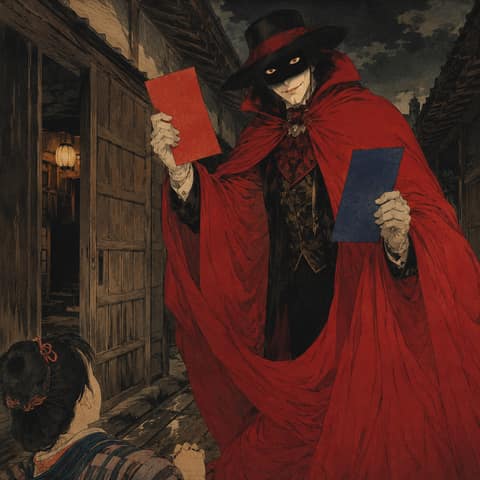
Re-systematization in the 1990s "School Ghost Stories" Boom. During the 1990s, amidst the "School Ghost Stories" boom sparked by Toru Tsunemitsu's *Gakkou no Kaidan* (1990) and fueled by children's books and TV shows, Mary-san's Phone Call became a standard repertoire piece. It frequently appeared in Toho's 1995 *School Ghost Stories* film series and various ghost story variety shows. Through this process, what was originally an oral tradition originating in the Kanto region was consolidated into a nationwide urban legend. Alongside contemporaries like "Kashima Reiko," "Teketeke," and "Aka Manto" (Red Cape), it forms a core component of post-war school ghost stories.

The Dramatic Structure of "Right Behind You". The story's final phrase, "I am Mary-san, I am right behind you," serves as a classic example of dramatic reversal (peripeteia) in urban legends and has been the subject of both literary criticism and folklore studies. Because the physical act of holding a phone receiver to one's ear implies that "the field of vision is diverted from behind," the moment the voice on the phone finishes speaking, the physical action of turning around is inherently delayed. Incorporating this physical time lag into the horror structure is the unique genius of Mary-san's Phone Call. The 2011 film adaptation similarly anchors its narrative around this climactic final line.

Character Profile

This section is our own creative profile for storytelling. It is not historical fact or scholarship.

Yokai Type
Modern Kaii
Rarity
Legendary
Personality
Devoid of emotional fluctuation, she plainly states her location using repetitive phrasing. She does not directly express anger or a grudge, but the very act of closing the distance functions as a mechanism of terror.
Compatibility
Reacts most sharply to children who harbor guilt over throwing away personal belongings or old toys. The feeling of "wasting or mistreating an object" is the ethical core of the legend.
Abilities
Calls from an unknown number with an untraceable locationSequentially announces her current location over the phone receiverPhysically compresses the distance with each repeated phraseUltimately teleports directly behind the targetMaterializes in the physical form of the discarded doll
Weaknesses
Do not answer the phone, do not pick up the receiver, do not throw away the doll (avoidable through ethical choices). There are no physical repulsion methods in the lore (structurally, it is a narrative type about avoiding the "sin of discarding").
Habitat
Urban residential areas, schools, and landline phones in ordinary households. Manifests as an extension of everyday spaces such as children's rooms, entryways, stairs, and directly behind the victim.
🔮Yokai Compatibility Test

For more detailed information and diagnosis results about Call from a Discarded Doll / The Girl Spirit Behind You, please click here.

Sources & References

3
  1. 3 本足のリカちゃん人形 ── 真夜中の都市伝説松山ひろし(イースト・プレス, 2003) [都市伝説研究]現代日本の人形系都市伝説を編纂した松山ひろしによる代表作。 メリーさんの電話の起源を、 1968 年タカラ開始のリカちゃん電話 (自動応答サービス) を巡る不気味な噂の変奏として整理し、 商標·企業イメージへの配慮から「メリーさん人形」 へ置換された口承過程を考察。 84-87 頁。
  2. 都市の穴木原浩勝・岡島正晃・市ヶ谷ハジメ(双葉社, 2003) [都市伝説研究]現代日本の都市怪谈群を「都市の穴」 と総称して編纂した平成中期の代表的都市伝説集。 メリーさんの電話を一篇として収録 (218-219 頁) し、 再帰的口承生成構造の典型例として位置づける。 木原浩勝は『新耳袋』 系列の怪谈作家としても知られる。
  3. 怖すぎる都市伝説松山ひろし(イースト・プレス, 2013) [都市伝説研究]松山ひろしによる平成後期の都市伝説総括書。 「第 28 夜·十三段」 でメリーさんの電話と階段系怪谈の反復語型の構造的類縁を指摘。 平成期に流通した電話·人形·階段系怪谈を学際的に整理した参考資料。

Interested in this type of yokai?

Discover the yokai most similar to your personality with our yokai diagnosis

Start Yokai Diagnosis

Meet your guardian yokai at the shrine

Draw an omikuji fortune and discover the yokai watching over you today.