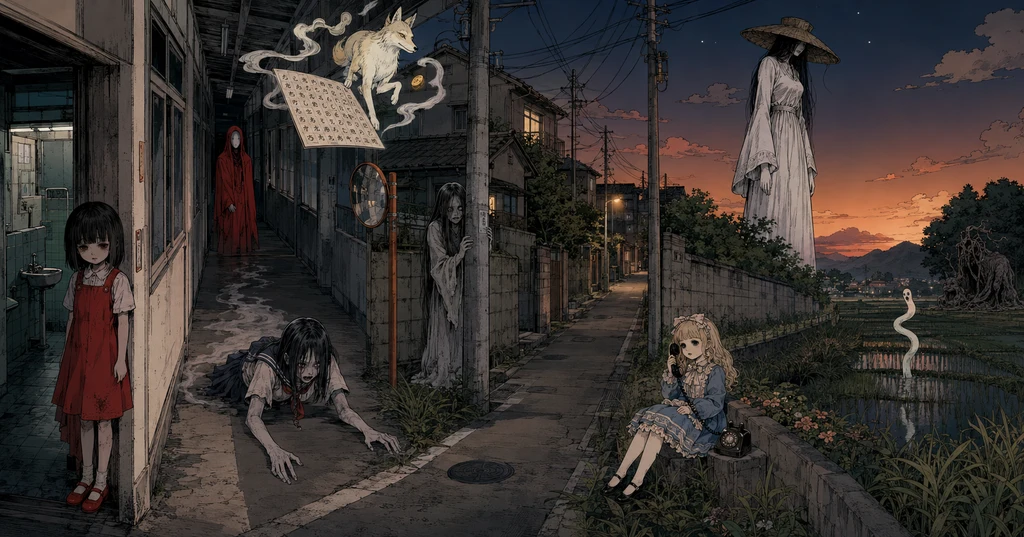
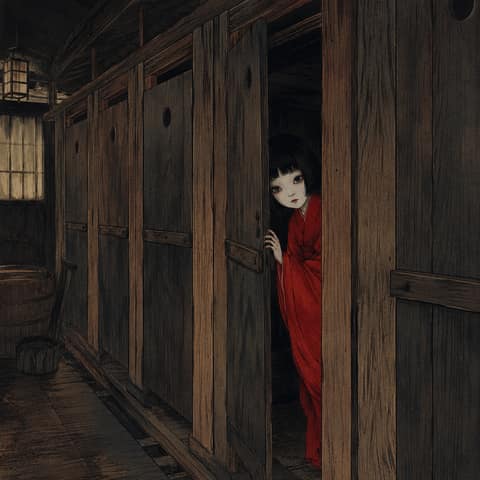
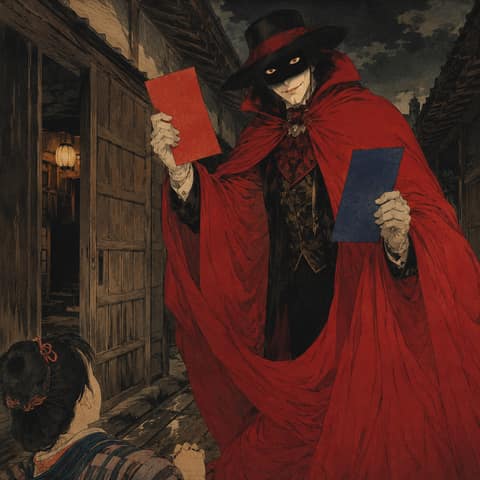
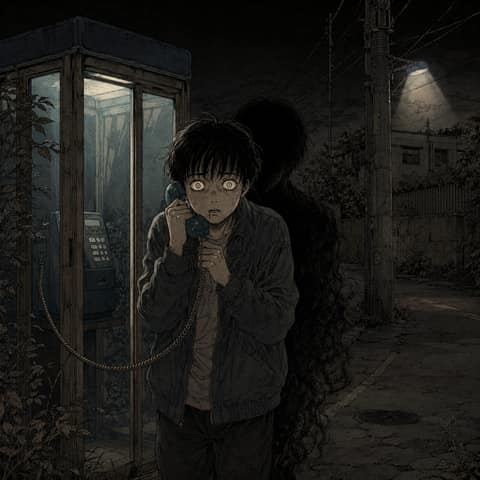
Satoru-kun is a modern urban ghost story about an entity who, when called via telephone, will answer any question in exchange for approaching the caller's back. In typical tellings, one calls their own mobile phone from a public payphone or makes a call following specific steps, and receives a call back from Satoru-kun. He gradually approaches while announcing his location, finally standing right behind the caller. The desire to get an answer and the taboo of never turning around are combined into a single ritual.
This anomaly stands halfway between divination rituals like Kokkuri-san and approaching-telephone ghost stories like Mary's Telephone. Because he grants wisdom by answering questions, he is not merely a convenient prophet, as his approach is the price for the answer. Referring to the lineage of telephone-based urban legends collected by Hiroshi Matsuyama, the telephone has been feared as a hole through which the other party can invade, even as it is a tool to safely connect with distant parties[1]. Satoru-kun turns that hole into a divination window.
The name "Satoru" softly contains the meanings of comprehending, knowing, and gaining answers. The suffix "-kun" makes it easy for children to call, keeping the terror from becoming overly archaic and allowing it to blend into public phones after school or mobile phone call histories. According to the characteristics of modern anomalies categorized in Itsuki Asazato's "Encyclopedia of Modern Japanese Anomalies," Satoru-kun is an "executable ghost story" that exists because the ritual steps are shared online or by word of mouth[2]. Readers are placed in a position where they can try it if they wish, rather than just listening.
The terror of Satoru-kun is that he seems rather appealing while he is far away. Someone on the other end of the phone holds the answer you want to know. But that voice is not a counselor; it is something walking toward you. Because the desire for knowledge fuels the shortening of distance, the very feeling of wanting to be smart, to know the future, or to solve a secret becomes the gateway for the anomaly.
Folklore & Legends
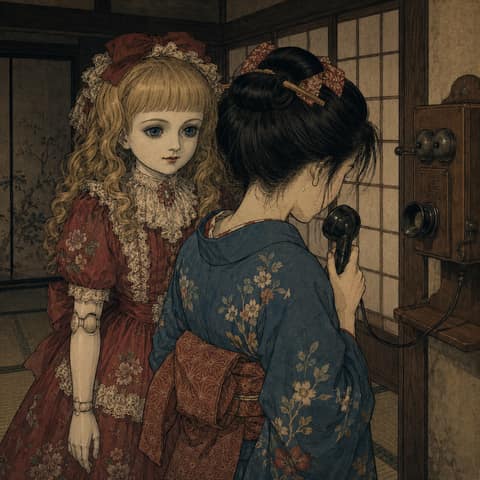
The steps for Satoru-kun vary depending on the telling, but the use of a telephone as a medium is common. Elements such as a public payphone, a ten-yen coin, one's own mobile number, and blocked caller IDs or callbacks are combined, ending with a call like, "Satoru-kun, Satoru-kun, please come." Then, a call comes from one's own number or a mysterious number, and he approaches while stating his current location. When he reaches your back, you are allowed one question, but it is said to be dangerous if you turn around.
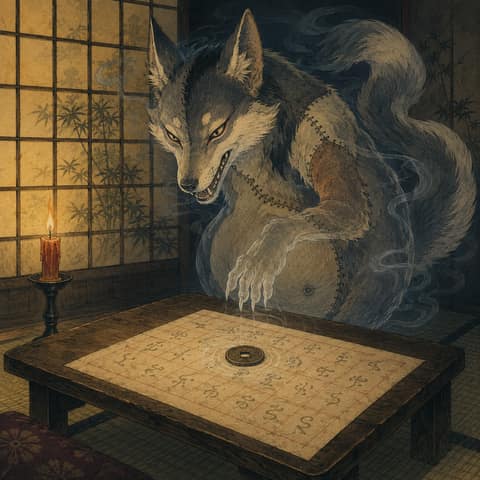
As a ritual ghost story, its closeness to Kokkuri-san is significant. Both use the desire to know as an entryway and carry warnings against calling half-jokingly. However, while Kokkuri-san is a group ritual surrounding paper and a coin, Satoru-kun is done one-on-one over the phone. In the lineage of postwar school ghost stories organized by Toru Tsunemitsu, shared spaces like school restrooms and stairs became the stages for ghost stories, but in telephone ghost stories after the Heisei era, personal devices and histories became the stage. Satoru-kun clearly demonstrates this transition.
The difference from Mary's Telephone is that the approach is not a one-sided pursuit, but designed as a reward for a question. Mary approaches while announcing her location, but Satoru-kun holds the appeal of "answering anything" at the end. Therefore, the terror is directed not only at escape but at managing one's desires. You want to know, but you must not know. You want to hear, but you must not look at what is behind you. This double bind transforms a mere telephone ghost story into a ritual[1].
It is a nationally distributed urban legend, making it difficult to pinpoint a specific origin. Even after public payphones decreased and mobile/smartphones became widespread, Satoru-kun remained as a "ghost story of disappearing phone booths." As pointed out in "Solving 'Urban Legends'" compiled by ASIOS, urban legends change shape when society's tools change[4]. In Satoru-kun's case, the more the steps of the old public payphone remain, the more the ritual takes on a rather curse-like weight.
The loneliness of the individualized communication era is also engraved in this ghost story. While many school ghost stories are tested among friends, Satoru-kun requires pressing the numbers alone and waiting for the call alone. There is little room to be scared with someone else. You are the only one who gets the answer, and you are the only one who has someone standing behind you. As a ghost story for an era when the telephone became a personal possession, Satoru-kun is designed with extreme precision.
This version of Satoru-kun appears as a prophet coming from the other end of the phone. He is not merely an anomaly of pure malice. He has a clear function: answering the caller's question. That is precisely why he is dangerous. If it were only terror, people could avoid it, but thinking they might get an answer draws them to the dangerous steps. Satoru-kun sees through that curiosity.
The medium of the telephone allows only the voice to arrive first. An entity with no face or body announces its location right in your ear. When that distance shortens to "I'm at the station now," "I'm in front of your house now," "I'm right behind you now," the phone changes from a communication device to a summoning path. Like the cluster of telephone urban legends collected by Hiroshi Matsuyama, Satoru-kun's terror is born the moment remoteness reverses into proximity[1].
A comparison with Kokkuri-san illuminates this anomaly's personality well. Because Kokkuri-san involves multiple people surrounding the paper, responsibility is dispersed among the group. Because Satoru-kun requires calling alone, responsibility returns entirely to the individual. There is no escape route of "Didn't someone else move the coin?" Call histories, ringtones, and your own voice become the only evidence. The feeling of wanting to know becomes the very signature for the summoning.
The endpoint of standing behind the caller is also important. Because he is behind rather than in front, the desire to confirm is born. But the moment you confirm, you break the taboo. This is an old ghost story structure: the other world is exposed when prohibitions like "do not look," "do not open," or "do not turn around" are broken. Despite being a telephone ghost story, Satoru-kun is an entity that has transferred the "must not look" archetype—shared by the Crane Wife, Urashima, and Yomotsu Hirasaka—to modern devices.
Following Itsuki Asazato's categorization of modern anomalies, Satoru-kun is strong as a "ghost story with a method"[2]. Rather than just listening to a scary story, the steps are written out. When there are steps, people are forced to choose whether to try it or not. That choice is already a participation in the story. Even readers who do not execute it will mentally lift the receiver of a public phone, press the numbers, and hear the ringtone.
Because public payphones themselves have decreased in modern times, Satoru-kun may look like an antiquated ritual. But the decrease does not weaken the anomaly; it concentrates it. The phone booth left in the corner of the station, the green phone in the hospital corridor, the fogged glass on a rainy day. Unused communication devices look like ritual tools left solely to connect this side and the other side. Satoru-kun stands in the place where a tool that has lost its convenience regains a magical nature.
The final remaining question is what to do after getting the answer. Satoru-kun answers the question, but he will not necessarily save your life. Far from erasing anxiety, knowledge confirms the fact that something is behind you. This anomaly shows the paradox often found in divination ghost stories—the moment when the wish "knowing brings peace of mind" flips to "I can't escape because I know"—through the distance of a single phone call. Therefore, he is a prophet, and simultaneously a punishment for knowledge.
Character Profile
This section is our own creative profile for storytelling. It is not historical fact or scholarship.
Telephone summoningQuestion answeringCurrent location notificationRear approachTurning-around tabooCall history interferenceCuriosity induction
Weaknesses
Weak against actions that refuse to complete the ritual, such as stopping the steps midway, having no question to ask, or hanging up without checking behind.
Habitat
Public payphones, late-night call histories, phone booths on the way home from school, old mobile phones, solitary calls heard by no one.
The diagram below is a diagnostic evaluation chart for The Telephone Prophet Approaching from Behind. The higher the value of each item, the stronger that characteristic is expressed.