YOKAI.JP

Hachishakusama(Hasshakusama)

AdPractical Japan travel guides · 2jp.cc

Basic Description

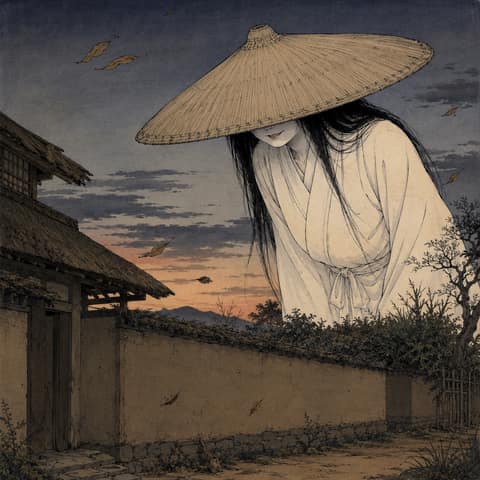
At the beginning of spring break, an unintelligible humanlike sound comes from a farm garden. After a sound wavering between po and bo, a hat passes above a hedge about two meters high, and a woman in a pale dress appears through a gap, her head higher than the hedge. Hachishakusama is one of modern Japan's best-known internet ghost stories, beginning when familiar proportions suddenly cease to make sense.

When the narrator tells his grandparents, their manner changes at once. His grandmother says that the Hachishakusama in their district is, as her name implies, about eight shaku tall. She may look to different witnesses like a young woman in mourning clothes, an old woman in a formal kimono, or a middle-aged woman in work clothes. What remains constant is a female form, abnormal height, something worn on the head, and an uncanny laugh like a man's voice. Under the modern standard of measurement, one shaku is ten thirty-thirds of a meter, so eight shaku is about 2.424 meters. The text leaves the hat's color and shape, hair, and face undescribed, making room for diverse later imagery.

The setting is a district about the size of an ōaza, with its city and former-village names withheld. Four Jizō statues stand at the village boundaries in the cardinal directions, blocking Hachishakusama's routes. The narrator spends the night from sunset until 7:00 the next morning in an upstairs room protected by paper talismans, sealed windows, salt at the four corners, a small Buddhist image, and prayer. In the night, a voice nearly identical to his grandfather's calls outside the door as something lightly taps the window. The next morning he sits at the center of a nine-seat vehicle, surrounded in eight directions by seven distantly related men and K in the front passenger seat; her prayers and vehicles before and behind carry him beyond the district. Ten years later, a call says that the Jizō on the road to his home has been broken, leaving the fear that the voice may return.

The earliest verifiable starting point is posts 908 through 916 of "Shall We Collect Stories So Scary They Are No Laughing Matter? 196," posted to the Occult Board of the anonymous forum 2channel on August 26, 2008. The same anonymous user made nine consecutive posts in roughly nine minutes, from 9:45:56 to 9:54:54 a.m. The thread welcomed personal accounts and fiction alike, and no independent source is known to substantiate a real place or event. Hachishakusama is internet lore born from the union of a story shaped like an old memory of the land and the rapid, consecutive-post form of an anonymous message board.

By September 22, 2008, less than a month after the post, it had been reposted under the title "Hachishakusama" on a Sharekowa compilation site. It later became a subject of folklore and narrative research, while the video anthology *Fūin Eizō 16: Hachishakusama no Noroi* and the novel *Otherside Picnic* and its anime adaptation gave it a voice, face, clothing, and movement through new storytellers. Its cultural history lies in the way an apparition that began without an official illustration grew as it passed from bodies that read, to bodies that listened, to bodies that watched.

A Glimpse of Hachishakusama

The closer you get, the less distinct the presence becomes.

Folklore & Legends

The narrator's paternal grandparents lived on a farm less than two hours away by car. After he began riding a motorcycle in high school, he visited alone during summer and winter breaks; spring break before his final year would be his last visit. Relaxing on the broad veranda on a sunny day, he hears a sound like something between po and bo. It seems human-made but never becomes meaningful words. A hat above a hedge about two meters high moves sideways, and at a gap a woman in a pale dress appears. He tries to fit the sight into the familiar world, taking her for a tall woman in platform shoes or a cross-dressing man.

His grandparents' reaction turns this everyday misperception into a local danger. On hearing "a hat," "taller than the hedge," and "a strange voice," his grandfather refuses to let him leave and fetches an elderly woman named K. His grandmother says that a troublesome being called Hachishakusama lives in their district: a woman about eight shaku tall who laughs in a manlike voice, though clothing and apparent age vary by witness. A rumor that she once followed a traveler is offered not as a certain explanation of the place but as an old account that has long circulated.

Hachishakusama is confined not to all Japan but to one district. The post hides the present city and former-village names, saying only that the area is about the size of a modern ōaza. She has limited roads by which to leave, and four Jizō were enshrined at the village boundaries in the cardinal directions. The narrator speculates that, because neighboring villages had arrangements giving priority to water-use rights, the district may have chosen to keep the apparition within its limits if harm came only every few years or every decade or so. The arrangement gives the story specificity but is not evidence for an actual village history.

The night's protection is made by layering objects and acts, not by a single infallible charm. K gives the narrator a paper talisman. In an upstairs room, windows are sealed with newspaper and talismans placed over it; salt is piled in four corners and a small Buddhist image set down. He is told not to leave until 7:00 a.m. and that his grandparents will not call to him. Soon after 1:00 a.m., something lightly taps the window and a voice nearly identical to his grandfather's invites him outside. As he almost approaches, he remembers the warning. The salt turns black, and the ambiguous laugh and tapping continue. The confinement lasts one night, not seven days.

Around 7:13 a.m. the voice and sounds stop, but the danger shifts to a group effort to take him beyond the district. He sits in the center of a nine-seat van, surrounded in eight directions by seven distantly related men and K in the front passenger seat. K chants something like a Buddhist invocation; his grandfather's light truck leads and his father's car guards the rear. A pale-dressed figure keeps pace, bends to peer through the windows, and taps the glass. Only the narrator seems able to perceive her form and laugh, though the others react to the tapping. Once they leave the district, the talismans are blackened, and he returns home with his father carrying new ones.

The danger is not a monster defeated by individual courage, but something endured through family, kinship, local knowledge, and movement beyond a boundary. The narrator's father says that a friend noticed by her died in his own childhood and that some people left the area. People who have not reached adulthood, especially children, are said to be most vulnerable, but no sex is specified. The narrator is kept from even attending his grandfather's funeral and from ever approaching the place again.

Ten years later, his grandmother says one Jizō that seals Hachishakusama has been broken: the one on the road to his home. The account does not say what happened to the other three or whether she crossed that road. It ends as he tells himself it is superstition while fearing the voice's return. The possibility that one road has opened extends the fear after the post ends.

The nine consecutive posts appeared on the morning of August 26, 2008. Their setting remains redacted, with no clue identifying a real place. The thread welcomed personal experiences, secondhand stories, and fiction, while the poster consistently frames this as a past experience. The anonymous post and its later preserved reposting are the parts of Hachishakusama's publication history that can be traced with certainty.

The Wayback Machine preserves a Sharekowa compilation page that had collected the nine posts under the title "Hachishakusama" by September 22, 2008. The story was thus early separated as a named ghost tale for readers who had not seen the original thread. Kōsuke Oshimi places Hachishakusama alongside Kune-kune as a well-known Sharekowa work and describes how encountering a local apparition in the countryside and being saved by someone who knows the area came to be seen as a characteristically Sharekowa pattern. Quantitatively, however, the whole thread contains more stories set at home or work than in mountains or the countryside. Hachishakusama is not its average story but a memorable work that became a measure of what later readers imagine Sharekowa to be.

Ryūhei Itō examines Hachishakusama as internet lore moving from text read on a message board, to spoken narration, to video composed on a screen. With no illustration in the first post, readers assemble a body from relative dimensions: a two-meter hedge, a second-floor window, and a head higher than a vehicle. Later pictures and videos supplied a white wide-brimmed hat, long black hair, and a young woman. The body that first varied by reader became a shareable image through repeated depictions, a process that forms part of its reception history.

In 2014, the video anthology *Fūin Eizō 16: Hachishakusama no Noroi* was released on DVD. Iori Miyazawa's first volume of *Otherside Picnic* incorporated Hachishakusama in 2017, and the fifth volume in 2020 carried the subtitle "Hachishakusama Revival". Episode 2 of the 2021 television anime is likewise titled "Hachishakusama Survival". Each work gives new body and action to gaps in the original post, passing Hachishakusama to different readers and viewers.

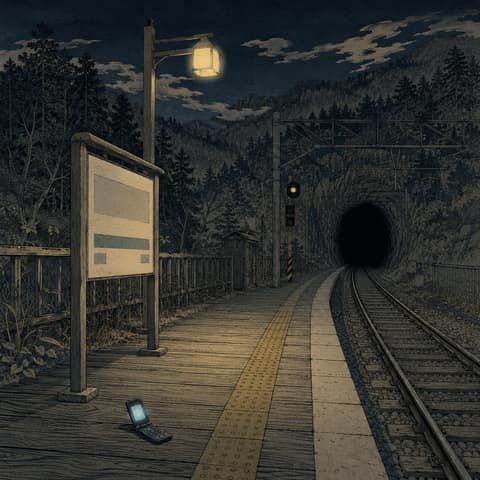
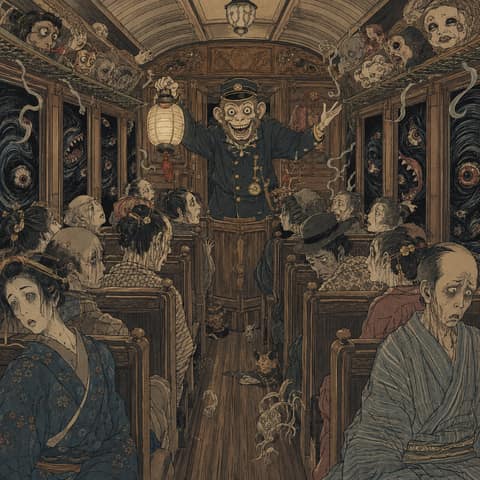
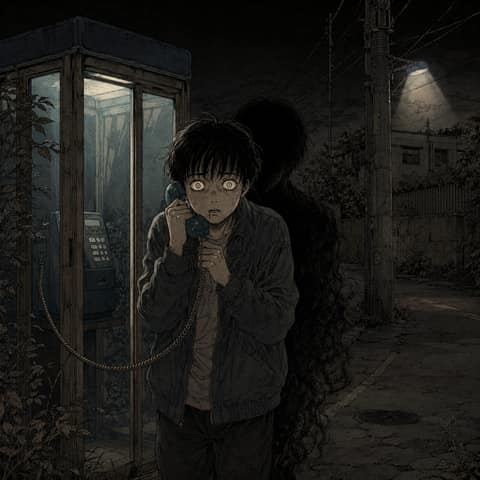
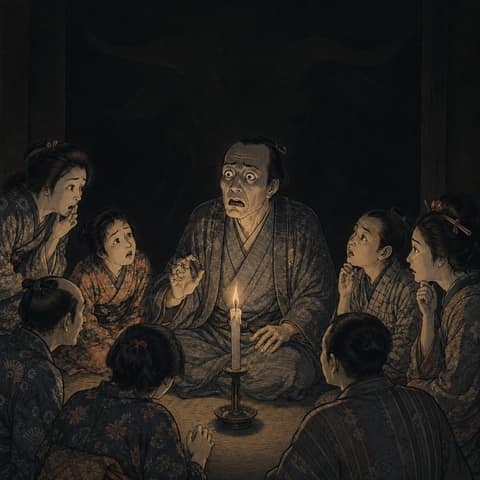
Yokai Cards3

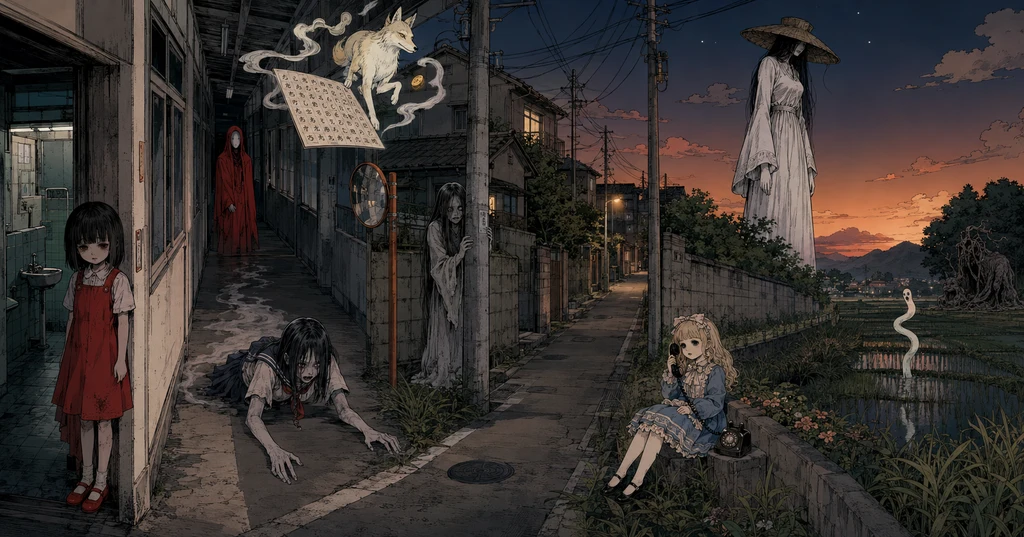
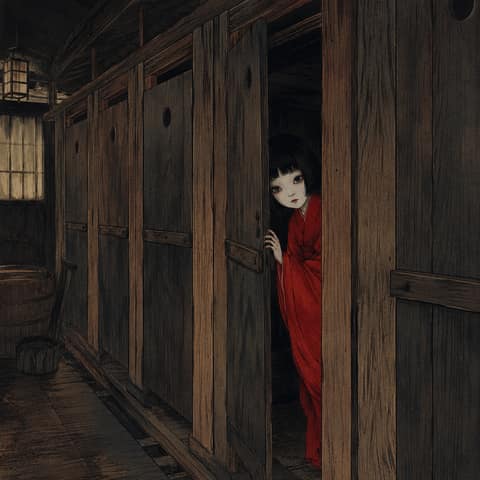
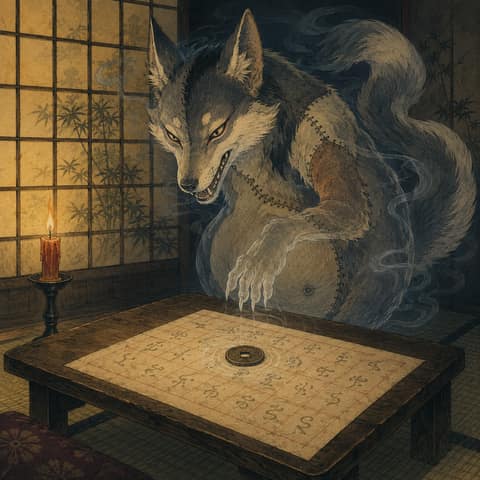
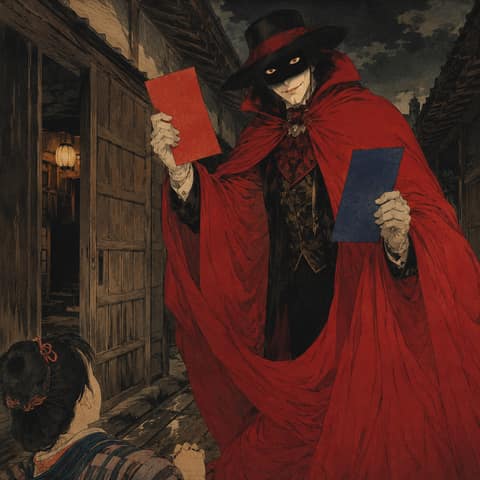
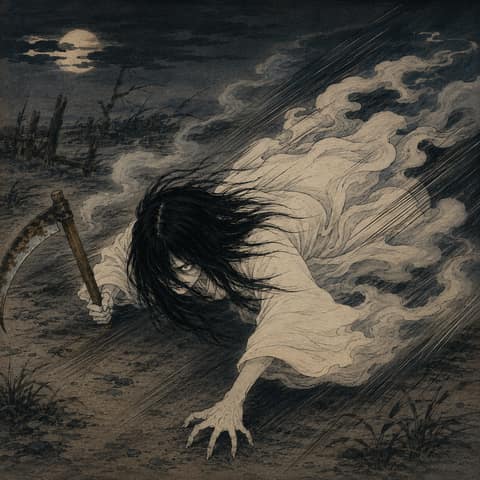
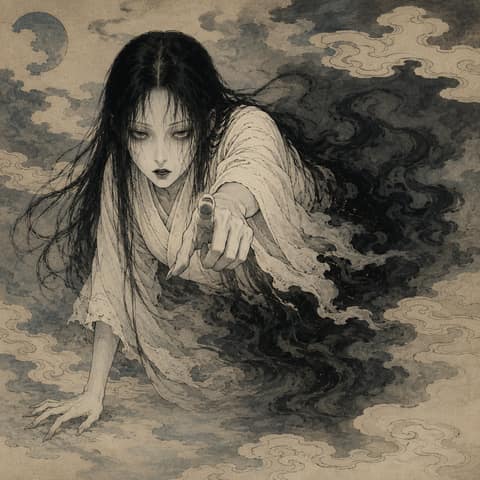
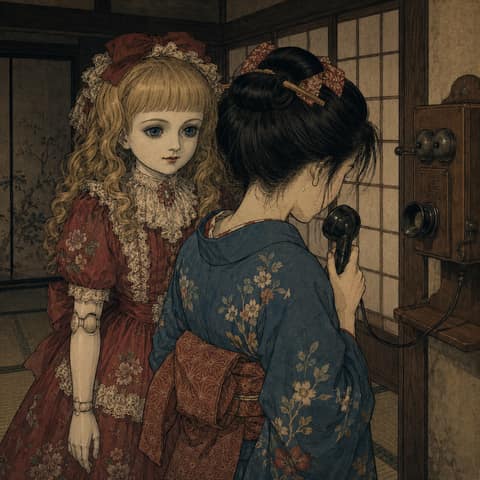
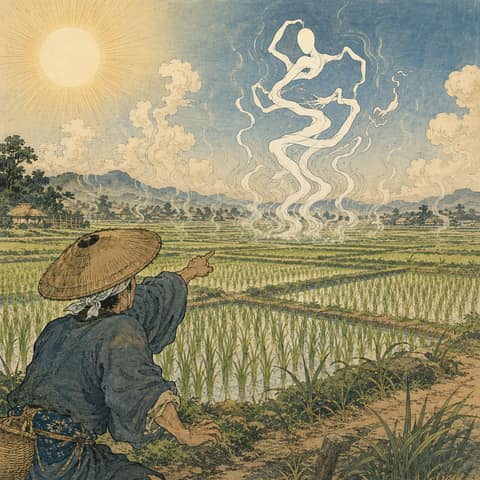
Hachishakusama across multiple art-style decks

Card gallery

Detailed Analysis

Nine Posts Completed in Nine Minutes

From posts 908 through 916, nine messages appeared at intervals of roughly a minute, bringing Hachishakusama's story to a close in about nine minutes. The thread's rules advised writers to finish a long story in advance and post it all at once. In the Sharekowa posting space, a completed event from the past flows onto the screen in a short span, and reading itself becomes the experience of receiving a ghost story. The reader is carried from a sunlit veranda to a sealed upstairs room, the inside of a vehicle, and the village boundary.

No grand apparition or ritual appears at the start. Instead, the text supplies ordinary details: a paternal family home, a farm, a motorcycle, spring break, and a warm veranda that still holds the season's chill. The narrator does not begin by believing in the uncanny. Seeing a hat move above the hedge, he assumes it belongs to a tall woman in platform shoes or a cross-dressing man. That mundane explanation makes his grandparents' changed reaction shift the reader from everyday life to ghost story.

A Humanlike Sound Arrives Before the Figure

Hachishakusama's first sign is sound, not appearance. It has no single fixed spelling: a brief po, a succession of poppo sounds, and a wavering that can seem voiced or unvoiced. The grandmother calls it laughter in a manlike voice. It is unnerving because it sounds as though a person made it rather than like a machine. As a humanlike voice that almost becomes meaningful speech but never does, it leaves the listener unable to tell who makes it or why.

At night, the sound suddenly becomes words almost identical to the grandfather's voice. The source does not say whether the thing tapping at the window and the one urging the narrator out are the same being. Yet the grandfather has already promised that he will never call to him before morning. That promise is the only test for distinguishing the real voice from the false one. The terror lies not in noise alone but in having to doubt the voice of someone who should be reassuring.

An Eight-Shaku Height Is Seen Through Comparison

If one shaku is ten thirty-thirds of a meter, eight shaku is approximately 2.424 meters. The story conveys this not in a measurement scene, but through a head above a hedge about two meters high, a head remaining outside the view from a car window, and a head lowering itself to peer into a vehicle. Fear comes less from the number than from hedges, windows, and vehicles made for human proportions no longer fitting.

The source's "about eight shaku" is a guide linking name and appearance, not an exact measurement. The usual conversion of roughly 2.4 meters is useful, but there is no need to insist that she is exactly that height. Her body is felt where familiar buildings and vehicles lose their expected scale.

More Than One Appearance

The narrator sees a hat and a pale dress. His grandmother says that others may see a young woman in mourning clothes, an old woman in a formal kimono, or a middle-aged woman in work clothes. The text does not describe the hat's color or shape, hair length, or face; the woman in the pale dress is only one of several appearances that change by observer.

A female form, abnormal height, something on the head, and laughter remain constant, while clothing and apparent age vary. Later illustrations repeatedly supplied a white wide-brimmed hat, long black hair, and a young woman, drawing the once-variable body toward a shared design. The variations recorded in the original post and the representative image popularized later belong to different periods in Hachishakusama's history.

Four Jizō Mark Off the District

The setting is not an endless space called "rural Japan," but one district, a former village about the size of a modern ōaza. She has limited roads by which to leave, and four Jizō stand at the eastern, western, southern, and northern village boundaries. One Jizō does not defeat the apparition by itself; together they hold the roads and create a bounded territory. The grandparents' plan to protect the narrator for one night and take him beyond the district the next morning has meaning only because there is a boundary.

An arrangement with neighboring villages over water-use rights is presented as hearsay and speculation. It is not a record of an actual practice, but the idea of exchanging the benefit of confining the apparition for a practical local benefit gives the village social depth. It imagines not simply good villagers suffering a monster they cannot defeat, but a more unsettled community negotiating with its neighbors in return for accepting danger.

One Night's Protection Is Not a Defeat

K's safeguards are paper talismans, windows sealed with newspaper, salt piled at four corners, a small Buddhist image, prayer, and a promise not to answer anyone's voice until 7:00 a.m. The salt turns black overnight, and the talismans are blackened after the party leaves the district. Several safeguards temporarily hold back Hachishakusama's effects while the others prepare an escape.

The narrator stays in the room for one night, from sunset until the next morning. He wakes after 1:00 a.m., endures the window sounds and borrowed voice, and opens the door around 7:13 when the morning television news confirms the time. These clock details tie open-ended fear to ordinary time. Morning does not complete a defeat: protection passes from room to vehicle, and from four still corners to eight moving directions.

Kin Make a Moving Enclosure

In the next morning's escape, the four corners of the room are replaced by eight directions in a nine-seat vehicle. The narrator sits at its center, surrounded by seven men who are relatives, however distant, and K. His grandfather protects the front, his father the rear, and K continues to pray from the front passenger seat. It is also said that the grandfather or father was prepared to stand in for him if necessary. Their bodies and K's prayer become a moving screen and barrier, not merely his own talismans.

Hachishakusama walks beside the vehicle and lowers her head to look through its windows. The others seem unable to perceive her form or voice, but they react to tapping on the glass. The story neither closes her off as one person's hallucination nor presents her in the same way to everyone. Sight, voice, and physical sound reach different groups, preserving both the narrator's isolation and the group's tension.

Only One Statue Is Broken

Ten years after the incident, the grandmother reports only that the Jizō on the road leading to the narrator's home has broken. We do not know the state of the other three or whether Hachishakusama crossed that road. He tells himself it is superstition while fearing that he may hear the voice again.

This unresolved ending invites retellings. Readers can imagine sightings or another encounter beyond the one opened road. The first story does not declare a monster completely freed; it leaves only one route that may have become dangerously open.

The Feel of an Old Tale and Internet Lore

Jizō, talismans, salt piles, a Buddhist image, Buddhist invocation, village boundaries, a former village, kinship, and water-use rights give readers a feeling of memory rooted in the land. Oshimi argues that encountering a local apparition in the countryside and being saved by someone who understands the circumstances came to be recognized as a Sharekowa template through well-known works. The post does not reproduce any particular book of magic; it brings familiar religious objects and communal relationships together in one story, creating historical depth within an anonymous post.

Ryūhei Itō discusses Nobiagari and Hachishakusama under the title "The Bodies and Yōkai of Electronically Transmitted Tales". Comparing this internet ghost story, published in 2008, with an older apparition reveals how a body that breaks the ordinary scale of hedges and roads has been imagined in different periods. The comparison does not establish a direct lineage; it reads how each story uses an abnormal body.
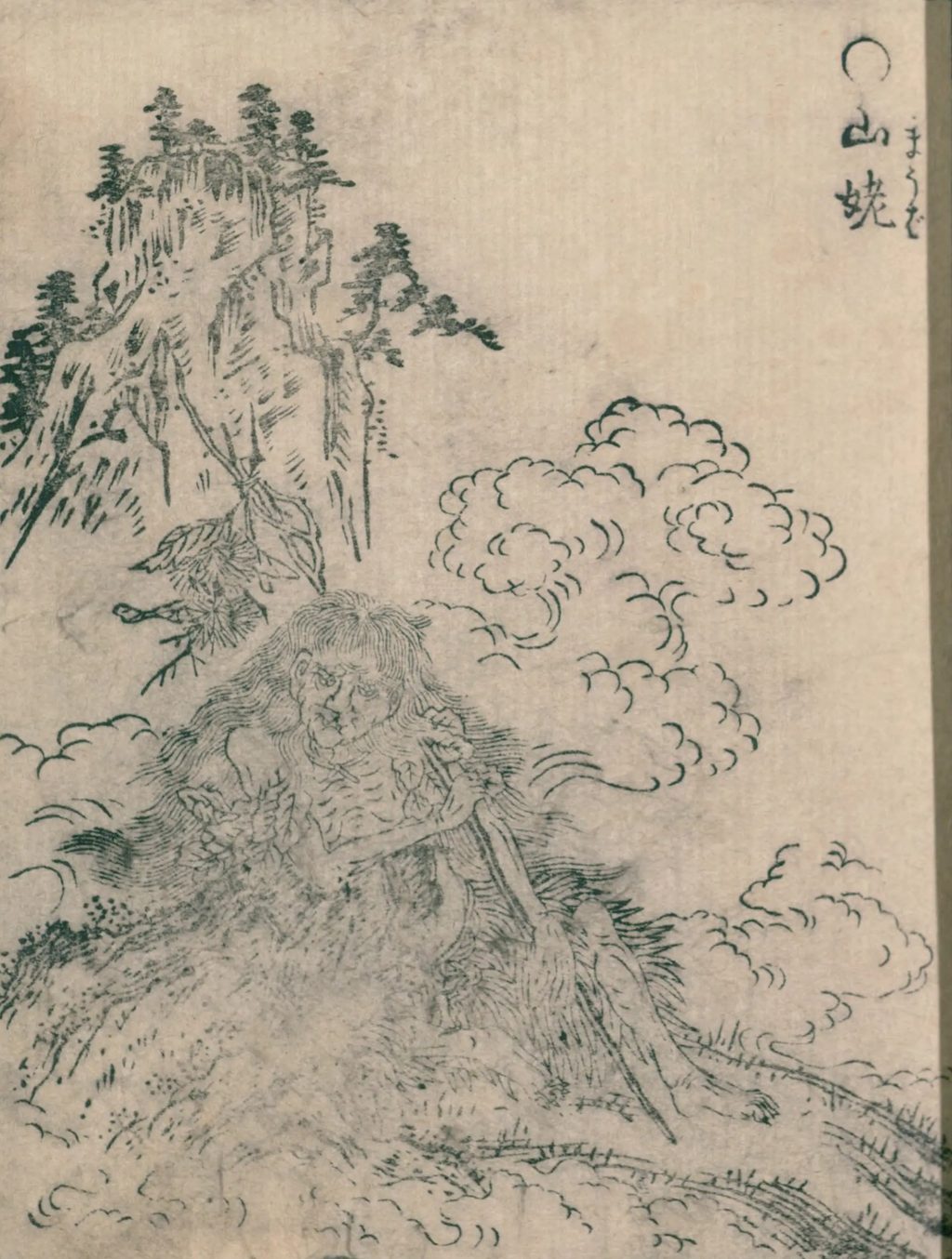
Toriyama Sekien's Yamauba, showing a long-haired mountain crone seated in the mountains, with rocky peaks and clouds behind her
Comparative source: Toriyama Sekien's Yamauba
A yamauba painted by Toriyama Sekien in the early modern period. It can be compared as an earlier visualization of an uncanny female being, but it is not evidence for a source or direct model of the 2008 Hachishakusama post.
Toriyama Sekien, *Hyakki Yagyō*, three volumes with three supplementary volumes [1], 1805, National Diet Library Digital Collections
著作権保護期間満了
原画から山姥の画面を切り出し、表示用に縮小した。色調は変更していない。

How an Unpictured Apparition Acquired a Form

The original post has no illustration. Readers construct a body from sound, a hat, a hedge, pale cloth, and a car window. Itō treats Hachishakusama as internet lore moving from text-based electronic transmission to audio and video, arguing that a change of medium also changes the recipient's bodily position. In a spoken reading, a performer must resolve the ambiguity between po and bo into one sound; in video, makers must decide the hat's shape, hair, face, and clothing length. Each re-creation fills gaps in the original text with new particulars.

A young woman in a white wide-brimmed hat and long black hair has consequently become the representative image. It is a contemporary reconstruction: many artists gave contour to the 2008 clues of a hat, pale clothing, and height. Together, the original post's variable female figure and the representative image formed collaboratively online show how an apparition without imagery gained a shared face.

New Tellings in Video and Fiction

The 2014 *Fūin Eizō 16: Hachishakusama no Noroi* is an early commercial video to bear Hachishakusama's name in its title. In 2017, *Otherside Picnic* incorporated Kune-kune and Hachishakusama into an alternate world where dangerous beings appear, and the second television-anime episode adapted the material as "Hachishakusama Survival". The 2020 fifth volume, *Otherside Picnic 5: Hachishakusama Revival*, brings Hachishakusama back into the same series.

Each work adds its own body, actions, and worldbuilding to the original post's gaps. By cultivating different Hachishakusamas around the brief 2008 ghost story, storytellers in each medium turned the woman once confined to one district at a village boundary into a cultural image recognized across generations.

Character Profile

This section is our own creative profile for storytelling. It is not historical fact or scholarship.

Yokai Type
Modern Kaii
Rarity
Legendary
Personality
She makes her form and voice known to young people she has noticed, then tries to lure them beyond their protection by calling in a voice like that of a relative.
Compatibility
In the post, people who have not yet reached adulthood—especially children—are said to be vulnerable. Rather than confronting her alone, they rely on people who know the locality, kin, layered safeguards of talismans and prayer, and escape beyond the boundary.
Abilities
Appears with an extraordinary height of about eight shakuMay look like women of different ages and clothing to different witnessesProduces an ambiguous, humanlike laugh that is difficult to distinguish as po or boPursues people she has noticed primarily by making her form and voice perceptible to themUses a voice almost identical to a relative's to lure people outside a sealed room
Weaknesses
In the post, four Jizō statues at village boundaries in the cardinal directions prevent Hachishakusama from moving beyond the district. Paper talismans, sealed windows, salt at four corners, and prayer before a Buddhist image are used together as a one-night safeguard; the next morning the narrator retreats beyond the boundary in a vehicle surrounded by kin. The account does not say that any one method defeats her by itself, and no permanent means of defeating her is known.
Habitat
A district roughly the size of a former village or a modern ōaza, with its location withheld. She appears in the grandparents' garden, above hedges, at house windows, on roads through fields, and at village boundaries. No actual prefecture, city, town, or village can be identified.
Sources & References

10
  1. 「メートル原器の重要文化財指定について」産業技術総合研究所(国立研究開発法人産業技術総合研究所, 2012) [公的資料]尺貫法の換算として1尺を10分の33メートルと示す公的資料。八尺は約2.424メートルに相当する。
  2. 「死ぬ程洒落にならない怖い話を集めてみない?196」レス908~916匿名投稿(ID: VFtYjtRn0)(2ちゃんねるオカルト板, 2008年8月26日) [ネット一次記録]2008年8月26日午前、同一IDの匿名利用者が約9分間に投稿したレス908~916。八尺様の現在確認できる最古の公開記録であり、投稿本文と公開日時を確認できる。物語内の事件が現実に起きたことを証明する資料ではない。
  3. 洒落怖まとめサイト「八尺様」洒落怖まとめサイト(洒落怖まとめサイト(Wayback Machine保存), 2008年9月22日までに公開) [早期再掲]元スレッドの9件を「八尺様」の題でまとめた早期再掲。投稿後1か月以内に独立した題名付き怪談として流通していたことを示す。
  4. 「『のびあがり』と『八尺様』―電承説話の身体と妖怪」伊藤龍平(『世間話研究』21、22~39頁, 2013) [研究論文]のびあがりと八尺様を「電承説話の身体と妖怪」の観点から掲げた研究論文。八尺様が民俗学・説話研究の対象となったことを示す。
  5. DVD『封印映像16 八尺様の呪い』(アットエンタテインメント, 2014年) [映像資料]2014年に発売された『封印映像』シリーズ第16弾。八尺様が商業映像へ取り込まれた受容史を示す。
  6. 『裏世界ピクニック』第1巻宮澤伊織(早川書房, 2017) [小説・受容資料]八尺様を作品世界へ取り込んだ小説第1巻。2017年以後の継続的な再創作を示す公式書誌。
  7. 「ネットロアで語られる場所を巡る一考察」押見皓介(『常民文化』45, 2022) [研究論文]洒落怖で語られる場所を数量的・類型的に検討し、八尺様と田舎型ネット怪談の位置を論じる大学紀要論文。
  8. 『ネットロア―ウェブ時代の「ハナシ」の伝承』伊藤龍平(青弓社, 2016) [研究書]ウェブ上の怪談が文字、音声、動画へと媒体を移りながら伝承される過程を扱う研究書。八尺様の受容史を考える基礎資料。
  9. 『裏世界ピクニック5 八尺様リバイバル』宮澤伊織(早川書房, 2020) [小説・受容資料]副題に「八尺様リバイバル」を掲げ、同じシリーズで八尺様を再登場させた小説第5巻。
  10. テレビアニメ『裏世界ピクニック』第2話「八尺様サバイバル」『裏世界ピクニック』製作委員会(テレビアニメ『裏世界ピクニック』公式サイト, 2021) [アニメ・受容資料]八尺様を題名に掲げたテレビアニメ第2話の公式エピソード情報。

Interested in this type of yokai?

Discover the yokai most similar to your personality with our yokai diagnosis

Start Yokai Diagnosis

Yokai Compatibility Test

The diagram below is a diagnostic evaluation chart for Hachishakusama, the Tall Woman in a Pale Dress. The higher the value of each item, the stronger that characteristic is expressed.

Meet your guardian yokai at the shrine

Draw an omikuji fortune and discover the yokai watching over you today.