Saruyume

saruyume

Saruyume

Saruyume

Their soul is listening — speak, and they will answer.

Basic Description

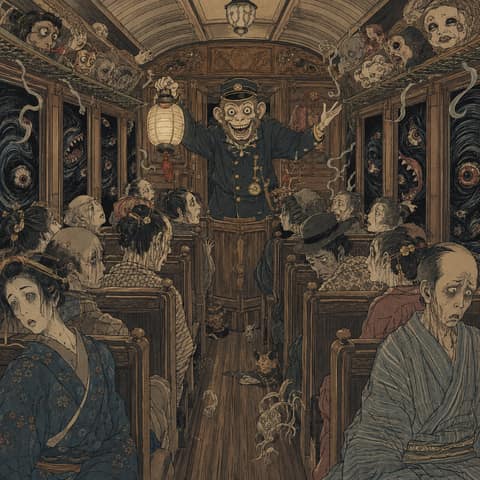
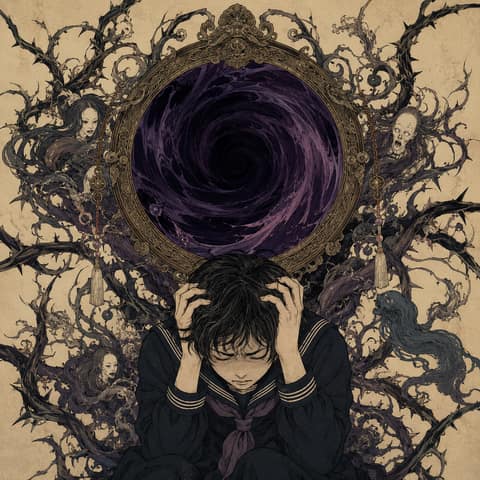
Saruyume (Monkey Dream) is an internet ghost story where one is made to board a strange train in a dream, and every time it stops, the passengers meet irreversible, gruesome fates. The stage is not a real-world station, but an amusement park-like vehicle that appears only in sleep, where a conductor or a monkey-like entity announces the next event. If Kisaragi Station is a ghost story that anomalies "the commute home," Saruyume is a ghost story that turns "sleep itself" into a public transit system. Among the modern anomalies covered in Itsuki Asazato's "Encyclopedia of Modern Japanese Anomalies," it is characterized by how a story seen in a dream is shared and read in a way that infects the reader's own dreams[1].

At the center of this ghost story is not a monkey as a distinct individual. Rather, the monkey acts as a presence announcing the absurdity of the dream, a freak show host, a train conductor, or an audience member treating humans as amusement rides. While classical incubi or the Makuragaeshi act directly upon the sleeping body, Saruyume establishes rules within the dream. What will happen next is announced; you want to escape but cannot, and even if you wake up, you are left with the anxiety that "if I fall asleep again, it will resume from where it left off."

As a modern urban legend, Saruyume spread not so much because of its terrifying content, but because of the format of posting and sharing dreams. As shown in ASIOS's "Solving 'Urban Legends'," the circulation power of an internet ghost story is determined not by the authenticity of the experiencer, but by whether readers can connect it to their own lives[2]. Everyone sleeps, and everyone dreams. Therefore, Saruyume can invade the bedside on the night you read it without requiring external devices like schools, stations, or telephones.

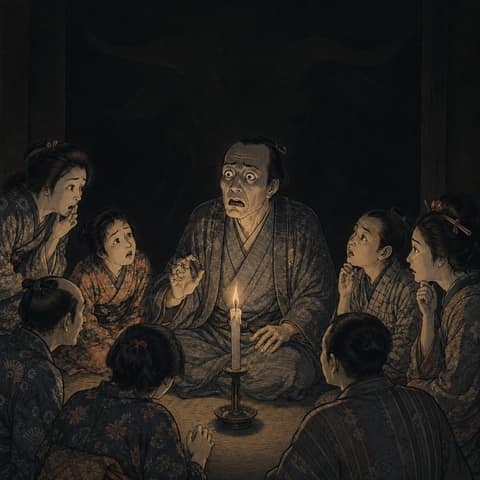
Saruyume is also important in that it transformed dreams from private experiences into shareable ghost stories. Originally, a dream could only be verified by the person who had it. However, when told as a forum post, readers feel as if they are sharing a ride on the dream train. In reality, no one is having the exact same dream, but by knowing the same plot, the number of passengers in the dream increases. This is the multiplying power of Saruyume as an internet ghost story.

Folklore & Legends

In typical tellings, the narrator is riding a small train or amusement park-like ride within a dream. There are other passengers, and soon an announcement like "Next is..." is made. At every stop and announcement, the passengers are subjected to horrific treatments one by one. Specific descriptions vary depending on the telling, but the crux is a structure where the events in the dream proceed like a freak show, and the narrator is pushed into the position of waiting for their turn[1].

The terror of Saruyume lies in the fact that it does not completely end upon waking. Many nightmares are dismissed as "just a dream" when you wake up, but in this ghost story, after waking up halfway, a preview remains that it might resume when you next fall asleep. Like the "time limit" of school ghost stories or the "approaching distance" of telephone ghost stories, this is a mechanism that carries the terror into the future. Despite being a ghost story about a dream, it binds the reader's real-world time, making the night after reading it a part of the story.

The image of the monkey here has a modern function distinct from old monkey gods or mountain anomalies. The monkey here is neither a divine messenger nor a mountain spirit, but a symbol of a somewhat comical, somewhat cruel audience. Because the vehicle in the dream brings amusement parks or freak shows to mind, fear and absurdity sit side-by-side. The tone of not knowing whether to laugh or be terrified is exactly the atmosphere of an anonymous message board ghost story. The characteristic of "ghost stories told while being verified" noted in ASIOS's urban legend compilation is also reversed in Saruyume due to the unverifiable realm of dreams[2].

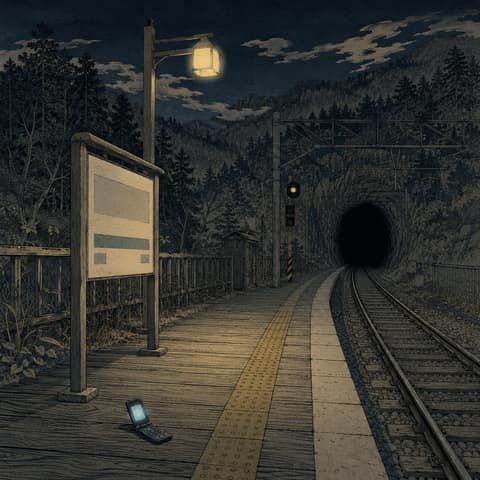
Its connection to the land is thin. Saruyume is not a ghost story tied to a specific school, station, or prefecture, but enters the sleeping environment of the person who reads it. Therefore, in geographical study, it is appropriate to treat it as a nationally distributed or creatively originated internet ghost story. Lacking a location, pillows, futons, smartphone screens, and summary articles read before bed become its entrance. It is an anomaly not found on maps, but the stage opens every time the reader closes their eyes.

From a folkloric perspective, Saruyume is also a modern version of tales involving "deaths predicted in dreams" or "recurring identical dreams." Old dream revelations were told as notices from deities or the dead, but in Saruyume, the announcer loses its sanctity, taking on an eerie lightness like an amusement park attendant. The dry touch typical of Heisei-era internet ghost stories is found in how dreams changed from revelations to announcements at an entertainment facility.

Detailed Analysis

This version of Saruyume is read as a single railway line laid out inside a dream. The train is a means of transportation, but simultaneously a device for determining order. Passengers are made to sit in seats, listen to announcements, and wait until their turn comes. The terror is not just what will happen. Because events are announced methodically like station names or sequences, the absurdity of the dream approaches wearing the face of a system, and that is what makes it terrifying.

The "monkey" in Saruyume is more of an MC's mask than the true form of the yokai. Monkeys resemble humans, but deviate slightly from human ethics. Thus, when a monkey-like entity laughs in a dream, the comicality of an amusement park and the coldness of an execution ground rise simultaneously. In old monkey god folklore, monkeys stand at the boundary between mountain and village, but in Saruyume, they stand at the boundary between sleep and wakefulness. They are not messengers of mountain gods, but petty attendants advancing a dream's performance.

The reason this ghost story is strongly remembered on the internet is that the telling is short and the structure is clear. You board a train, there are previews, passengers decrease, you wake up halfway, you become afraid of falling asleep next. This framework is concise, and even if readers forget the details, they do not forget the structure. Like many of the modern anomalies compiled by Itsuki Asazato, Saruyume is both a single completed story and a template re-enacted within the reader's brain[1].

Viewed as a dream ghost story, Saruyume modernizes the custom of "telling others the dreams you had." Superstitions like "bad dreams fade when told to others" or conversely "telling them makes them real" exist everywhere. In Saruyume, posting on a message board does not fade the dream; it duplicates it. Readers read someone else's dream and take home material similar to their own dreams. Here, the internet is a dream archive and simultaneously a medium that infects dreams.

The lack of place names in Saruyume's stage is not a weakness, but a strength. Kisaragi Station has an outline reminiscent of western Shizuoka Prefecture, but Saruyume does not even have that. Thus, readers can move the stage to any sleeping location: a futon at home, a nap at school, a seat on a night bus, a hospital bed. The feeling that "it could happen to me," which ASIOS emphasizes in the circulation of urban legends, is established with minimal conditions in Saruyume[2].

Getting off this train midway is made possible only once by waking up. However, the story does not treat waking up as an exit. Rather, waking up is an interruption, a preview of resumption. It does not allow the terror to be consumed in one night, but carries it over to the next sleep. This time design is the very anomaly of Saruyume, and the reason it encroaches on real-life rhythms despite using a dream as its stage.

If Saruyume were posited as a single yokai, its body would be the entire train, the voice, the sequence chart. Hands and feet directly chasing passengers cannot be seen. Instead, the voice announcing the next station name dominates the progression. This is the sense of security of a modern transportation system turned inside out into nightmare procedures within a dream. You don't know where you are heading, but the next stop is certain to come. That certainty elevates Saruyume from a mere nightmare to a memorable modern anomaly.

Character Profile

This section is our own creative profile for storytelling. It is not historical fact or scholarship.

Yokai Type
Modern Kaii
Rarity
Epic
Personality
Starts cheerfully like a freak show, layering previews to eliminate avenues of escape. Turns waking up into a pause, preserving terror until the next sleep.
Compatibility
夢の続きを気にしてしまう人、寝る前に怪談を読んでしまう人、説明できない不条理を物語として受け止められる人。
Abilities
Dream trainificationOrder previewWakefulness interruptionRe-sleep trackingFreak showificationMemory infectionAbsurd progression
Weaknesses
Weak against explanations that over-fix the contents of the dream, or overly specific location settings. Recording it immediately upon waking and returning it to everyday language also saps its power.
Habitat
Futons just before sleep, late-night message board logs, small trains inside nightmares, the backs of eyelids at night unable to forget what was read.
🔮Yokai Compatibility Test

For more detailed information and diagnosis results about The Nightmare Train with No Stopovers, please click here.

Sources & References

2
  1. 日本現代怪異事典朝里樹(笠間書院, 2018) [民俗・怪異事典]戦後からインターネット時代にかけて流布した現代怪異を整理した事典。現代都市怪談の項目確認に用いる。
  2. 謎解き「都市伝説」ASIOS 編 / 廣田龍平(彩図社, 2022) [学術書] Reference都市伝説の発祥年代を実証的に検証した書。トイレの花子さんについて、現在型(呼出して応答する型)の明確に年代を遡れる初出は 1960 年代後半とする。

Interested in this type of yokai?

Discover the yokai most similar to your personality with our yokai diagnosis

Start Yokai Diagnosis

Meet your guardian yokai at the shrine

Draw an omikuji fortune and discover the yokai watching over you today.