The Question Outlasts the Monster's Face
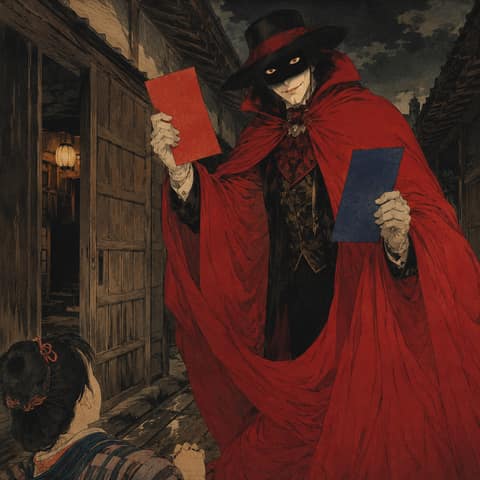
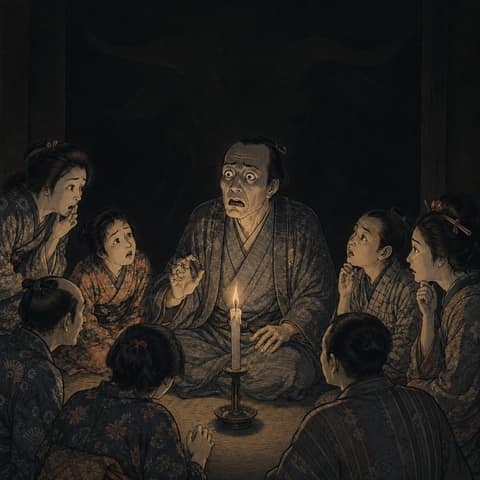
This account concerns not the man said to have roamed Tokyo streets in 1939, but the toilet ghost story in which schoolchildren choose colors or clothing. A recollection in which a cloaked man at a toilet entrance asks "A red mantle or a blue mantle?"[2] and versions asking for a paper color inside a stall or offering a red chanchanko[4] do not share the same noun or appearance. They are recognizable as one family because each demands a brief choice in an enclosed place and turns the spoken color into bodily fate.
At the start, the apparition offers no long origin. A child enters a stall alone, closes the door, and hears only "What color do you want?" The colors—red, blue, white, yellow—are familiar and the question easy. Having heard the rumor once, the child can imagine its continuation upon entering the same toilet. Its terror lives less in seeing a monster than in waiting for a question not yet heard.
The Chosen Color Becomes the Body
Color names are both items offered and predictions of what follows. In the Toyoshina recollection, red means being stabbed and stained with blood; blue means being drained of blood and turning blue[2]. In a Tokyo paper telling, red leaves the victim bloodied, blue means strangulation and a blue face, while white brings no harm[4]. In red-blue-yellow tellings, red is a rain of blood, blue blood loss, and yellow safety[5].
The paper or mantle need not actually be handed over. Those who choose red become red with blood; those who choose blue acquire a blue face or body. The object named in the question returns to the respondent's body. Even the red-chanchanko account ends not with ordinary clothing but with spattered blood that looks like a red garment. Color, body, and death are condensed into one vivid image.
A Third Color Makes an Escape
Add another color to red and blue and the ghost story gains a route out. White-safe and yellow-safe tellings mean that the question cannot be avoided, but the outcome is not fixed. A story reported in Fujisawa, Kanagawa, in 1990 has a voice ask three times at the fifth toilet from the right in the women's-staff restroom whether it should drape a red mantle over the listener. She answers, "I decline," and sees a figure with twelve swords through its back; flowing blood takes the form of a mantle[10]. Refusal may avert direct harm while leaving another dreadful image behind.
A third color or a refusal is not extraneous decoration. Children naturally ask what happens if they name another color, or say nothing at all. White, yellow, refusal, and silence are born from that continuation. A solution effective in one school need not work in another, however: each shared escape becomes part of a newly remade tale.
Mantle,
Paper,
Hanten,
Chanchanko
The object named in the question reshapes setting and ending. A mantle gives a person at the doorway an appearance; paper suits a commodity that may be absent from a toilet. Hanten and chanchanko allow the verb "put on" to lead to a body stained with blood and made to look clothed. Narazaki traces changes among mantle, paper, hanten, and chanchanko, as well as wordplay that turns hanten into "spots"[7]. Similar sounds can yield an ending in which spots appear on the skin.
Red is the base color. Of nineteen color-related Matsutani examples presented by Seikai, eight are red-blue, four red-white, and four red-blue-yellow[8]. Whichever set appears, the rule remains: the selected color corresponds to a bodily result. That concise rule, rather than a fixed name or face, makes the tales recognizably related.
Monster,
Ghost,
or Disembodied Voice
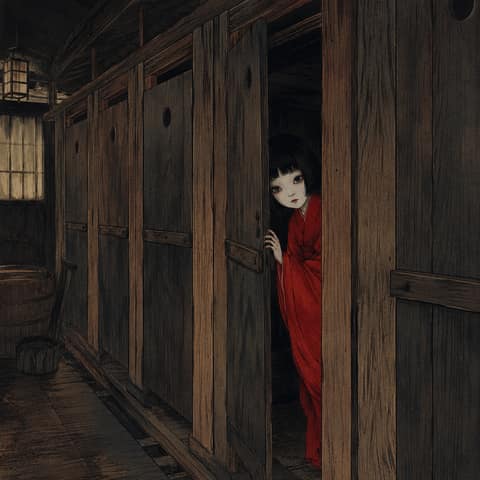
No shared portrait belongs to the questioner. The Toyoshina recollection places a cloaked man at the toilet entrance[2]. The Amagasaki collection calls the other party merely a "ghost"[3]. Tokyo accounts can make only the question audible from within a stall, without needing a face or body[4]. Rather than forcing them into one male, female, ghostly, or masked figure, leaving the speaker unseen better preserves their shared fear.
This absence is not a lack of description. A listener cannot see beyond the closed stall door and imagines position and form from voice alone. A hem, a paper color, or a ceiling shadow supplies fragments; children fill the rest with what they know. Aka Manto traveled not because everyone pictured the same face, but because an unfixed face could enter each school's toilet.
The School Toilet as a Small Otherworld
Everyone knows where the school toilet is, but each person is alone when using it. Tsunemitsu describes science, music, and art rooms and toilets as places that can feel outside ordinary life compared with a normal classroom[5]. In the toilet, a child closes the door, loses sight of others, and is physically vulnerable. A pupil who laughs at the rumor in the corridor can remember the question as directed at them after entering a stall.
The tale does not need the whole school. A detail such as "the end toilet," "fifth from the right," or "women's staff restroom" puts one forbidden point inside an ordinary building. Children who hear it begin to see the line of stalls and depth of the corridor differently. Before showing a creature in a toilet, Aka Manto marks a dangerous spot on the school's floor plan.
Talismans and Responses Made by Children
The response to fear need not be an adult-provided method of defeat. In Amagasaki in 1972, younger pupils went to the toilet linked together instead of alone[3]. At a school where the red-blue-yellow tale spread, children carried yellow handkerchiefs to school and held them in the toilet; those who forgot borrowed one and relieved themselves chanting "Yellow, yellow"[5].
Going together, wearing the safe color, and saying the right words become children's own safeguards. Yellow cloth did not possess ancient power against Aka Manto; it became a talisman because rumor defined yellow as safe. The tale makes not only fear but rules for whom to accompany, what to carry, and what to answer.
The White Mask Given by Modern Works
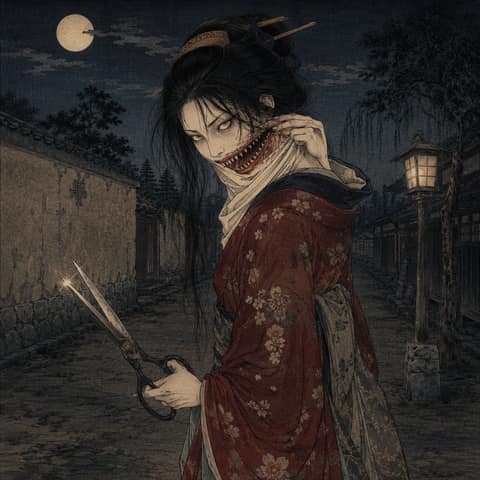
Oral stories with no settled appearance require a concrete body when adapted for games and video. Chilla's Art's 2019 game *Aka Manto* designs Aka Manto as a pursuer in a red cloak and white mask[6]. The white face makes the figure legible in darkness and turns a short toilet exchange into an escape from a visible enemy. Such works are one route by which a masked Aka Manto became a shared modern image.
But the white mask is not an appearance jointly recorded in the Toyoshina recollection, the Amagasaki red-white-paper story, and Tokyo's red-blue-white accounts. It is one powerful face supplied by a work to oral tradition's blank space, not a recovery of every older tale. Distinguishing the unseen voice from the masked pursuer also reveals the shift from spoken exchange to visual monster.
A Ghost Story Whose Right Answer Keeps Changing
Aka Manto's terror exceeds a single rule that both red and blue always mean death. A casually named color returns to the respondent's body as blood, complexion, clothing, or rain. At another school, white or yellow appears, paper becomes mantle or chanchanko, and the safe answer changes. Just as a listener thinks they know the correct response, storytelling moves first and makes a new question.
That variability has kept Aka Manto alive longer than any one monster. So long as the small frame of question, color, and bodily conclusion remains, tellers can add their own school toilet, familiar word, and escape they heard from friends. Aka Manto is not a story that protects a finished setting. Each time a child imagines another choice and passes it on, the tale is made again.
Character Profile
This section is our own creative profile for storytelling. It is not historical fact or scholarship.
Yokai Type - Modern Kaii
Category - Ghosts & Spirits
Rarity - Epic
Personality - Neither the questioner's sex, appearance, nor inner character is fixed. At a stall or toilet entrance, it briefly asks for a color and turns the reply into a result involving blood, complexion, or clothing. Some versions make white or yellow safe.
Compatibility - A good match for readers who enjoy comparing variants rather than deciding one correct answer, including the safe colors and talismans children devised alongside the school ghost story.
Abilities - Asks a color or clothing choice at a school toilet or its entranceMakes the chosen color produce different outcomes involving blood, complexion, or clothingChanges the object of the question among mantle, paper, hanten, and chanchankoUses choice sets such as red-blue, red-white, and red-blue-yellowIncludes tellings in which choosing white or yellow brings safetyIncludes tellings that reveal no figure, only a voice from outside the stall
Weaknesses - No weakness is shared by every telling. White, yellow, "I decline," going with friends, and yellow handkerchiefs belong to specific collections or children's responses, not a universal means of defeating the apparition.
Habitat - School toilets, especially stalls, the end of a row, or an entrance. Collections differ between pupils' and women's-staff facilities; it cannot be fixed to one building or a single place of origin.