Voices and severed heads in Tanba.*Kuchi Tanba Kōhishū*, edited by Kakita Ioji and Tsuboi Tadahiko in 1925, is an important modern record of local Tsurube-otoshi lore.[1] In Hōki, formerly part of Sogabe Village in Minamikuwada District, a presence was said to descend from a kaya tree and call, “Is the night work done? Shall I lower the bucket? Creak, creak,” before laughing and rising into the tree again. In the hamlet of Tera, the story is much more violent: a severed head drops from an old pine and eats people, then remains absent for two or three days after satisfying its hunger. Even within the Sogabe area, a being that startles people with its voice stands beside a predator that takes human life. Tsurube-otoshi did not begin as a single creature with a fixed appearance. It changed as it attached itself to the old trees and night roads of each community.
Falling buckets and riddles in Hokuriku.The Hokuriku examples assembled by Matsumoto Kōzō record several forms under names such as Tsurube-otoshi, Tsurube-oroshi, and tsurube-oroshi.[3] In Fukui, one story tells of a bucket falling from a zelkova and injuring a passerby. Another has a voice ask late at night whether the bucket should be lowered and whether the evening's work is finished, after which the bucket descends. Elsewhere, the being challenges night travelers to a verbal exchange and devours anyone unable to answer. In Ishikawa, a Tsurube-otoshi descends as though connected to the heavens above an abandoned residence and carries away anyone who touches it. A prank, a dangerous falling object, a disembodied voice, a man-eater, and a thing descending from the sky cannot be sorted cleanly into two or three definitive types. This refusal to settle into one body is one of the yokai's defining features.
The modern image of a giant face.In his 1992 original painting *Tsurube-otoshi*, Mizuki Shigeru depicted the yokai as a colossal face bearing down from a tree.[6] The red-tinged giant face or severed head now widely associated with the name was reinforced by such modern yokai art. Yet not every local Tsurube-otoshi has a face: in some tales only a bucket falls, while in others nothing is perceived beyond a voice. The modern image is a powerful doorway into the tradition, but it is not its only correct form. No one knows what will descend from the darkness of the canopy next. That uncertainty may be precisely why Tsurube-otoshi endured in so many places.
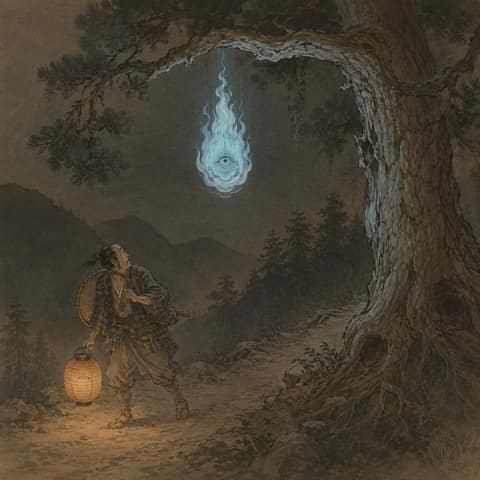
At dusk on a mountain road, a branch creaks once overhead. You look up, but the canopy has already dissolved into darkness. The moment you begin walking again, laughter rings out and an enormous severed head plunges down with the speed of a well bucket. In this form, Tsurube-otoshi turns the simple act of falling into terror.
Placed side by side, the two stories reveal a method of attack. First, a voice or the sound of a branch draws the traveler's attention overhead. Then the thing closes the distance at once from the darkness of the canopy. After the attack, it rises again as though a rope were hauling up a well bucket. The name describes its motion more precisely than its appearance. The everyday movement of a bucket at a familiar well, transferred to an old tree at night, becomes a dreadful question: what is about to fall onto the person below?
Nor can its difference from Tsurube-bi be decided by appearance alone. The early-modern Tsurube-oroshi and Sekien's Tsurube-bi center on uncanny fire descending from a tree.[2] The severed-head form instead centers on voice, sudden descent, and predation. Even so, both inhabit old trees and move up and down like a well bucket. No source shows a flame simply transforming into a face, but the evidence is equally insufficient to call the traditions unrelated. A sounder reading is that a shared older name and motion acquired different bodies in different local narratives.
Mizuki Shigeru's 1992 original painting *Tsurube-otoshi* clearly embodies the modern impression of an enormous face appearing in a tree.[6] A giant head communicates danger immediately and makes the instant of descent easy to visualize. It was therefore more readily remembered in manga, encyclopedias, and three-dimensional figures than an invisible voice or an ordinary bucket. Yet returning to the local tales after seeing the face lets us hear what the picture cannot show: a question about finished night work, the creak of a rope, the movement of leaves, and a presence drawing closer from somewhere above. Tsurube-otoshi's true domain is not the giant face alone. It is the instant in which a person cannot help but look up.
Character Profile
This section is our own creative profile for storytelling. It is not historical fact or scholarship.
A capricious and cruel presence that waits in the crown of an old tree. It uses laughter or a call to make travelers look up, then plunges down while their attention is fixed overhead.
Compatibility
Those drawn to night mountain roads and the space beneath old trees are more likely to encounter it. A cautious traveler who notices sounds overhead and chooses open paths is more likely to expose its ambush.
Abilities
Plunging from the crown of an old treeDrawing a traveler's attention with laughter or a callAttacking in the form of a giant severed headFrightening passersby by dropping a well bucketConcealing its presence in the shadow of an old tree
Weaknesses
The traditions record no fixed weakness or method of defeating it shared across regions. Avoiding the ground directly beneath old trees and noticing laughter or creaking branches overhead are the clearest ways to evade an encounter.
Habitat
Old kaya, pine, zelkova, and other trees along mountain roads and village boundaries in Sogabe and Funai in Tanba Province, Kuze in Mino Province, the Hokuriku region, and elsewhere.
The diagram below is a diagnostic evaluation chart for Tsurube-otoshi, the Severed Head That Falls from an Old Tree. The higher the value of each item, the stronger that characteristic is expressed.