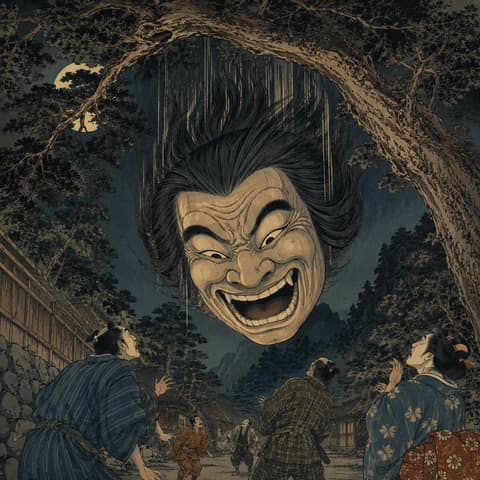
Tsurube-otoshi
tsurube-otoshi
Tsurube-otoshi, the Severed Head That Falls from an Old Tree
At dusk on a mountain road, a branch creaks once overhead. You look up, but the canopy has already dissolved into darkness. The moment you begin walking again, laughter rings out and an enormous severed head plunges down with the speed of a well bucket. In this form, Tsurube-otoshi turns the simple act of falling into terror. Two scenes from the traditions of the former Sogabe Village, preserved in *Kuchi Tanba Kōhishū*, are especially important for understanding this image. The presence in the kaya tree at Hōki calls, “Is the night work done? Shall I lower the bucket? Creak, creak,” descending with laughter before climbing back into the tree. From an old pine at Tera, by contrast, a severed head drops and eats people. The detail that it stays away for two or three days after feeding makes it more than a passing illusion. It was imagined as a hungry predator lying in wait along the community's night roads. Placed side by side, the two stories reveal a method of attack. First, a voice or the sound of a branch draws the traveler's attention overhead. Then the thing closes the distance at once from the darkness of the canopy. After the attack, it rises again as though a rope were hauling up a well bucket. The name describes its motion more precisely than its appearance. The everyday movement of a bucket at a familiar well, transferred to an old tree at night, becomes a dreadful question: what is about to fall onto the person below? The giant severed head is not Tsurube-otoshi's only form. Hokuriku traditions also record a being that drops the bucket itself from a tree, one that forces travelers into a riddle-like exchange, and one that carries anyone who touches it into the sky. The head is a forceful image connecting the man-eating traditions of Tanba with modern yokai art, but it cannot stand for every regional account. The form described here brings one strand of the wider tradition into focus: Tsurube-otoshi as a predator hidden in an old tree. Nor can its difference from Tsurube-bi be decided by appearance alone. The early-modern Tsurube-oroshi and Sekien's Tsurube-bi center on uncanny fire descending from a tree. The severed-head form instead centers on voice, sudden descent, and predation. Even so, both inhabit old trees and move up and down like a well bucket. No source shows a flame simply transforming into a face, but the evidence is equally insufficient to call the traditions unrelated. A sounder reading is that a shared older name and motion acquired different bodies in different local narratives. Mizuki Shigeru's 1992 original painting *Tsurube-otoshi* clearly embodies the modern impression of an enormous face appearing in a tree. A giant head communicates danger immediately and makes the instant of descent easy to visualize. It was therefore more readily remembered in manga, encyclopedias, and three-dimensional figures than an invisible voice or an ordinary bucket. Yet returning to the local tales after seeing the face lets us hear what the picture cannot show: a question about finished night work, the creak of a rope, the movement of leaves, and a presence drawing closer from somewhere above. Tsurube-otoshi's true domain is not the giant face alone. It is the instant in which a person cannot help but look up.