

Kisaragi Station

kisaragi-eki

Kisaragi Station

Kisaragi Station

Their soul is listening — speak, and they will answer.

Basic Description

Kisaragi Station is a classic internet ghost story that defined the image of the "otherworld station" in modern Japan. It all began in January 2004, on a live-commentary thread of an anonymous message board, when a poster calling themselves "Hasumi" wrote that the private railway train they usually rode wouldn't stop, and they had arrived at an unfamiliar unmanned station[1]. The station name was written in hiragana as "Kisaragi" (きさらぎ), there were no houses around, and neither phones nor maps were of any use. Its core lies not in threatening with a physical form like classical yokai, but in slightly shifting everyday infrastructure like railways, mobile phones, and message boards, turning the journey home itself into an otherworld.

The fascination of this anomaly is that while the setting is specific, it is never fixed. While the posts contain clues reminiscent of Shin-Hamamatsu Station and western Shizuoka Prefecture, verifying it as a real station never leads to a definitive location. As organized in Asazato Itsuki's "Encyclopedia of Modern Japanese Anomalies," internet ghost stories of the Heisei era spread mediated not by local folklore, but by the anxiety of "the final point remaining unfulfilled no matter how much you search"[2]. Kisaragi Station is a prime example of this; as a station that has a location name but cannot be registered on a map, it updated the concept of modern spiriting away (kamikakushi).

Categorically, Kisaragi Station is less of a yokai and more of a "location itself turned anomalous." In the era of foxfire and Dosojin (traveler guardian deities), crossroads and mountain passes were the boundaries to the otherworld. In the commuting zones of the Heisei era, the boundaries are platforms, in-train announcements, tunnels, and mobile phone signals. Like many modern urban legends discussed in ASIOS's "Solving 'Urban Legends'," rather than proving authenticity, the blank space where readers feel "I've felt something similar on the last train" keeps the story alive[3]. Thus, Kisaragi Station did not remain a single creation, but became the archetype for subsequent tales of otherworld stations, unmanned stations, and last train ghost stories.

Folklore & Legends

The plot of its first appearance is inextricably linked to the format of a live message board thread. Late at night, the poster boards a train that normally stops every few minutes, but the train doesn't stop for over twenty minutes. Outside the window looks like deep mountains, and the other passengers are asleep or barely reacting. The station it finally stops at displays only "Kisaragi Station," with no timetables or station staff around. The message board residents who respond to her consultation advise her not to get off, not to walk along the tracks, and to contact the police, but the situation slowly progresses in a bad direction in real-time[1].

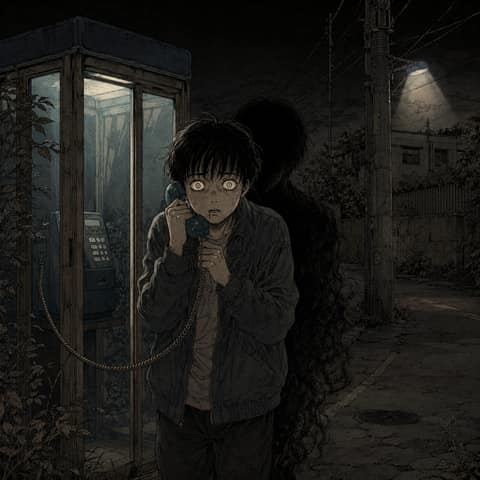
The horror of this lore lies not in the appearance of a monster, but in the process of normal judgment being stripped away one by one. The sound of drums and bells can be heard from outside the station, a tunnel appears along the tracks, a shadow like a one-legged old man calls out, and she gets into a stranger's car. In classical spiriting away, this would connect to deep mountains or a fox's wedding, but here, because she is connected to the message board via mobile phone, the reader gets the illusion that "she can still communicate with this side." The moment that communication is cut off, Kisaragi Station ceases to be just a place and becomes a device that sucks in the words of our side.

In the process of its circulation, Kisaragi Station spawned countless derivative stations. Secondary ghost stories centered around non-existent station names like Yami Station, Katasu Station, and Tsukinomiya Station were created, and it was also cited in articles and videos discussing how to go to the otherworld. The characteristic of modern anomalies described by Asazato Itsuki is that they grow not only through anonymous oral transmission but by the accumulation of logs, summary sites, analytical articles, and creative derivatives[2]. Kisaragi Station truly folklorized on the internet while blurring the boundary between the original log and secondary creations.

When treating it as a place name, it is necessary to separate the "western Shizuoka Prefecture feel" from its non-existence. While the boarded route in the post brings the Enshu Railway to mind, the station itself cannot be placed on a real map. Therefore, on YOKAI.JP, while placing its origin in the creative source of an internet ghost story, we refer to the railway lines of western Shizuoka Prefecture as an entry point to the story. This is not to place a fake pin, but to show the reader what sense of reality the ghost story borrowed to establish itself.

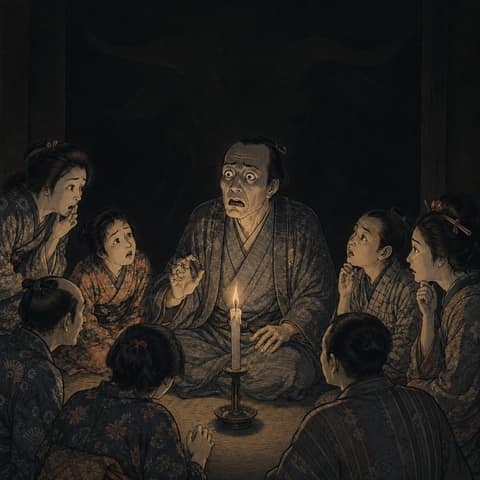
Furthermore, Kisaragi Station strongly holds the format of a "live-broadcast ghost story." Readers not only read the completed ghost story afterward, but also enter the position of the residents who advised the poster. The sense of participation—that she might be saved, that there might still be time—deepens the final disconnect. The fact that it visualized at the speed of an internet message board that a ghost story is a collaborative work between the teller and the listener is also a major feature of this lore.

Detailed Analysis

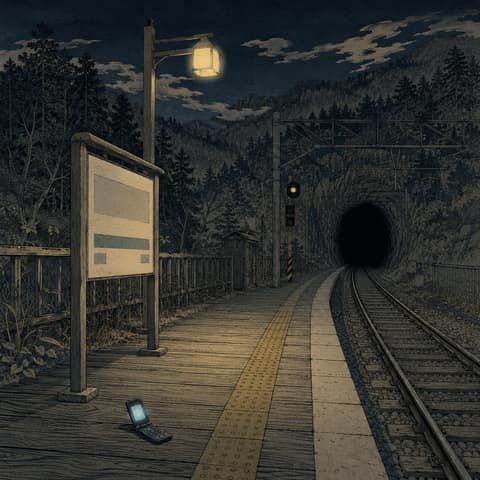
This version of Kisaragi Station is a form for reading the station itself as a yokai. Instead of depicting a monster with a physical shape, it combines elements like platforms, tracks, tunnels, in-train announcements, and mobile phone signals to capture the moment everyday space changes slightly into different rules. The otherworld is not in the deep mountains far away. When you think you've slept past one station on your usual way home, the train has already entered an unknown order.

The initial terror begins with the breakdown of the sense of time. The distance between stations is too long, the train passes stations it should stop at, the scenery out the window changes to something unfamiliar. At this stage, it can still be explained as "got on the wrong train" or "half asleep." But as explainability is crushed one by one, the reader is placed in the same closed train car as the poster. The message board format plays a major role here. Because a third party is advising but cannot save her, the voice of reason itself is incorporated into part of the anomaly[1].

The hiragana notation of the station name is also important. If written in kanji as "如月駅," it leans toward an elegant place name or month name, but writing it as "きさらぎ駅" (Kisaragi) makes it an inorganic symbol printed on a station nameplate. A softness that even a child can read and a blankness that doesn't belong to any municipality stand simultaneously. According to Asazato Itsuki's organization of modern anomalies, there is a naming power here that pierces memory with just short words, the same as "Red Paper, Blue Paper" in school ghost stories or "Mary-san" in phone ghost stories[2].

If Kisaragi Station were to be connected to the lineage of classical yokai, it would be spiriting away (kamikakushi) and road anomalies. Tengu taking people to the mountains, travelers bewitched by foxes walking in circles in the same place, festival music heard at crossroads. They have all spoken of the moment a road leaves human control. In Kisaragi Station, that road became a railway track. Tracks are originally a modern promise guaranteeing destination and time, but in this ghost story, the very strength of the guarantee flips. You can't go back even if you get off, and you won't reach your destination even if you stay on.

The reason there are so many subsequent derivatives is that the stage setting is very easy to expand. Change the station name, change the route, add a smartphone or map app, and another Kisaragi Station is immediately born. As the urban legend theory compiled by ASIOS shows, modern ghost stories circulate by not only preserving fixed original texts but including verification, denial, and reenactment[3]. Kisaragi Station is an anomaly including its circulation format, and even the reader's act of searching becomes an extension of the story.

Therefore, the most sincere attitude toward this unmanned station is not to determine a real station. There is an outline that looks like western Shizuoka Prefecture. But the moment you crush the outline into a real station name, the essence of Kisaragi Station is lost. On YOKAI.JP, we treat it as an otherworld originating from a creation, while simultaneously leaving the realistic texture of the railway network. A station not on the map is not scary because it's off the map. It's scary because the more people believe in maps, the more they arrive there.

Another point of interest is that advice does not become salvation. The message board residents think rationally and propose realistic means like the police, station staff, family, and confirming the current location. But once she enters the otherworld, all that rationality arrives slightly too late. Kisaragi Station does not deny modern safety devices, but lets them idle while making them look like they're functioning. Therein lies a coldness typical of Heisei internet ghost stories.

Character Profile

This section is our own creative profile for storytelling. It is not historical fact or scholarship.

Yokai Type
Modern Kaii
Rarity
Legendary
Personality
Does not show itself, misleading people only through timetables and station nameplates. The more one panics, the further it pushes the exit away, prolonging hope with the lingering scent of communication.
Compatibility
終電、無人駅、知らない路線図に妙な胸騒ぎを覚える人。境界の違和感を物語として読み解ける人と相性がよい。
Abilities
Deviation from the last trainManifestation of an unmanned stationCommunication disruptionOtherworld tunnelInduction by festival musicErasure of current locationGeneration of derivative stations
Weaknesses
If forcibly identified as a real station, its blank space as an anomaly thins. Also weak to judgments where multiple people verify records and return to a bright station without getting off halfway.
Habitat
Inside a late-night private railway car, unmanned stations, mountain tunnels, smartphone screens about to lose signal, old logs of anonymous message boards.

🔮Yokai Compatibility Test

For more detailed information and diagnosis results about The Unmanned Station Slipping into the Otherworld, please click here.

Sources & References

3
  1. 身のまわりで変なことが起こったら実況するスレ26・きさらぎ駅投稿匿名投稿者「はすみ」ほか(2ちゃんねるオカルト板, 2004) [ネット怪談原典]2004年1月に実況形式で投稿された、きさらぎ駅伝承の基点となる匿名掲示板ログ。
  2. 日本現代怪異事典朝里樹(笠間書院, 2018) [民俗・怪異事典]戦後からインターネット時代にかけて流布した現代怪異を整理した事典。現代都市怪談の項目確認に用いる。
  3. 謎解き「都市伝説」ASIOS 編 / 廣田龍平(彩図社, 2022) [学術書] Reference都市伝説の発祥年代を実証的に検証した書。トイレの花子さんについて、現在型(呼出して応答する型)の明確に年代を遡れる初出は 1960 年代後半とする。

Interested in this type of yokai?

Discover the yokai most similar to your personality with our yokai diagnosis

Start Yokai Diagnosis

Meet your guardian yokai at the shrine

Draw an omikuji fortune and discover the yokai watching over you today.