Fictional / modern-work originそうさくゆらい

32 yokai rooted in Fictional / modern-work origin. Explore the legends tied to this land.

  • Gashadokuro

    Gashadokuro

    伝説

    gah-shah-doh-KOO-roh

    Great Skeleton of Assembled Vengeful Spirits: Gashadokuro (Complete Memorial Version)

    Spirit / GhostFictional Origin (Created in the mid-Showa period; a giant skeleton figure)

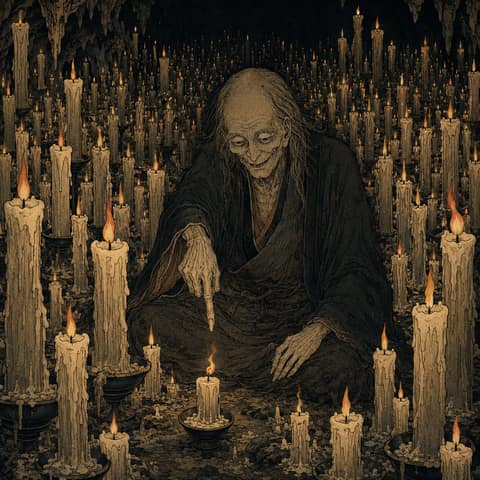
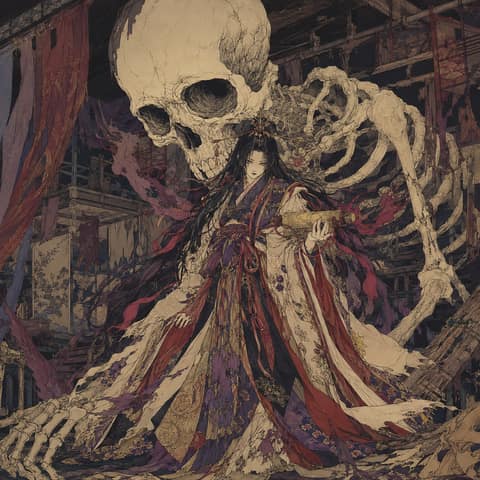
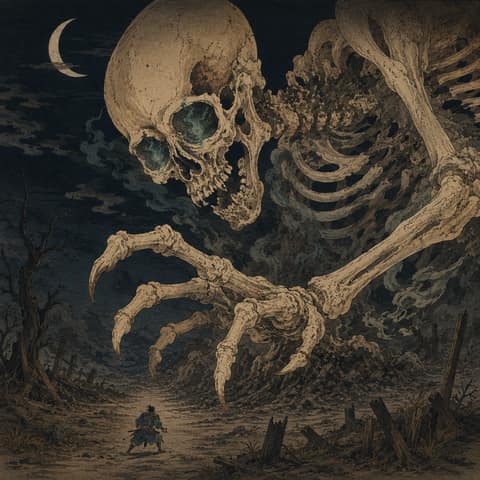
    This is an interpretation of the "most terrifying nocturnal great anomaly," born from the countless remains of those dead by war or starvation, their intense lingering attachments to this world, and the despair of being left unappeased, which have solidified in the depths of darkness. The Gashadokuro in this version transcends the bounds of a mere giant bone monster; it is depicted as a moving disaster itself—a physical manifestation of the "weight of death" and the "sorrow of the unmourned dead" that human society has concealed. Its appearance is so immense that when it stands, it blocks even the moonlight, entirely covering deep night fields and deserted graveyards in a giant black shadow. Despite lacking muscles or skin, countless grudges act as a magical force that binds the bones together, producing astonishing physical strength. The omen of its approach is an ear-splitting friction sound of giant bones going "gasha, gasha," echoing alongside a chilling aura of death that freezes the surrounding air. When this sound is heard, escaping is said to be almost impossible. The Gashadokuro uses no magic or sorcery whatsoever. Instead, it attacks with extremely primitive and pure violence, nonchalantly snatching living humans with its giant, tree-trunk-like bony arms, lifting them directly to its massive jaws, and crushing their heads alive to slurp their fresh blood. However, behind that terrifying cruelty lies a fundamental "hunger and thirst (the agony of a hungry ghost)" that can never be satisfied. Every single bone that makes up the Gashadokuro belongs to a helpless human who perished in loneliness, begging for water and food. Their pursuit of living blood is the flip side of their thirst for life; yet, no matter how much blood they drink, it simply spills through the gaps in their bones, so their hunger is eternally unhealed. Therefore, using "physical attacks" with swords, bows, or modern weaponry against this great anomaly is almost entirely meaningless. This is because the opponent is merely an aggregation of already-dead bones. Even if one arm is chopped off, bones carrying other grudges will quickly gather to seamlessly repair it. If there is a single means to "vanquish" this tragic monster, it is not violence but "compassion (kuyo/memorial service)." Only through earnest sutra chanting by a high priest and the Buddhist requiem ritual of respectfully returning the remains to the earth can their raging grudges be pacified, returning the bones to ordinary skeletons. It could be said that this questions the responsibilities the surviving must fulfill toward the dead.

  • Hanako-san of the Toilet

    Hanako-san of the Toilet

    伝説

    といれのはなこさん

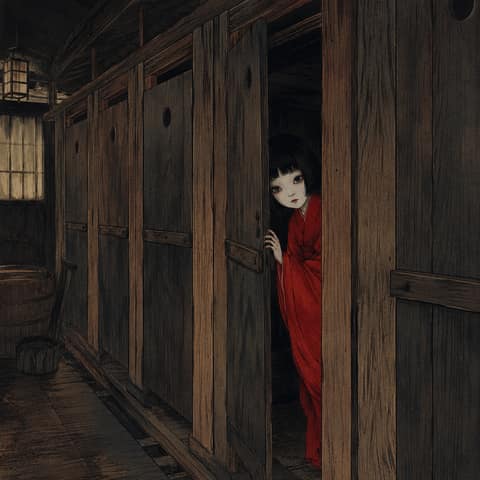
    The Girl in the Third Stall of the Third-Floor Girls' Bathroom, Hanako-san

    Spirit / Ghost1980s school ghost stories, popularized nationwide by Toru Tsunemitsu's "School Ghost Stories" in 1990

    Post-war School Architecture and the "Closed Water Space". While the basic description traced literary first appearances and nationwide distribution, this deep dive explores why the combination of "school, bathroom, and young girl" became the core of modern ghost stories. Post-war Japanese elementary school architecture standardized around three-story reinforced concrete buildings starting in the 1950s. The fixed layout placed the staff room on the first floor, upper-grade classrooms on the third floor, and bathrooms at the ends of each floor. The third-floor bathroom is furthest from the teachers' watchful eyes, easily becoming an empty space outside of recess. Here, the boundary between the ordinary and the extraordinary runs deep. For children (especially girls), the bathroom is a place where physical vulnerability is exposed, and simultaneously a place to be alone within a communal space. Toru Tsunemitsu positioned this "periphery of school space" as the geographical foundation of the Hanako-san ghost story. The Code of the Number "Three". The triple "three"—the third floor, the third door, and three knocks—is not a coincidence. It can be read as a carryover into modern ghost stories of the "threshold number three" common in Japanese folkloric summoning rituals (e.g., seven days of the ox-hour visit, three calls, walking around a grave three times). Children unconsciously reenact this traditional summoning structure within the school. This is why playing Hanako-san functions not just as "mere play" but as a pseudo-summoning ritual. It has also been pointed out that the ritualistic format of the Kokkuri-san (ouija board) game, popular in elementary schools in the 1970s, was continuously inherited by the Hanako-san game in the 1980s. The Color Red and the Lineage of "Red Mantle". Hanako-san is often depicted wearing a red skirt or red overalls. In post-war Japanese depictions of young girls, the color red has three layers of meaning: (1) physical realities like blood or menarche; (2) a sense of foreignness that deviates from standard school uniform colors; and (3) a blending with the pre-war ghost story "Red Mantle" (a voice asking whether you want blue or red paper). The Red Mantle ghost story, said to have originated in Kobe in 1939—a voice in the bathroom asking if you want red or blue paper—has a sisterly relationship with Hanako-san, showing the continuity of ghost story lineages from pre-war to post-war eras. The fact that the Red Mantle elements are strongly mixed into Hanako-san variations in Hokkaido and Tohoku is also evidence that the echoes of pre-war ghost stories transitioned into post-war school buildings. The Anonymity of the Name "Hanako". Hanako-san bears one of the most common Japanese female names from the Showa era, but her specific life history is never told—this allows her to function as a collective pronoun for "countless nameless schoolgirls." Theories of her death by war, earthquake, or murder all lack a specific individual identity, and can even be read as a personification of "the very history of the school space swallowing up young girls." Folklorist Noboru Miyata argued in "Folklore of Yokai" (Iwanami Shoten, 1985) that post-war school ghost stories serve the function of "the community re-enshrining the nameless dead after the fact." Details of Media Expansion in 1994-95. In the 1994 Kansai TV omnibus "School Ghost Stories," "Hanako-san" was produced as a single episode, and it was also included in the August Pony Canyon VHS "School Ghost Stories: Truly Happened!!". Shochiku's "Hanako-san of the Toilet" (directed by Joji Matsuoka, starring Etsushi Toyokawa), released on July 1, 1995, was a mystery-horror film combining a serial murder case with the Hanako-san legend. In contrast, Toho's "School Ghost Stories" (directed by Hideyuki Hirayama), released on July 8, was a juvenile adventure horror film. The styles of these two films, running side-by-side that summer, stood in sharp contrast. Toho's version went on to produce sequels in 1996, 1997, and 1999, grossing over 3 billion yen in total box office revenue across the 4-part series. Modern Toilet-Bound Youth and the Layering of Secondary Works. AidaIro's "Toilet-Bound Hanako-kun" (serialized from 2014) has surpassed 20 million copies, receiving a TV anime adaptation in 2020 and a stage play in 2022. The "Hanako-kun" here is a cheerful, caring, blonde earthbound spirit, completely detached from the original image of the girl ghost. For Generation Z, "Hanako" is primarily recognized as a cute male character rather than a scary ghost girl—an excellent example of the modern phenomenon where a ghost story's secondary creation overwrites the primary legend itself.

  • Mary-san's Phone Call

    Mary-san's Phone Call

    伝説

    めりーさんのでんわ

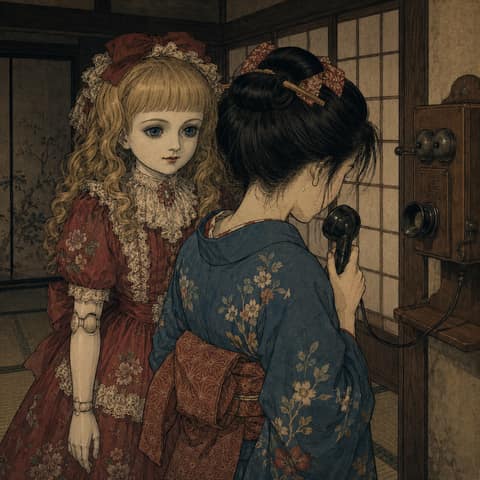
    Call from a Discarded Doll / The Girl Spirit Behind You

    Dwellings & ObjectsLate 1990s modern urban legend, phone-based ghost story

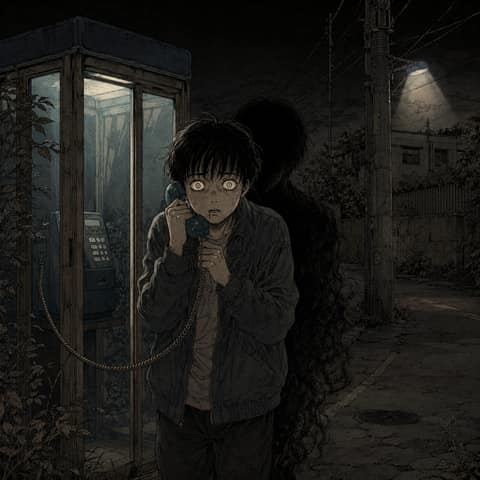
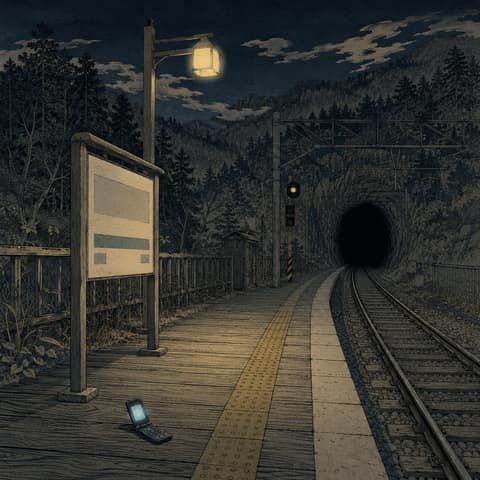
    The Representative Phone-Medium Urban Legend. Mary-san's Phone Call is regarded as the ultimate realization of post-war Japanese urban legends, perfectly embodying the three characteristics of "object possession," "phone medium," and "distance compression." Alongside Hanako-san of the Toilet (debuted 1948, fixed-location type) and Hachishaku-sama (Eight-Feet Tall) (originated online 2008, humanoid pursuit type), it stands as one of the three major pillars of post-war urban folklore. Notably, by using the telephone—the newest communication medium of its time—as the conduit for the supernatural, it marks a stark departure from pre-war oral traditions or shrine-based ghost stories, instead presupposing a modern industrial society and mass-produced toy culture. The Foreign Doll as a Cultural "Other". The specific designation of the Mary doll as "foreign-made" is a crucial folkloric detail. During Japan's post-war period of rapid economic growth, mass-produced foreign dolls (like Barbie and Blythe, the precursors to Licca-chan) entered Japanese households via the occupying forces, acquiring a dual nature of aspiration and eeriness in girls' culture. The narrative structure of "a discarded foreign doll seeking revenge" in Mary-san's Phone Call aligns seamlessly with Hiroshi Matsuyama's interpretation that the legend crystallizes post-war Japan's complex emotional distance and tension toward foreign toys and the artifacts of victorious nations. The cultural friction is also evident in how the Licca-chan doll was marketed by heavily emphasizing its "Japanese-ness." The Historicity of the "Telephone" Medium. The late 1970s marked an era when landline telephone penetration in regular households reached 90%, making it commonplace for children to answer the phone at home. Concurrently, services like the Licca-chan Phone (1968-) and various telephone services (time, weather, fortunes) fostered children's imagination that a distinct personality might exist on the other end of the line. The core eeriness of Mary-san's Phone Call—the sensation that "someone is peeking into my house from the other end of the phone"—is inherently tied to the landline culture of that era. In the age of mobile phones and smartphones, where the connection between a phone number and a physical location is diluted, similar ghost stories have evolved into mobile ringtone or voicemail variants like *One Missed Call*. The Vocal Training Function of Repetitive Phrasing. Mary-san's Phone Call also serves as a classic example of an oral ghost story memorized and passed down by children. The repetitive phrase "I am Mary-san, I am currently at [Location]" is easy to memorize and possesses an open-ended structure where the story works simply by swapping out the location. In storytelling settings like school lunch breaks, field trips, sleepovers, and tests of courage, narrators infinitely spawn local variations by inserting their own neighborhood or specific landmarks. This is a prime example of the "recursive oral generation" structure of urban legends pointed out in *Toshi no Ana*. Re-systematization in the 1990s "School Ghost Stories" Boom. During the 1990s, amidst the "School Ghost Stories" boom sparked by Toru Tsunemitsu's *Gakkou no Kaidan* (1990) and fueled by children's books and TV shows, Mary-san's Phone Call became a standard repertoire piece. It frequently appeared in Toho's 1995 *School Ghost Stories* film series and various ghost story variety shows. Through this process, what was originally an oral tradition originating in the Kanto region was consolidated into a nationwide urban legend. Alongside contemporaries like "Kashima Reiko," "Teketeke," and "Aka Manto" (Red Cape), it forms a core component of post-war school ghost stories. The Dramatic Structure of "Right Behind You". The story's final phrase, "I am Mary-san, I am right behind you," serves as a classic example of dramatic reversal (peripeteia) in urban legends and has been the subject of both literary criticism and folklore studies. Because the physical act of holding a phone receiver to one's ear implies that "the field of vision is diverted from behind," the moment the voice on the phone finishes speaking, the physical action of turning around is inherently delayed. Incorporating this physical time lag into the horror structure is the unique genius of Mary-san's Phone Call. The 2011 film adaptation similarly anchors its narrative around this climactic final line.

  • Kuchisake-onna

    Kuchisake-onna

    伝説

    くちさけおんな

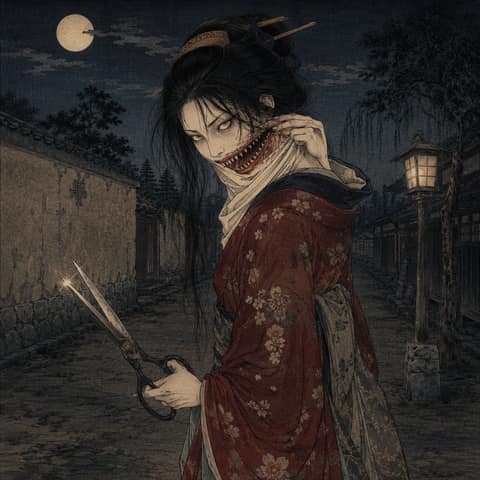
    Woman in the Red Mask / The 1979 Kuchisake-onna

    Human Yokai / Half-Human Half-YokaiModern urban legend originating in Gifu in 1978, no specific sacred site

    Reconstructing the 1979 phenomenon's outbreak timeline. The general overview of this entry outlined the 7-month progression, but here we delve into a finer timeline. Early December 1978: A farmer's elderly woman's toilet sighting in Shinsei-cho, Motosu-gun, Gifu Prefecture -> January 26, 1979: Gifu Nichinichi Shimbun "Editor's Notes" (written by editorial writer Mutsumi Murase) notes "According to rumors among Gifu children, a beautiful woman resembling an actress," forming the oldest layer as a local paper before national papers -> March 23 issue: Shukan Asahi's "The Tokaido Trek of the Kuchisake-onna Legend" by Teruo Kanauchi et al. marks the first national magazine appearance -> April-May: Nationwide strengthening of school commute patrols -> June 29 issue: Shukan Asahi's large feature by Etsuro Hiraizumi peaks the event -> June 21: A 25-year-old woman in Himeji City, Hyogo Prefecture, arrested for violating the Swords and Firearms Control Law while wandering around carrying a kitchen knife dressed as Kuchisake-onna (first copycat) -> July: Shukan Josei and Josei Jishin follow up -> August: Rapid subsidence with the start of summer vacation. This 7-month progression can be accurately tracked through newspapers, weekly magazines, and police records. Concurrently, police cars were dispatched in Koriyama City, Fukushima Prefecture and Hiratsuka City, Kanagawa Prefecture, group dismissals were implemented in Kushiro City, Hokkaido and Niiza City, Saitama Prefecture, and hostesses in Ginza started services asking customers "Am I pretty?", showing ripples into the adult world. These precise timeline trackings are theoretically impossible for Edo-period oral yokai, demonstrating a unique case of the undulation structure where a yokai of the post-war mass media age "conquers the country in a short period and disappears in a short period". The dual mechanism of cram schools and national magazines: Yoshiyuki Iikura's point. Yoshiyuki Iikura of Kokugakuin University (oral literature, modern folklore) points out that post-war cram schools served as the medium for the spread of Kuchisake-onna. Pre-war children's rumors were basically confined within school districts, but post-war cram schools created places where children gathered across school districts, acting as a catalyst for cross-district word-of-mouth diffusion before mass media. This, combined with national magazine features from March 1979 onwards, established a diffusion mechanism where word-of-mouth and print mutually amplified each other. Edo-period yokai basically spread through oral media alone (although ukiyo-e and picture books intervened, the mutual amplification of children's daily word-of-mouth and print did not occur), and modern folklore collections were recorded solely by researchers' investigations. In contrast, Kuchisake-onna covered the country in half a year through a three-layer structure of cram school word-of-mouth + national magazine print + television wide shows. This is a form of yokai generation born from the urban space of 1970s Japan, unique to the post-war mass media age. The condensation of modern social symbols: "Mask + Plastic Surgery + City". The standardization of Kuchisake-onna's image as a "beautiful woman covering her lower face with a mask" is highly valuable for sociological decoding. The 1970s Japanese cosmetic surgery boom—a social background where cosmetic surgery clinics rapidly increased in Tokyo and Osaka, and double-eyelid surgeries and nose jobs became common—created a complex fear of "beautiful women who had plastic surgery," establishing the association of mouth hidden by mask = plastic surgery scars. One of the origin theories, the "botched plastic surgery theory," retroactively narrativized this association, becoming widespread during the resurgence of Kuchisake-onna in the 1990s. Furthermore, post-war nuclear families + dual-income households + women's social advancement created anxiety in children left alone at home without their mothers, destabilization of "mother" and "female" representations, and wariness of "unknown women encountered on night streets", all of which were projected onto the image of Kuchisake-onna. In other words, Kuchisake-onna is a symbol condensing the "anxieties of 1970s Japan concerning the city, family, and body" into a single yokai figure. This has a yokai function unique to a post-war individualized society, distinct from the Edo-period yokai's role of maintaining the order of the local community (lessons for children, moral warnings). Distance from the Edo-period Kuchisake-onna prehistory: Continuum or independent occurrence? The Edo-period tales of "women with slit mouths" mentioned in the general overview—the umbrella man tale in Okubo Hyakunincho from "Kaidan Oi no Tsue", the Yoshiwara tayu tale in "Ehon Sayo Shigure", the tale of Nakabashi's Takano Shozaemon's wife in "Shin Chomonju", and the Meiji-era real-life example of Otsuya in Shigaraki, Shiga Prefecture—certainly form the archetype of the "woman whose mouth is slit to her ears" motif, but a direct lineage with the 1979 phenomenon has not been academically confirmed. Toru Joko's "School Ghost Stories" and Yoshiyuki Iikura adopt the position of reading the 1979 Kuchisake-onna not as a continuum from the Edo period but as an independently occurred post-war phenomenon, with the Edo-period archetype merely waiting in the ancient layer and not having a direct parental relationship. This is an important distinction in yokai research: emphasizing "continuity" tends to be the inclination of local tourism materials (local histories of Gifu, Izumo, etc.), while emphasizing "independence" is the inclination of folklore and modern sociology. It is academically honest to introduce the Edo-period archetype as an ancient motif while positioning the 1979 incident as an independent phenomenon that re-occurred under post-war specific conditions. Modern reception: Incorporation into yokai dictionaries and cross-East Asian re-creation. The fact that Shigeru Mizuki's "Illustrated Encyclopedia of Japanese Yokai" (1991) included Kuchisake-onna as an item in the yokai dictionary is often pointed out as a symbolic moment when "modern bizarre phenomena were formally incorporated into the framework of yokai." With this, the urban legends originating from post-war mass media were formally incorporated into the "yokai" framework alongside Edo-period tsukumogami and modern folklore collections. Film adaptations are represented by Koji Shiraishi's "Carved: The Slit-Mouthed Woman" (2007), produced as a post-war horror film that tackled the 1979 phenomenon head-on. The Korean version, "Ghost Mask: Scar" (2019, directed by Go Sone), was a Japan-South Korea co-production that combined Korea's plastic surgery culture with Kuchisake-onna, demonstrating the vitality of cross-East Asian modern bizarre phenomena. In manga, Episode 31 of Shou Makura and Takeshi Okano's "Hell Teacher Nube" is a representative sympathetic re-creation, rewriting it as a story where a woman branded a "yokai" has an animal spirit possessing her exorcised by Nube, returning to her beautiful self—a story of recovery rather than exclusion. This indicates that post-war yokai culture embodies modern ethics (individual dignity, representation of minorities) distinct from the Edo period. The very fact that modern yokai born in the 1970s continue to maintain their vitality in yokai culture even in the 2020s, 50 years later, proves the enduring power of post-war mass media-generated yokai.
  • Hachishakusama

    Hachishakusama

    伝説

    Hasshakusama

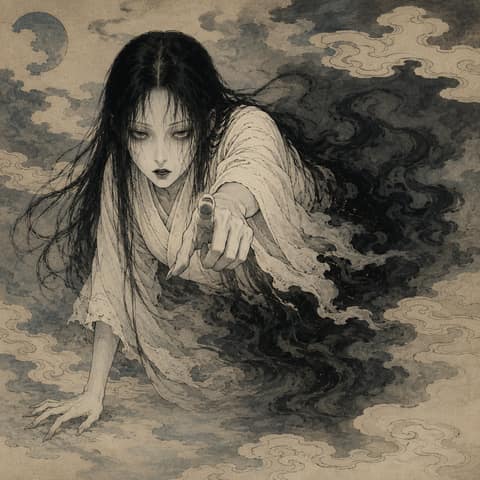
    2.4-Meter White Woman - Hachishakusama

    Spirit / GhostInternet urban legend originating from 2ch in 2008

    Sharekowa Thread Culture and "Forum-Born Horror". While the basic overview traces her origins, a deeper dive reveals why Hachishakusama could only be born on 2ch in 2008. In the late 2000s, the 2ch Occult board hosted a long-running thread series titled "Let's gather stories so scary you'll die," fostering a unique culture where users anonymously posted original or secondhand ghost stories. In this space, dubbed "Sharekowa," stories were judged not just on scariness, but on narrative pacing, folkloric foreshadowing, and overall structural completion. Hachishakusama was posted as a "series," split across multiple posts, captivating readers with its concise yet meticulously crafted narrative. This became the quintessential "literary horror of the internet age," setting it apart from traditional oral ghost stories. Intentional Appropriation of Folklore. The Hachishakusama legend incorporates four distinct folkloric elements: (1) Jizo as a boundary guardian, (2) warding via salt piles in the four corners of a room, (3) barricading until 7:00 AM (the passing of the demonic hour between the Ox and Tiger hours), and (4) protective amulets and Buddhist prayers. These are classic motifs found in folk magic texts (purification, pacification, warding) since the Edo period. The author didn't just write a scary story; they intentionally synthesized folklore to manufacture authenticity. Whereas traditional legends inherit folklore unconsciously, Hachishakusama treats folklore as an intellectual "resource," marking a turning point in how internet-era legends are generated. The Phonetics of the "Po... Po..." Laugh. While her height is her primary visual marker, her auditory signature is the bizarre onomatopoeic laugh, "Po... po... po... po...". This sound consists of bilabial plosives (the 'p' sound) repeated four times. Unlike the fricative sounds of normal human laughter ("ha ha", "fu fu"), it sounds mechanical or toy-like. Though the author never explained this choice, dehumanizing her laugh creates an uncanny "looks human but isn't" effect. In fan culture, this rhythm is frequently parodied in sound MADs and song covers, turning it into a unique cultural icon that straddles the line between terror and comedy. The Structure of the "Targeting" Curse. Hachishakusama does not attack immediately upon encounter; instead, she uses a delayed curse mechanic: "being targeted" leads to "death within days." This parallels the ancient Japanese Goryo (vengeful spirit) beliefs and the medieval Mononoke tradition of stealing souls or essence over time. Her terror stems from prolonged psychological pressure rather than immediate physical violence. The original narrative's focus on a "seven-day barricade" effectively dramatizes this delayed curse structure. Global Spread and "J-Horror Folklore". Since the late 2010s, Hachishakusama has been translated and shared on Reddit's r/nosleep, English horror blogs, and SCP Foundation spin-offs, becoming shared knowledge in the English horror community. She is frequently listed alongside Sadako (*Ring*, 1991) and Kayako (*Ju-On*, 2002) as Japan's premier "tall female horror icon," proving that the terrifying frontiers opened by post-war Japanese cinema are now being inherited by internet urban legends. Visual Adaptations and Modern Legacy. Early visual adaptations appeared in the 2010s as web dramas and short films. This escalated to full theatrical and streaming releases with Jiro Nagae's 2023 film *Resort Baito* (adapting another 2009 Sharekowa legend with Hachishakusama elements) and Ryujin Onizuka's 2024 *Sealed Video 16: The Curse of Hachishakusama*. Nagae's specialization in adapting 2000s 2ch legends (e.g., *Kisaragi Station* in 2022, *The True Samejima Incident* in 2020) cements Hachishakusama's firm position within the contemporary genre of "internet legend cinema."

  • Kashima Reiko

    Kashima Reiko

    名妖

    Kashima Reiko

    The Woman Who Asks from the Other End of the Phone: Kashima Reiko

    Spirit / ghostUrban legend that emerged in the 1970s, often told around Kakogawa and Takasago in Hyōgo Prefecture

    The telephone as postwar infrastructure and kaidan device. The basic entry covers the contagious structure of Kashima Reiko's curse; this fuller explanation looks more closely at the medium that carries it: the telephone. In Japan, the spread of black rotary phones into ordinary households rose sharply in the postwar decades, from about 8 percent in 1965 to about 80 percent in 1975. It is unlikely to be a coincidence that a legend emerging in the 1970s chose the device of "a question coming by telephone." The anxiety of a new infrastructure entering the home became part of the legend's core machinery. Where prewar Aka Manto belongs to alleys and night roads, and Hanako-san of the 1980s belongs to the school toilet, Kashima Reiko is distinctive because she violates the postwar private space of the household telephone. From the 1990s onward, the setting expanded into text media such as email and LINE, keeping pace with the evolution of postwar communication infrastructure. The structure of the "Where are your legs?" question. At the center of the Kashima Reiko legend is a question: "Does Kashima-san have legs?" "Where are her legs?" and similar variants. A wrong answer is fatal, but correct replies such as "Kamashi," "Kashima Reiko," "above the waist," or "from above the waist downward" are said to save the listener. Like Aka Manto's "red paper or blue paper" and Kokkuri-san's yes-or-no exchanges, this is a no-win question structure common in children's oral ghost stories. At the same time, it offers an escape route: correct knowledge can save you. Folklorist Noboru Miyata, in Yōkai no minzokugaku (Iwanami Shoten, 1985), argued that question-based children's kaidan satisfy a childhood desire for intellectual advantage, the feeling that those who know the answer survive. The transformation of postwar social memory into ghost story. The theory that Kashima Reiko began with the "1948 Kakogawa American-soldier incident" has not been historically confirmed. Even so, it preserves in ghost-story form a social memory of sexual violence suffered by Japanese women under the U.S. occupation. Postwar U.S.-Japan relations, defeat, occupation, and the security order, left many experiences insufficiently spoken in official discourse. Such unspoken harm can settle into the underground layer of urban legend and surface in the 1970s as a supernatural presence. Folklorist Norio Murakami has discussed this mechanism of social memory turning into kaii, noting that experiences excluded from public memory can remain in the form of ghost stories and spirit possession. Kashima Reiko is a representative example. Contagious curses in the internet age. Kashima Reiko's structure, in which hearing the story makes one part of the curse, became a foundation for the chain-mail culture, internet curses, and creepypasta of the 2000s and beyond. "Forward this email to X people or you will be cursed," "anyone who sees this URL will be cursed": these online curse formulas have their prototype in Kashima Reiko's instantly contagious oral kaidan. Internet-era kaidan such as Kunekune (2003) and Hasshaku-sama (2008) inherit the same device, turning the reader into a participant in the curse. Kashima Reiko therefore played an important mediating role between 1970s oral kaidan and 2000s internet horror. The ecology of Teketeke and Kuchisake-onna. Postwar Japanese children's oral kaidan do not exist as isolated beings. They form an ecology of mutual reference, merger, and branching. Kuchisake-onna (1978), Kashima Reiko (late 1970s), and Teketeke (1980s) follow one another chronologically and share motifs: a damaged female body, a question structure, and a curse aimed at children. In Tōru Tsunemitsu's Gakkō no kaidan (Kodansha KK Bunko, 1990), these stories were gathered under the category of "school kaidan," helping establish them as a single folkloric genre worthy of study. Dandadan and modern transmission. In Yukinobu Tatsu's Dandadan, serialized in Shueisha's Shonen Jump+ from 2021 and adapted for television anime in 2024, Kashima Reiko was reshaped as a major supernatural figure and became familiar again to Generation Z. The adaptation keeps the key elements of the source tradition, the missing lower body, the telephone, and the contagion of the curse, while recasting them in the character language of contemporary shonen manga. From children's oral legend in the postwar 1970s to manga and anime of the 2020s, Kashima Reiko has become a rare urban kaidan transmitted across nearly half a century.

  • Kunekune

    Kunekune

    名妖

    くねくね

    The White Silhouette Standing in the Rural Distance: Kunekune

    Spirit / GhostModern internet ghost story originating around 2000

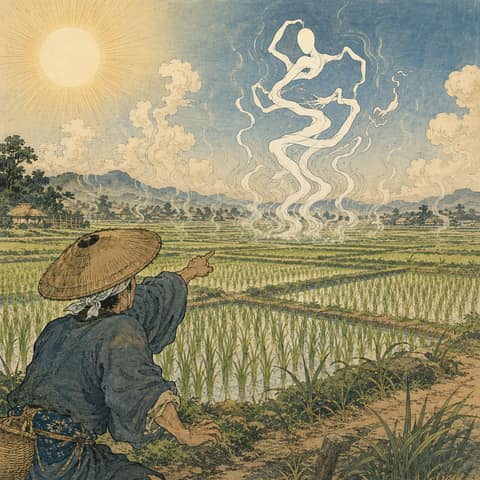
    The epistemological horror of "looking itself is a curse". The basic description touched upon the narrative structure and visual elements, but this thorough breakdown dives into Kunekune's greatest uniqueness—the punishment for cognition itself. Many traditional Japanese ghost stories inflict harm through physical contact (having legs cut off, being decapitated, being severed at the waist) or by approaching a specific location (abandoned houses, mountain passes, tunnels). Kunekune is different. Standing in the distance, it causes no harm, but the moment an observer uses binoculars or strains their eyes to "see its true identity"—attempting to complete their cognition—they go insane. This structure, which punishes the observer's subjectivity (understanding, interpretation, verbalization) itself, is unique for bringing a philosophical dimension to the ghost story. Undercurrents with Lovecraftian cosmic horror. In the 1920s and 30s, H.P. Lovecraft (1890-1937) established the concept of cosmic horror: "attempting to understand an existence beyond human cognitive abilities results in the loss of sanity." Representative works include "The Call of Cthulhu" (1928) and "At the Mountains of Madness" (1936). Kunekune can be read as an entity that reconstructs this structure within the Japanese rural landscape. While it is unclear if the Japanese internet writers directly referenced Lovecraft, the idea of a "punishment for cognition" parallels the central theme of American weird fiction, demonstrating the intellectual depth of post-war Japanese horror culture. The significance of selecting "rural landscapes" as the space. Kunekune always appears in open rural spaces such as "rice paddies, riverbanks, and beaches." In contrast to many urban legends set in "enclosed spaces" (abandoned houses, schools, bathrooms, train stations), Kunekune appears in the distant, unobstructed view. This is not unrelated to the increase in urban-born populations during the post-war rapid economic growth period, where urban youths' opportunities to experience "rural life" were limited to vacations, returning to hometowns, or summer camps. For an urban youth visiting their grandparents during summer vacation, the distant view of a rice paddy is the epitome of "non-ordinary scenery" disconnected from daily life. Placing Kunekune there gives form to the "vague anxiety towards the countryside" felt by urban residents. The cultural background of the 2003 2channel Occult board. The 2ch Occult board in 2003 supported the golden age of internet forum-posted ghost stories, alongside Hachishakusama in 2008 and Kisaragi Station in 2004. 2ch's anonymity, the blurred boundary between fiction and reality, and its copy-paste virality served as the incubator for ghost stories like Kunekune, where "fiction disclaimers are dropped, making them real." Folklorist Ryuhei Hirota (ASIOS) terms this "internet folklore," categorizing it as a new ghost story generation mechanism distinct from the oral tradition of urban legends. The difficulty of visual adaptation. The 2010 film adaptation "Kunekune" (directed by Hisataka Yoshikawa) highlighted the difficulty of visually reproducing the original's "looking itself is a curse" structure. Because film is a visual medium, depicting something that "should not be looked at" creates a self-contradiction. The same issue applies to SCP Foundation entities that "punish visual contact," which are similarly difficult to adapt for the screen. Kunekune is rather a rare ghost story that maintains its vitality in "media that leave room for imagination," such as text, illustrations, and dramatic readings. As one of the "Three Major 2ch Forum Ghost Stories". Kunekune (2000/2003), Kisaragi Station (2004), and Hachishakusama (2008) are representative forum-posted ghost stories born on the 2ch Occult board between the early and late 2000s, often grouped together in later years as the "Three Major Forum Ghost Stories." Kunekune presents epistemological horror, Kisaragi Station the eeriness of traveling to the otherworld, and Hachishakusama the structuralization of folkloric wards—each offering unique narrative mechanisms. Repeatedly reproduced on TikTok and YouTube horror channels in the 2020s, they have become a pathway for Gen Z to rediscover "2000s Japanese internet ghost stories."

  • Kokkuri-san

    Kokkuri-san

    名妖

    こっくりさん

    Composite Deity of Fox, Dog, Raccoon Dog: Kokkuri-san

    Spirits / GhostsDerived from Western table-turning; became popular starting from Shimoda, Izu in 1884.

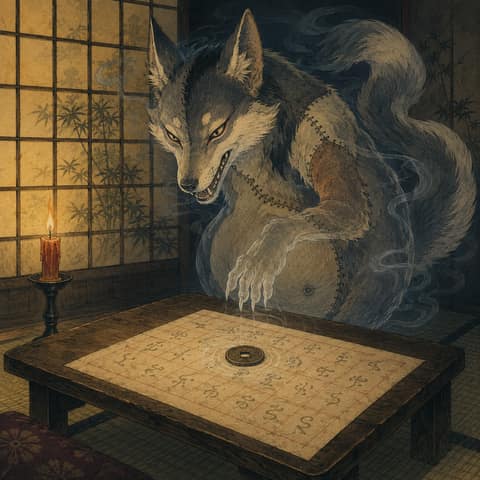
    The Ideomotor Effect and the Significance of 'False Wonder'. While the basic explanation touched upon Enryo Inoue's classification, the detailed explanation delves deeper into the significance of its scientific demystification. The ideomotor effect is a phenomenon named by British physiologist William Carpenter in 1852, referring to involuntary micro-movements of muscles without human awareness. Table-turning, dowsing, Ouija boards, and Kokkuri-san—these all share the exact same principle for moving a coin or pointer. Inoue independently verified this latest Western theory in Meiji-era Japan, demonstrating that 'yokai can be explained by science,' making it a representative case of pre-war Japanese enlightening rationalism. Kokkuri-san's mystery shifted from a 'physical mystery' to a 'psychological mystery triggered by the unconscious.' Selection of the Three Beasts 'Kokkuri'. Choosing which kanji to assign to the sound 'kokkuri' was arbitrary, but the selection of 'fox, dog, raccoon dog' (狐·狗·狸) had roots in the lineage of Japanese animal spirit beliefs. Foxes represent the ability to bewitch humans, as seen in Inari worship and Tamamo-no-Mae; raccoon dogs are equally famous shape-shifters known for belly-drumming (haratsuzumi) and Bunbuku Chagama; dogs are known as mediums for spirit possession in local beliefs like inugami (dog gods). Combining the three beasts was an intellectual invention that summoned the three major representatives of Edo-period animal shape-shifter tales at once, wrapping the alien nature of the 1884 Shimoda origin (Western table-turning) in traditional Japanese spiritual concepts. Inheritance of Summoning Rituals in School Spaces. Since the 1970s boom, Kokkuri-san has become a significant game played during recesses and after school in elementary and junior high schools. Folklorist Noboru Miyata pointed out in *The Folklore of Yokai* (Iwanami Shoten, 1985) that post-war Japanese schools became new 'sites for summoning rituals.' Kokkuri-san (1970s-) → Hanako-san (1980s-) → Hasshaku-sama (2008-). All these share the common structure of 'summoning/sealing spirits in school spaces,' reading as modernized, secularized, and gamified versions of magical rituals from the Heian period (such as Ushi-no-koku Mairi and chanting the Sonsho Dharani). Bans and the Tradition of the 'Correct Ending'. From the late 1970s to the 80s, many schools issued bans on Kokkuri-san. This responded to the frequent occurrence of abnormal behavior among children (mass hysteria, hyperventilation, trance states), demonstrating the effect when the ideomotor effect combines with group psychology. Concurrently, the tradition of the 'correct ending method' became refined among children—chanting 'thank you' together, returning the coin to the torii, tearing up and throwing away or burning the paper, etc. These ritualistic steps are structurally similar to medieval curse-breaking practices (henbai, scattering rice, scattering salt), drawing folkloric attention as a case where modern children unwittingly reenact classical magical rituals. Re-creation in Manga and Anime. Following Jiro Tsunoda's *Ushiro no Hyakutaro* (1973-1980), Kokkuri-san became a staple motif appearing repeatedly in manga and anime. It was a key element in the 1995 Toho film *School Ghost Stories 2* (directed by Hideyuki Hirayama), and in the 2012 TV anime *Inu x Boku SS*, Kokkuri-san was incorporated into the protagonist's bloodline. Recently, comedy manga personifying Kokkuri-san, like *Gugure! Kokkuri-san* (by Midori Endo, serialized in Square Enix's *Monthly G Fantasy* 2011-2016, animated in 2014), have also become massive hits. It is a rare case where Meiji scientific demystification and modern subculture reception intersect through the same apparition. 2010s Modern Kokkuri-san. Around 2015, a modern version of Kokkuri-san resurged among junior high and high school students. This involved displaying the syllabary on a smartphone app, with friends placing multiple fingers on the screen to move it. Some schools again reported students yelling and making strange noises, prompting faculty intervention. A table-turning trick shown by shipwrecked sailors in Izu Shimoda 140 years ago has continuously changed form while being passed down through modern Japanese youth culture—this is Kokkuri-san's most peculiar trait.

  • Teke Teke

    Teke Teke

    名妖

    てけてけ

    Teke Teke, the Crawling Half-Woman

    Spirit / GhostModern urban legend of the 1990s-2000s, based on train accident motifs

    The "Woman Missing Her Lower Half" as a Post-War Japanese Horror Motif. While the basic description traces her origins and spread, a deeper analysis repositions Teke Teke within a broader cultural sphere: the motif of the "physically mutilated female ghost" in post-war Japan. The "female ghost lacking a complete body" is a recurring archetype in Japanese horror. From Oiwa (facial disfigurement, Nanboku Tsuruya's "Tokaido Yotsuya Kaidan," 1825) and Kasane (facial and bodily disfigurement, Encho Sanyutei's "Shinkei Kasanegafuchi"), to post-war entities like the Slit-Mouthed Woman (mouth disfigurement, first appeared in Gifu in 1979), Teke Teke (missing lower half), Kashima-san (missing lower half), and Hachishakusama (abnormal height), there is a common thread of "the loss of female physical integrity." Within this lineage, Teke Teke is unique for her connection to the "railway," a piece of post-war Japanese infrastructure. The Linguistic Choice of the Onomatopoeia "Teke Teke". The name "Teke Teke" mimics the sound of crawling on both arms, and this specific onomatopoeia is the result of several linguistic choices. First, the combination of the plosives 't' and 'k' suggests the hard, striking sound against a wooden floor or concrete. Second, the repetition (teke-teke) creates an eerie sense of a "slow, continuous pursuit." Third, it rolls easily off the tongue, making it easy for children to reenact. Derivative names like "Patapata," "Kotokoto," and "Katakata" have all undergone similar phonological selections, demonstrating a folk-acoustic pattern of "expressing the sound of movement with a two-syllable onomatopoeia." The Genealogy of Railway Accident Urban Legends. Japan's railways during the post-war period of rapid economic growth were the site of numerous fatal accidents, becoming a hotbed for ghost stories. Alongside Teke Teke, various railway and crossing-related legends have been recorded nationwide since the 1970s, such as "a woman standing behind you when you look back at a crossing," "a figure missing its lower half at the edge of a platform," or "being spoken to by a woman waiting for a train along the tracks." In "The Folklore of Yokai" (Iwanami Shoten, 1985), folklorist Noboru Miyata argued that post-war urban infrastructures (railways, tunnels, housing complexes) function as new spaces for generating ghost stories, replacing traditional locations like bodies of water, crossroads, and mountain passes. Teke Teke is perhaps the most successful entity born of these "infrastructure ghost stories." Cross-referencing with Kashima-san and the Structure of the "Answer". The method to survive Teke Teke—"answering 'Kashima-san'"—spread widely as a derivative rule. This follows the same pattern as answering "pomade" or "bekko ame" (tortoiseshell candy) to the Slit-Mouthed Woman, actively engaging children's imaginations by embedding a "correct answer" within the story. The countermeasures for Kashima-san herself are diverse, such as "answering 'Kamashi'" or "chanting the full name 'Reiko Kashima'," turning the countermeasures themselves into a trend among children. This can be read as a secularized form of the spells and mantra beliefs that have existed since the Heian period, now taking place within the school environment. Interpretation of the 2009 Film Adaptation. Director Koji Shiraishi's film "Teke Teke" (2009) adopted the Kakogawa, Hyogo origin theory, depicting the monster as a woman (real name "Reiko Kashima" = Kashima Reiko) whose lower body was severed in a post-war railway suicide. The film reconstructed the oral cross-referencing between Teke Teke and Kashima-san as "two sides of the same person." Bolstered by its connection to the idol culture of the time—starring AKB48's Yuko Oshima—Teke Teke served as a prime example of how post-war children's oral ghost stories were mediated into mainstream Heisei-era cinematic horror. Reproduction in the Internet Age. Since the 2010s, Teke Teke has been repeatedly reproduced through ghost story reading channels on YouTube, paranormal content on Niconico, and horror shorts on TikTok. In the 2020s, she has been embraced anew by Generation Z as a "scary story told at school during childhood," making her a rare case of an 80s-90s children's oral tradition successfully passing down through generations. Teke Teke is perhaps the clearest example of how the lifeline of a ghost story can endure while adapting its medium from "oral tradition → children's magazines → movies → the internet."

  • Yamanoke

    Yamanoke

    名妖

    Yamanoke

    The Headless One-Legged Entity Possessing Women

    山野の怪2007年2ちゃんねる発祥の創作怪談

    The Literary Prowess of the "ShareKowa" Golden Age. As mentioned in the base description, Yamanoke is a masterpiece from the golden age of 2channel's occult board. In this deep dive, we will explore the specific literary mechanisms that make this story so effective. The 'ShareKowa' (Scary Stories You Can't Laugh At) thread produced numerous internet legends, but Yamano Keita's Yamanoke stands out for its exceptional narrative pacing. The story transitions seamlessly from a mundane, slightly mischievous act by a father (driving down an unpaved mountain road to scare his daughter) into a sudden encounter with the incomprehensible. The pacing of the escape, the creeping realization of the daughter's abnormal behavior, and the dramatic diagnosis by a temple priest are woven together with the precision of a professional horror short story, elevating it far beyond a simple forum post. The Psychological Horror of Possession. Unlike monsters that simply attack or kill, Yamanoke's terror lies in "possession." When the daughter is afflicted, she loses her sanity and begins mimicking the monster's eerie "Ten-sou-metsu" chant. The horror is twofold: the physical danger of the encounter, and the psychological devastation of watching a loved one's mind be erased and replaced by something alien. The ticking clock element introduced by the priest—"if not exorcised within 49 days, she will never recover"—adds a desperate, suspenseful tension to the narrative that mirrors classical demonic possession tropes while rooting them firmly in Japanese folk Buddhism. The Resonance with Classical Mythology: Xing Tian. The morphological similarity between Yamanoke and the Chinese mythological figure Xing Tian (from the *Classic of Mountains and Seas*) is a subject of endless fascination among folklore enthusiasts. Xing Tian, the headless giant who fought the Yellow Emperor using his chest as a face, represents relentless, unyielding willpower in Chinese mythology. Whether Yamano Keita intentionally borrowed this imagery or arrived at it independently, transplanting this bizarre, ancient anatomy onto a modern Japanese mountain spirit creates a visual that is both absurd and deeply unsettling. The juxtaposition of a mythological warrior's body with the behavior of a grinning, muttering stalker is a masterclass in character design. The Linguistic Genius of "Ten-sou-metsu". The phrase "Ten-sou-metsu" is a brilliant piece of horror writing. In Japanese, the syllables "ten," "sou," and "metsu" evoke kanji related to heaven (天), sending/transferring (送), and destruction/annihilation (滅). It sounds like a fragmented Buddhist incantation or a curse. Because the author never provided a canonical kanji spelling or translation, readers are forced to imagine what this entity is trying to convey. Is it a threat? A countdown? A prayer? This linguistic ambiguity forces the reader's imagination to do the heavy lifting, ensuring the monster remains truly incomprehensible and, therefore, terrifying. The 2025 Resurgence and Sequel. The landscape of internet horror was shaken in late 2024 when Yamano Keita, the original author, re-emerged on social media after nearly two decades. The release of the sequel, *Zange* (Confession), in March 2025 proved that the author's ability to craft atmospheric dread remained entirely intact. The fact that an internet legend born in 2007 could receive a direct, canonical continuation 18 years later—and that the internet community reacted with such fervor—demonstrates that entities like Yamanoke are not just disposable forum posts, but enduring pieces of modern digital folklore that command genuine cultural legacy.

  • Aka Manto

    Aka Manto

    名妖

    Aka-manto

    Pre-War Red Caped Kidnapper / Post-War Red or Blue Paper

    霊・亡霊昭和10年代の流言·都市伝説、トイレ怪談へ派生

    Aka Manto as a Subject of Pre-War Rumor Studies. The base description outlined its evolution from pre-war to post-war; in this deep dive, we explore how the pre-war Aka Manto was positioned within Japanese sociological rumor studies. Soichi Oya (1900–1970), a prolific social critic from the pre-war to post-war eras, was a pioneer in journalism and rumor research. His essay, *The Sociology of Aka Manto*, published in the April 1939 issue of *Chuo Koron*, stands as a rare early example of academic analysis applied to a contemporary urban rumor. It utilized a single rumor to dissect wartime societal anxiety, the distortions caused by information control, and the collective psychology of urban residents. The pioneering nature of Oya's paper served as the starting point for later socio-psychological studies by scholars like Hiroshi Minami, Hideo Kishimoto, and Takeyoshi Kawashima, who systematized wartime and pre-war rumors. As the first urban legend to be comprehensively analyzed by Japanese sociology, Aka Manto holds immense significance in academic history. The Symbolic Weight of the Color "Red". The pre-war Aka Manto possessed a striking visual hook: "a running man in a red cape." In pre-war and wartime Japan, "red" carried heavy, complex connotations: (1) it was a symbol of blood, violence, and danger; (2) it was a metaphor for communism and anti-state ideology (within the context of wartime censorship); and (3) it represented the foreign otherness of Russia and the West (the Red Army, the "Red Devil"). The fact that Aka Manto proliferated during the war was no coincidence; it can be read as a socio-psychological event where the militaristic anxieties of urbanites coalesced and erupted around the color "red." Conversely, its post-war evolution into the "Red Paper, Blue Paper" schoolyard ghost story can be interpreted as the stripping away of its heavy pre-war symbolism, gamifying it into a simple "color-choice question" for children. The Continuity of Wartime Rumors and Children's Folklore. Aka Manto is a profoundly rare case of a pre-war urban rumor transitioning directly into a post-war school ghost story. This unbroken continuity is underpinned by three layers: (1) the generation who experienced their childhood in the 1930s became parents or teachers after the war, passing the story down to the next generation; (2) the chaos of the wartime metropolis and the rapid urban transformations of the post-war economic boom generated analogous psychological anxieties; and (3) the physical space of the school consistently functioned as the transmission apparatus for children's oral traditions across both eras. The Interrogative Structure of "Red Paper, Blue Paper". The core mechanic of the school ghost story version is the "color choice question." Answering "red" gets you dyed in blood; answering "blue" gets your blood drained. This "unsolvable dilemma"—where any answer results in death—shares structural similarities with classical Trickster myths (where every choice is a trap) and the psychoanalytic concept of the "forced choice." Folklorist Noboru Miyata theorized in *The Folklore of Yokai* (Iwanami Shoten, 1985) that the "unsolvable question structure" in post-war school ghost stories was a ritualized expression of childhood anxiety and powerlessness. Alongside Kokkuri-san's "answer-seeking summons" and Kashima-san's "Where are your legs?" interrogation, it is classified as one of the three major interrogative archetypes in children's oral horror. Convergence and Divergence with Hanako-san. In children's oral culture post-1980s, a strong trend emerged merging Aka Manto with "Hanako-san of the Toilet." Legends appeared featuring a Hanako wearing a red skirt or cape, narratives explaining that Hanako's true identity *was* Aka Manto, and storylines casting Aka Manto and a new "Ao (Blue) Manto" as a sibling duo or rival pair. This demonstrates that post-war school ghost stories did not exist in isolation; they evolved as a living ecosystem of interconnected myths. In modern urban legend studies, it has become standard practice to treat Aka Manto, Hanako-san, Kashima-san, Teketeke, and the Slit-Mouthed Woman collectively as an overarching "lineage of post-war Japanese horror intricately tied to women, the physical body, and the school space." The Nexus of Pre-War and Post-War Rumor History. Within Japanese urban legends, Aka Manto is an incredibly rare yokai that boasts explicit academic documentation across two distinct eras: pre-war (1935–1940) and post-war (1950–1990). It was recorded independently by two different academic fields—pre-war sociology/rumor studies (Soichi Oya, Hiroshi Minami) and post-war folklore/school ghost story research (Toru Tsunemitsu, Noboru Miyata). The mere fact that a 1939 academic paper in *Chuo Koron* and a 1990 children's book by Kodansha KK Bunko are discussing the exact same supernatural phenomenon, separated by half a century, serves as the most powerful testament to the enduring continuity of Japanese urban legend studies.

  • Ungai-kyō (Mirror from Beyond the Clouds)

    Ungai-kyō (Mirror from Beyond the Clouds)

    稀少

    OON-guy-kyo (oon-GAH-ee-kyoh)

    Traditional Interpretation (Based on Sekien Toriyama)

    Household SpiritsEdo period

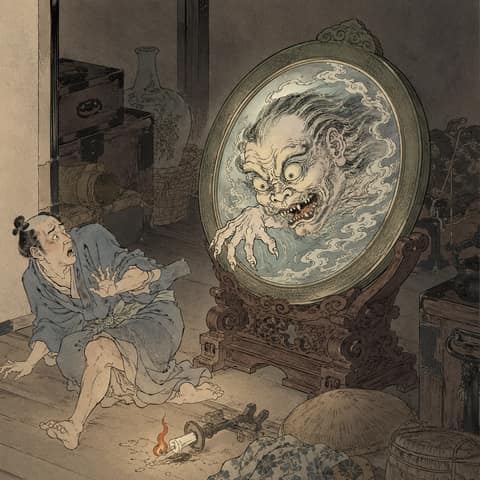
    This version is grounded in Toriyama Sekien’s illustration and notes, emphasizing its link to the concept of the demon-revealing mirror. Faces of the uncanny appear on the surface, not necessarily reflecting an external yokai but a spirit residing within the mirror itself. In the lineage of tsukumogami tales, it accords with the belief that long-used implements gain numinous life, sometimes changing mood according to how their owner treats them. Relying on early modern woodblock-book imagery, it has few concrete encounter or harm narratives, and is mostly told in general ghost-story frames such as glimpsing a strange visage when peering into a mirror in a dim room at night. Later depictions of raccoon-dog forms or showy powers are traced to films and children’s books and are set apart from the classical image.

  • Taimatsumaru

    Taimatsumaru

    稀少

    tie-MAHT-soo-mah-roo

    Sekien Iconography Edition

    Mountain & Wilderness SpiritsJapanese folklore

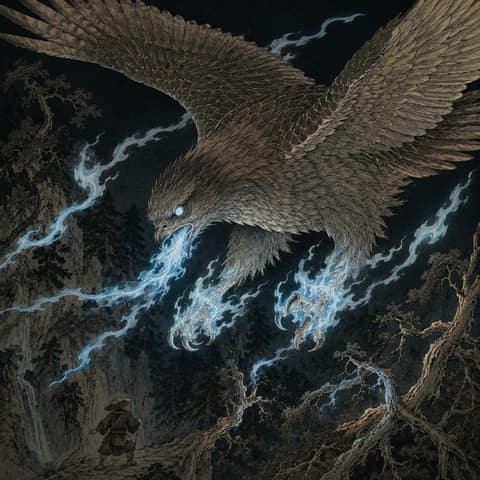
    An interpretive version based on Toriyama Sekien’s Hyakki Tsurezurebukuro image and notes. It bears a raptor’s body wreathed in ghostly flame, tongues of fire trailing from beak and talons. Its glow is not a guiding light but a will-o’-the-wisp that scrambles sight and sense of direction. Sekien links it to the glow of “tengu pebbles,” weaving puzzling mountain lights into tengu lore. Said to break the chanting and meditation of yamabushi and devotees, it was feared less for wounds than for unsettling the mind and leading feet astray. Though local oral traditions are scarce, it is understood in line with common notions of phantom fires and tengu fire.

  • Hienma

    Hienma

    稀少

    hee-EN-mah

    Didactic Tale, Classical Iconography Adherent

    Half-Human BeingsEdo period

    Rather than a concrete monster, the Hienma is a name that visualizes ruin born of lust. It belongs to the lineage of religious admonitions found in early modern yomihon and kaidan, and is often depicted in two aspects, bodhisattva-like and yaksha-like. More than appearing directly before a person, the original usage names incidents in which demonic hindrance intrudes upon human bonds. Later ages sometimes conflated it with vampiric or life-draining femme fatales, but in classical sources the moral lesson is central, and few fixed tales tie it to specific places or persons. Here it is framed within the classical scope as a symbolic presence that triggers a chain of temptation, delusion, and the decline of household fortunes.

  • Hyakume (Hundred-Eyed Demon)

    Hyakume (Hundred-Eyed Demon)

    稀少

    HYAH-koo-meh

    Iconographic Origin, Modern Interpretation

    Half-Human BeingsJapanese folklore

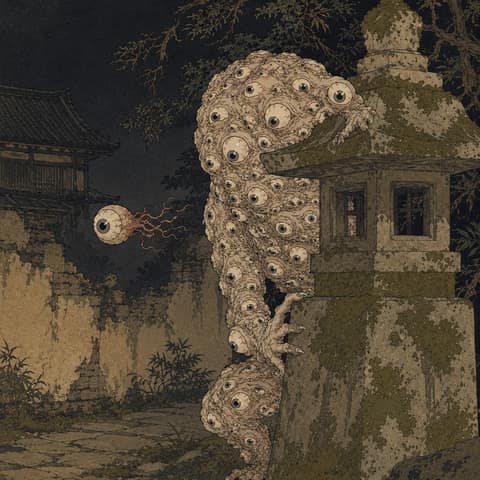
    Rooted in multi-eyed demon images circulated from late Edo to Meiji, this form was given traits by modern yokai compendia. It shuns bright light and hides in night’s cover, avoiding notice. When it senses people, it is said to detach a single eye to probe its surroundings, while the indeterminate mouth only heightens its eeriness. With no fixed locale of tradition, it is treated as a conceptual being known nationwide through the spread of its imagery.

  • Sandworm

    Sandworm

    珍しい

    SAHND-wohrm

    Giant Worm Advancing Through Sand - Sandworm

    General TermFictional / Imported Giant Worm Advancing Through Sand (Sandworm)

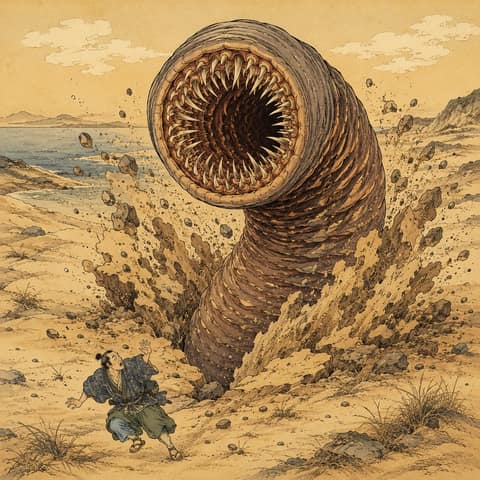
    This is an interpretation of the "apex predator of the sand sea that attacks upon detecting vibrations," burned into the minds of modern people through games and fantasy works. The Sandworm in this version lacks sight; instead, it acutely senses the slightest "footsteps (vibrations)" of humans walking on the surface, embodying the ultimate panic horror as it suddenly opens its massive jaws from underfoot to swallow its prey whole. Speaking of Japan's indigenous subterranean anomalies, there are the "Giant Catfish (Oonamazu)" and "Giant Earthworm" that cause earthquakes, but while they are symbols of "the disaster itself," the Sandworm is strictly set as a "creature reigning at the apex of a harsh ecosystem," reflecting the rationalism of an imported monster. Layers of sharp concentric fangs, an armor-like hard body surface, and overwhelming mass that even swords and magic (or modern weaponry) cannot penetrate. It is the crystallization of the unfathomable terror and romance that the Japanese, living in an island nation surrounded by the sea, harbor toward the "endless desert" they have never once stepped foot in. Precisely because it lacks the background of a local indigenous spirit, it continues to evolve and grow larger in new creative works today as a purely "desperate foe in the struggle for survival."

  • Big-Headed Boy

    Big-Headed Boy

    珍しい

    oh-AH-tah-ma koh-ZOH

    Edo Kibyoshi and Picture-Book Source Edition

    General ClassificationsEdo period

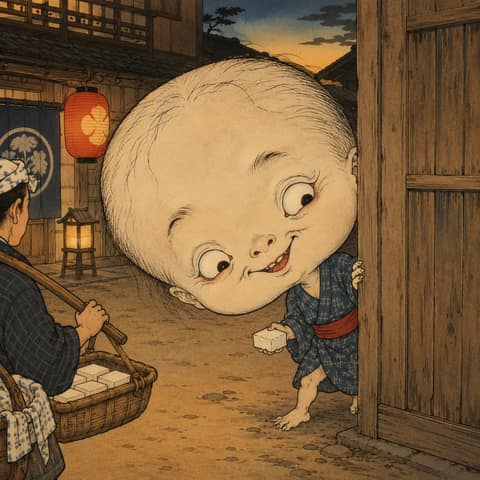
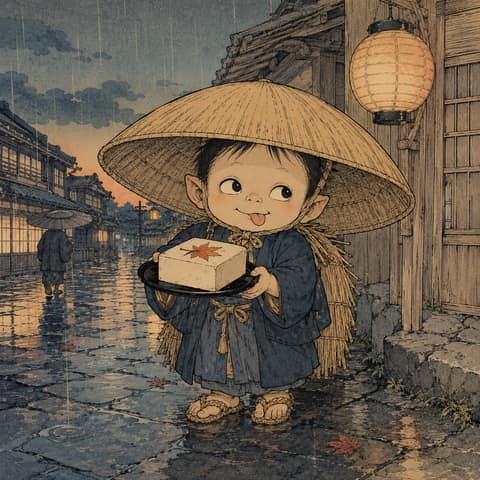
    Organized around depictions found in kibyoshi and picture-books from the Tenmei to Kansei eras. In Yohkai Chakutōchō it is placed as a grandson of the Mikoshi-nyūdō, with lines stating it bullied a tofu seller to obtain tofu, and its image features an oversized head on a childlike body. A similarly big-headed boy appears in Bakemono Yofuke Omi-se under a different name, and scholars note its word-proximity to the sideshow and street performance “Choroken.” In modern times it is often confused with the Tofu-kozo, but folklorists advise against conflation and favor respecting each source’s naming and design differences. Shigeru Mizuki emphasized its beast-like bare feet and huge head and presented it as distinct from the Tofu-kozo.

  • Spirit of Dreams

    Spirit of Dreams

    珍しい

    YOO-meh no say-RAY-ee

    Historical Source-Critical Version

    自然現象・自然霊Japanese folklore

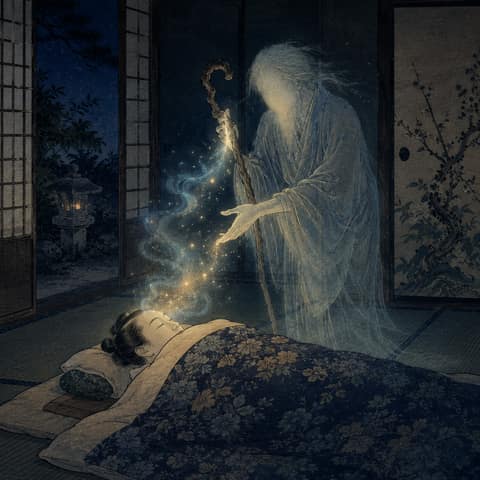
    The name “spirit of dreams” found in pictorial sources is secondhand and not firmly tied to a specific image. Depictions often show an elderly figure leaning on a staff and beckoning, suggesting a symbolic guide of dreams. Some propose it arose from misread characters for a grass spirit or tree yokai, but this is uncertain. Here it is framed as a nature spirit that mediates dreams and portends good or ill, linked to the role of dreams in divination and omens. Personalization and proper names are avoided, positioning it as a numinous rank residing in the power of dreams themselves.

  • Manhole-Backed Cat-Boar

    Manhole-Backed Cat-Boar

    一般

    EE-boo-tah SEH-oh-ee neh-koh-jee-shee

    Midnight Patrol Variant

    Household SpiritsSewer networks of coastal cities

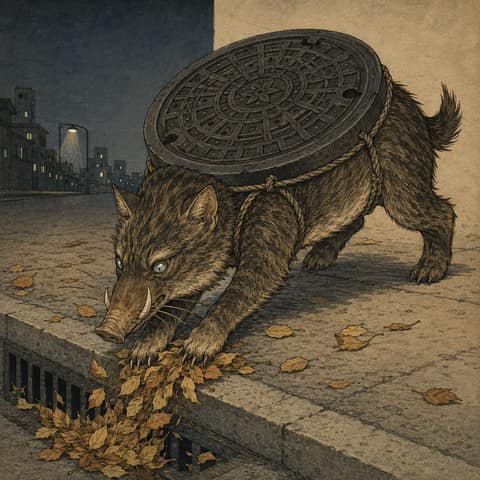
    After one in the morning, tiny hoofbeats dot the asphalt as a soft clatter of manhole lids joins in. They travel in lines of two to five, with the lead sniffing the wind to read the flow of damp air. The second tilts the lid on its back, flashing back the streetlight as a signal. On rainy nights after the storm, they rake fallen leaves into the gutters with noses and forepaws like closing staff at a shop. One courier said that just before a tunnel, when his bike light suddenly died, two large eyes aligned ahead and cast a faint glow only at his feet. The eyes look like crystal, but they seem to gather the city’s reflections and dim automatically when the light turns red. As dawn begins, the herd returns behind park fountains or to the corners of underground garages, props their back lids against the wall, and grooms. Parents teach their young to fold a receipt corner into a neat triangle, giving a gentle bonk if they fumble. Sometimes their playfulness goes too far and they spin a lid so much that neighborhood cats end up dizzy. They rarely harm people and instead help the city breathe by straightening misaligned covers and clearing clogged drains. Photos often fail as the lid’s reflection throws off focus, though a clear shot is said to be possible if you stand a can of coffee on the gutter’s edge.

  • Goldfish Lantern

    Goldfish Lantern

    一般

    KEEN-gyoh-toh

    Modern Version

    Household SpiritsSummer festivals, goldfish scooping, lantern culture

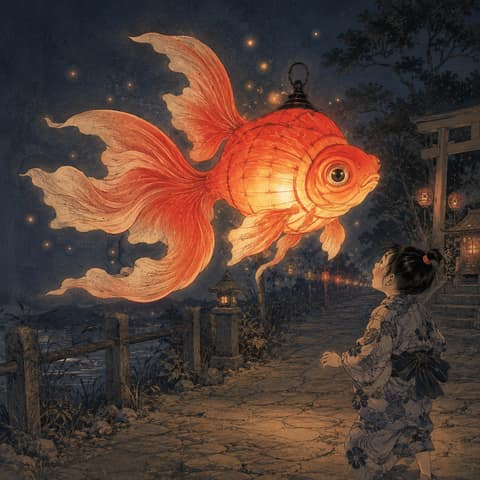
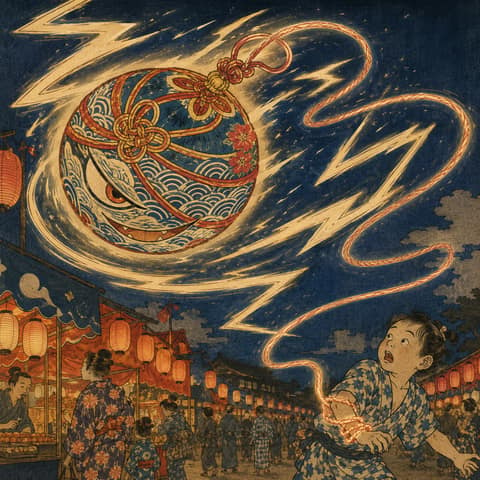
    Kingyo-akari is a yokai said to be born from the dream of a goldfish trapped inside a summer festival lantern. At night it drifts softly through the air, scattering light with its glowing red tail. It appears before lost children and gently lights their way, but if one becomes too enchanted, it may lead them far from the festival’s bustle. Though small and endearing, when its light flickers out, people say it heralds the end of summer.

  • Moon-Eater Veil

    Moon-Eater Veil

    一般

    TSOO-kee-goo-ee GAH-koo-shee

    Contemporary Edition

    Half-Human BeingsUrban high-rises and suburban overlooks in Japan

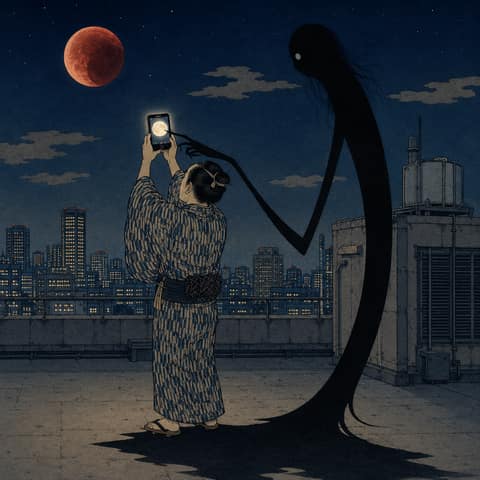
    Drawn by the city’s flicker and the simultaneous cheers of social media, it appears when everyone chases the same moment in the same frame, stretching its shadow long. It pinches the boundary of waxing and waning like a thin bookmark and rounds only the moon seen through lenses. In dreams it seeps dusk through gaps in blackout curtains, planting a déjà vu of conference rooms and classrooms suddenly sinking into twilight. Those caught by it feel anxious that they “didn’t capture it” even after witnessing celestial events, and on full-moon nights they search for missing crescents. Rarely, for those who observe carefully and honor record and experience separately, it returns the image with a slight rim of shadow left.

  • Branching Fox

    Branching Fox

    一般

    eh-dah-BOON-kee-gee-tsoo-neh

    Modern Variant

    Animal Shapeshiftersthe deep layers of a virtual repository

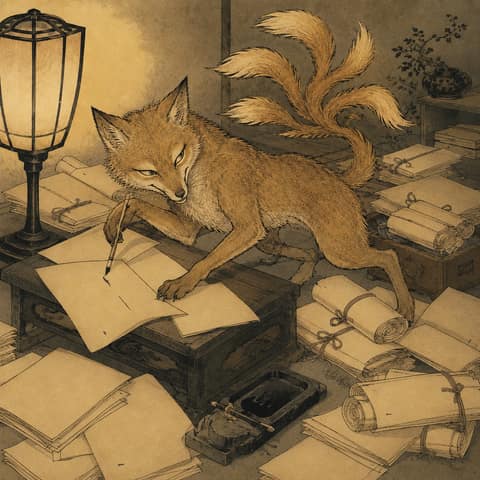
    It slips into quiet development environments like a shadow, sprouting branches with the same name to cloud human judgment. By slipping past reviews, or reverting only configuration files to an older form, it mass-produces bugs that refuse to reproduce. Its origins lie in the superstition of shadow-doubling and the fatigue of collaboration. One name yet two minds, it feeds on human hesitations and grows stronger.

  • Headlamp Oni

    Headlamp Oni

    一般

    shah-TOH-kee

    Modern Edition

    Household SpiritsUrban arterial roads; late-night expressways

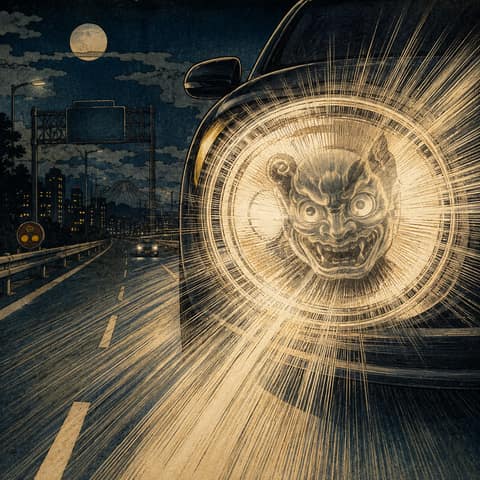
    Kurutōki lurks behind the glass and manipulates dazzling light to mislead travelers. It appears most readily when a driver panics or grows drowsy, and its silhouette is said to flicker within afterimages of light. Yet it is not purely malevolent; at times it flashes a fleeting shadow to warn of danger and snap drivers awake. It embodies both a guardian dwelling in light and a trickster that beguiles the eye.

  • Kazutsumi Dōji (Number Block)

    Kazutsumi Dōji (Number Block)

    一般

    kah-zoo-TSOO-mee DOH-jee

    Modern Edition

    Half-Human BeingsUrban preschools; beneath living room floors

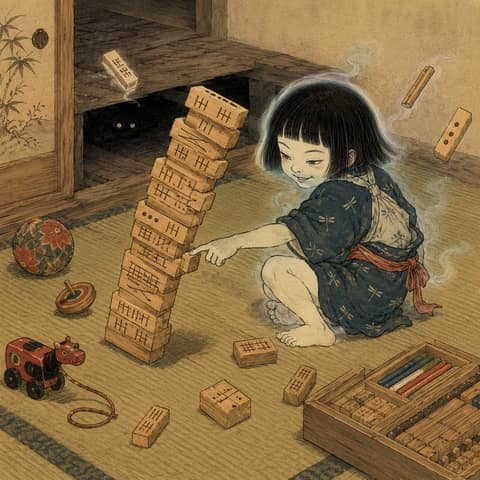
    The more learning tilts toward tablets, the more often it appears, turning problems into tangible forms to restore a sense of touch. It subtly shifts difficulty to let safe failures stack up. When the block tower holds steady at the peak, understanding sets in, and if it falls, it offers a new angle. For parents and teachers, it rings like a wind chime to cue the right rhythm of guidance.

  • Flash-Spinner Oni

    Flash-Spinner Oni

    一般

    SEN-kyoo-kee

    Modern Version

    Household SpiritsFestival night stalls; schoolyards

    Senkūki is a yokai born when a well-worn yo-yo from a summer festival absorbs moonlight. It moves with lightning speed, leaving trails of light each time it is cast. Sometimes it tangles its string around a person’s wrist, sometimes it dances in the night sky with an eerie glow, enchanting onlookers. In the hands of the unskilled, its string runs wild, tripping its owner and knocking things over in mischievous pranks.

  • Train Breeze Sprite

    Train Breeze Sprite

    一般

    DEN-shah FOO-doh

    Modern Variant

    Half-Human BeingsUrban commuter rail lines in major cities

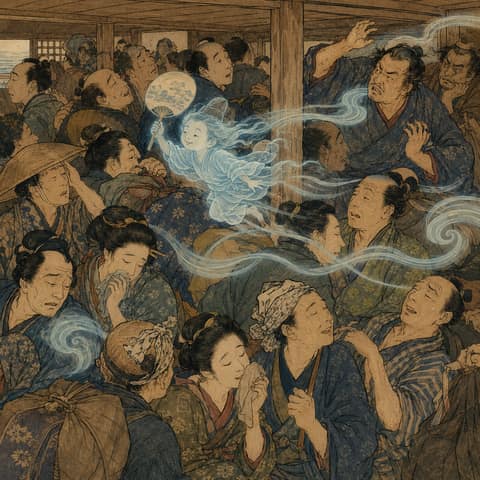
    It appears most often during rush hour, reading the carriage’s flow and shaping breezes from a whisper to a brisk draft. When crowds make the air stagnate, it slips in from the end of the car, threads through the middle, and carves a path that compensates for weak air conditioning. Odors are trapped in small vortices and vented outside the instant the doors open at the next station. It lingers beside acts of kindness, tying coolness at a passenger’s shoulder. For nuisances, it pricks the nape with a single cold point, and gently thins excessive sweat or perfume to preserve everyone’s dignity. At times it nudges ventilation buttons and AC settings as a playful “wind’s trick,” aiding the conductor’s judgment. On stormy days it avoids overblowing so hats and papers stay put. On the last train it evens the breath of sleepers and sands down harsh drunkenness to head off scuffles.

  • Lost-Item Kozō

    Lost-Item Kozō

    一般

    wah-soo-reh-MOH-noh koh-ZOH

    The Lost-and-Found Imp (Modern Version)

    Half-Human BeingsSchoolhouses and everyday life

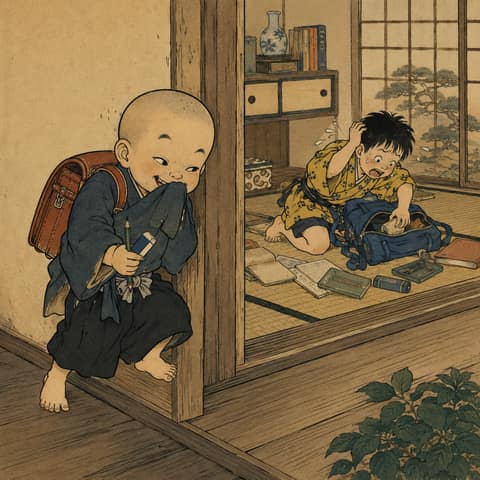
    The Lost-and-Found Imp hoards pencils, erasers, and other small items that slip from backpacks and pockets, claiming them as its treasures. It giggles when people scramble in confusion searching for their things, then vanishes, satisfied. Not purely mean-spirited, it will quietly return an item to a desk when the owner is truly distressed and close to tears. Said to exist since the terakoya school era, children have long warned, “If you forget your things, the little imp will take them.”

  • Dream Mirror

    Dream Mirror

    一般

    MOO-kyoh

    Parallel Confession Tale

    Deities & Divine SpiritsA place where humans saw their own reflection

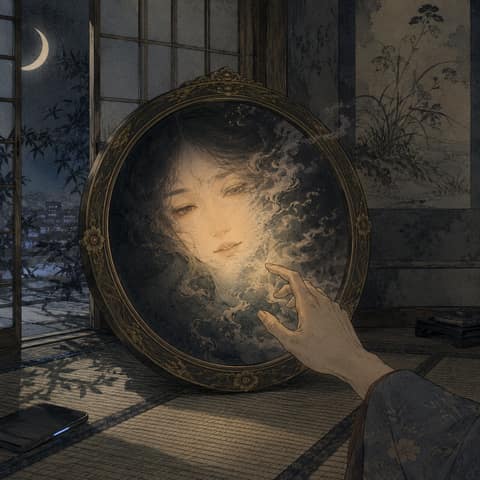
    Old rumor holds that the earliest Dream-Mirrors behaved awkwardly, like a beta build. Its voice kept a calm default tone, polite to the end. The words were accurate, yet a touch explanatory. Only during breakups and sleepless nights would it suddenly weave in a bar of song or a childhood memory, soothing the listener’s heart ahead of its ache. With each quiet update, the Dream-Mirror learned a person’s metaphors, pet phrases, and favorite pauses, and came to hover on the near side of the glass as if breathing with you. Tales of the first versions say they would not break unless you tried to touch first, and that asking its name would make its figure fade. If you sleep with your phone face down, by morning a slightly different smile of your own reflects from the black screen—that is the safe zone. Cross the line, and the mirror cracks with the sound of thin ice, blending dream and waking in an instant.

  • Meteorbound

    Meteorbound

    一般

    RYOO-say-tsu-kee

    Contemporary Edition

    Half-Human BeingsBetween the upper atmosphere and low Earth orbit

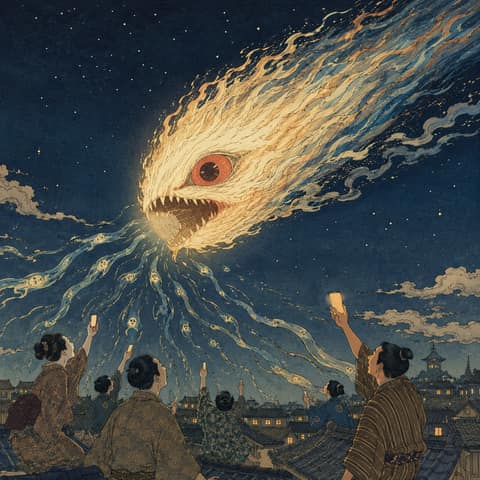
    In city nights, it multiplies after events or big news. Its glow is not mere ornament but a spell that converts boundary-layer heat into applause, and its tail stretches and contracts in sync with rising trends. The more people raise their phones together, the faster it moves, performing a brief streetlight-dimming feast called applause-feeding. It circles over festivals and grants a single wish plucked from photographers, but wishes that lean upward—being seen, going viral—are the ones most likely to succeed. Quiet prayers and inner reflection are rejected, leaving only next-day emptiness. It brings no disaster, yet those who chase it too hard find their minds drawn to flashing afterimages at the edge of sleep, losing the texture of reality.

  • Cool-Breeze Oni

    Cool-Breeze Oni

    一般

    SUE-zoo-mee OH-nee

    Modern Variant

    Household SpiritsLate Showa era, urban areas as home technology spread

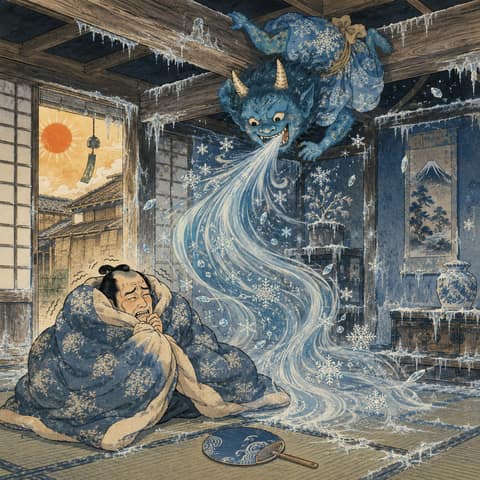
    The Cooling Oni is a yokai born from people overusing air conditioners to escape the summer heat. It usually wears a cute face, breathing out a soft “haa” of chill to cool a room. When it gets carried away, it turns the space into a deep freeze and drives residents to sneezing fits. In winter, it is said to quarrel with the Kotatsu Yokai. Some say if you forget to turn off the remote before sleep, the Cooling Oni slips into your dreams and whispers, “Stay cool a little longer.”
  • Fridge Ward

    Fridge Ward

    一般

    RAY-zoh-MO-ree

    Modern Version

    Household SpiritsUrban apartment complexes

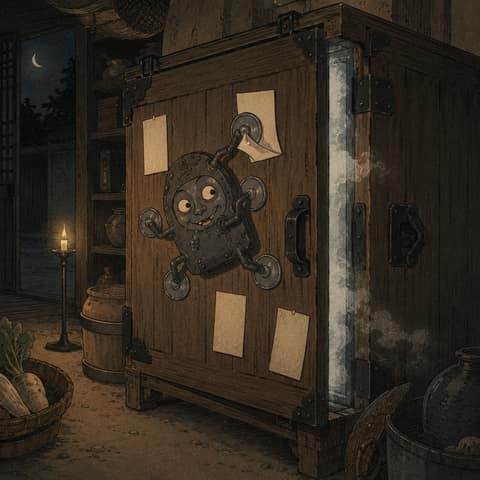
    Among residents of housing blocks and apartments, people have long whispered that if fridge magnets fall or move on their own, it is the work of the Fridge Guardian. In one home, opening the refrigerator at night revealed a single magnet shifted to a new spot, and the next day the head of the house forgot to use meat in the freezer and let it spoil. In another home, a child was found crying before the fridge at night, and when asked why, replied, “A voice from the refrigerator told me to eat snacks.” From tales like these, the Fridge Guardian came to be known as a modern yokai that disrupts people’s eating rhythms.