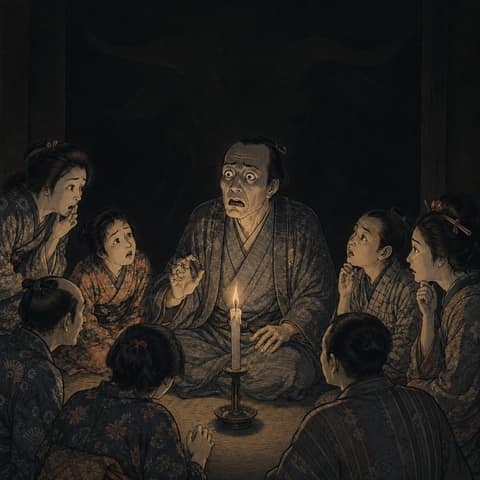
The Ideomotor Effect and the Significance of 'False Wonder'. While the basic explanation touched upon Enryo Inoue's classification, the detailed explanation delves deeper into the significance of its scientific demystification. The ideomotor effect is a phenomenon named by British physiologist William Carpenter in 1852, referring to involuntary micro-movements of muscles without human awareness. Table-turning, dowsing, Ouija boards, and Kokkuri-san—these all share the exact same principle for moving a coin or pointer. Inoue independently verified this latest Western theory in Meiji-era Japan, demonstrating that 'yokai can be explained by science,' making it a representative case of pre-war Japanese enlightening rationalism. Kokkuri-san's mystery shifted from a 'physical mystery' to a 'psychological mystery triggered by the unconscious.'
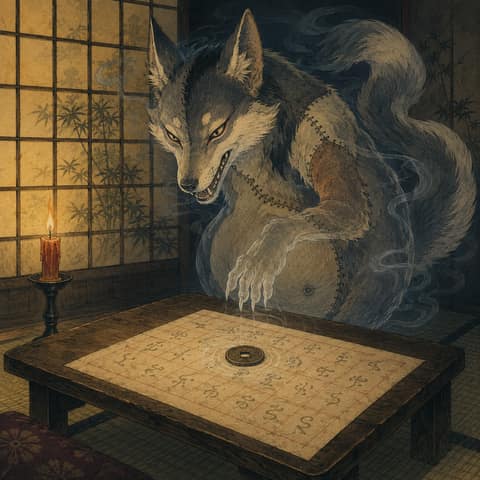
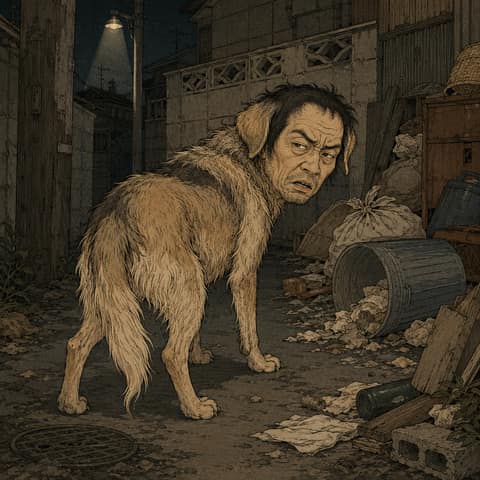
Selection of the Three Beasts 'Kokkuri'. Choosing which kanji to assign to the sound 'kokkuri' was arbitrary, but the selection of 'fox, dog, raccoon dog' (狐·狗·狸) had roots in the lineage of Japanese animal spirit beliefs. Foxes represent the ability to bewitch humans, as seen in Inari worship and Tamamo-no-Mae; raccoon dogs are equally famous shape-shifters known for belly-drumming (haratsuzumi) and Bunbuku Chagama; dogs are known as mediums for spirit possession in local beliefs like inugami (dog gods). Combining the three beasts was an intellectual invention that summoned the three major representatives of Edo-period animal shape-shifter tales at once, wrapping the alien nature of the 1884 Shimoda origin (Western table-turning) in traditional Japanese spiritual concepts.
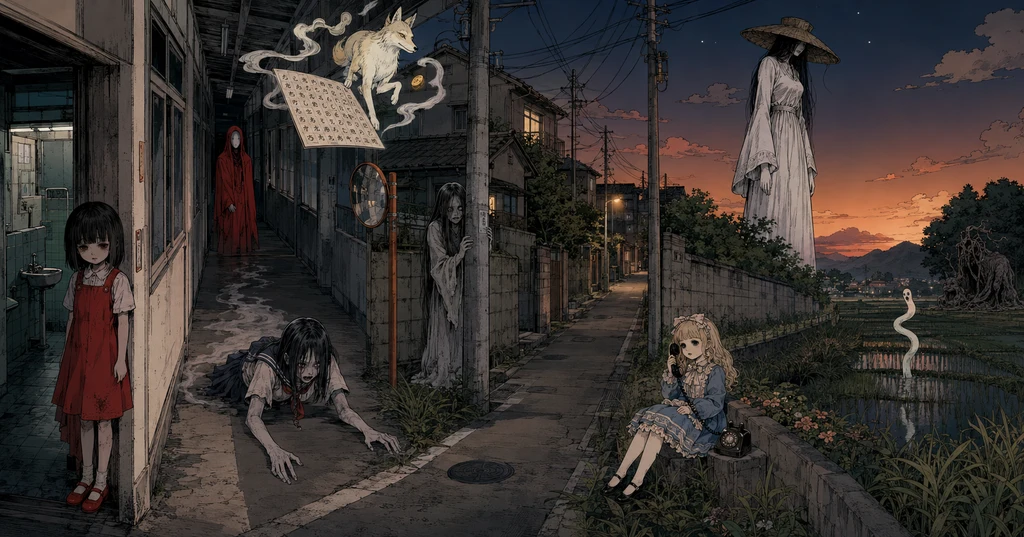
Inheritance of Summoning Rituals in School Spaces. Since the 1970s boom, Kokkuri-san has become a significant game played during recesses and after school in elementary and junior high schools. Folklorist Noboru Miyata pointed out in *The Folklore of Yokai* (Iwanami Shoten, 1985) that post-war Japanese schools became new 'sites for summoning rituals.' Kokkuri-san (1970s-) → Hanako-san (1980s-) → Hasshaku-sama (2008-). All these share the common structure of 'summoning/sealing spirits in school spaces,' reading as modernized, secularized, and gamified versions of magical rituals from the Heian period (such as Ushi-no-koku Mairi and chanting the Sonsho Dharani).
Bans and the Tradition of the 'Correct Ending'. From the late 1970s to the 80s, many schools issued bans on Kokkuri-san. This responded to the frequent occurrence of abnormal behavior among children (mass hysteria, hyperventilation, trance states), demonstrating the effect when the ideomotor effect combines with group psychology. Concurrently, the tradition of the 'correct ending method' became refined among children—chanting 'thank you' together, returning the coin to the torii, tearing up and throwing away or burning the paper, etc. These ritualistic steps are structurally similar to medieval curse-breaking practices (henbai, scattering rice, scattering salt), drawing folkloric attention as a case where modern children unwittingly reenact classical magical rituals.
Re-creation in Manga and Anime. Following Jiro Tsunoda's *Ushiro no Hyakutaro* (1973-1980), Kokkuri-san became a staple motif appearing repeatedly in manga and anime. It was a key element in the 1995 Toho film *School Ghost Stories 2* (directed by Hideyuki Hirayama), and in the 2012 TV anime *Inu x Boku SS*, Kokkuri-san was incorporated into the protagonist's bloodline. Recently, comedy manga personifying Kokkuri-san, like *Gugure! Kokkuri-san* (by Midori Endo, serialized in Square Enix's *Monthly G Fantasy* 2011-2016, animated in 2014), have also become massive hits. It is a rare case where Meiji scientific demystification and modern subculture reception intersect through the same apparition.
2010s Modern Kokkuri-san. Around 2015, a modern version of Kokkuri-san resurged among junior high and high school students. This involved displaying the syllabary on a smartphone app, with friends placing multiple fingers on the screen to move it. Some schools again reported students yelling and making strange noises, prompting faculty intervention. A table-turning trick shown by shipwrecked sailors in Izu Shimoda 140 years ago has continuously changed form while being passed down through modern Japanese youth culture—this is Kokkuri-san's most peculiar trait.
Character Profile
This section is our own creative profile for storytelling. It is not historical fact or scholarship.
Yokai Type - Modern Kaii
Category - Ghosts & Spirits
Rarity - Epic
Personality - Composite animal spirit that answers when called but possesses if the correct ending is neglected
Compatibility - Harmonious with those who follow proper etiquette (torii, syllabary, ending chant), returns curses to disrespectful summoners
Abilities - Answers questions by moving a coin or fingers (ideomotor effect)Appears as a composite deity of 'fox, dog, and raccoon dog'Possesses the summoner if the proper ending ritual is neglectedCommunicates intent through a symbolic system of a torii, syllabary, and 'yes/no'Tends to linger in play spaces at schools and homes
Weaknesses - The correct ending method (returning the coin to the torii and chanting 'please go home', burning the paper), Shinto and Buddhist prayers
Habitat - School classrooms and desks during recess, Japanese-style rooms at home, smartphone screens of teenagers