Reading a Page from the Original Illustration
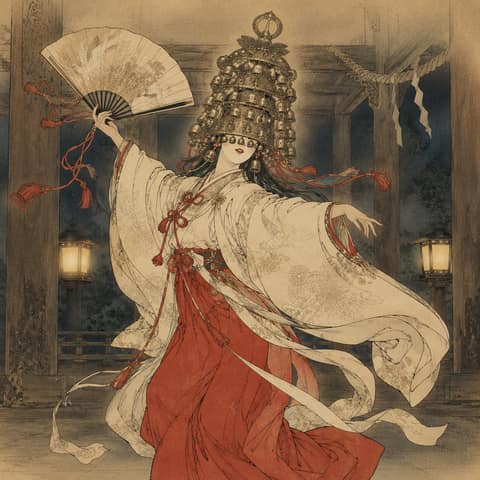
The best place to begin with Toriyama Sekien’s Suzuhiko-hime is not a later color picture, but a page in a printed book. In frame 4 of the lower volume of the National Diet Library’s Hyakki Tsurezure Bukuro, Suzuhiko-hime appears on the left-hand page, facing Ungai-kyō on the right. A railing runs along the far left. Beyond it, a figure leans forward and holds out an opened fan[1]. Her sleeves and fan push broadly into the page, while fine forms like small bells and long cords cover her head until the line between face and ritual object becomes uncertain.
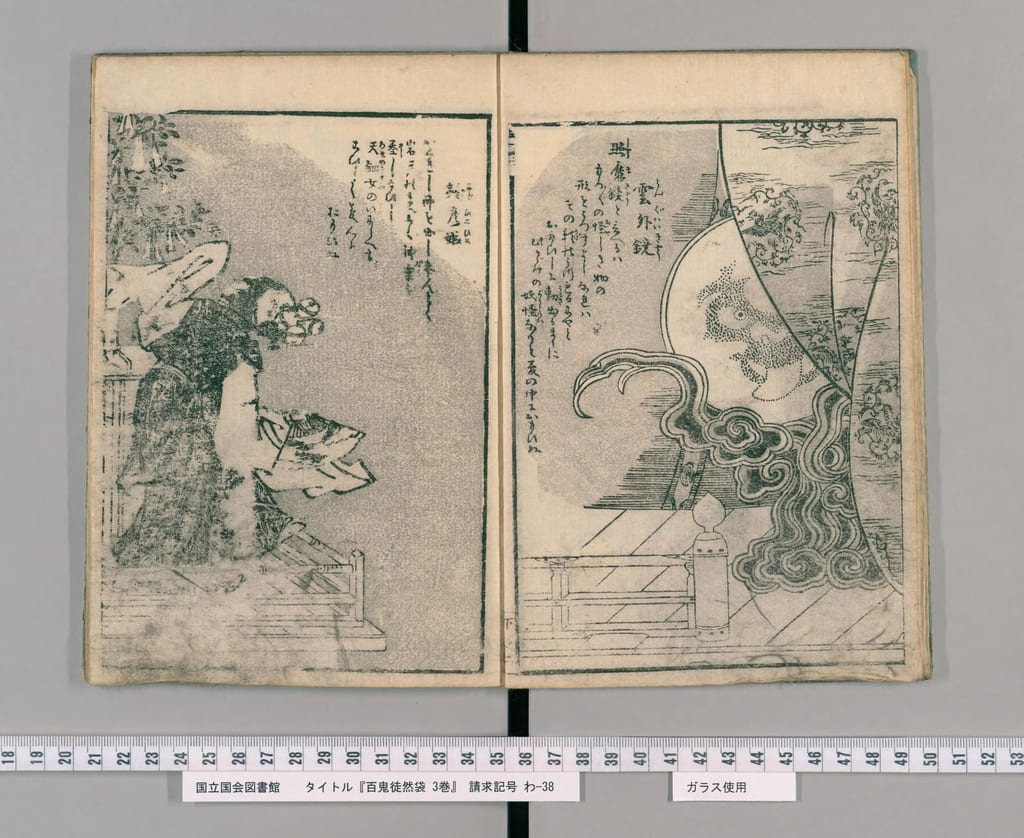
The image does not record a full sequence of dance. It catches the fan open at one instant, but gives no steps, rhythm, or bell sound; its caption does not supply an action either. Nor does the railed setting identify a particular shrine or kagura hall. Separating the pose that can be read from the page from the dance a viewer may imagine makes Sekien’s composition clearer.
A Short Caption and a Distant Myth
Beside the image, Sekien writes of Ame-no-Uzume performing kagura before the rock cave in an attempt to bring out the hidden deity, and of remembering that old time longingly, as in a dream. The original has no punctuation. It gives neither parents, age, dwelling, owner, nor reason for Suzuhiko-hime’s transformation. It does not even explicitly make Suzuhiko-hime its speaker, leaving room to understand the line as Sekien’s dreamlike narration.
“Hime” is no key to a historical princess. It can be read as giving the female figure in the illustration an elegant sound joined to the name of the bells, but Sekien does not explain his naming. Suzuhiko-hime cannot be traced through a biography contained in the name alone; she comes into being through the name, image, and caption acting together.
An Early Modern Invention Reflecting Ame-no-Uzume
Sekien did not simply redraw the myth of Ame-no-Uzume. He layered a memory of kagura and bells from his own early modern world over the myth and rearranged them as a new yokai. In the rock-cave episode of the *Kojiki*, Ame-no-Uzume wears hikage as a sash and makasaku as a headdress, carries bamboo leaves, and stamps on an overturned tub while entering divine possession. Kagura bells do not appear in the text[2]. The *Kojiki* writes 天宇受売命 (Ame-no-Uzume no Mikoto), whereas the *Nihon Shoki* uses 天鈿女命 (Ame-no-Uzume no Mikoto)[5]. Sekien chose the latter, connecting ancient myth with the kagura imagery familiar to early modern viewers.
This difference does not diminish Suzuhiko-hime. On the contrary, the absence of bells from the classical text brings Sekien’s inventiveness into view: mythology, kagura, bells, and female form are assembled in one dream image. To describe a bell absent from the source as an implement Ame-no-Uzume actually held would erase that creative move.
A ten-bell iron kagura suzu carrying an inscription dated 1516 survives as an example from before Sekien[6]. Keeping the actions of classical myth distinct from ritual implements established by the early modern period places Suzuhiko-hime not as an artifact from antiquity, but as an image in which visual traditions from different times meet.
From an Unnamed Bell Bearer to a Named Yokai
Comparison with bell-bearing creatures before Sekien makes the transformation visible. Frame 16 of a mid-Edo Hyakki Yagyō Emaki manuscript held by the National Diet Library depicts a birdlike creature advancing with a small cluster of bells, beneath a long white veil or crest[3]. Imai calls this type “a crane in miko dress holding bells” and explains Suzuhiko-hime as a yokai that combines miko and bell imagery[4].
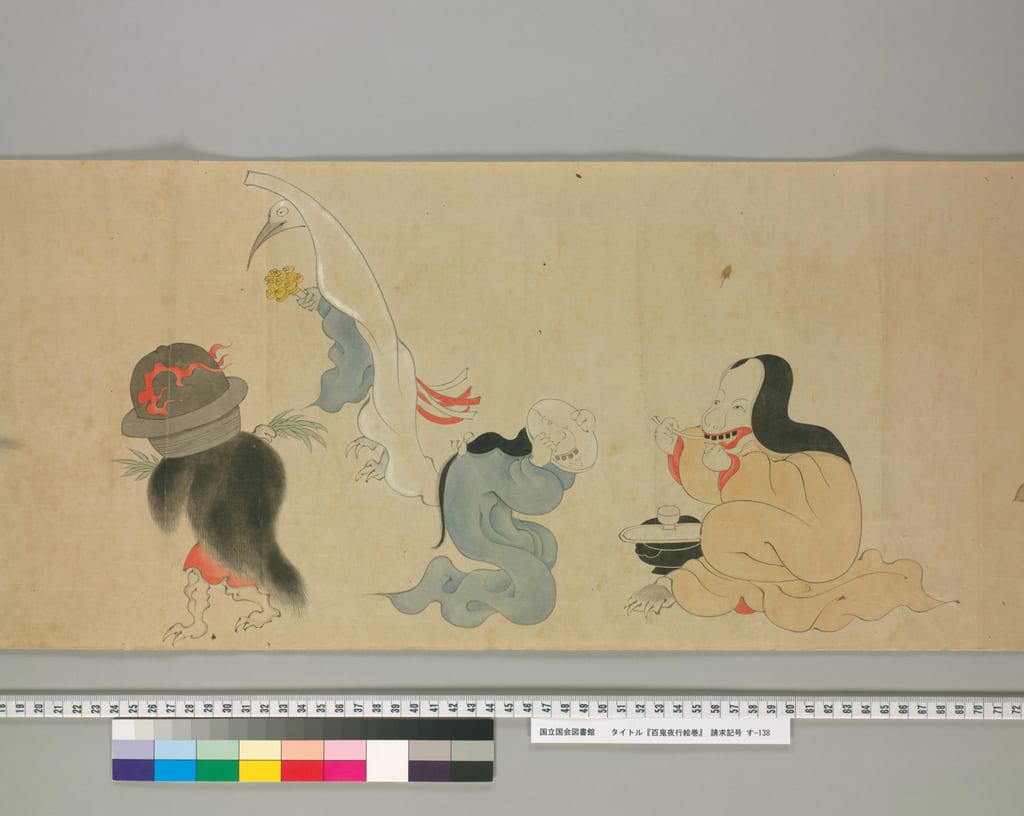
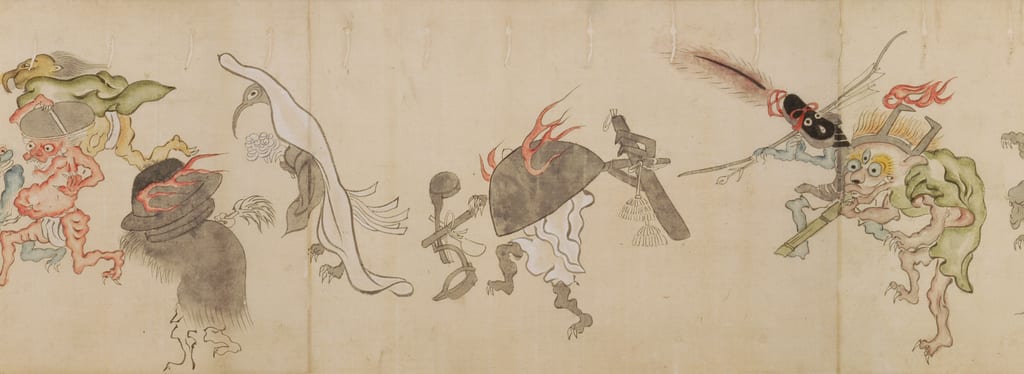
Their common elements are miko-like dress, a birdlike outline, and bells. The differences are greater still. The scroll creature is bird-shaped and holds bells in its hand; Sekien’s image reads as a human figure whose bells are integrated with her head, extending an opened fan. Comparison reveals Sekien’s reconstruction, but does not permit the name Suzuhiko-hime to be projected back onto the scroll-era figure. Because many manuscripts exist, the NDL copy cannot be declared Sekien’s single source image either.
Returned to a Crowd in Yoshitoshi’s Print
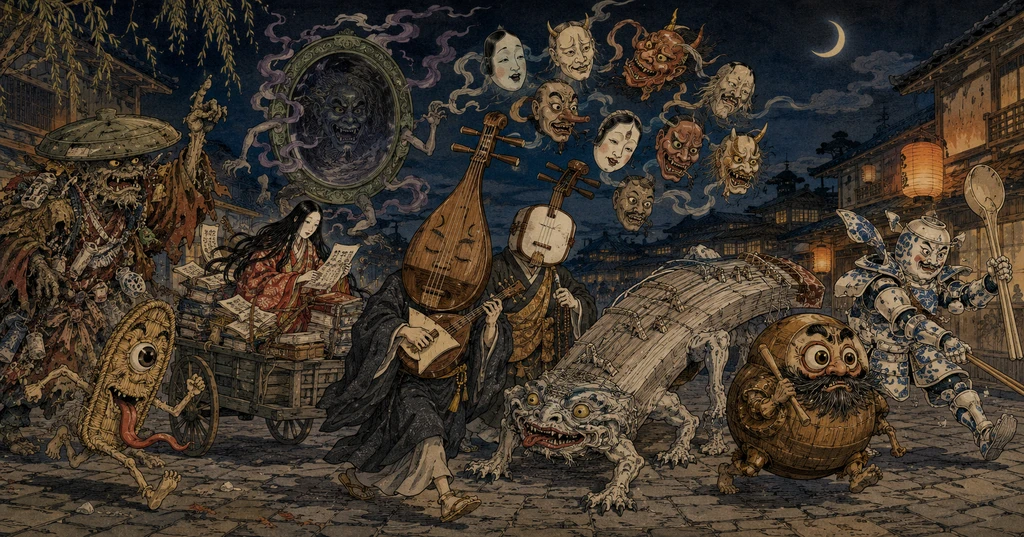
The figure Sekien named on one page entered a crowd again some eighty years later. Tsukioka Yoshitoshi’s 1865 diptych Hyakki Yagyō layers Daruma, biwa, kettles, fish-shaped implement yokai, and other figures in dense color. Near the center-left appears a Suzuhiko-hime-like form with bells above the head and a fan in hand[7]. Sekien’s pale printed page and Yoshitoshi’s nishiki-e differ sharply in color, density, and motion.
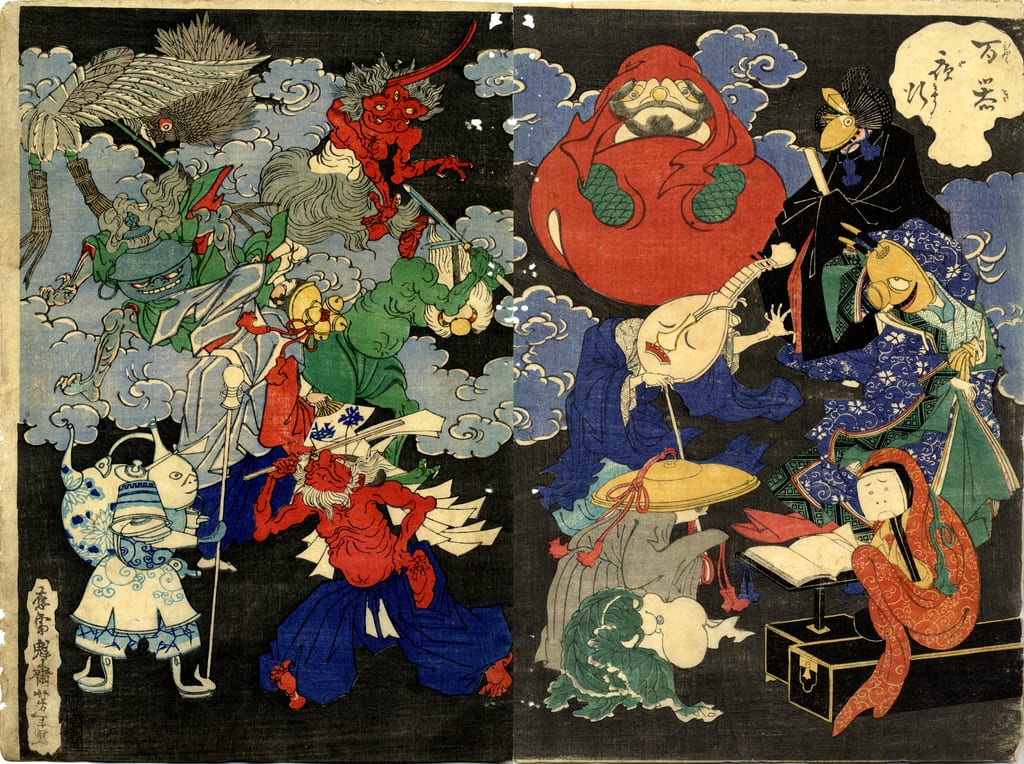
Imai observes a figure closely resembling Suzuhiko-hime in Yoshitoshi’s picture and identifies fourteen tsukumogami there as borrowings from Sekien’s yokai books[4]. This does not show Suzuhiko-hime gaining a new local legend. It shows that Sekien’s outline had become a yokai image that could be quoted. Set beside one another, the unnamed parade figure, Sekien’s individual page, and Yoshitoshi’s colored crowd reveal a history sustained more by the inheritance of pictures than by the inheritance of stories.
The Quiet Afterimage of Bells and Fan
Sekien’s Suzuhiko-hime stands not amid violent motion, but in a quiet instant that might be just before a dance begins or just after it ends: a lowered face, a fan offered forward, and bell cords falling from above. The sound itself is absent, yet the page seems on the verge of a delicate ringing.
The caption’s phrase “as in a dream” deepens that stillness. A sense of character comes not from accumulating episodes, but from the lowered face, the offered fan, and the dream-worded longing for ancient kagura. From them, a calm, elegant, slightly unreal presence may naturally emerge.
Bells that welcome deities and a procession of creatures walking through the night belong to different emotional worlds. Sekien holds them together in one female form. Neither wholly pure nor wholly ominous, she remains still before the viewer, as if about to dance; that suspended quality is her lasting appeal.
Sekien’s page leaves unheard sounds and unspoken movements to the viewer’s imagination. Its open space lets Suzuhiko-hime receive different colors, voices, and stories in later periods while keeping the same quiet face. That afterimage explains how such a rich figure can grow from a short original source.
Character Profile
This section is our own creative profile for storytelling. It is not historical fact or scholarship.
Yokai Type - Traditional Yokai
Category - Household Spirits
Rarity - Rare
Personality - Quiet, elegant, and faintly dreamlike, she seems to carry a hushed longing for old kagura.
Compatibility - She resonates with stories of kagura, ritual implements, and implement yokai, and with readers drawn to lingering quiet and old images.
Abilities - An implement transformation in which kagura bells overlap with a human formOpens a dance fan and changes the atmosphere through the lingering sound of bellsCalls up the memory of old kagura like a dream
Weaknesses - No fixed weakness is recorded. Sekien’s illustration and caption also give no means of defeat or rite of appeasement.
Habitat - A stage-like space with a railing. No appearance tradition ties her to a particular shrine or region.