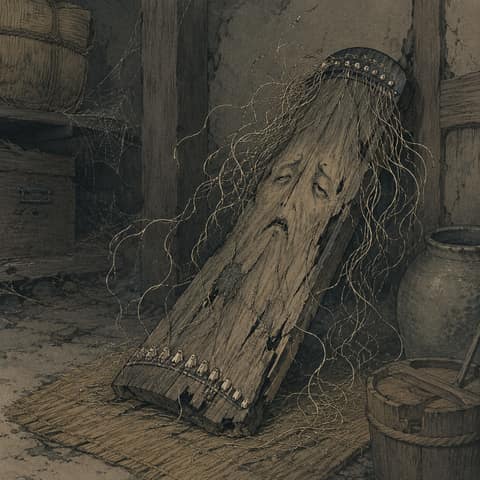
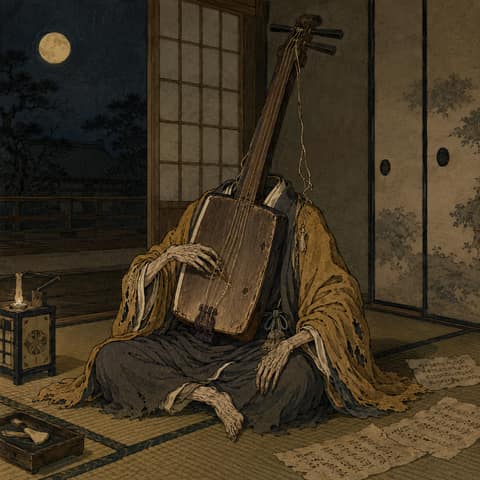
The Kotofurunushi is a tsukumogami (an artifact that has transformed into a yokai) born from an old koto, depicted in the Edo-period yokai bestiary *Hyakki Tsurezure Bukuro* by the artist Toriyama Sekien. Its visual design is highly striking: sorrowful eyes and a mouth emerge on the surface of an old, broken koto that has been abandoned for years, with countless snapped strings hanging down like the tangled hair of a deranged female demon. This is not merely an anthropomorphized object, but a visualization of the intense grudge of an instrument—a tool whose sole purpose is to produce sound—being forced into silence and left to rot.
The deepest charm of this yokai lies in the cruel paradigm shift of Japanese music history hidden within Sekien's commentary accompanying the illustration. Sekien wrote: "Since the blind man Yatsuhashi reformed the melodies, the Tsukushi Koto exists in name only, and those who know its sound are exceedingly rare..." This refers to Yatsuhashi Kengyo, a genius blind musician of the early Edo period. Yatsuhashi Kengyo learned the traditional playing methods of the ancient "Tsukushi Koto," which had previously been played elegantly among aristocrats and monks primarily in northern Kyushu, and dramatically reformed it into a modern style (Sokyoku), gaining immense popularity.
However, as the price for Yatsuhashi's new style sweeping the world, the good old "Tsukushi Koto" became completely obsolete, forgotten by history with no one left to play it. In other words, the Kotofurunushi is not just a monster of an old instrument; it is the incarnation of the sorrowful resentment of "loser's art" (the music of an old school)—eliminated by the advent of a genius (Yatsuhashi Kengyo) and left without an audience. It is an extremely cultural and musicological yokai.
Folklore & Legends
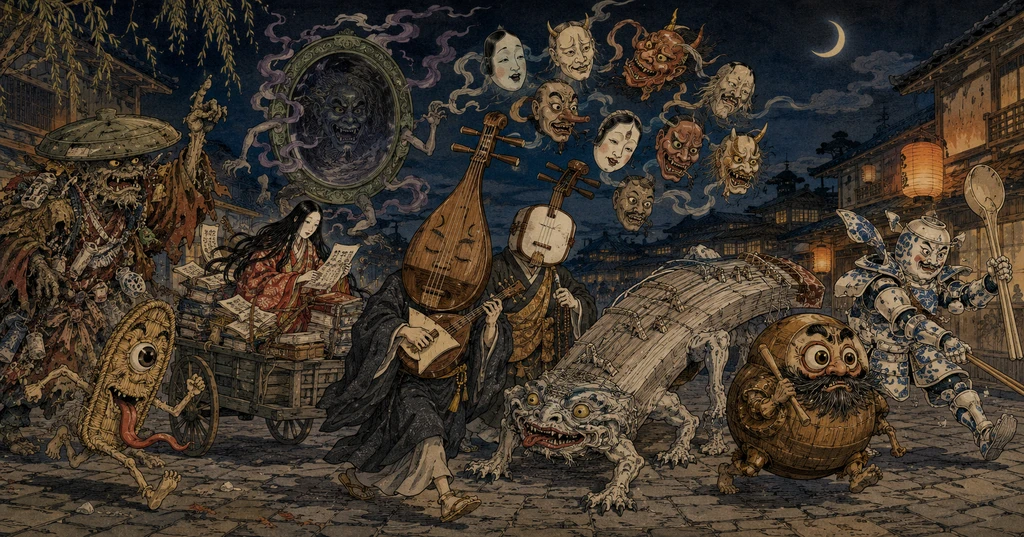
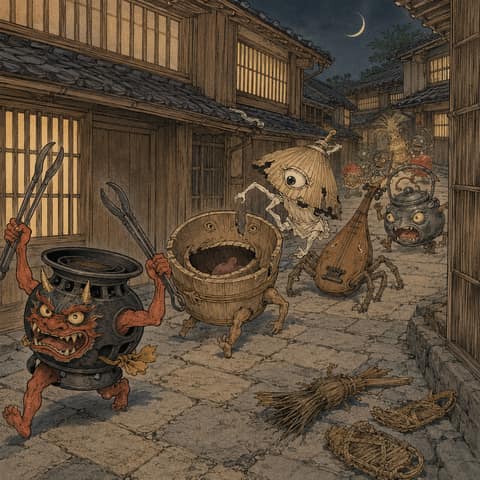
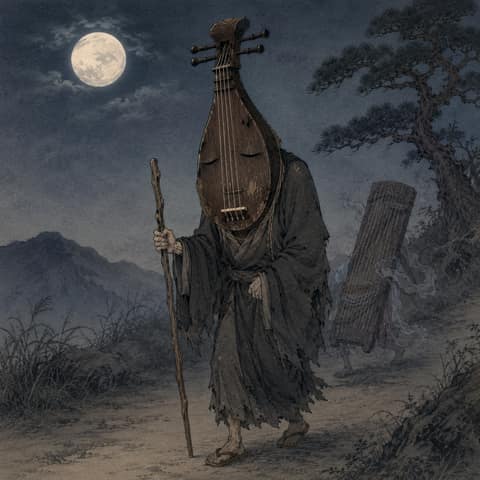
The concept of old instruments becoming tsukumogami is not original to Sekien. In the Muromachi period's *Hyakki Yagyo Emaki* (Night Parade of One Hundred Demons Picture Scroll) and *Tsukumogami Emaki*, lutes (biwa) and kotos had already been depicted sprouting limbs and walking around. While deeply respecting these classical iconographic traditions, Sekien breathed new life into the Kotofurunushi by endowing it with the specific musical-historical tragedy of the "downfall of the Tsukushi Koto."
In the lore of tsukumogami, swords and farming tools often transform into yokai for physical reasons, such as "absorbing too much blood" or "being treated roughly," but instrument tsukumogami fall into darkness due to "loneliness" and "silence." No matter what beautiful tones a masterpiece instrument harbors, once the trend passes and it gathers dust deep in a storehouse with no human left to pluck its strings, the fundamental thirst of the instrument to "sound" turns into madness.
Furthermore, in modern folklore and local ghost stories, this Kotofurunushi is sometimes confused with legends of actual trees or land, such as the "Koto Camphor Tree" passed down in Saga Prefecture (Hizen Province), which tells of an ancient camphor tree where Emperor Keiko held a banquet that produces the sound of a koto every night. However, it must be noted that the Kotofurunushi originally intended by Toriyama Sekien is not a sacred tree of a specific land, but rather a highly sophisticated, literary Edo-period yokai that anthropomorphizes the conceptual sorrow of "forgotten music of the old era."
This is the most orthodox and tragic interpretation of the Kotofurunushi, embodying the despair and sorrow of the "Tsukushi Koto" buried in the darkness of music history by the rise of the genius Yatsuhashi Kengyo. This Kotofurunushi is not a savage yokai that attacks and devours humans. Its true horror and melancholy unfold quietly deep within unvisited storehouses or ruined mansions late at night.
In the darkness, the old koto—abandoned for years, cracked, and covered in dust—begins to tune itself without the help of any hands. Then, the countless snapped and frayed strings writhe like living creatures, or like the black hair of a vengeful female ghost, and begin to play the archaic, heavy, obsolete melodies of the "Tsukushi school" that modern humans can no longer comprehend. That tone, mixing the pride once loved by aristocrats and high priests with the raw despair of now being ignored by everyone, induces a heart-wrenching, intense nostalgia and psychological unease in anyone who hears it.
The goal of the Kotofurunushi is not revenge, but the pure and maddening thirst of an instrument: "I just want someone to listen to my sound." Therefore, swords or talismans are not needed to appease this yokai. If someone who understands old music wipes the dust off this old koto, carefully restrings it, and affectionately plays its ancient tunes once more, its years of resentment will be sublimated as if it were an illusion, and the Kotofurunushi will revert to just being a masterpiece instrument. It is an entity that brilliantly expresses the cruel transitions of art and the uniquely Japanese affection for tools.
Character Profile
This section is our own creative profile for storytelling. It is not historical fact or scholarship.
Harbors deep resentment over being forgotten, but deep down is extremely lonely and desperately craves an audience.
Compatibility
Those who love traditional music, individuals who show deep affection for forgotten history and old tools.
Abilities
Auditory hallucinations of ancient Tsukushi Koto melodies playing on their ownManipulating countless snapped strings like a madwoman's hair or tentaclesDirectly instilling intense nostalgia and melancholy into the listener's mind
Weaknesses
Affectionate tuning and maintenance (resentment is sublimated by being played again), the glamorous tones of modern Sokyoku (Yatsuhashi school), respectful memorial services or ritual burning of the instrument
Habitat
Abandoned tatami rooms, instrument storehouses, old tool repositories in temples and shrines
The diagram below is a diagnostic evaluation chart for The Forgotten Tsukushi Koto, Kotofurunushi. The higher the value of each item, the stronger that characteristic is expressed.