YOKAI.JP

Yokai Encyclopedia

Encyclopedia of Japanese Yokai

39 Yokai|14 Category|Page 1 of 2
Localization in Progress - More content available in Japanese version
View Japanese
Sort by: NameAscending
付喪神・骸怪
  • Abumikuchi

    Abumikuchi

    Rare

    ah-BOO-mee-KOO-chee

    Sekien Zue Conformant

    Animated Objects & UndeadJapanese folklore

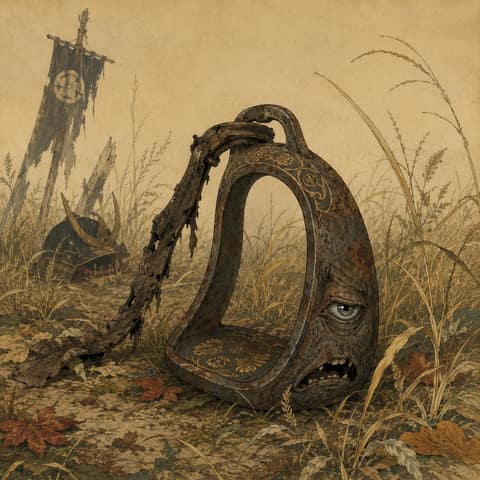
    An abumiguchi depicted per Toriyama Sekien’s Illustrated Bag of a Hundred Tools. An ancient stirrup sprouts eyes and a mouth, shown lying on the ground or dragging its straps. A quoted line from the Noh play Tomonaga invites readings of battlefields and fallen warriors in the background, yet no concrete deeds or harms are recorded. Following tsukumogami conventions, it is the resentment and lingering attachment of a tool long used then discarded given form. This aligns with Edo-period essays that teach “cherish your implements,” and likely reflects the Tsurezuregusa passage warning about horse gear, echoed in its pairing with the Saddle Fellow. The modern retelling that it “awaits its master,” seen in Mizuki Shigeru’s notes, lacks support in older sources and is not adopted here. No verified field traditions are known, and no region is specified.
  • Bakezōri (Haunted Straw Sandal Tsukumogami)

    Bakezōri (Haunted Straw Sandal Tsukumogami)

    Uncommon

    bah-keh-ZOH-ree

    Tsukumogami Sandal Spirit

    Animated Objects & UndeadJapanese folklore

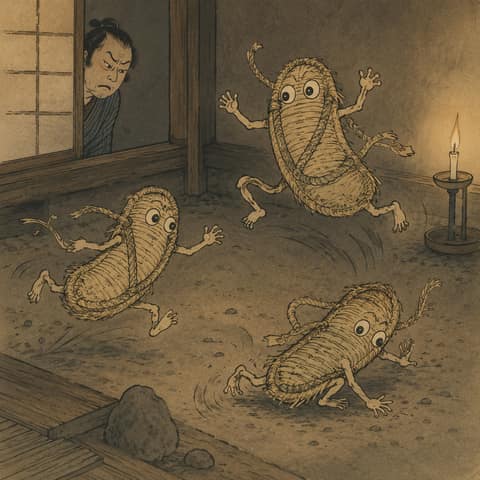
    A reconstructed image based on medieval to early modern depictions of sandal tsukumogami. Straw sandals were everyday items that wore out quickly and were often discarded, so after a certain number of years they were thought to gain a resident spirit. It reveals itself with noisy nighttime footsteps and aimless hopping, yet causes little harm. The “singing footwear” anecdote found in modern yokai encyclopedias likely conflates a geta folktale and lacks firm evidence as a distinct tradition of the straw-sandal specter. In folklore studies it is understood as a visual emblem of the norm “do not treat tools carelessly,” and is classed as one type within the broader category of tsukumogami.

  • Bakotsu

    Bakotsu

    Uncommon

    Bakotsu

    The Walking Bakotsu of Tosa

    Tsukumogami / Skeletal YokaiKochi

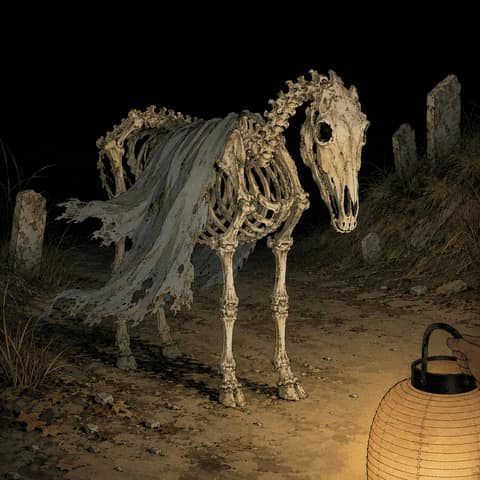
    The visual depiction of Bakotsu in the *Tosa Obake Zoshi* adopts an extremely unique and theatrical narrative composition among Japanese yokai art. In a dimly lit room, separated by a torn and sagging old mosquito net, the bipedal, skeletal "Bakotsu" and a giant toad yokai named "Yadomori" are seated facing each other, as if quietly recounting their respective life stories. Though Bakotsu is a complete skeleton with its ribcage and skull entirely exposed, it wears a crude cloth wrapped around its waist, displaying remarkably human-like gestures. This bizarre confrontation hides deep folkloric roots specific to the Tosa region. "Yadomori" is the regional Shikoku dialect for a toad, which was originally revered as a beneficial creature and a "guardian deity of the house" that ate pests, and thus was strictly forbidden to kill. However, the scroll's explanatory text establishes that this particular toad was cruelly killed by humans and turned into a yokai out of sheer resentment. In other words, both the "Bakotsu" (burned to death in a fire and left on the roadside) and the "Yadomori" (unreasonably murdered by human hands) share a common background: they are "the grudges of animals that lost their lives due to the selfish convenience of humans and were denied proper burial." Their conversing within the boundaries of a mosquito net—a symbol of human daily life—can be deeply interpreted as expressing the tragic solidarity of "beasts" cast aside into the dark corners of human society. Additionally, in the Edo period, there was a custom of extracting fat (bone fat) by boiling horse bones to make extremely cheap, poor-quality candles, which were referred to in slang as "horse bones" . The coincidence between the remains of a horse used as a cheap candle to light the dark, and a yokai born from being burned to death in the disaster of a "fire," is by no means accidental. The practical wisdom of the people at the time and the dark underbelly of a society that thoroughly exploited life are sharply projected onto the visual design of the Bakotsu yokai. Standing up not to curse humans, but simply to assert its existence, its figure is the very embodiment of the anguished cries of voiceless animals.

  • Biwa Bokuboku

    Biwa Bokuboku

    Epic

    BEE-wah BOH-koo-BOH-koo

    Canonical Iconography

    Animated Objects & UndeadJapanese folklore

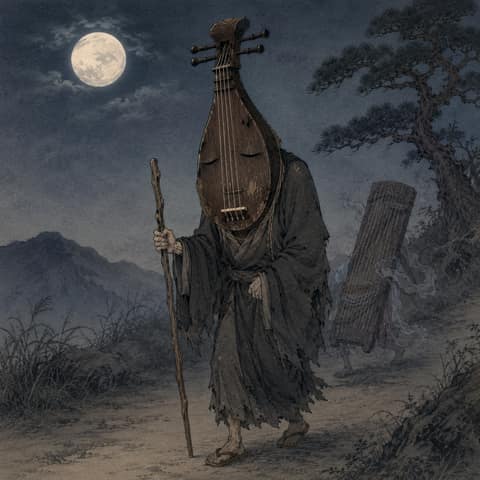
    A standard reading grounded in Sekien’s imagery and the lineage of Muromachi picture scrolls. A biwa long played and cherished attains spirit, joins the night parade clad like a blind lute priest. Its tone captivates the heart and carries an allegory urging awe and respect for venerable instruments. It does not hinge on particular biographies or local lore; praise of crafted objects and cautionary reverence are its themes. Tales tied to famed instruments such as Genjō and Makiba serve only to frame the tsukumogami worldview, while the conduct of the Biwa Moku-moku itself survives chiefly in pictorial form. In images it walks with eyes closed, leaning on a staff, sometimes paired on the same spread with a koto tsukumogami.

  • Boroboroton

    Boroboroton

    Rare

    boh-roh-boh-roh-TOHN

    Sekien Zufu Edition

    Animated Objects & UndeadEdo period, Japan

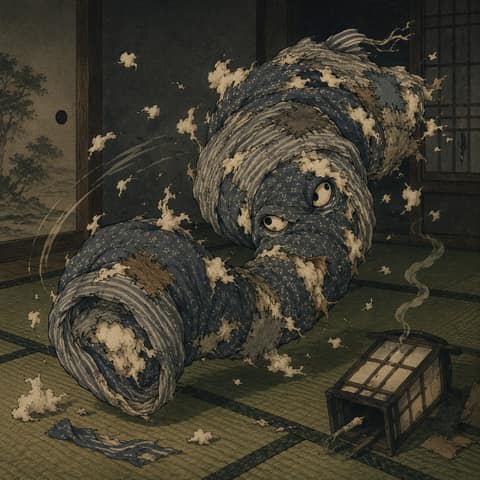
    An image based on Toriyama Sekien’s Hyakki Tsurezure-bukuro. A futon long used and then cast aside rises at night, bounding about the room to startle its former owner. Its malice is mild, acting mainly as a chastening presence that creates a commotion to spur repentance. The name is often read as a play on the tattered fabric’s “boro-boro” and the term for Fuke Zen monks, intertwining beliefs about spirits inhabiting tools with literary wit. Though local folk attestations are scarce, iconographically it is treated as a link in the lineage of tsukumogami tales.

  • Byōbu-Nozoki (Screen-Peeker)

    Byōbu-Nozoki (Screen-Peeker)

    Rare

    BYOH-boo no-ZOH-kee

    Iconographic Tradition–Conforming Version

    Animated Objects & UndeadJapanese folklore

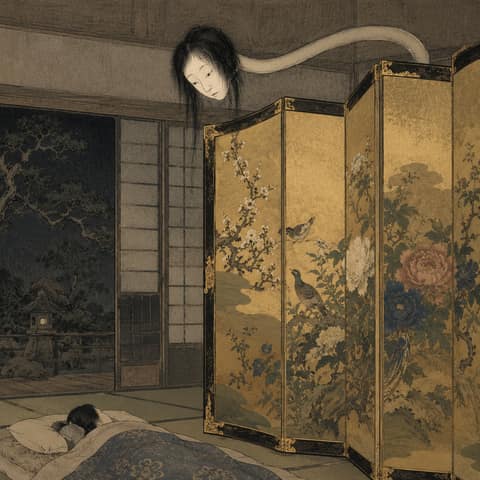
    Centered on the commentary in Toriyama Sekien’s Konjaku Hyakki Shūi, this reading emphasizes the habit of peering in from beyond the folding screen. Rather than causing harm directly, it primarily spies on hidden affairs. Some note that the image of lofty screens in Chinese classics shaped its formation, while in Japan it became linked to the belief that bedroom furnishings can accrue spirit, with a folding screen that has long reflected human lives aging into a yokai. It is not a fixed local deity but is understood as a type of haunted implement tale (tsukumogami).

  • Dust-Heap Demon King

    Dust-Heap Demon King

    Rare

    chee-ree-ZOO-kah KAI-oh

    Iconographic Origin – Sekien Edition

    Animated Objects & UndeadJapanese folklore

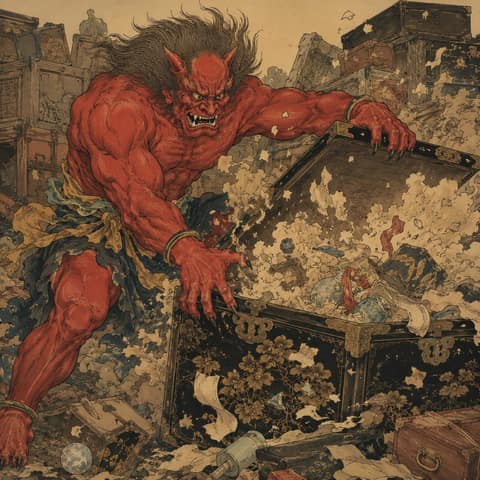
    In literature, Chinzuka Kaiō is known chiefly from Toriyama Sekien’s Hyakki Tsurezurebukuro image, with no concrete deeds or sayings recorded. The painting shows a strongly muscled, red-hued oni prying open a kara-bitsu chest as dust and paper scraps swirl. Sekien appended a note calling it the “chief of the mountain hags formed from piled-up dust,” echoing the Noh play Yamanba’s line “clouds’ dust piles up and becomes a mountain hag.” However, no tradition directly links this yokai to Yamanba, leaving its placement ambiguous. Similar images appear in Meiji-era copies and anonymous picture scrolls, sometimes renamed as “kaiki” (monstrous oni). Since the Heisei era, some explain it as “king of dust and garbage tsukumogami,” but this is a later interpretation without proof in older sources. Iconographically, it is viewed as an early modern creation merging the “splitting the treasure chest” motif from Night Parade of One Hundred Demons scrolls with phrasing quoted from Essays in Idleness.

  • Elder Shamisen

    Elder Shamisen

    Rare

    SHAH-mee-CHOH-loh

    Sekien Zue Version

    Animated Objects & UndeadEdo period

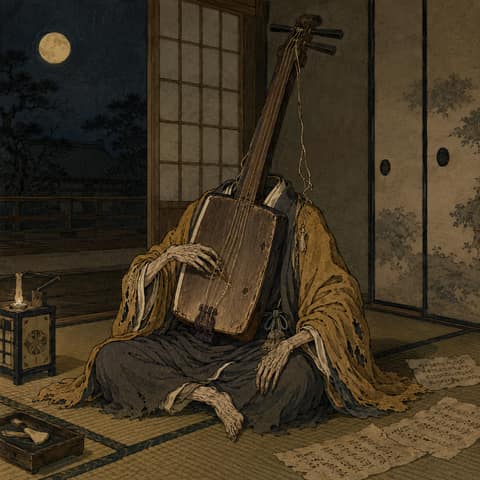
    An interpretation grounded in the pictorial tradition of Toriyama Sekien’s Hyakki Tsurezure-bukuro. A shamisen that has gained a soul through long use is depicted like an aged monk, with robe-like garb and staff-like fittings. It plays on the proverb “a novice cannot leap straight to elder,” reinforcing the lesson that one must advance step by step in the arts, and it also cautions against mistreating tools. Similar images appear in Tsukioka Yoshitoshi’s prints, and later yokai encyclopedias introduce it as a representative tsukumogami. Lacking many named folktales, it spread chiefly through paintings and printed books.

  • Fuguruma Yōhi (Letter-Carriage Enchantress)

    Fuguruma Yōhi (Letter-Carriage Enchantress)

    Rare

    FOO-goo-ROO-mah YOH-hee

    Iconographic Edition, Sekien Toriyama Source

    Animated Objects & UndeadEdo period

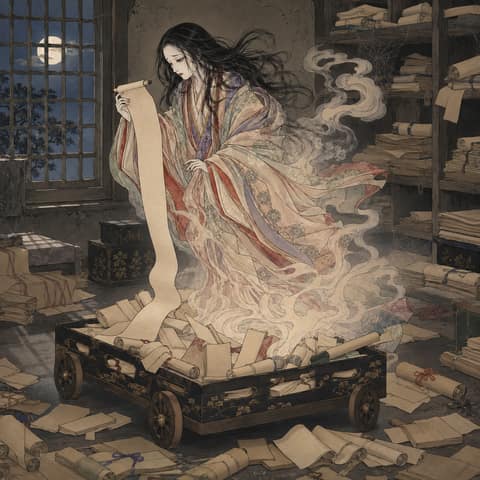
    An interpretation grounded in the imagery and captions of Toriyama Sekien’s Hyakki Tsurezure Bukuro. The document cart was a conveyance for papers in the imperial court, temples, and aristocratic residences, kept ready for emergencies. The accumulated sentiments within long-kept love letters are thought to congeal and manifest as a lady-in-waiting–like apparition. With little basis in oral tradition, this is a conceptual yokai born of early modern literature and painting, more often told as a presence that displays and summons remorse than as one causing concrete harm. The customary name is Fumikuruma Yohi, though later sources sometimes confuse it with Fumikuruma Yoki.

  • Fukuro Mujina (Bag Badger)

    Fukuro Mujina (Bag Badger)

    Rare

    FOO-koo-roh MOO-jee-nah

    Annotated Iconography Edition (Seiyan-Toriyama Based)

    Animated Objects & UndeadEdo period

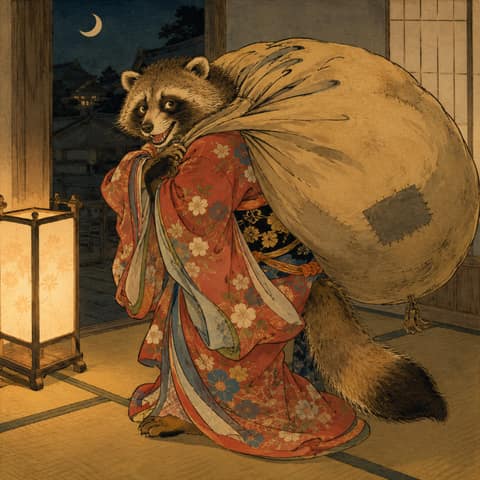
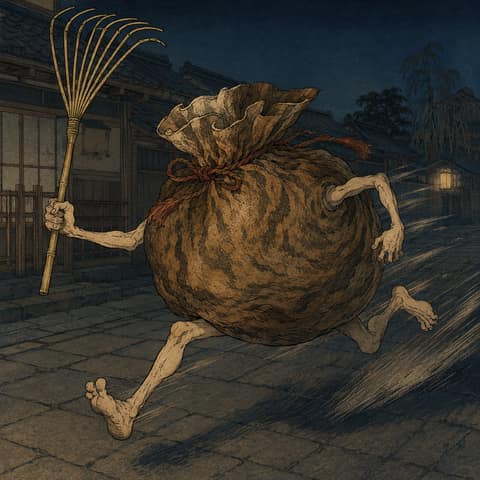
    A version grounded in the image and brief annotation from Toriyama Sekien’s Hyakki Tsurezure Bukuro. It appears as a womanly mujina carrying a night-duty bag over her shoulder, yet from another angle the bag itself may be the yokai, with the porter’s pose serving as a metaphor. Its conduct lures people into rash judgments and lays bare the absurdity of empty speculation. Actual harm is slight, limited to confronting those who “rummage in the bag” of guesswork on night roads or in parlors and leaving them disgraced. True to picture-scroll lineage, no fixed era or locale is given, favoring witty identification and playful satire.

  • Furaku-Furaku (The Dangling Lantern Spirit)

    Furaku-Furaku (The Dangling Lantern Spirit)

    Rare

    boo-RAH-boo-RAH

    Sekien Plate Standard

    Animated Objects & UndeadJapanese folklore

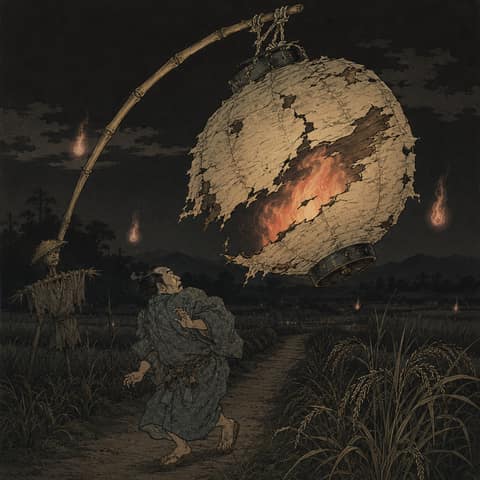
    An arrangement of Furafurabu based on the depiction in Toriyama Sekien’s Hyakki Tsurezure Bukuro. The lantern is tied to bamboo, its torn paper resembling a mouth, tilting as it looms over the road. The scene evokes rice field ridges and scarecrows, and while the caption mentions “the lantern fire of Yamada,” it also muses that it might be foxfire. This yields competing readings—either a fox in disguise or a transformed implement—but since the volume files it among tool-spirits, understanding it as a tsukumogami is appropriate. The name varies between “Fufuraku” on the image and “Furakaku” in the catalog, though “Furafurabu” is generally accepted. No fixed local legends or concrete curse tales survive; it is received as a subtype of the generic lantern yōkai, a visual fright that startles travelers at night.

  • Furu-Utsubo (Aged Quiver Spirit)

    Furu-Utsubo (Aged Quiver Spirit)

    Rare

    FOO-roo OOT-soh-boh

    Toriyama Sekien Iconography Standard

    Animated Objects & UndeadJapanese folklore

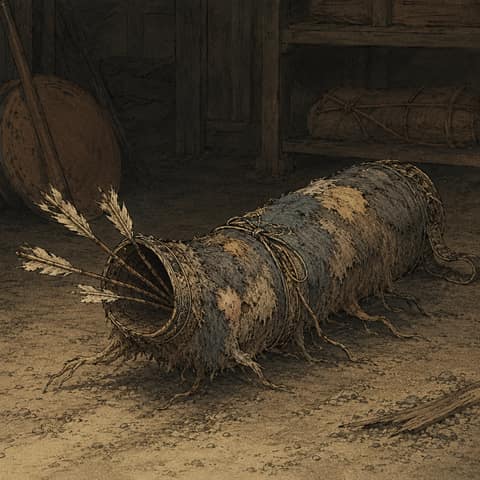
    Grounded in the classic image from Toriyama Sekien’s Hyakki Tsurezure Bukuro, it is understood as an aged leather or fur-covered utsubo quiver that raises its mouth and creeps along the ground. Its origin is not from a clear oral tale but from the tsukumogami belief that objects become ensouled with age. The accompanying text names the warrior who shot the field fox of Nasu no Hara (Tamamo-no-Mae), hinting that a quiver once emblematic of martial glory turns yokai after being forgotten. An earlier prototype is presumed in Muromachi-period Night Parade scrolls depicting object-spirits bearing bow and arrows, which Sekien reinterpreted and named. By night it slowly roams deserted roadsides and house shadows, said to make a sound like fletchings brushing. It is not strongly malicious, but when treated roughly it creaks and cries in warning, stirring memories of its former master.

  • Garei (Spirit of the Painting)

    Garei (Spirit of the Painting)

    Uncommon

    GAH-ray

    Garei (Ochikuri Monogatari Edition)

    Animated Objects & UndeadKyoto (anecdote from the Kanjuji household)

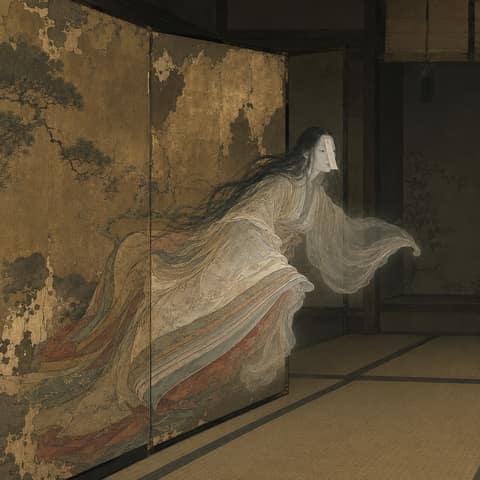
    An image-spirit as portrayed in a late Edo essay. A woman steps forth from an old screen painting, and any treatment applied to the picture manifests as real-world phenomena—the core motif is the linkage between image and reality. Signs caused by the aging of the object are perceived as hauntings, yet they subside through repair and reverent care, fitting within tsukumogami tradition. The writer names specific places and households, but the entity’s purpose is unstated, its warnings and appearances are brief, and the events end once the piece is appraised and restored. Rather than the painter’s fame empowering a spirit, the tale chiefly cautions against mistreating fine works. Harm to people is rare; its hallmarks are visual manifestation and a return to its locus, vanishing before the screen. Later readings cite it as an exemplar underscoring the importance of memorial rites for objects.

  • Hair Oni (Kamikki)

    Hair Oni (Kamikki)

    Rare

    KAH-mee-oh-nee

    Sekien Zukai Edition

    Animated Objects & UndeadJapanese folklore

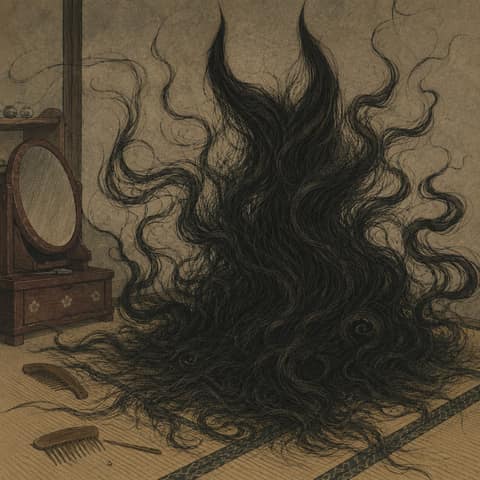
    An iconographic reading of the Hair Demon as depicted in Toriyama Sekien’s Hyakki Tsurezure Bukuro. A woman’s hair, infused with its owner’s passions, becomes autonomous, standing on end at midnight as its locks extend and contract like living things. Cutting it offers only brief respite, for it regrows and multiplies at once. Rooted in a dual folk view that both sanctifies and shuns hair, it is shown as a being where tsukumogami traits cross with vengeful-spirit nature. Its body is a mass of hair without face or limbs, asserting menace through motion and shifting length. Memorial offerings and proper hair-cutting rites are said to calm it, yet no certain banishment method is recorded.

  • Hatahiro

    Hatahiro

    Rare

    HAH-tah-HEE-roh

    Emaki Source – Sekien Edition

    付喪神・骸怪Japanese folklore

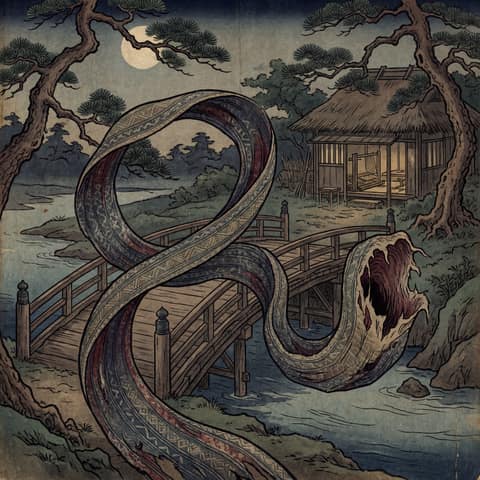
    A version based on the conceptual monster Toriyama Sekien presented through painting and notes. Resentment dwelling in a cloth takes serpentine form and wanders in search of its master, merging the symbolism of tool-spirits and snakes. As folklore data, independent oral accounts are scarce, so it remains a pictorial taxonomy that links tsukumogami tales with legends of loom sounds heard near water. Etymological notes mention associations with the performance term “nijūhiro” and wordplay, but firm sources are limited. Visually, a long bolt of cloth writhes into a snake shape, its tip commonly rendered like a tongue or a slit.

  • Heiroku

    Heiroku

    Rare

    HAY-roh-koo

    Iconography-Concordant Version

    Animated Objects & UndeadJapanese folklore

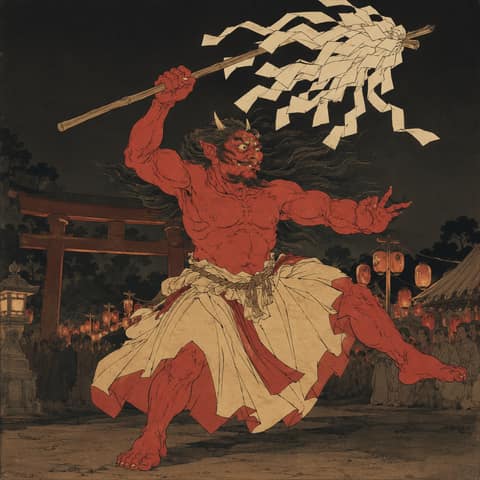
    An interpretation grounded in Toriyama Sekien’s examples and Muromachi picture scrolls, taking the aberrant figure bearing a gohei as its standard. The paper-streamer wand signals ritual purity, yet Henroku brandishes it as an emblem of turmoil. It is not tied to any specific land or person, and is understood as an allegorical presence that appears where festivals or shrine order falter. Later traditions sometimes read it as a tsukumogami inhabiting the gohei, but firsthand accounts are scarce, and it is discussed chiefly within the lineage of visual iconography.

  • Horned Washbasin Hanzō

    Horned Washbasin Hanzō

    Rare

    TSOO-noh-HAHN-zoh

    Gazu-tan, Sekien Edition

    Animated Objects & UndeadKyoto Prefecture (associated tradition)

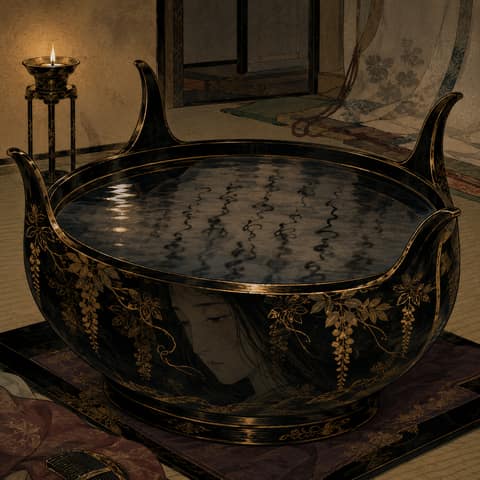
    An interpretation centered on Toriyama Sekien’s depiction of the horned washbasin figure. The rim of the jet-black basin rises like horns, and when lamplight is reflected on the clear surface, only deceitful characters added to a paper will blur and eventually dissolve away. As a tsukumogami of implements, it values human care and decorum, revealing its strange nature only when treated rudely. Rather than causing harm, it is said to expose hidden falsehoods. Echoing Noh and classical poetry, it is often shown alongside courtly cosmetics and writing instruments. Regional lore is scarce, with mentions largely confined to early modern picture compendia and encyclopedias.

  • Hossumori, the Fly-Whisk Guardian

    Hossumori, the Fly-Whisk Guardian

    Rare

    HOSS-soo-MOH-ree

    Sekien Iconography Standard

    Animated Objects & UndeadEdo period; derived from picture scrolls

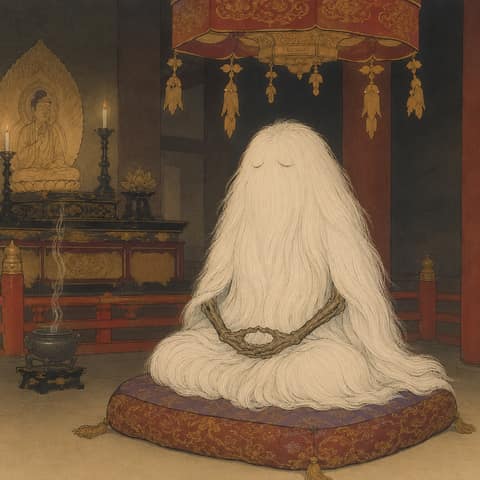
    Based on the tsukumogami of the fly-whisk as depicted in Toriyama Sekien’s Hyakki Tsurezure Bukuro. Seated cross-legged beneath a canopy, it embodies the purity of a ritual implement and the quietude of a spirit matured through long use. Strong Zen symbolism underlies it, with an allusion to “the Buddha-nature of the dog,” implying that Buddha-nature manifests beyond sentient and insentient distinctions. In China the fly-whisk was said to dispel demonic hindrances, leading to the idea of a tool-spirit that allows nothing to obstruct enlightenment. Though a tool-yokai, it is not told to cause disturbances like other Hyakki creatures; instead it sits in composure, contemplating its own nature. Its image is chiefly tied to places where ritual implements gather within temples—main halls, monks’ quarters, and storerooms—rather than to specific local legends.

  • Hyōtan Kozō (Gourd Boy)

    Hyōtan Kozō (Gourd Boy)

    Rare

    HYOH-tahn koh-ZOH

    Iconographic Tradition–Tsukumogami Interpretation

    Animated Objects & UndeadJapanese folklore

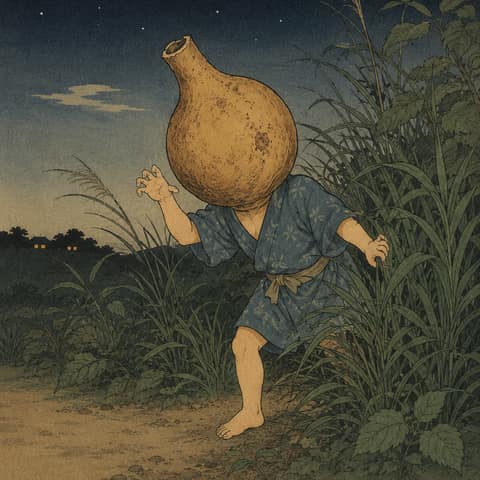
    An interpretation based on Toriyama Sekien’s Hyakki Tsurezure Bukuro and related Hyakki Yagyō iconography. Gourds served as containers for water or sake and as percussion in festivals, and after long use were believed to acquire spirit in line with the tsukumogami view. The Gourd Boy appears as a human figure with a gourd for a head, briefly emerging from a night path or from grass to make passersby flinch, and little more. Its nature, name, and any definite harm are not fixed in sources, and alongside utensil-yokai like the Mortar Monk it is read as an allegorical old tool given life. Local oral lore is scant, with paintings and later commentaries as the main sources.

  • Kameosa

    Kameosa

    Rare

    KAH-meh-OH-sah

    Iseya Toriyama Plate Edition

    Animated Objects & UndeadEdo period

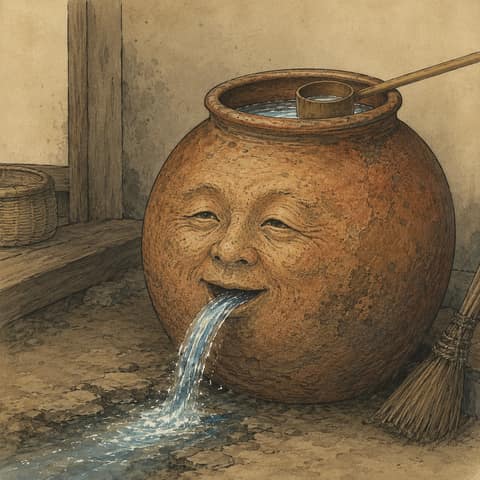
    An interpretation based on Toriyama Sekien’s Hyakki Tsurezurebukuro image and inscription. The water jar faces forward, its rim becomes the mouth, and patterns on the body are read as eyes and nose. The inscription pivots on the phrase “calamity turns to good fortune,” entrusting the vessel with the idea that blessings fill after adversity. Placed at the end of the volume to serve a congratulatory cadence, its nature is read as leaning more toward good than ill. Though grouped with tsukumogami familiar to early modern life, independent oral lore or怪談 are scarce. Later retellings expand the “inexhaustible when drawn” motif into control over water’s increase, decrease, and measured pouring, but the original is a symbolic painting with verse, and narrative deeds are limited.

  • Kinutanuki

    Kinutanuki

    Rare

    kee-noo-tah-NOO-kee

    Based on Sekien’s Illustrated Compendium

    Animated Objects & UndeadEdo (place of publication)

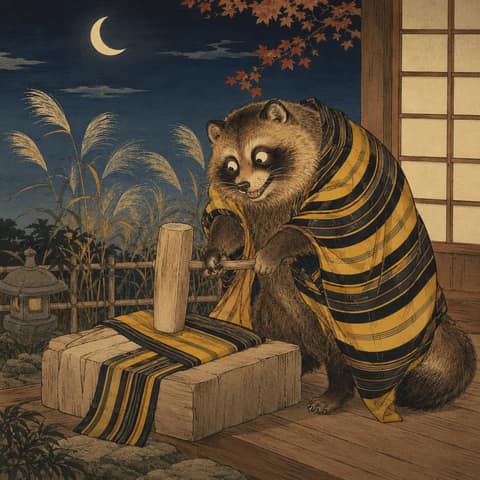
    The Silk Tanuki is a yokai born from printed books, a visual conceit that overlays vocabulary from Hachijo silk (Kihachijo) with tales of shape-shifting tanuki. In Sekien’s example, a tanuki draped in silk patterns is paired with a caption that evokes both the name Hachijo and popular lore of trickster tanuki. Independent oral traditions are scarce; later readings add the sound of fulling blocks and cloth-beating gestures, but these remain reinterpretations of the image. Its nature aligns with object-spirits and a mitate-based tsukumogami, more a crystallization of wordplay and design in print culture than a field-reported apparition. It is described as wearing the yellow-striped Kihachijo motif and revealing itself less by appearance than by nocturnal cloth-beating sounds, yet such traits are interpretive and no fixed image is established.

  • Koinryō

    Koinryō

    Rare

    koh-EEN-ryoh

    Edo Iconography Conformant

    Animated Objects & UndeadJapanese folklore

    A reconstructive reading based on Toriyama Sekien’s compositional layout and notes. The主体 is a leather coin pouch that, with age, has become a tsukumogami. Its rake-like implement echoes motifs from medieval picture scrolls and likely implies the act of sweeping up or gathering, though sources do not state this conclusively. It moves with great speed, dashing like a herald at the head of a procession, and is imagined merging with the motley ranks of the Night Parade of Haunted Tools. Its name suggests echoes of “tiger hide” and “inrō,” yet no citation is given and the origin remains unknown. No region-specific lore survives; from its placement alongside Yarikechō and Zenkamanasu within the work, it is understood as one among a group of antiquated implements. The entry avoids embellishment, limiting traits to Sekien’s notes and comparable iconography.

  • Kotofurunushi

    Kotofurunushi

    Rare

    koh-toh-koh-roo-NOO-shee

    The Forgotten Tsukushi Koto, Kotofurunushi

    Tsukumogami / MukurogaiFukuoka Prefecture (Former Tsukushi Province / Spirit of a forgotten Koto)

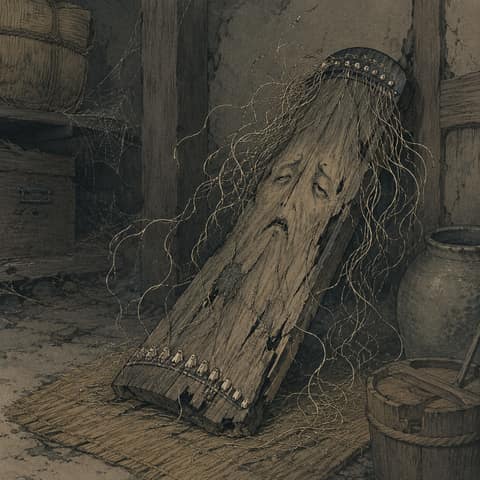
    This is the most orthodox and tragic interpretation of the Kotofurunushi, embodying the despair and sorrow of the "Tsukushi Koto" buried in the darkness of music history by the rise of the genius Yatsuhashi Kengyo. This Kotofurunushi is not a savage yokai that attacks and devours humans. Its true horror and melancholy unfold quietly deep within unvisited storehouses or ruined mansions late at night. In the darkness, the old koto—abandoned for years, cracked, and covered in dust—begins to tune itself without the help of any hands. Then, the countless snapped and frayed strings writhe like living creatures, or like the black hair of a vengeful female ghost, and begin to play the archaic, heavy, obsolete melodies of the "Tsukushi school" that modern humans can no longer comprehend. That tone, mixing the pride once loved by aristocrats and high priests with the raw despair of now being ignored by everyone, induces a heart-wrenching, intense nostalgia and psychological unease in anyone who hears it. The goal of the Kotofurunushi is not revenge, but the pure and maddening thirst of an instrument: "I just want someone to listen to my sound." Therefore, swords or talismans are not needed to appease this yokai. If someone who understands old music wipes the dust off this old koto, carefully restrings it, and affectionately plays its ancient tunes once more, its years of resentment will be sublimated as if it were an illusion, and the Kotofurunushi will revert to just being a masterpiece instrument. It is an entity that brilliantly expresses the cruel transitions of art and the uniquely Japanese affection for tools.

  • Kutsutsura

    Kutsutsura

    Rare

    koo-TSOO-TSOO-rah

    Iconographic Critical Edition

    Animated Objects & UndeadJapanese folklore

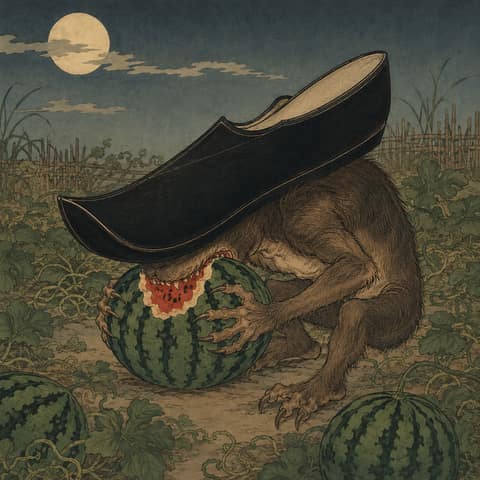
    A version organized from Toriyama Sekien’s anecdotes and imagery, presenting a beast-man figure bearing a symbolic clog (kutsu) to signify an animated implement. In Hyakki Tsurezure Bukuro, paired with the opposing page’s Long Crown, it allegorizes the proverb “Do not put on shoes in a melon patch, nor adjust your crown beneath a plum tree,” depicting caution against suspicion through a yokai image. No concrete sightings or harms are recorded; it is loosely linked to tales of creatures that eat melons in fields, and banishment is mentioned only via talismanic precedents. No firm association with specific Japanese locales is attested, and its design likely references Muromachi-period yokai scrolls featuring beast forms bearing shallow clogs.

Showing 1 - 24 of 39 yokai