Bakotsu[1] is a *mukuro* (corpse) yokai said to be the animated skeletal remains of a horse that burned to death in a fire, having absorbed eerie spiritual energy after being denied a proper burial. It is famously depicted in the *Tosa Obake Zoshi* (Tosa Yokai Scroll), produced in Tosa Province (modern-day Kochi Prefecture) during the mid-to-late Edo period. It possesses a bizarre and uncanny appearance: a gigantic, fully skeletonized horse standing upright on two legs, draped in tattered, threadbare rags around its waist. Among the many yokai traditions across Japan, it is extremely rare for a “horse skeleton” to move autonomously. Rather than being a malevolent, vengeful spirit that actively attacks or curses humans, Bakotsu embodies the regret of livestock meeting an untimely end and the sorrow of “beasts of burden” cast aside the moment they outlive their usefulness. Though an apparition that startles travelers on old night roads, it serves as a cautionary tale emphasizing the importance of *chikusho kuyo* (memorial services for animals) and the ethical duty to respect living creatures to the very end. Thus, it strongly reflects the localized folk beliefs and views on life and death of the Shikoku region.
Folklore & Legends
The primary historical document that preserves the appearance and story of Bakotsu is the *Tosa Obake Zoshi*[1], a 16-tale yokai scroll said to have been handed down within the Yoshimoto family, retainers of the Fukao clan (the chief retainers of the Tosa Domain). Unlike the highly commercialized yokai illustrations of Toriyama Sekien that circulated in Kyoto and Edo, this scroll, painted by an anonymous local artist, holds great academic value for recording the rustic, visceral folk beliefs actually whispered in rural villages. In this scroll, Bakotsu is depicted as the transformed remains of a horse that perished in a blaze.
In Edo-period agrarian society, large livestock like horses and oxen were an absolute necessity for farming and transport, cherished almost like family members. However, when these animals died, owners were forbidden from burying them privately and had to transport them to designated local disposal sites (*umasuteba*). Dead livestock were then dismantled by specific social classes, with every part—skin, meat, and bone—thoroughly utilized. But bones charred by fire and rendered useless were often simply abandoned. Villagers, while fearing the “impurity of death” (*kegare*), also harbored a sense of awe and guilt toward the massive piles of bones left by the roadside. The numerous stone monuments dedicated to Bato Kannon (the Horse-Headed Kannon) erected along these roads were meant to comfort the spirits of the dead animals.
Furthermore, there is a theory that the Japanese idiom “not knowing which horse's bone this is”[2]—used to mock or disparage someone of unknown origin—derives from these massive, hard-to-dispose-of bones, or the low-quality oil (bone fat) boiled down from them. The context behind the birth of the Bakotsu yokai is intricately woven with sympathy for livestock treated coldly as “useless objects” once their labor value vanished, and the unconscious guilt of the masses for neglecting proper memorial rites. While there are no specific records of exact appearance times or direct harm to humans, the tale of discarded roadside bones creaking in the night likely functioned as a requiem for lives consumed for human convenience.
Bakotsu is a yokai said to be the bones of a horse that kept moving even after death.
It appears on lonely roads or old travel routes, clattering as it walks—more eerie than aggressive.
Q2
Why a horse specifically?
A:
Horses were central to work, travel, and war in old Japan. They symbolized vitality and loyalty.
A horse returning as a skeleton embodies endurance beyond death—a haunting reminder of devotion and labor that never rested.
Q3
What does Bakotsu look like?
A:
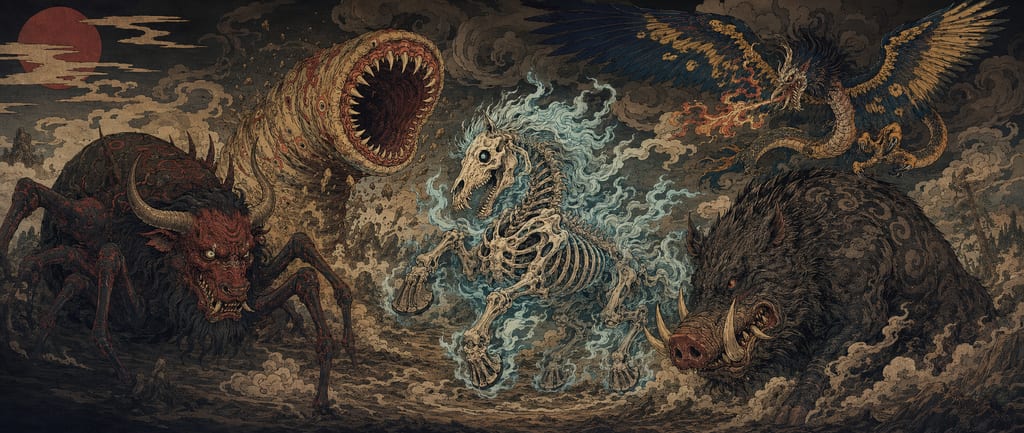
Most depictions show a horse made entirely of bones, sometimes with tattered reins or glowing eyes, walking with an unnatural stillness.
Q4
Is Bakotsu dangerous?
A:
Not in most stories. Its presence is more a warning than an attack.
It reminds travelers to show respect—to animals, labor, and things that served them.
Q5
Where does the legend come from?
A:
Rather than one single origin, Bakotsu appears across multiple folk regions, ghost stories, and Edo-period illustration scrolls.
Q6
So why do fans compare Bakotsu to a character in One Piece?
A:
There’s no official confirmation linking the two.
However, fans often compare Bakotsu to the Gorosei member Ethanbaron V. Nusjuro during his transformed state.
The bone-horse silhouette, the ancient authority, and the “beyond-death presence” resonate with Bakotsu’s imagery.
Q7
Why does the comparison feel so strong?
A:
Because both figures evoke:
Something older than history,
Something that outlived its era,
Something that commands respect rather than fear.
This is a shared visual language that transcends source.
Q8
Does this mean One Piece used Bakotsu as direct inspiration?
A:
Not necessarily.
What it means is: when cultures share archetypes, we often recognize the echoes.
Good storytelling speaks myth fluently.
Q9
What themes does Bakotsu represent today?
A:
Unfinished purpose;
Memory that refuses to fade;
The emotional life of things that carried us;
Respect for what once served us.
In other words:
Don’t forget what carried you this far.
The visual depiction of Bakotsu in the *Tosa Obake Zoshi* adopts an extremely unique and theatrical narrative composition among Japanese yokai art. In a dimly lit room, separated by a torn and sagging old mosquito net, the bipedal, skeletal "Bakotsu" and a giant toad yokai named "Yadomori"[1] are seated facing each other, as if quietly recounting their respective life stories. Though Bakotsu is a complete skeleton with its ribcage and skull entirely exposed, it wears a crude cloth wrapped around its waist, displaying remarkably human-like gestures.
This bizarre confrontation hides deep folkloric roots specific to the Tosa region. "Yadomori" is the regional Shikoku dialect for a toad, which was originally revered as a beneficial creature and a "guardian deity of the house" that ate pests, and thus was strictly forbidden to kill. However, the scroll's explanatory text establishes that this particular toad was cruelly killed by humans and turned into a yokai out of sheer resentment. In other words, both the "Bakotsu" (burned to death in a fire and left on the roadside) and the "Yadomori" (unreasonably murdered by human hands) share a common background: they are "the grudges of animals that lost their lives due to the selfish convenience of humans and were denied proper burial." Their conversing within the boundaries of a mosquito net—a symbol of human daily life—can be deeply interpreted as expressing the tragic solidarity of "beasts" cast aside into the dark corners of human society.
Additionally, in the Edo period, there was a custom of extracting fat (bone fat) by boiling horse bones to make extremely cheap, poor-quality candles, which were referred to in slang as "horse bones" [2]. The coincidence between the remains of a horse used as a cheap candle to light the dark, and a yokai born from being burned to death in the disaster of a "fire," is by no means accidental. The practical wisdom of the people at the time and the dark underbelly of a society that thoroughly exploited life are sharply projected onto the visual design of the Bakotsu yokai. Standing up not to curse humans, but simply to assert its existence, its figure is the very embodiment of the anguished cries of voiceless animals.
Character Profile
This section is our own creative profile for storytelling. It is not historical fact or scholarship.
Harmonizes with those who value mourning and memorials for the dead
Abilities
Extremely difficult to see in the darkApproaches without making footstepsEmanates an eerie aura that reminds humans to mourn animalsCan make small pebbles and fallen leaves rustle
Weaknesses
Sutra chanting, proper burial, gathering and cleaning of bones
Habitat
Along old post roads, rural intersections, around ruined shrines
The diagram below is a diagnostic evaluation chart for The Walking Bakotsu of Tosa. The higher the value of each item, the stronger that characteristic is expressed.