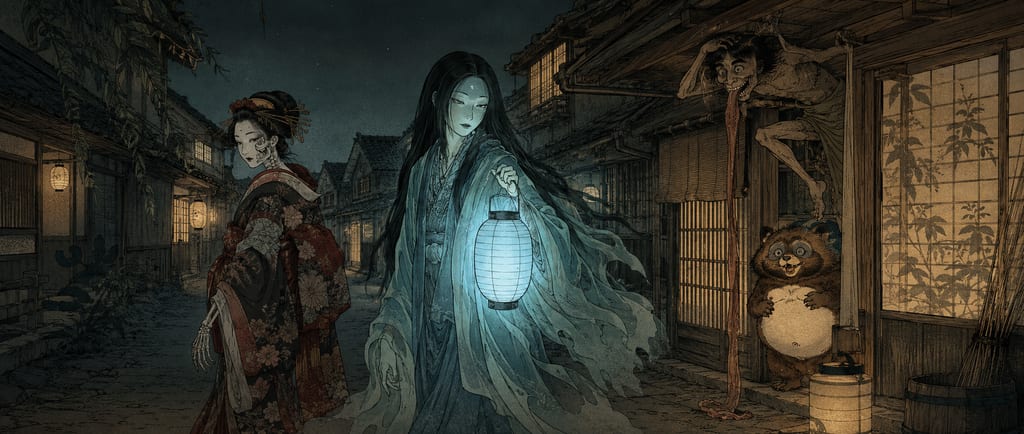
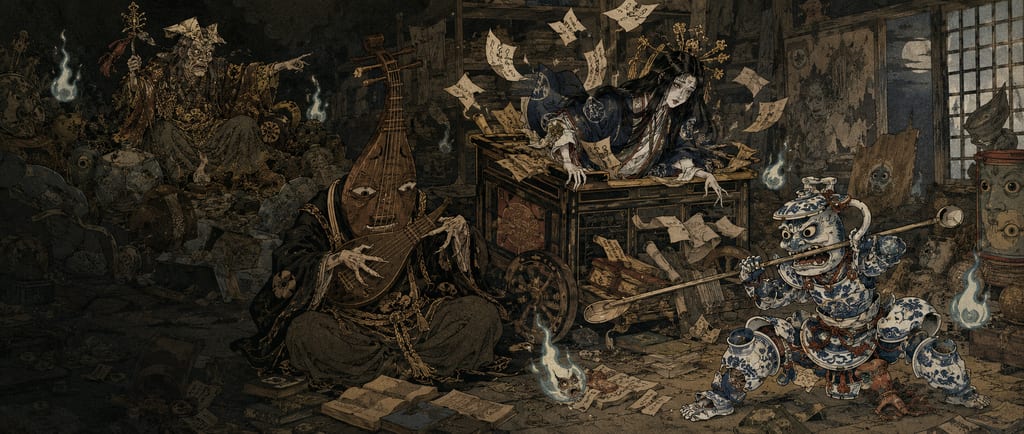
A version grounded in the image and brief annotation from Toriyama Sekien’s Hyakki Tsurezure Bukuro. It appears as a womanly mujina carrying a night-duty bag over her shoulder, yet from another angle the bag itself may be the yokai, with the porter’s pose serving as a metaphor. Its conduct lures people into rash judgments and lays bare the absurdity of empty speculation. Actual harm is slight, limited to confronting those who “rummage in the bag” of guesswork on night roads or in parlors and leaving them disgraced. True to picture-scroll lineage, no fixed era or locale is given, favoring witty identification and playful satire.
Character Profile
This section is our own creative profile for storytelling. It is not historical fact or scholarship.
Yokai Type - Traditional Yokai
Category - Animated Objects & Undead
Rarity - Rare
Personality - taciturn, wryly sardonic
Compatibility - fond of teasing careless gossip and idle conjecture
Abilities - bewitchment that induces human guessworkmimicry as an object (a bag)faint footfalls and rustling to draw attention
Weaknesses - direct inspection and verification, rigorous logic, observation in bright light
Habitat - townhouse parlors, night-duty rooms, under an andon lamp