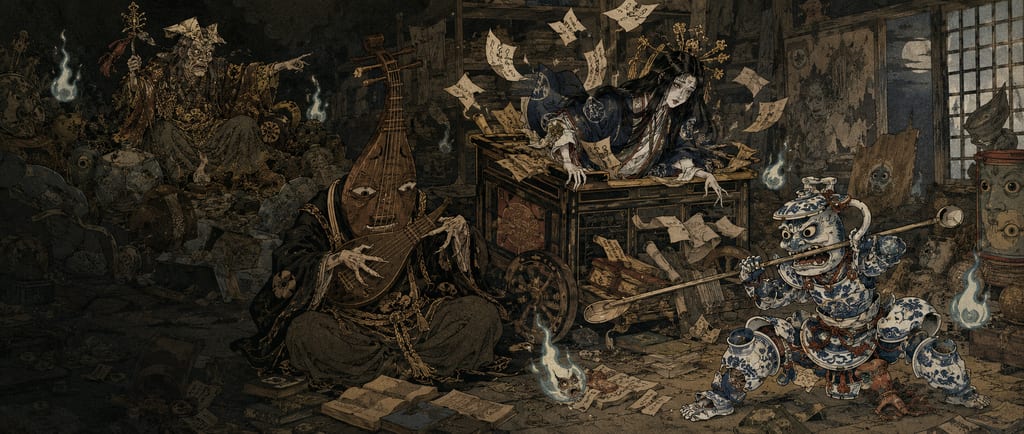
A yokai depicted by Toriyama Sekien in Hyakki Tsurezure Bukuro. It shows a small goblin, monk-like in a komusō style, popping out of a box with a sake choko cup perched on its head. Sekien’s note alludes to the Tang-era tale of an ink spirit appearing before Emperor Xuanzong, hinting that this creature belongs to the same family of animated objects. The name combines bōzu imagery of mendicant Zen monks (kōro/boro/“kure-boro” wordplay), the komusō-like appearance, and the sake cup (choko), suggesting a half-monk, half-lay figure born of punning and visual play.
Folklore & Legends
There is little to no localized oral tradition; the figure is known chiefly from pictorial sources. Sekien appears to reference dreams and marvels surrounding the Tang emperor and the legend of an ink spirit, overlaying these with the tsukumogami idea of tools gaining souls. While its look invites confusion with komusō or mendicant monks called boro/kure-boro, the name is understood as associative wordplay rather than a term from regional lore, and no specific folk tales are recorded.
Guided by Sekien’s imagery and captions, this reading foregrounds its nature as a tsukumogami, a spirit of aged utensils. The little goblin, komusō-like with a sake cup as a hat, emerging from a box accords with the belief that long-used drinking vessels and tools gain spirit and appear at set times. The caption’s citation of Xuanzong and the Spirit of Ink bolsters the idea that spirits arise in objects such as calligraphy, painting tools, and sake ware, with Chokoburo composed pictorially as one of that kind. It does not point to a concrete religious entity of komusō or boro, but playfully borrows half-monk, half-lay visual cues, with a name born of puns and association. No locale of oral tradition is identifiable; its character is chiefly that of a visual怪 within Edo print culture.
Character Profile
This section is our own creative profile for storytelling. It is not historical fact or scholarship.
The diagram below is a diagnostic evaluation chart for Conforming to Traditional Iconography. The higher the value of each item, the stronger that characteristic is expressed.