YOKAI.JP

Yokai Encyclopedia

Encyclopedia of Japanese Yokai

39 Yokai|14 Category|Page 2 of 2
Localization in Progress - More content available in Japanese version
View Japanese
Sort by: NameAscending
付喪神・骸怪
  • Kyōkotsu (Mad Bone)

    Kyōkotsu (Mad Bone)

    Epic

    KYOH-koh-tsu

    Sekien Zue Version

    Animated Objects & UndeadEdo period

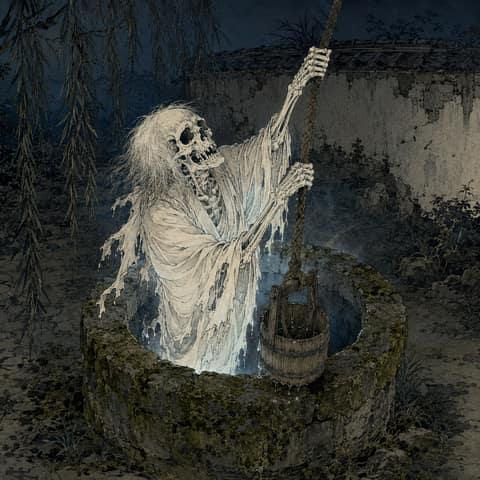
    A form named and illustrated by the Edo-period artist Toriyama Sekien, who depicted white bones in a well as “Kyōkotsu.” The motif shows a skeleton in white garb linked to a bucket rope, rising from the well’s depths, often accompanied by phrases stressing violent grudge. Oral tradition for a proper name is sparse, and the figure likely arose from the linkage of image and words (dialect “kyōkotsu,” the term for bare bones “髑髏/白骨”). Later writers attached explanations such as “bones discarded in a well” or “spirits of the drowned or those who fell,” but primary sources do not fix its nature. Its eeriness as a skeletal image is emphasized, foregrounding symbolism over spiritual rank.
  • Kyōrinrin (Scripture Spirit)

    Kyōrinrin (Scripture Spirit)

    Uncommon

    KYOH-reen-reen

    Tradition-Faithful Edition

    Animated Objects & UndeadKyoto

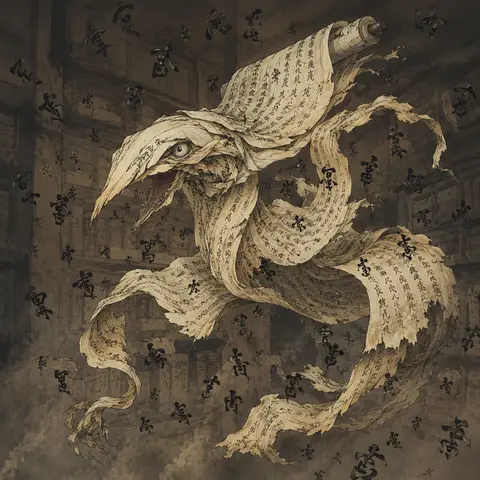
    Based on Sekien’s design, it is portrayed as a frayed Buddhist scroll that unrolls by itself, its ends moving like limbs. It sidles up without a sound and quivers in response to chanting. If someone desecrates a venerable sutra—tearing it, trampling it—then late at night the rustle of paper and faint sutra-recitation are said to echo, while characters from the scripture drift within lamplight. Conversely, if the sutra is purified and properly stored, it settles down and remains harmless, even dusting the study. This figure stands at the crossroads of early modern book-veneration and tsukumogami belief. Its association with the bird-headed figure in the Night Parade scrolls is understood through the beak’s symbolism as a bearer of words and spell-power, though exact locales and names are unknown beyond scattered sources.

  • Menreiki

    Menreiki

    Epic

    MEN-ray-kee

    Classical Iconographic Interpretation

    Animated Objects & UndeadJapanese folklore

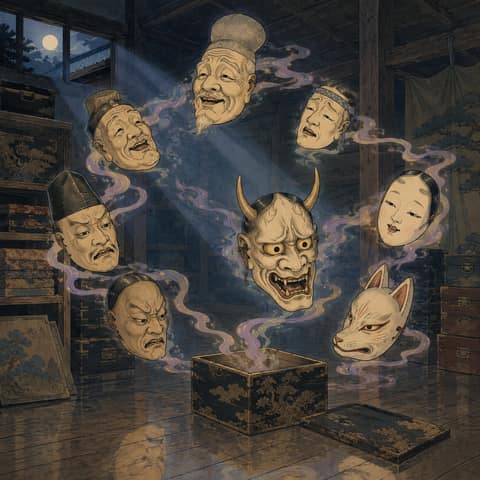
    Based on Toriyama Sekien’s illustration and notes, this version interprets Noh and Sarugaku masks as having accumulated vital aura over long years. The spiritual qi residing in the masks is said to rise at night, slip out from shelves and boxes, line up, and dance. They do not harm people without cause, showing resentment only when treated roughly, a later tsukumogami-like trait, yet at its core the phenomenon is an allegory for the living vitality born from the masks’ refinement. In households that revere the arts, they are enshrined and purified, with words of blessing offered during airing and maintenance to calm their numinous power.

  • Mishige (Enchanted Rice Paddle)

    Mishige (Enchanted Rice Paddle)

    Uncommon

    MEE-shee-geh

    Meshibitsu – Tradition-Accurate Version

    Animated Objects & UndeadOkinawa

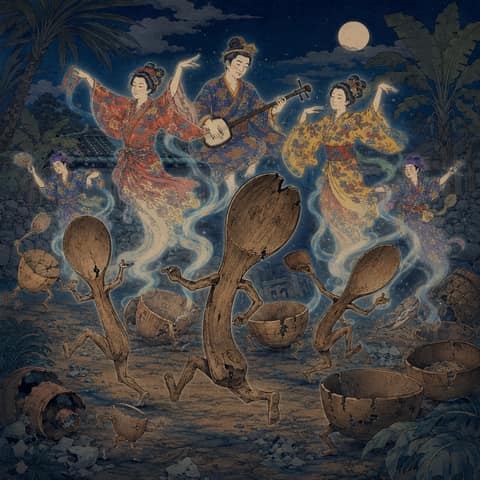
    Based on the tsukumogami image of the meshibitsu told across Okinawa. A rice bin long used or cast aside gains a spirit and becomes active at night. It may appear alone or with kindred utensils like pot bins, forming circles to dance and make lively sounds in empty squares or dumping grounds. To human eyes they can look like young men and women, inviting passersby to join their revel if approached, then returning to their utensil forms at dawn. Some tales tell of beguiling illusions such as appearing as a cow or other odd shapes, but they are not killers, serving more as a warning against mistreating old tools. Households were advised not to discard aged rice bins or pot bins carelessly, but to dispose of them quietly or offer words of thanks.

  • Mokugyo Daruma

    Mokugyo Daruma

    Rare

    MOH-koo-gyoh dah-ROO-mah

    Iconographic Tradition, Sekien Lineage

    Animated Objects & UndeadJapanese folklore

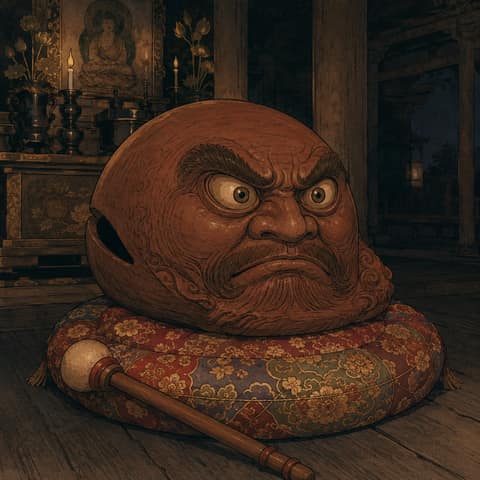
    An interpretation of a tsukumogami rooted in Toriyama Sekien’s imagery, layering the sleepless symbolism of the wooden mokugyo with Daruma’s rigor of training. More often understood as a moral metaphor within temple culture than as a tale told to frighten. Some regions claim a mokugyo sounds on its own in the hall at night, but systematic oral tradition is scarce. Later artists such as Yoshitoshi followed the design, fixing the visage of a face upon a mokugyo seated on a round mat. It is positioned less as a source of terror than as a presence that sharpens the tension of practice.

  • Nyoi Jizai (Will-at-Will Scepter Spirit)

    Nyoi Jizai (Will-at-Will Scepter Spirit)

    Uncommon

    NYOH-ee jee-ZAI

    Emaki Edition

    Animated Objects & UndeadJapanese folklore

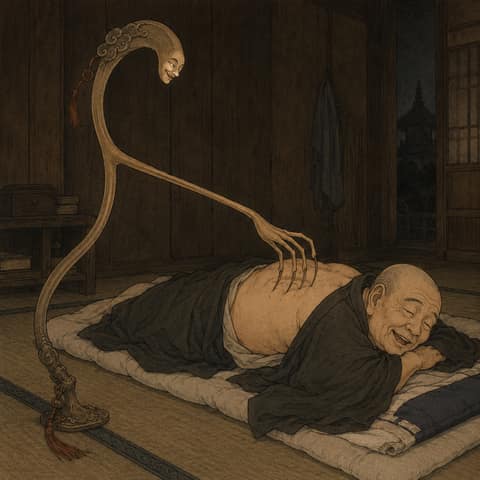
    A consolidation based on the nyoi monster depicted in Muromachi-period Night Parade of One Hundred Demons scrolls and on Toriyama Sekien’s Hyakki Tsurezure Bukuro images and captions. Following the tsukumogami belief that tools gain spirit with age, the nyoi’s original function of “reaching at will” is exaggerated as occult power. Two iconographic lines exist: one shows a humanoid with a tea-brown body and long claws that scratch a person’s back with extended arms, the other shows the nyoi itself sprouting wings and drifting in midair. Both appear late at night in bedrooms or Buddhist rooms, said to seek out itchy spots and places the hand cannot reach. Some readings hold that the morally wanting are left with claw marks, yet region-specific oral lore is scant, and the figure relies mainly on pictorial sources and later yokai commentaries.

  • Saddle Fiend

    Saddle Fiend

    Rare

    KOO-rah-yah-ROH

    Toriyama Sekien Plate Conformant

    Animated Objects & UndeadJapanese folklore

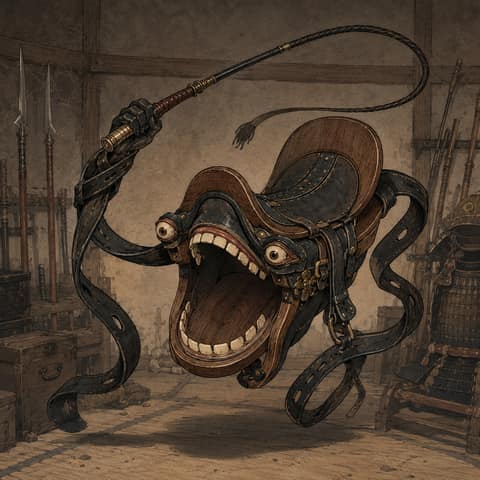
    An image based on Toriyama Sekien’s Hyakki Tsurezurebukuro. The saddle itself forms the torso, accompanied by a caption indicating damage around the front bow. Eyes peer from the base of the stirrup leathers, and the mouth splits at the front bridge to reveal fangs. The hands are rendered as extended girth straps, grasping a whip at the tip. As a tsukumogami, it follows the early modern idea that old implements gain spirit through long use or resentment. The saddle, a nexus between lord and retainer and a vessel of battlefield memory, serves as a moral emblem warning against wrongful deaths and negligence. Paired with the stirrup mouth, it thematizes preparedness and care for one’s tack, with its monstrosity reflecting carelessness and impropriety like a mirror.

  • Seto General

    Seto General

    Rare

    SEH-toh TIE-shoh

    Iconographic and Mitate-Derived Version

    Animated Objects & UndeadUncertain (Edo-period pictorial works)

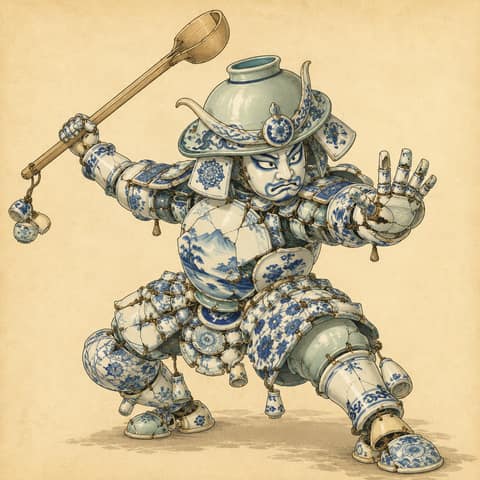
    Rooted in Sekien’s picture manuals, this tsukumogami-style portrayal recasts rivalry among ceramic centers like Seto and Karatsu into the guise of a warrior effigy. The body is a composite of cups, sake flasks, warming pans, and plates arranged as armor, while the accompanying text brims with wit, blending diction from Chinese classics and military tales. Rather than a field-sighted apparition, it crystallizes the idea of spirits inhabiting objects and the Edo-period literacy that likened trends and the prestige of named masterpieces to a “battle.” The motif continued into Meiji-era ukiyo-e and is viewed as a classic in the lineage of the Night Parade of One Hundred Demons.

  • Shirōneri

    Shirōneri

    Epic

    shee-ROH-neh-ree

    Based on Sekien’s Illustrations

    Animated Objects & UndeadJapanese folklore

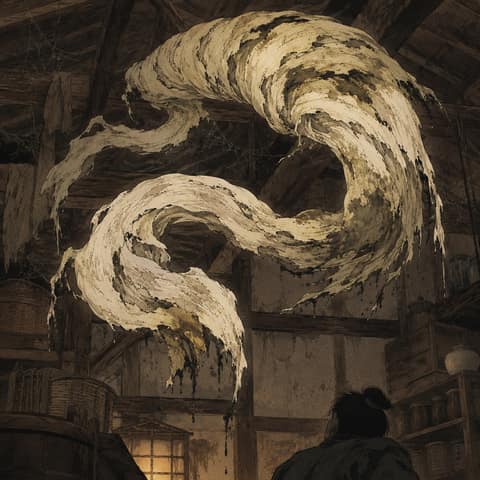
    Anchored in Toriyama Sekien’s imagery, this version sees an aged dishcloth trailing long and fluttering in the wind, reimagined as a yokai. The original illustration offers little about harming humans, so it is understood as a symbol of attachment to old objects and the impermanence of things. Aggressive traits found in later ghost tales should be kept separate; here the focus is the eerie nature of a “moving old cloth” and the visual impression of it gliding between walls under a night lamp.

  • Shōgorō (the Gong Spirit)

    Shōgorō (the Gong Spirit)

    Rare

    SHOH-goh-ROH

    Sekien Plate Edition (Toriyama Sekien-Inspired)

    Animated Objects & UndeadEdo period, Kamigata tradition (Osaka)

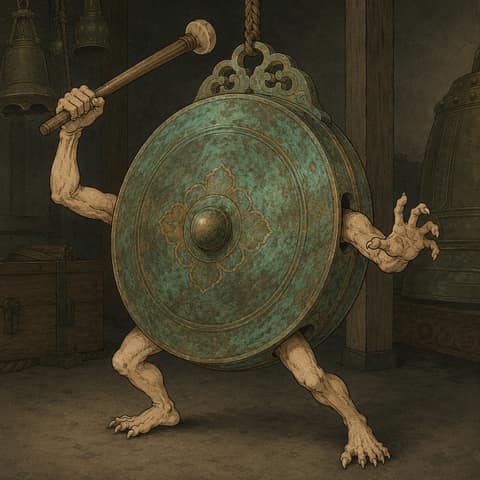
    An interpretive reconstruction based on Shōgorō from Toriyama Sekien’s Hyakki Tsurezure Bukuro, linking the tsukumogami notion of spirits inhabiting tools with the muromachi-era Waniguchi bell monster seen in Night Parade picture scrolls. Because the name plays on words, it cannot be conclusively read as the vengeful spirit of any specific person. In the Kansai region it has been read against the Yodoya “Golden Rooster” legend, serving as an image that warns against the pursuit of wealth and fame. It is depicted as a round temple gong or waniguchi bell sprouting limbs, sounding of its own accord to give warning. No field sightings survive, and primary sources are picture scrolls, yokai paintings, and their notes.

  • Straw-Raincoat Sandals

    Straw-Raincoat Sandals

    Rare

    MEE-noh WAH-rah-jee

    Iconographic Tradition Edition

    Animated Objects & UndeadJapanese folklore

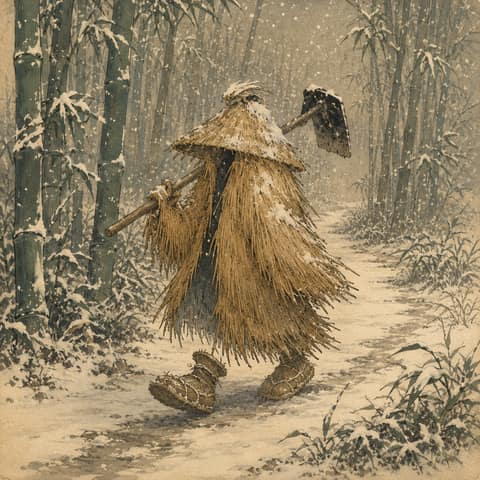
    A reimagining of the straw raincoat and straw sandals yokai based on Toriyama Sekien’s imagery. The straw raincoat serves as a protective emblem akin to visiting-deity garb, while the sandals take on the role of roadside boundary charms. Weathered by long use and harsh storms, they are believed to have gained spiritual potency and slipped into the human world. The act of shouldering a hoe evokes farm labor and service to local land deities, and the snowy bamboo grove setting suggests purity and deep quiet. Specific deeds go unrecorded, but it was likely feared as creaking sandal steps at midnight or a walking cloak’s silhouette in a blizzard, with little emphasis on malice. An emblematic member of the early modern tsukumogami ensemble, it reflects reverence for the lifespan and toil of tools.

  • Suzuri-no-tamashii

    Suzuri-no-tamashii

    Rare

    sue-ZOO-ree no tah-mah-SHEE

    Phantom of Dan-no-ura / Spirit of the Akama Inkstone

    Tsukumogami / GaikaiYamaguchi

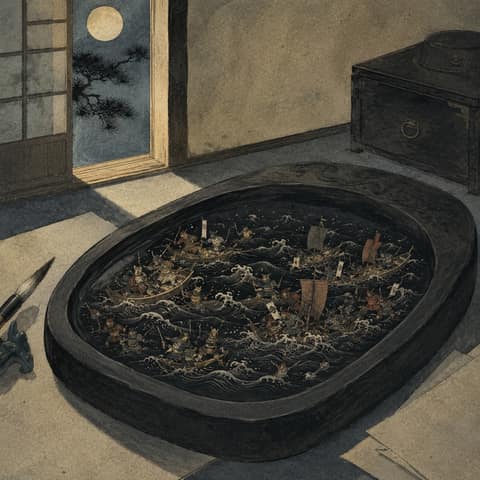
    This interpretation remains most faithful to Toriyama Sekien's commentary, transforming the inkstone—a static piece of stationery—into a "screen of phantoms" that projects the dynamism and tragedy of history. This yokai never threatens or curses its owner. It quietly reveals its form only when the owner possesses deep cultivation and a strong empathic connection to history. In a study enveloped in midnight silence, one pours cold water and gently begins to rub the inkstick. The phenomenon occurs when the flickering candlelight illuminates the surface of the black, glistening liquid ink (the sea of the inkstone). Suddenly, mingled with the rich fragrance of the freshly ground ink, the faint "scent of the sea breeze" and "scent of blood" begin to drift through the air. Then, within the mere few centimeters of the ink sea in the inkstone, pure white crests of waves rise, miniature warships crowd together, and Minamoto and Heike warriors—no larger than grains of rice—appear. They cross swords, loose arrows, and fall into the waves one after another, recreating the decisive Battle of Dan-no-ura. If you listen closely, angry shouts, the sound of crashing waves, and the screams of the court ladies of the Heike echo like a distant auditory hallucination. This is a physical vision manifested through the resonance between the "kotodama" (spirit of language) in *The Tale of the Heike* read by the literatus and the hundreds of years of sorrowful memories held by the "Akama stone," which was quarried from the very sea where the Heike perished. The Spirit of the Inkstone is a "spirit of literature" of unparalleled beauty, poetry, and bottomless melancholy, proving how the act of reading is a mystical ritual that transcends time and space to converse with the dead.

  • Yamaoroshi

    Yamaoroshi

    Rare

    yah-mah-oh-ROH-shee

    Based on Sekien Toriyama’s Iconography

    Animated Objects & UndeadJapanese folklore

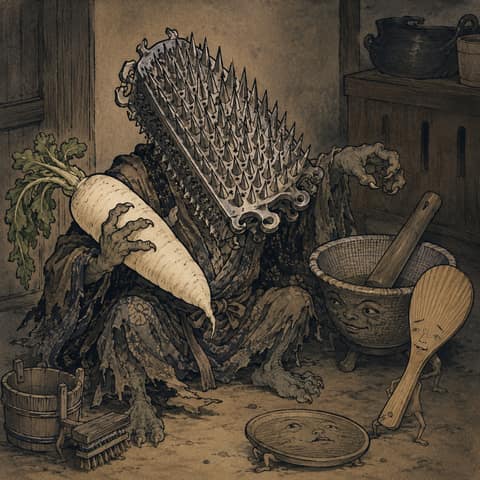
    A reconstruction guided by Sekien Toriyama’s image and notes. The head resembles a grater, its surface studs likened to porcupine quills. Though written as “Yamaoroshi,” its nature is not a mountain wind itself but an abstract monster born from combining a utensil (grater) with a bestial image. Daikon radishes and mortars placed nearby signal a tsukumogami-style scene, with no specific harm or blessing described. Rooted in Edo-period paintings, it lacks regional oral lore or cult, and later handbooks often present it as an example of utensil transformation and wordplay.

  • Yarikechō (Spear Tuft Spirit)

    Yarikechō (Spear Tuft Spirit)

    Rare

    yah-ree-keh-CHOH

    Yarigechō (Iconographic Tradition)

    Animated Objects & UndeadEdo period, Japan

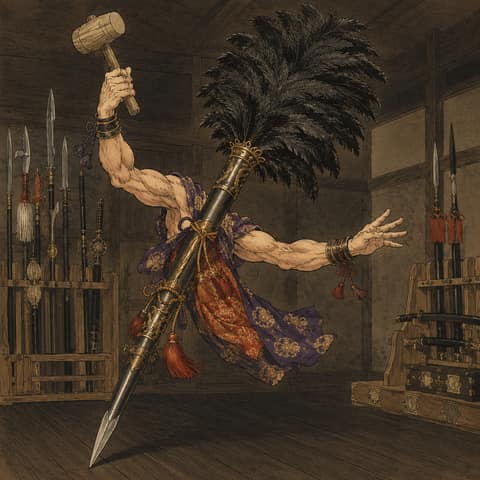
    A type of tsukumogami typical of early modern yokai art. The hair-spear used both as a practical weapon and as a symbol in processions was thought to accrue spiritual potency through associations with masters and tales of valor. In Hyakki Tsurezure Bukuro, Sekien depicted it wielding a wooden mallet, assigning it a specific object-name while drawing on older iconographic bones. The name Yarigechō likely arose where Night Parade motifs from the Muromachi era, Edo antiquarian taste, and the culture of famed implements converged. Modern print editions and nishiki-e varied the image, sometimes stressing the spear’s decorative plumes, yet it lacks distinctive oral lore and is known mainly through pictures and bibliographic notes.

  • Zen-Gama-no-Shō (Zen Kettle Monk)

    Zen-Gama-no-Shō (Zen Kettle Monk)

    Rare

    ZEN-gah-mah-noh SHOH

    Iconographic Tradition: Tsukumogami Kettle

    Animated Objects & UndeadJapanese folklore

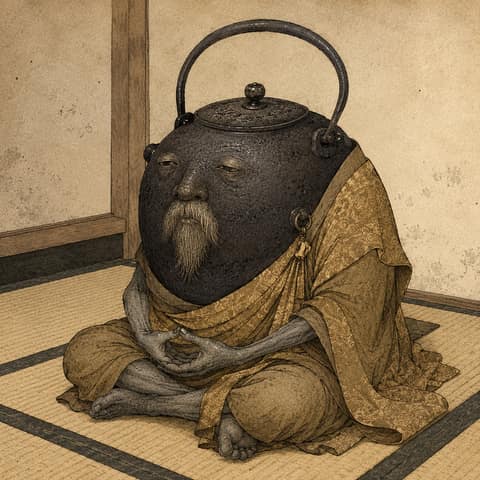
    Based on examples by Toriyama Sekien, this image depicts an aged tea kettle manifesting with spiritual authority. Its posture and arrangement inherit compositional methods akin to the Night Parade of One Hundred Demons scrolls, often shown marching alongside Torakakushi and Yarinaga. The name plays on the kinship between chanoyu and Zen, hinting at a caricature of a Buddhist priest. By the logic of mononari, tools long used or neglected accrue ki, appear before people, and inspire awe. Meiji painters continued this iconographic lineage, and yokai catalogues and dictionaries classify it as a type of tsukumogami, though specific local legends are scant. Later commentaries add anecdotes of startling humans, but early records offer little confirmation, so it is understood chiefly through its iconographic tradition.

Showing 25 - 39 of 39 yokai