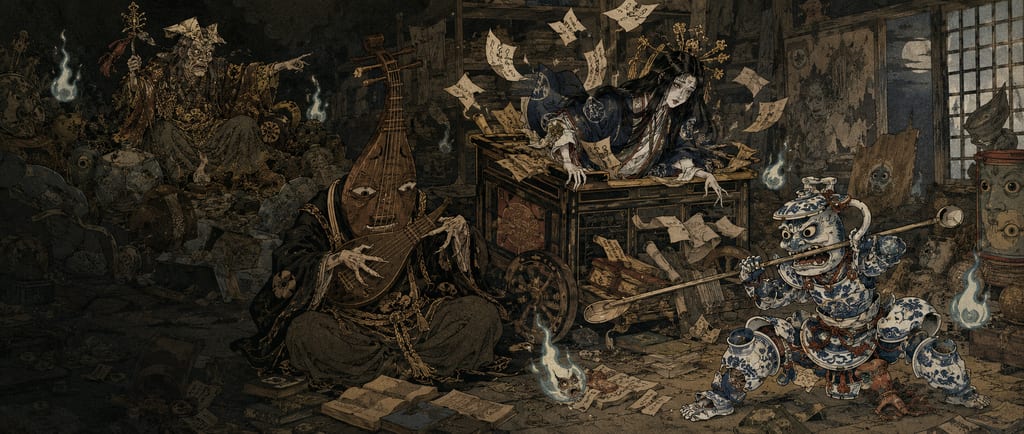
A tsukumogami of a feather-crested spear (ke-yari) depicted by Edo-period artist Toriyama Sekien in Hyakki Tsurezure Bukuro. The spear, adorned with bird plumes at its tip, is said to have gained spirit through long years and storied use. Sekien portrays it leaping about brandishing a mallet. His note hints that a peerless warrior once wielded the weapon, suggesting the renown of a famous spear could awaken its numinous power—an example of an object becoming ensouled.
Folklore & Legends
Sekien’s Yarikechō likely inherits its pose from Muromachi-era Night Parade scrolls that show a yokai raising a wooden mallet. Later sources mention the feathered ke-yari and the term tori-ge yari, proposing that the name arose from a reversal of those words. In Tsukioka Yoshitoshi’s late Edo/Keiō-period print Hyakki Yagyō, a similar figure appears holding a spear-like implement instead of a mallet.
Yokai Cards2
Yarikechō (Spear Tuft Spirit) across multiple art-style decks
A type of tsukumogami typical of early modern yokai art. The hair-spear used both as a practical weapon and as a symbol in processions was thought to accrue spiritual potency through associations with masters and tales of valor. In Hyakki Tsurezure Bukuro, Sekien depicted it wielding a wooden mallet, assigning it a specific object-name while drawing on older iconographic bones. The name Yarigechō likely arose where Night Parade motifs from the Muromachi era, Edo antiquarian taste, and the culture of famed implements converged. Modern print editions and nishiki-e varied the image, sometimes stressing the spear’s decorative plumes, yet it lacks distinctive oral lore and is known mainly through pictures and bibliographic notes.
Character Profile
This section is our own creative profile for storytelling. It is not historical fact or scholarship.
resonates with arms and armor, harmonizes with objects from military processions
Abilities
manifesting spiritual vigor that boosts the force of processionscalling forth solidarity among spirits dwelling in old implementsstartling people with percussive onomatopoeia by hammering stools and stands with a wooden mallet
Weaknesses
loses momentum if it is stripped of provenance or missing its spearhead or plumes, calmed by purification rites or fragrant ablutions
Habitat
armories of samurai estates, staging areas for festivals and processions, back rooms of antique dealers
The diagram below is a diagnostic evaluation chart for Yarigechō (Iconographic Tradition). The higher the value of each item, the stronger that characteristic is expressed.