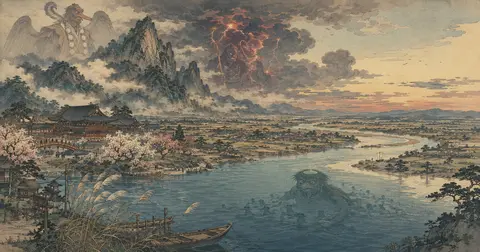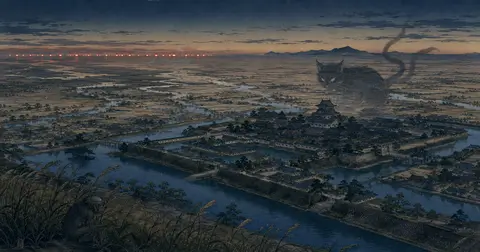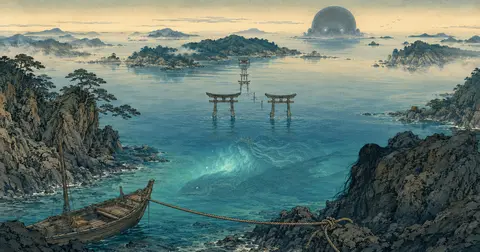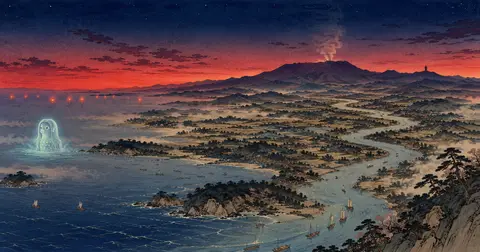
The yokai of Okinawa stand on an entirely different genealogical tree from those of the Japanese mainland. In contrast to the mainland yokai colored by Buddhist hell scrolls and Shinto exorcisms, the spirituality of Ryukyu here is a world where gods visit from Niraikanai, the otherworld beyond the sea, descend upon the sacred groves (*utaki*) of the forest, and women ── *noro* and *yuta* ── act as mediums for the voices of gods and the dead. On this horizon of faith, uniquely cultivated by the Ryukyu Kingdom which lasted for 450 years, the ancient subtropical banyan trees and the sea surrounded by coral reefs are the very dwellings of spirits.
When the folklorist Kunio Yanagita, in his late work *The Sea Road* (*Kaijo no Michi*), proposed that rice, coconuts, cowrie shells, and Japanese culture itself crossed the southern seas, these islands were placed at the gateway. Rather than viewing Okinawa as a frontier, we should see it as a place where the oldest memories of Japan lie exposed ── with such a gaze, let us visit the gods and yokai of Ryukyu, traveling from the main island, to the forests of Yanbaru, and onto the remote islands of Miyako and Yaeyama.
From Beyond the Sea ── The Creator God and Visiting Gods
The mythology of Ryukyu begins with the sea.
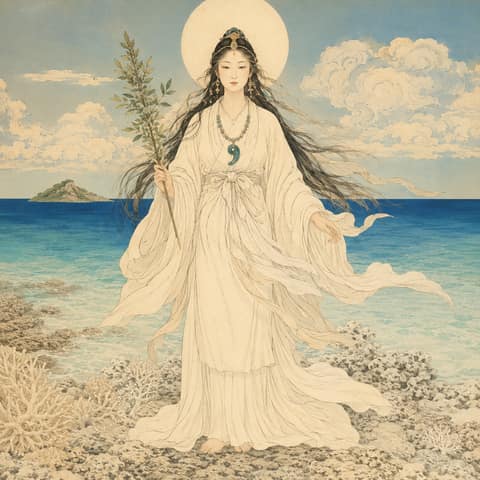
Amamikiyo
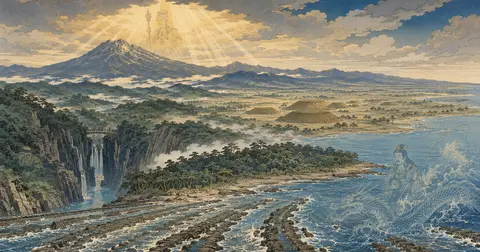
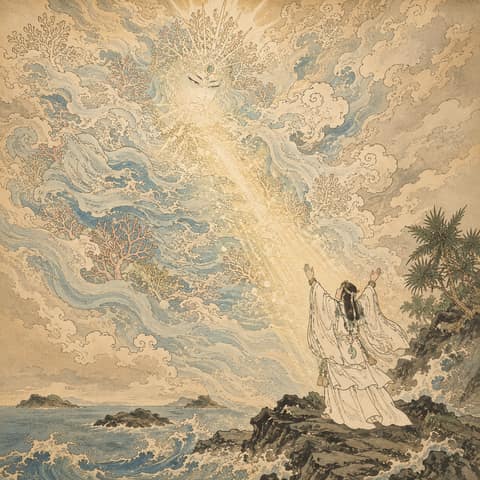
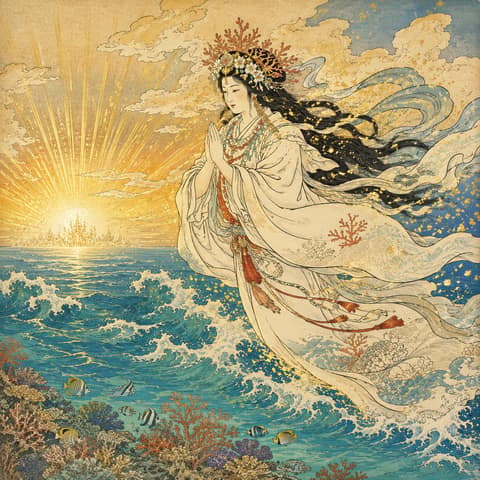
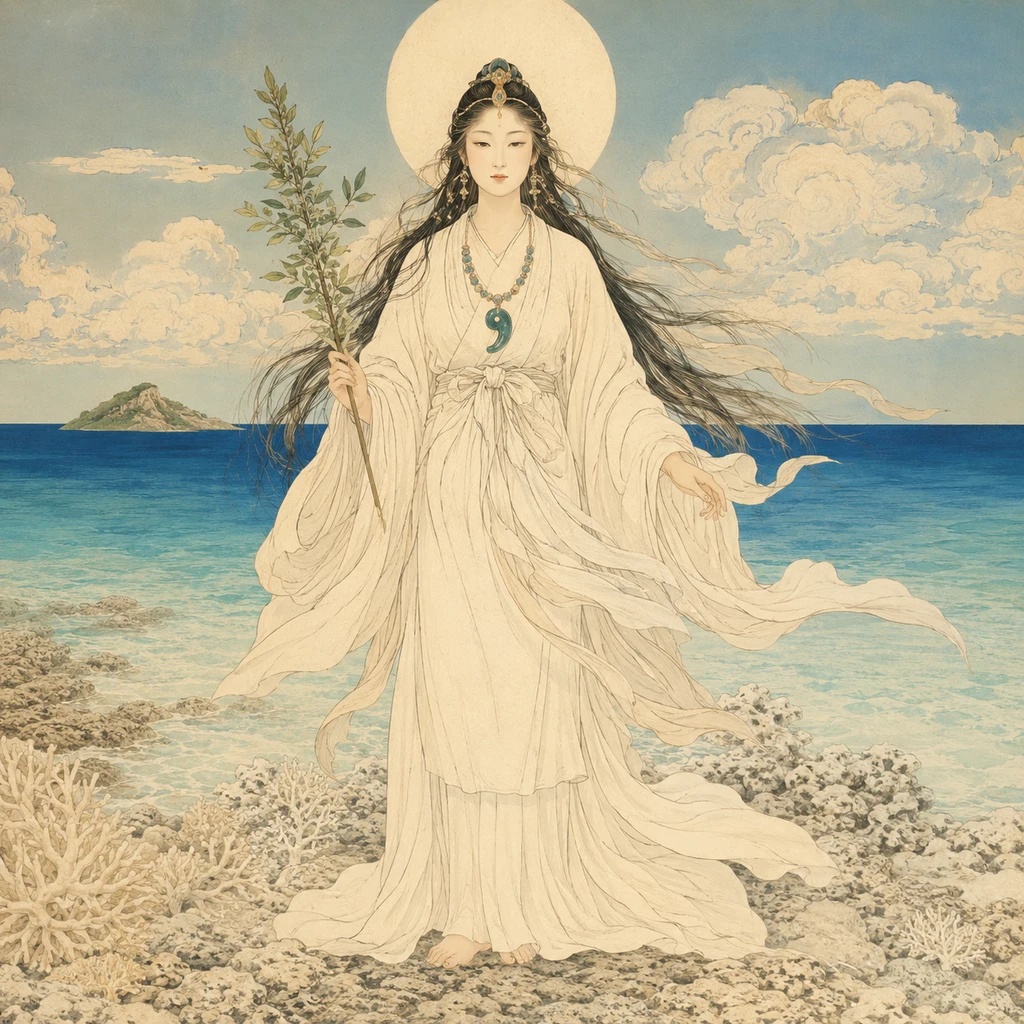
Amamikiyo (also known as Amamiku) is the creation deity believed to have formed the islands and lands of the Ryukyu archipelago. It is said that they came across the sea from Nirai Kanai, the otherworld, to shape the islands, settle people upon them, and establish the sacred groves known as *utaki*. In some accounts, Amamikiyo is paired with the male deity Shinerikiyo, and the two are said to have created the land and its people under the command of the sun god. Other texts portray Amamikiyo as a solitary creator. Regardless of these literary variations, Amamikiyo stands at the apex of the Okinawan belief system, serving as the root of the Ryukyuan pantheon connected to other visiting deities like Kinmamon from Nirai Kanai and the goddesses who manifest at the *utaki*.
Read moreThe creator god said to have crossed over from Niraikanai beyond the sea, formed the islands, and opened the seven *utaki* is Amamikiyo. This name is recorded in the ancient song collection compiled by the Shuri royal government, the *Omoro Soshi* (1531-1623)[1], and in Ryukyu's first official history, the *Chuzan Seikan* (1650)[2]. The *Omoro Soshi* sings that two gods, Amamikiyo and her male counterpart Shinerikiyo, created the land and people by order of the sun god, while the *Chuzan Seikan* speaks of creation by the single god Amamikiyo ── the fluctuation between dual-god and single-god creation stems from these different sources. The Ryukyuan view of the otherworld has two systems: Niraikanai beyond or beneath the sea, and Obotsukagura in the sky, and Amamikiyo was also a mediator who traveled between both to bring the heavenly god's commands to the earth. Although a creator god, Amamikiyo does not become the ancestor of a lineage that gives birth to successive gods like Izanagi and Izanami of the mainland; the uniqueness of Ryukyuan mythology lies in the fact that Amamikiyo remains strictly a pioneer god who "created islands, opened utaki, and settled people." Amamikiyo is said to have first descended on Kudaka Island, the sacred site of the sea, and opened *utaki* including Asumui Utaki in Kunigami. Kudaka Island, where Amamikiyo first landed, remains Ryukyu's premier sacred site today, where once every twelve years, in the Year of the Horse, a divine ritual called "Izaiho" was held, transforming women born and raised on the island into divine women (*nanchu*) (it ended in 1978 due to a lack of successors). Many of the *utaki* designated as royal sacred sites, such as Asumui Utaki, Sefa Utaki, and Madamamui Utaki in Shuri, link their origins to this Amamikiyo creation myth. In later ages, the "Agari-umai," an Eastern Pilgrimage undertaken by the king to sacred sites, also mapped this legend of visitation and national creation onto the geography, and the very arrangement of the sacred sites, allowing one to worship Kudaka Island across the sea from Sefa Utaki, engraves the myth into the land.
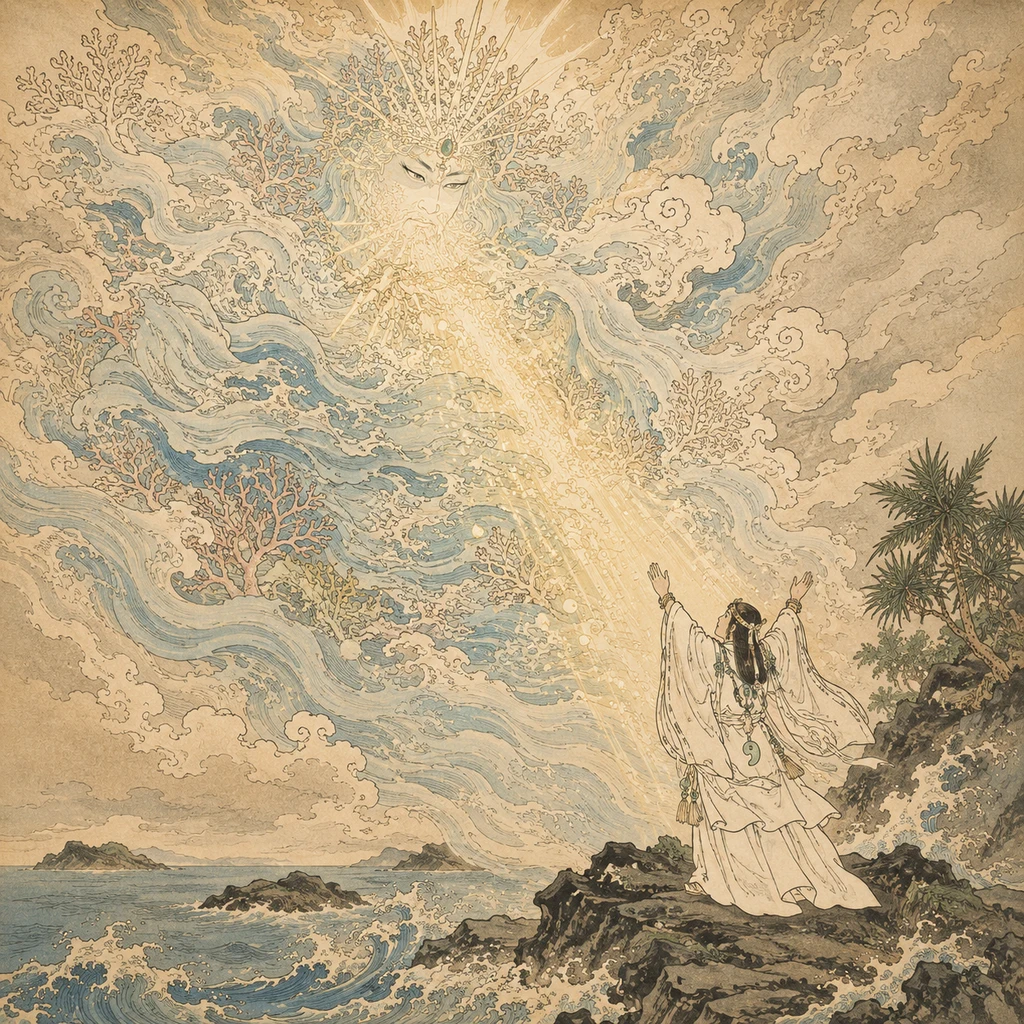
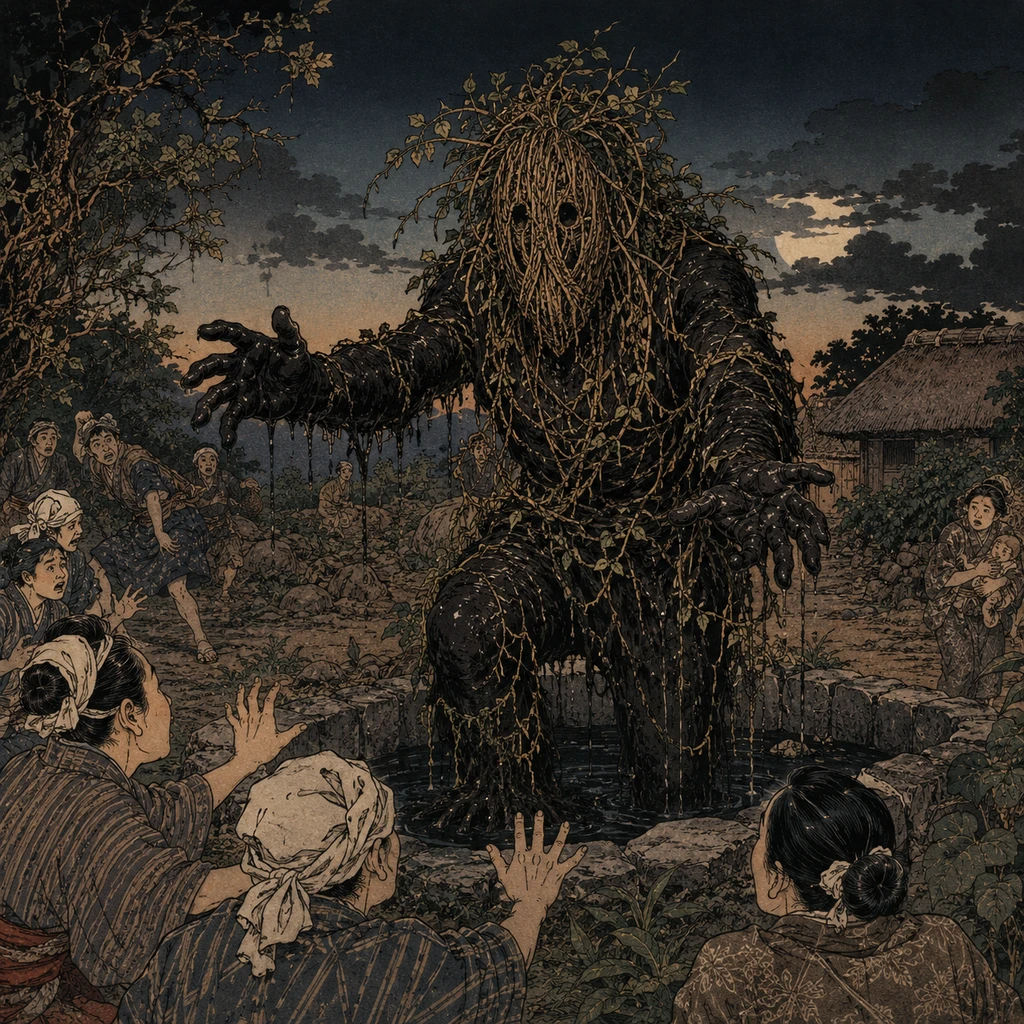
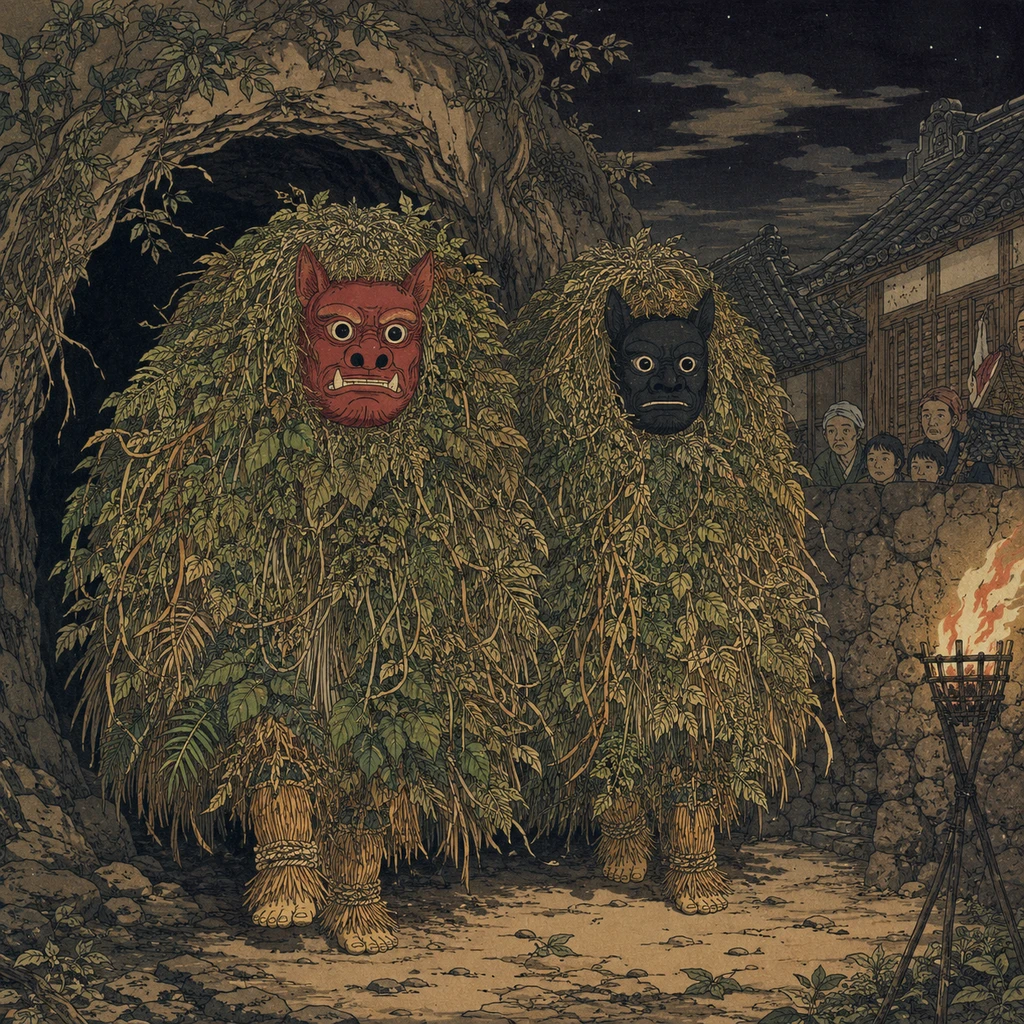
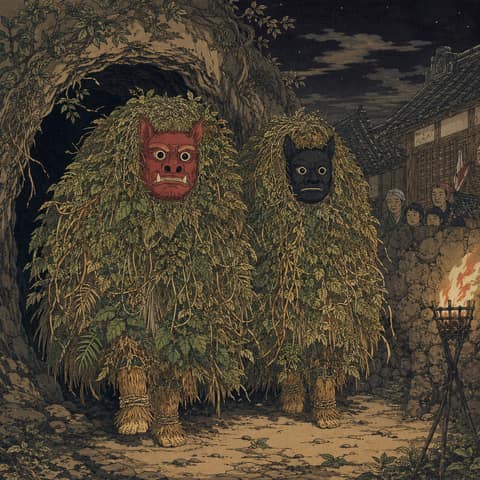
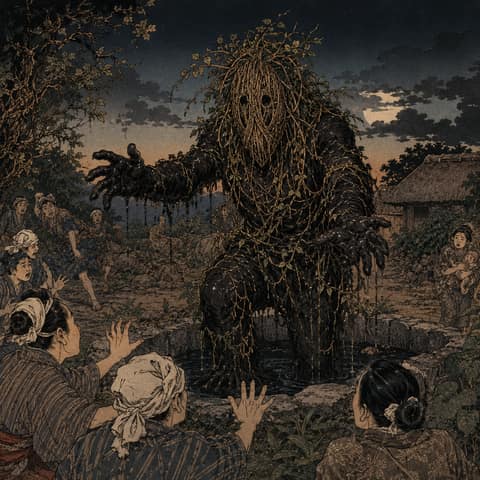
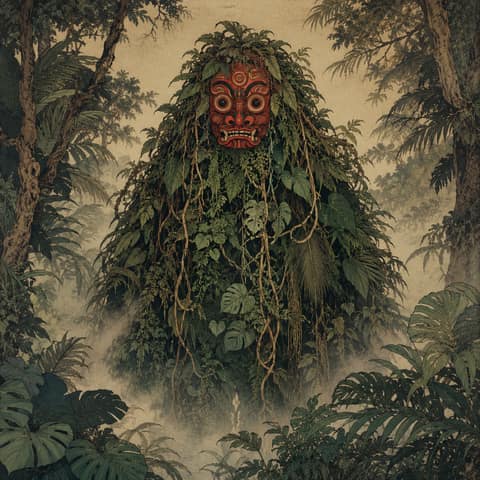
Coming from beyond the sea to exorcise misfortune and bring bountiful harvests ── this concept of "visiting gods" (raihoshin) is not only found in creation myths but vividly survives in festivals in various regions today. It is the sense that gods are not always present in this world, but "visit" once a year from the otherworld of the sea or the depths of the earth. The supreme god Kinmamon[3], who visits from Niraikanai, is said to manifest by possessing the highest-ranking divine woman, the Kikoe-ogimi. The early 17th-century *Ryukyu Shinto-ki* records two dualistic phases: the "Kinmanmon of Kiraikanai" who descends from heaven, and the "Kinmanmon of Obotsukagura" who rises from the sea, suggesting this god was an ambiguous existence visiting from both heaven and sea. And the goddess who has been considered identical to this Kinmamon since ancient times is Kimitezuri, the goddess governing the sea and the sun. Scholars differ on whether it is the name of a god or a ritual gesture, but both have been revered as divine figures visiting from Niraikanai to protect the kingdom. In Shimajiri on Miyako Island, Paantu ── three Paantu representing Parent (Uya), Middle (Naka), and Child (Fufa) ── cover their entire bodies in mud from the bottom of the *nmariga* (birth spring), wrap themselves in vines, and smear the mud on residents, newly built houses, and newborns to exorcise evil. Being smeared with mud is proof that misfortune has been driven away, and people gladly accepted it even if their festive clothes were soiled. In the Nobaru district, a different form of Paantu centered around women and children is passed down. This is an Important Intangible Folk Cultural Property of Japan and the only existence in Okinawa Prefecture registered as a UNESCO Intangible Cultural Heritage "Visiting God" in 2018. In Yaeyama, Akamata-Kuromata, covered entirely in vines, visit the harvest festival from the underground otherworld. This festival, held in Komi on Iriomote Island, Aragusuku Island, Kohama Island, and Miyara on Ishigaki Island, is a secret ritual involving only those with qualifications; photography and speaking of it are strictly forbidden, and its full details never leave the communities even today. In Yaeyama, there are also visiting gods like Mayunganashi, who visits in the guise of a traveler to announce good harvests and longevity, and Miruku, who parades through the harvest festival wearing the mask of a smiling Maitreya. Once a year, strange-looking gods visit the village from beyond the sea or mountains, bring fortune, and return ── these festivals of visiting gods are the moment when the Niraikanai faith takes its most visible form, and while faintly resonating with the demons of Setsubun and Namahage on the mainland, they have been welcomed in Okinawa as "gods who bring fortune."
Spirits of Trees and Forests ── Kijimuna and Bunagaya
If the sea is the path of the gods, the trees are the dwellings of spirits.
Kijimuna
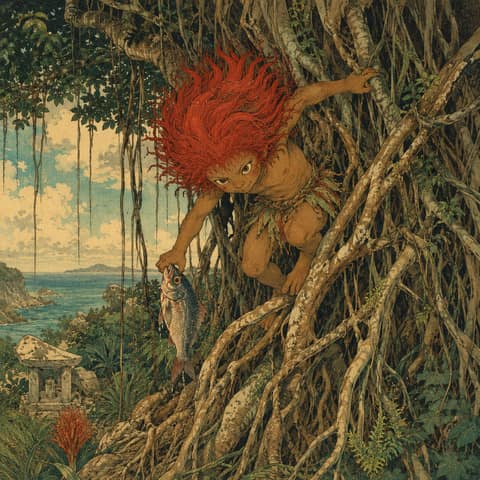
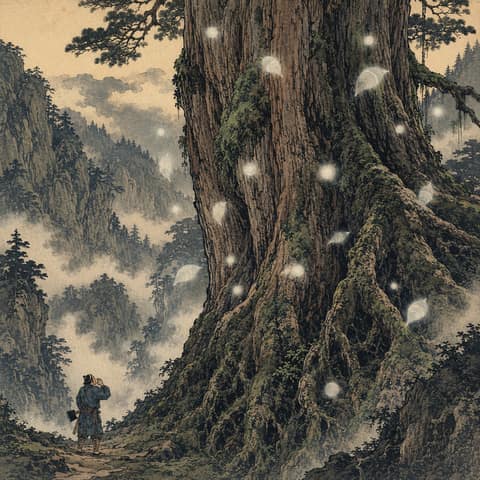
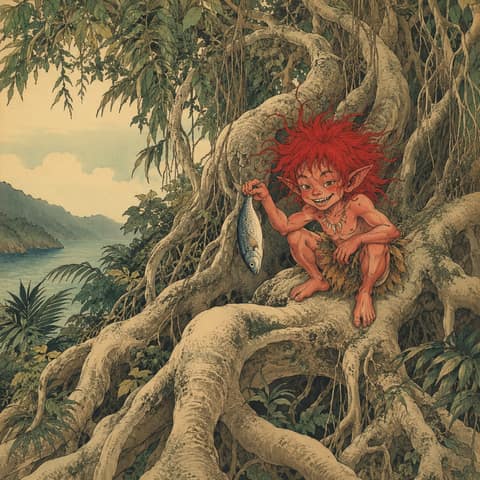
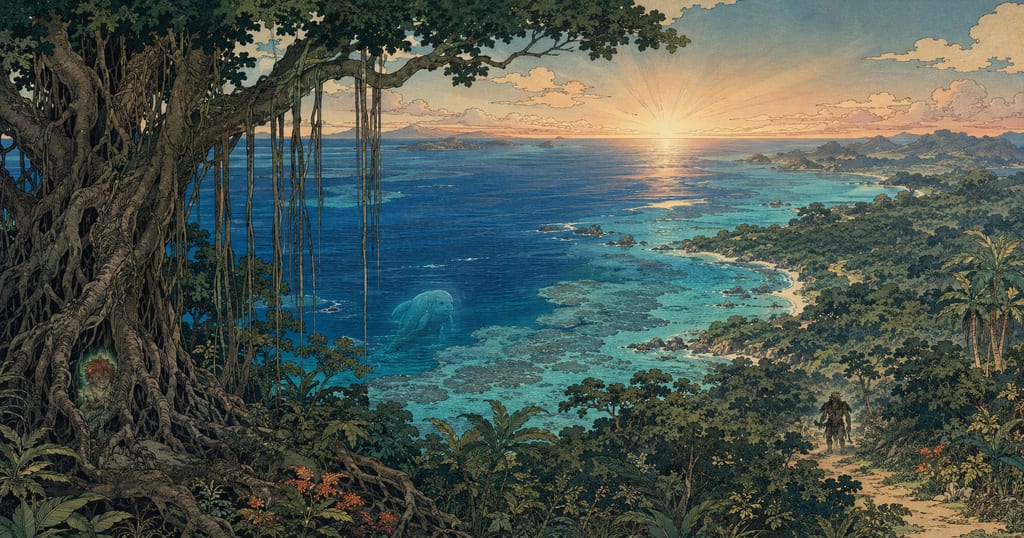
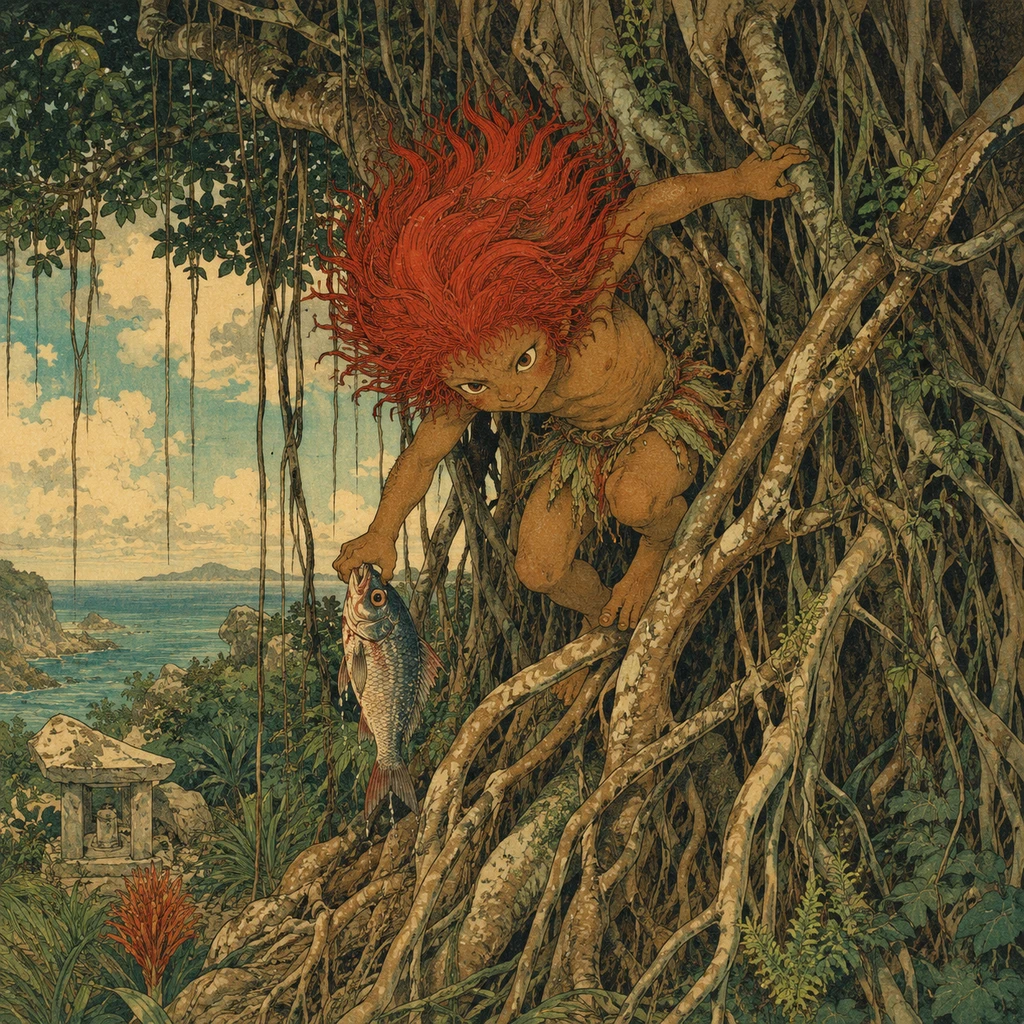
Kijimuna is a tree spirit passed down through generations around the main island of Okinawa and the Amami archipelago. They are said to dwell in old banyan trees (known in Okinawan dialect as *gajumaru*, scientific name *Ficus microcarpa*). When appearing before humans, they are described as being the size of a three or four-year-old child, covered entirely in red hair, with a face dyed completely red. While called "Bunagaya" in the Kijoka district of Ogimi Village, and known by other names like "Bunagai," "Bunangaya," "Michibata," "Handanmi," and "Akaganda" in different regions—giving the illusion of multiple distinct yokai—folklorists categorize them as beings of the exact same lineage. They are highly skilled at fishing and often cooperate with humans to bring massive catches. However, they possess a peculiar dietary habit: they eat only the left eye of the fish and return the rest to the human. They harbor an extreme loathing for octopuses, chickens, and flatulence. If their banyan tree is cut down, they will hold a grudge and curse the offender for the rest of their life. Notably, there is no lore of the Kijimuna in the Yaeyama Islands, confirming it as an endemic spirit of the Okinawan main island cultural sphere.
Read moreThe Kijimuna, said to dwell in old banyan trees, takes the form of a red-haired child and is said to bring large catches of fish if a fisherman befriends it. However, it prefers to eat only the left eye of the fish, extremely hates octopuses, and relentlessly curses those who damage its host tree or break a promise. It is sometimes witnessed as a fireball drifting over the night sea. Rather than a yokai, it is a spirit dwelling in the boundary between forest and sea, associating equally with humans, capriciously bringing wealth, and baring its fangs if betrayed ── that sense of distance well reflects the Okinawan view of nature. Why it hates octopuses or prefers the left eye remains untold, simply passed down as "just the way it is" ── it is precisely in the realm that cannot be rationalized that the reason for a spirit to be a spirit lies. The manga artist Shigeru Mizuki was also fascinated by the Kijimuna, evaluating the old banyan tree where it lives as "a tree that looks like yokai would live there," leaving sketches and depicting it in his works, making it known nationwide.
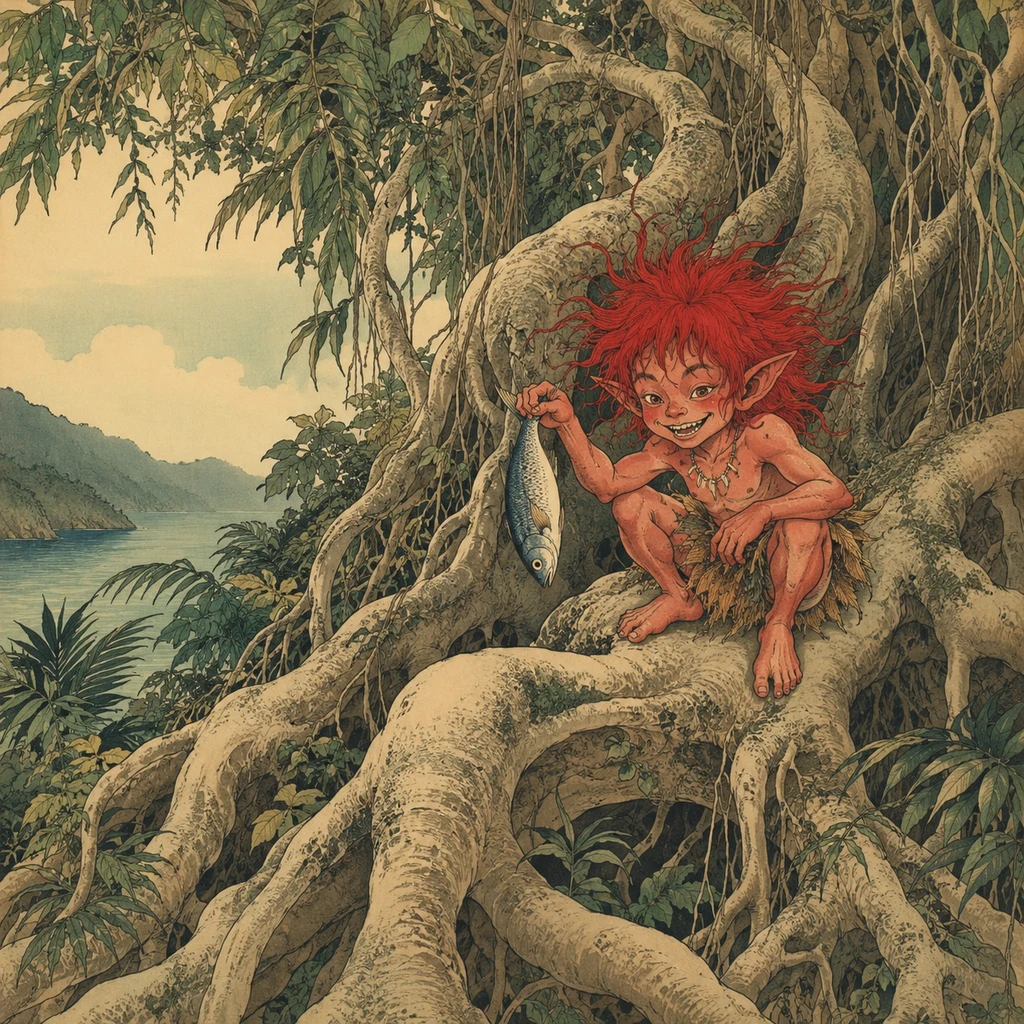
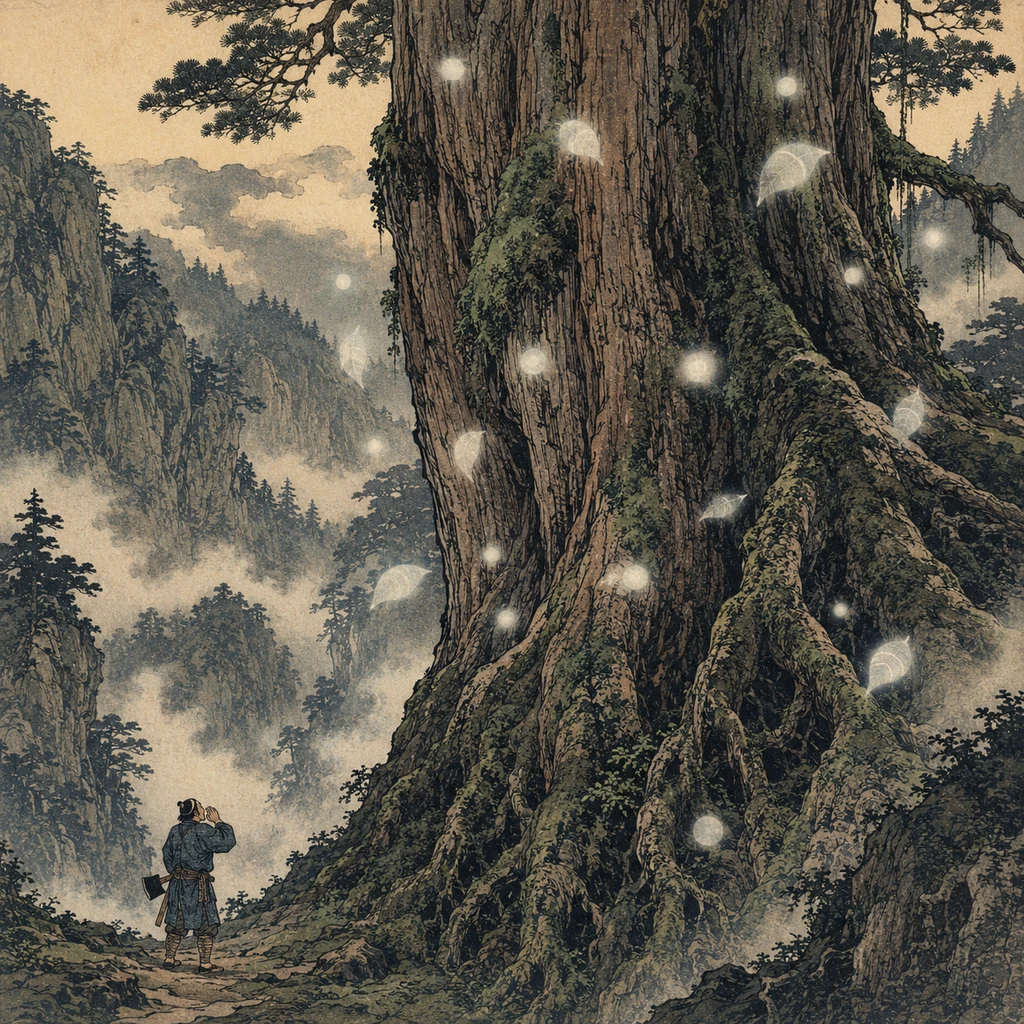
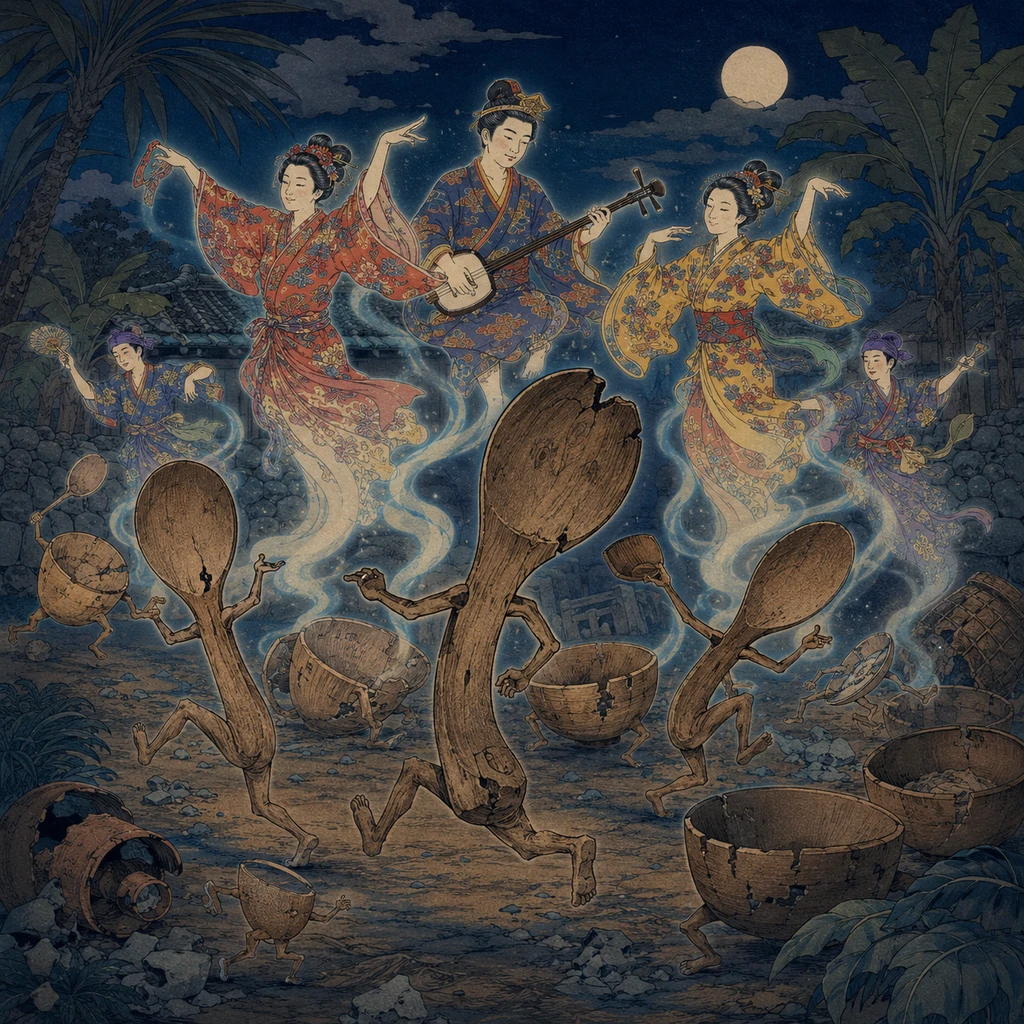
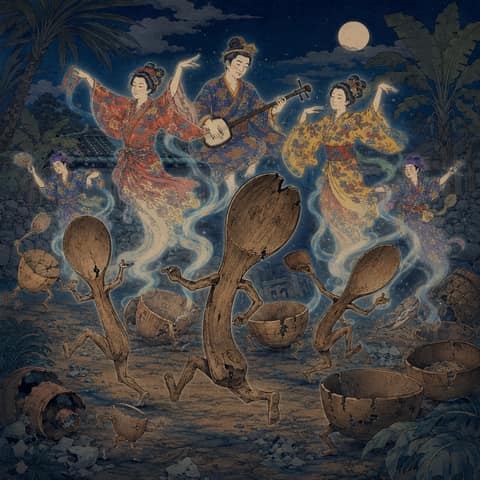
In Yanbaru, the northern part of Okinawa's main island where deep evergreen broadleaf forests spread, dwells the Bunagaya, closely related to the Kijimuna. While its appearance as a red-haired child is similar to the Kijimuna, the Bunagaya is considered a spirit of the forest and rivers themselves rather than just an old tree, and is characterized particularly by its handling of fire (Bunagaya fire). It is said there was also a test-of-courage-like custom called "Arami," where people went to see the Bunagaya fire appearing like lamps in the mountain valleys at night. Ogimi Village champions this red-haired spirit as the symbol of "The Village of Bunagaya" and even uses it as a mascot character for village revitalization ── the once-feared forest spirit is now welcomed as the pride of the village. In Okinawa, it has been believed that spirits dwell in all surrounding nature and tools, including tree spirits (*kodama*) dwelling in trees and tool monsters (*tsukumogami*) like the Mishige, an old rice paddle that has transformed. The tales of old rice paddles or pot lids turning into monsters over the years, such as the Mishige, are manifestations of the sense that life dwells in tools as well. Including the Kenmun of Amami (present-day Kagoshima Prefecture) ── a spirit with a dish on its head, loving sumo, dwelling in banyans, preferring fish eyes, and hating octopuses, almost identical to the Kijimuna ── these form a homologous lineage of "small ones living in trees" stretching north and south along the Kuroshio Current. Amami is now part of Kagoshima Prefecture, but it was once within the territory of the Ryukyu Kingdom, and their spirituality is seamlessly connected. These yokai quietly tell us that the spirits of Okinawa are connected not by administrative boundaries, but within the spheres of ocean currents and vegetation.
Prophecies and Monsters of the Sea ── Zan and Yonatama
In the sea surrounding the islands dwell monsters that sway the life and death of humans.
Zan
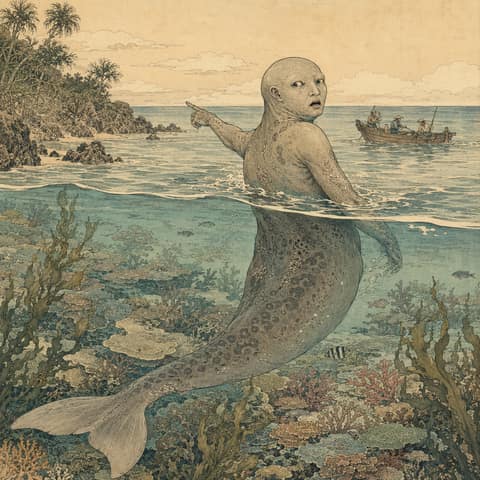
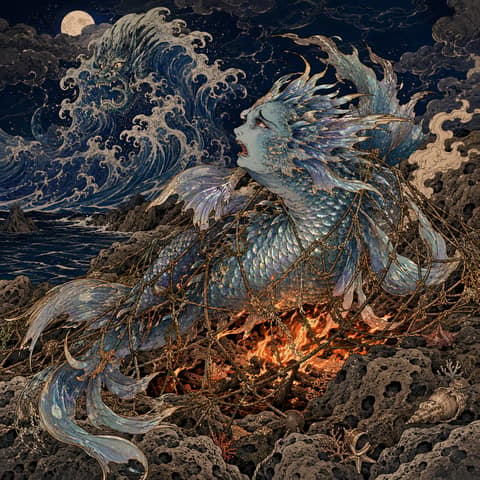
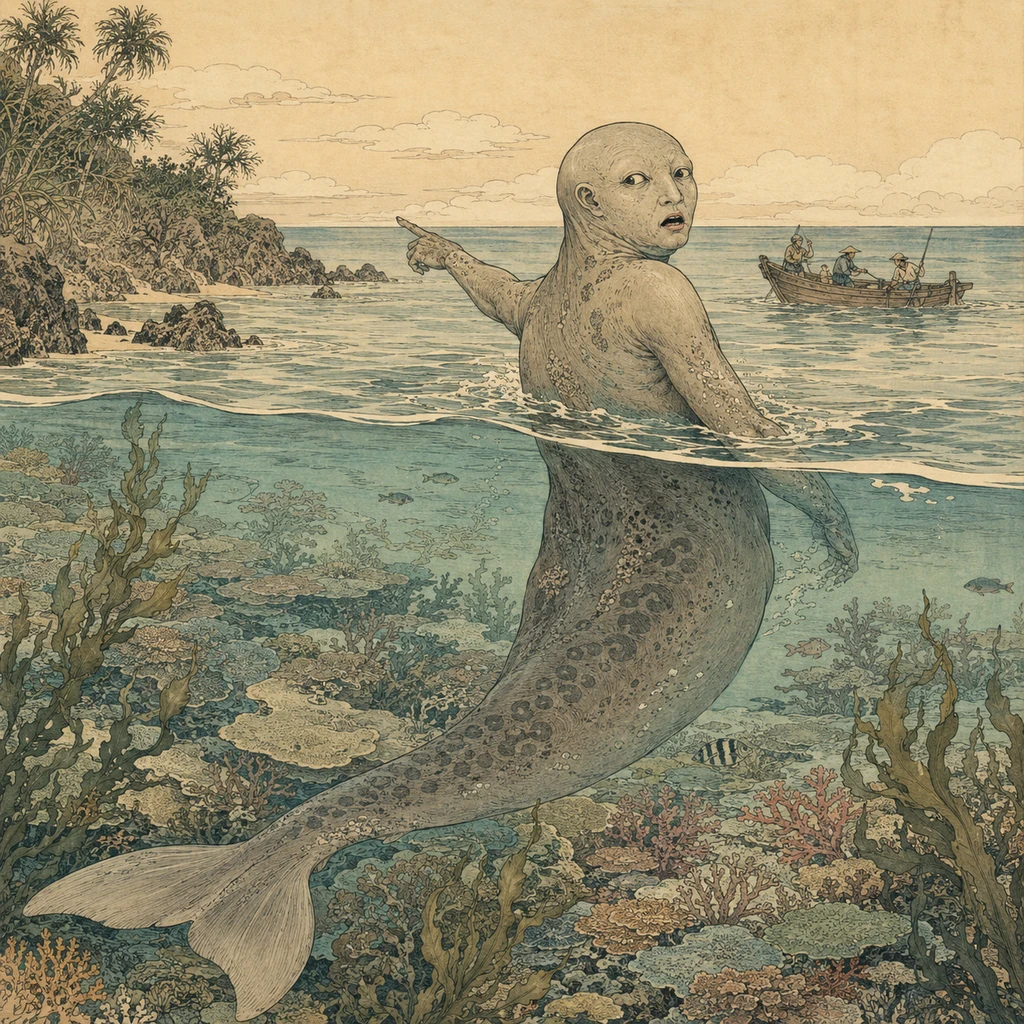
Zan is a mermaid-like sacred creature said to inhabit the seas of the Ryukyu Arc. In local speech it is also called Zanu or Zano. The figure is generally understood to have grown from encounters with the dugong, a real marine mammal long revered as a messenger of the gods from Yaeyama to Amami. Some descriptions give Zan the beautiful upper body of a woman and the lower body of a fish. It is gentle and does not seek to harm people. When caught in a fisher's net, it weeps and pleads for its life; if released, it repays that mercy by warning its rescuer of danger at sea. Zan is not a raging monster but a guardian that stands on the side of life, giving human beings time to escape a disaster they cannot yet see.
Read moreThe mermaid Zan, a deified dugong, appears in the seas of Yaeyama. When a fisherman caught a Zan in Nosoko Village on Ishigaki Island, the Zan shed tears and begged for its life; as thanks for being released, it warned, "A tsunami is coming soon, flee to the mountains." The people of Nosoko who believed this fled to the mountains and were saved, while the neighboring village that did not believe it was swallowed by the tsunami and destroyed ── this is the memory of the Great Yaeyama Tsunami of Meiwa in 1771 sublimated into a prophecy tale of a sea beast. The dugong is a real marine mammal, called "Zan" or "Zanu" in Ryukyu and considered a messenger of the gods; its meat was prized as an elixir of youth and longevity and presented to the Ryukyuan kings. Its figure, grazing on seaweed and occasionally raising its upper body above the sea surface, is thought to have given birth to the mermaid legends. Dugongs in the waters near Okinawa have now decreased in number to the point of being critically endangered, and the messenger of the gods that once heralded tsunamis and saved villages has now switched to the side needing protection by human hands.
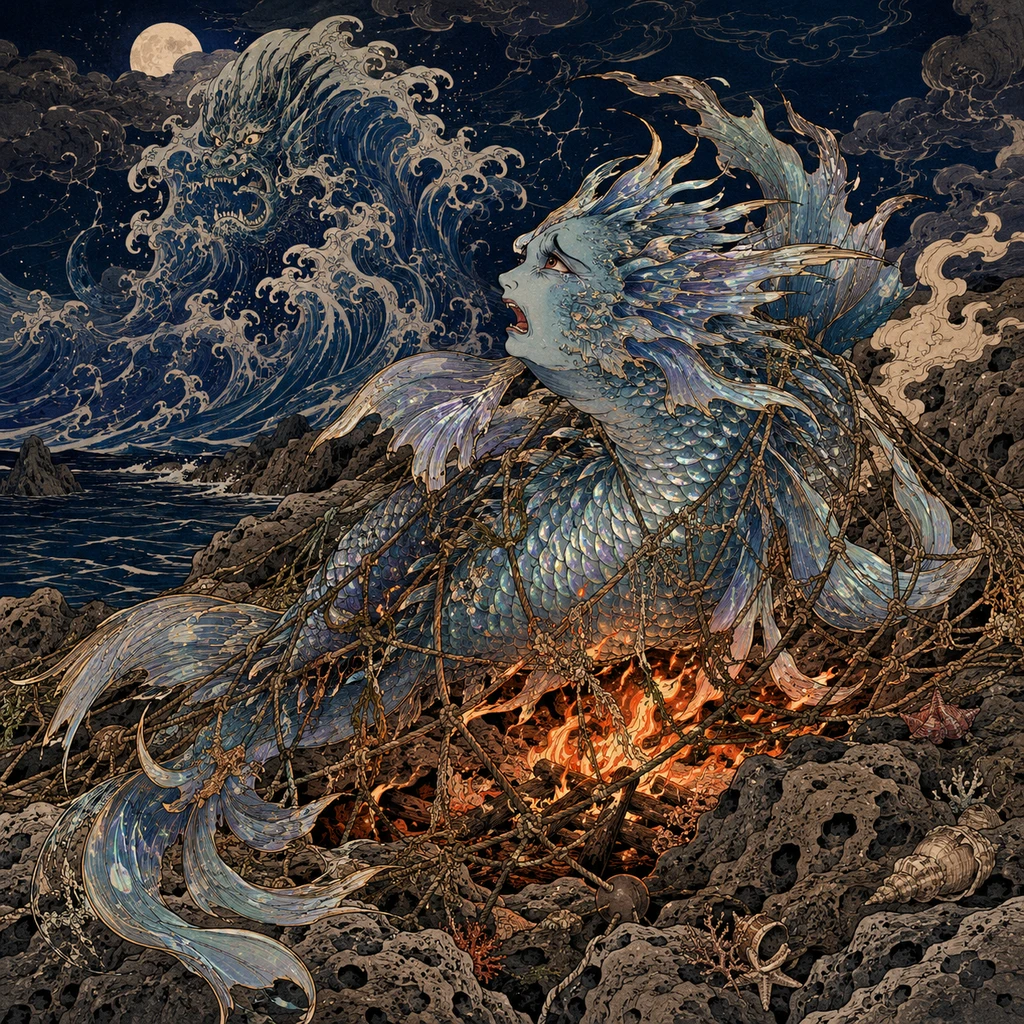

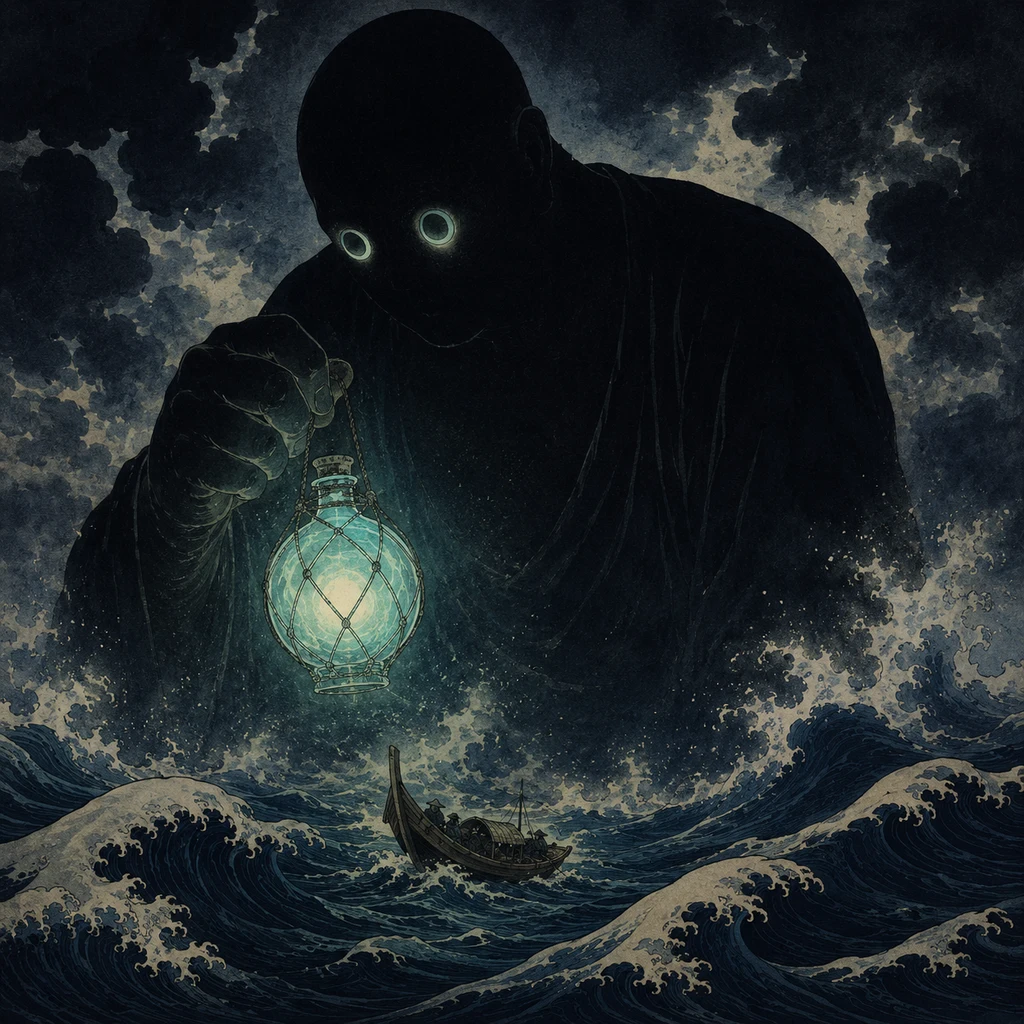
Even concerning the same memory of a tsunami, the Yonatama[4] passed down on Shimoji Island in Miyako stands in complete contrast to the Zan. On the night a fisherman caught this sea spirit and was about to roast it over a net, a voice called from the offing, "Yonatama, why do you not return?" The Yonatama replied, "I am being roasted by fire and cannot move. Cause a tsunami and come get me." Immediately after a mother and child who heard this voice fled to Irabu Island, a massive tsunami swallowed Shimoji Island. It is said that the sunken ruins of the fisherman's house became the present-day "Tori-ike" (Passage Ponds). Tori-ike remains today on Shimoji Island as two side-by-side ponds, connected underground to the sea. Local historian Kenshiku Inamura interpreted Yonatama as "Yona (sea) + Tama (spirit)," meaning a sea spirit, and Kunio Yanagita also wrote about this sea spirit in his autobiography *Seventy Years of My Hometown*. The roasted monster asks its companions offshore for help, and a tsunami comes in response ── narrating the fury of nature as an emotional exchange between sea creatures reveals the islanders' awe and familiarity with the sea. The savior Zan, and the roasted, cursing Yonatama ── the monsters of the sea became either guardian deities or disasters depending on human behavior. The Great Tsunami of Meiwa, remembered by both Zan and Yonatama, was an unprecedented disaster that struck Yaeyama and Miyako in 1771, reportedly causing over ten thousand deaths on Ishigaki Island alone. Giant boulders washed ashore by the tsunami, "Tsunami Stones," still dot the coastline today, and that memory has been passed down in the form of stories about prophecies by sea beasts or sea spirits. On the shores, there were also tales of the Iso-onna (shore woman), who sneaks aboard via the stern mooring rope, covers her victim with her long hair, and sucks their blood, and the Umi-bozu (sea monk), appearing as a slimy black shadow on the night sea, trying to drag people in.
Fire and Mud ── Monsters and Demons of the Remote Islands
Leaving the main island and crossing to the islands of Miyako and Yaeyama, the monsters take on an even deeper local color.
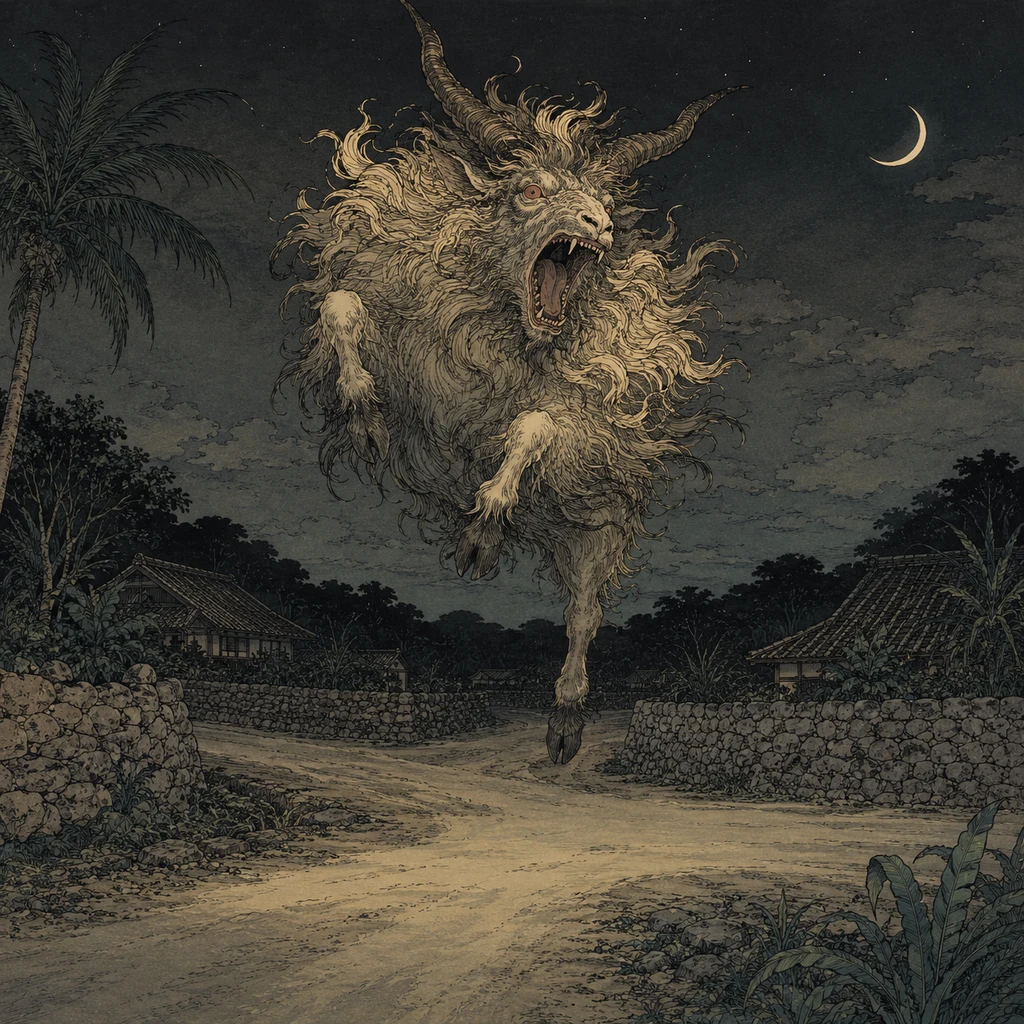
Kataashi-pinza
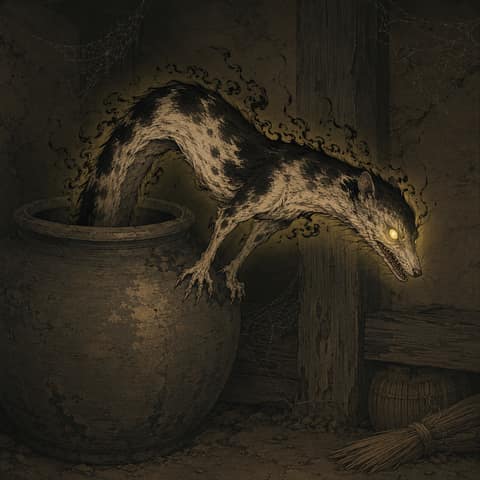
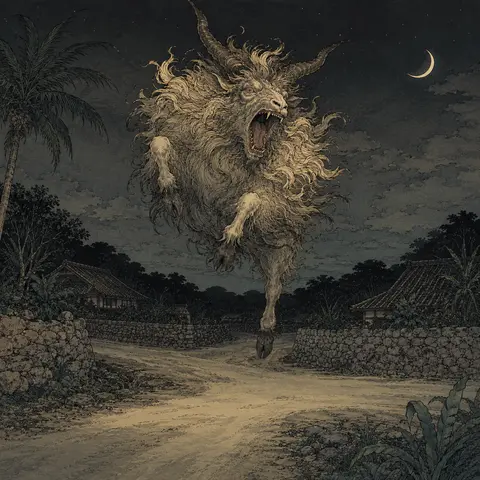
The Kataashi-pinza is a type of *majimun* (an Okinawan folkloric spirit or monster) native to Miyako Island, taking the form of a goat with only a single hind leg. The word "pinza" means "goat" in the local Miyako dialect. According to legend, it appears at deserted crossroads (*yumata*) late at night. As it approaches, its front hooves strike the ground with a sharp "gan" sound, while its solitary hind leg drags along with a grinding "guri-guri" noise. Suddenly, it lets out a terrifying shriek and leaps clean over the head of whoever happens to be passing by. It is deeply feared by the islanders, as anyone who is jumped over by the creature will have their *mabui* (soul) snatched away, leaving them bereft of their senses or even dead.
Read moreAt a crossroads in the urban area of Miyako Island, locally called "Ganguriyumata," it is said that the One-Legged Pinza, a goat yokai with only one hind leg, appears. "Pinza" means goat in the Miyako dialect. It appears making a "gan" sound with its front legs and a "guriguri" sound with its hind leg, letting out a terrifying scream as it leaps over a person's head. Those leaped over were said to have their soul (Mabui) extracted, going mad or dying ── this is the most vivid manifestation of the Okinawan taboo that if an animal Majimun passes under your crotch, your soul will be stolen. As for why it has only one leg, various theories are told: it was abused, it fled from being eaten, or it failed a landing. In Okinawa, the soul is called "Mabui," and it was believed that a strong shock or fear causes one to "drop their Mabui," leading to absentmindedness, fever, and wasting away. The reason those leaped over by the One-Legged Pinza go mad is also said to be because this Mabui was stolen, and a "Mabuigumi" ritual by a *yuta* was necessary to call back the fallen soul.
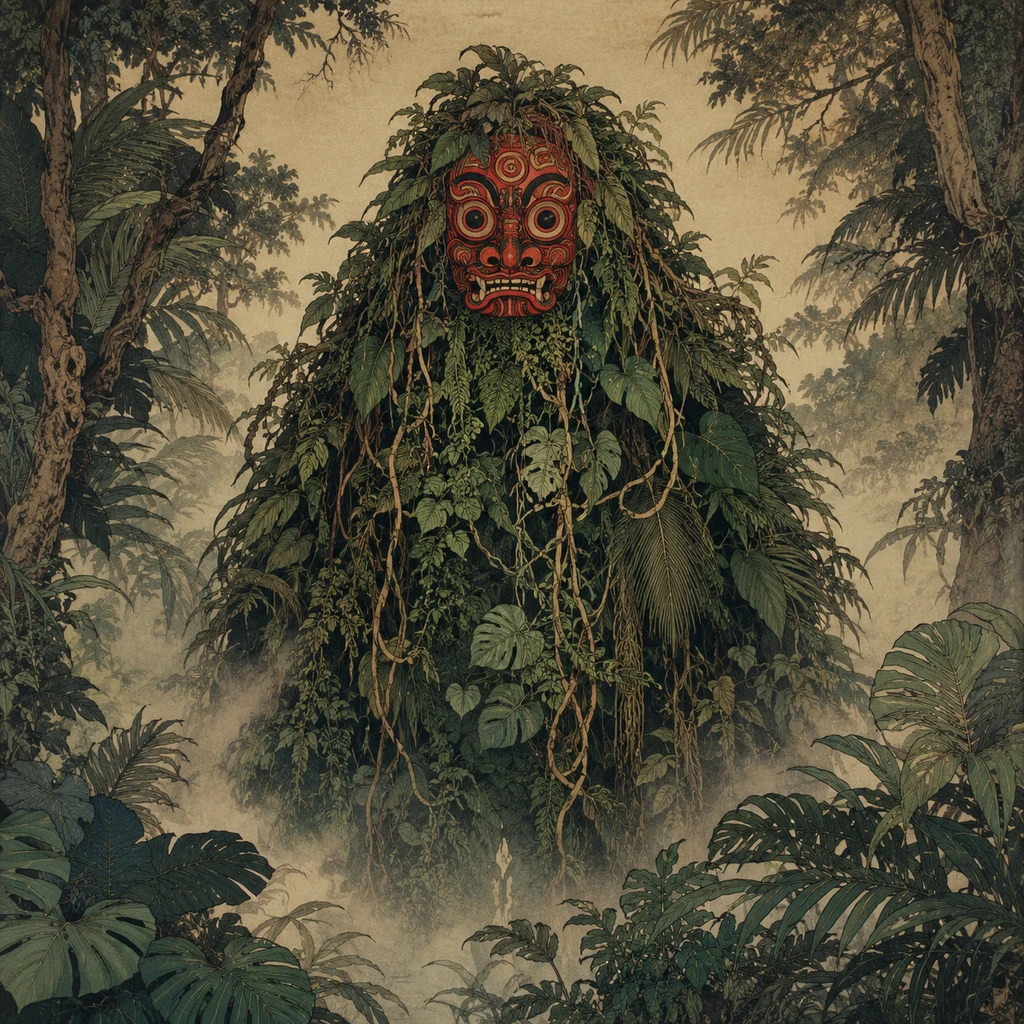
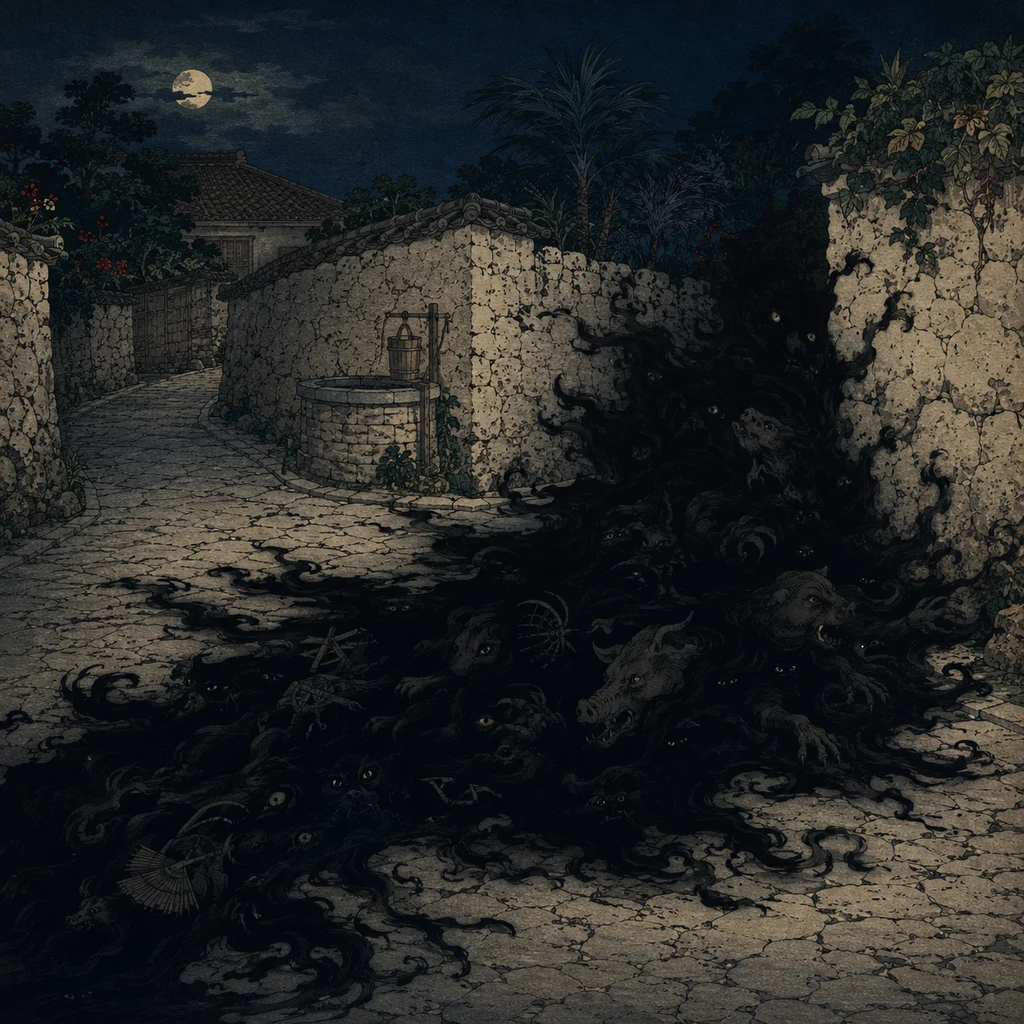
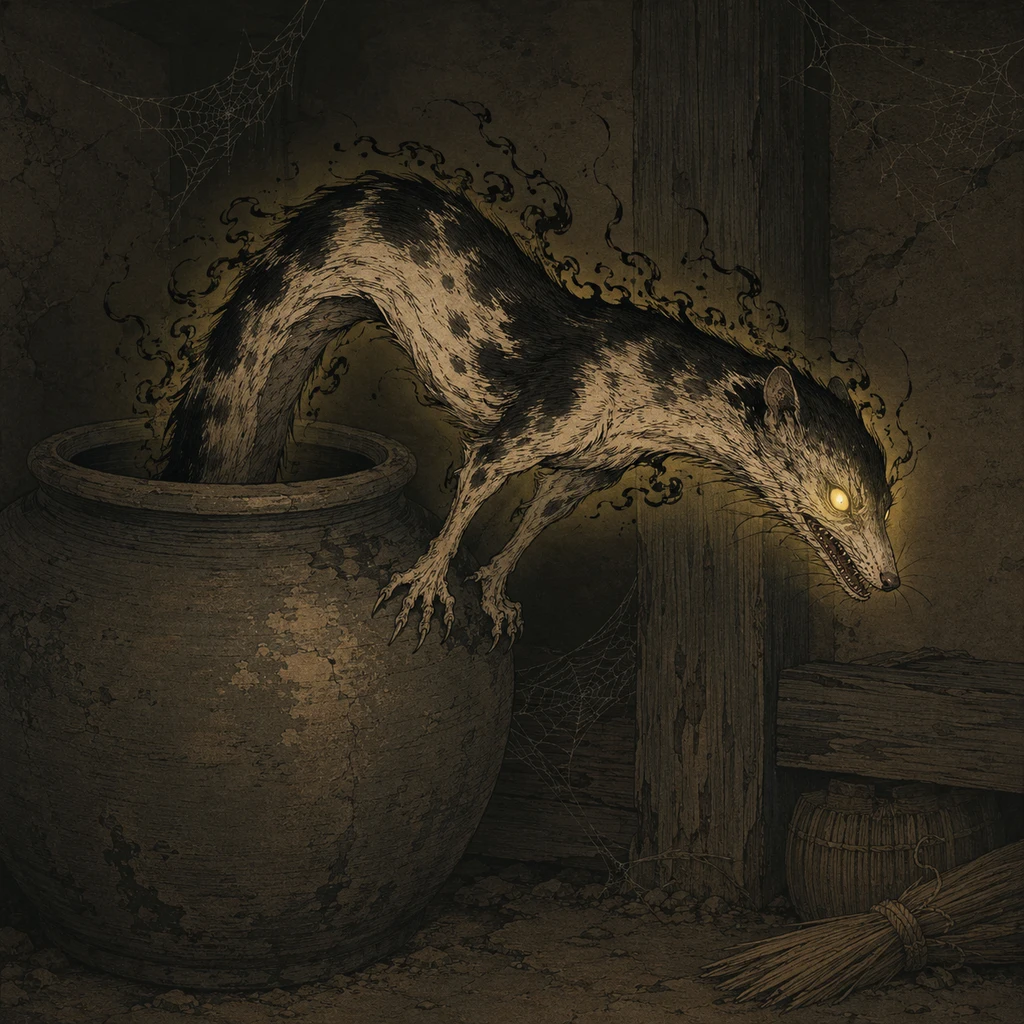
In Okinawa, monsters that threaten people are collectively called Majimun. "Maji (demon) + mun (thing)," meaning a demonic thing. They appear on night roads in familiar forms such as pigs, babies, cows, or chickens, and it is said that if they pass under a person's crotch, they extract the soul, which is why the admonition to "never let an animal or Majimun pass under your crotch" is passed down throughout the islands ── when discussing Okinawan yokai, this "crotch-passing" taboo is an indispensable core. A characteristic of Okinawa is that familiar livestock and creatures turn into Majimun, such as the Akanguwa-Majimun crawling as a baby, or the Uwa-guwa-Majimun in the form of a pig. The Akamata is a real, two-meter-long snake that preys on habu vipers, and the yokai of the same name is said to be the monstrous transformation of that reddish-brown giant snake. Every night, it transforms into a beautiful young man to visit a young woman ── it is known for the "snake groom" tale where the woman sticks a threaded needle into the hem of the young man's kimono, and following the thread the next morning leads to a snake hole. The visited woman conceives a snake child, but on the 3rd day of the 3rd month of the lunar calendar, she goes down to the beach, steps in the tide, and washes the child away to purify herself ── this is told as one of the origins of the Okinawan annual event "Hama-uri" (Going down to the beach). The plot of exposing the true identity of a heterogeneous groom visiting nightly with a needle and thread is the same "snake groom" motif as the mainland's Mount Miwa legend (the snake body of Omononushi-no-Kami), but while mainland snakes tend toward divine marriage, the Okinawan Akamata grounds itself in exorcism and an annual event, showing its regional color. The idea of returning the child to the sea to purify the disaster while fearing the snake resonates with the Southern Islands' view of the otherworld, which sees beyond the sea as the source of life. There are also monsters born from the human heart, such as the Ichijama, a living wraith turning hatred into curses, or the Inugami, using dog spirits. Hama-uri is still an annual event held on the 3rd day of the 3rd month of the lunar calendar, where women and children go to the beach to gather shells and purify themselves ── the story of the Akamata washing away the snake child is tied to its origin. Even tools were said to become Majimun, such as the Mishige-Majimun formed from old rice paddles and ladles, or the Gan-Majimun where a funeral palanquin (*gan*) turns into a cow or horse, and at night crossroads, some appeared to bewilder people and make them eat dirt or tide water. Confronting these, calming them, or calling back stolen souls to return them to the human world was the role of the *yuta*'s prayers.
The Universe of Niraikanai ── Utaki and Noro/Yuta
To understand the yokai of Okinawa, one must know the structure of the faith behind them.
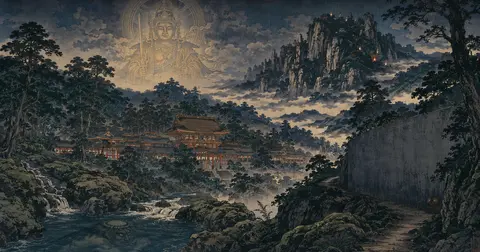
This system, called Ryukyu Shinto or Utaki faith, has no founder or scriptures. At its core is the otherworld beyond (or beneath) the sea, Niraikanai[5]. From there, gods visit at the beginning of the year to bring bountiful harvests, and return at the end of the year. The souls of the living also come from there, and the souls of the dead depart to there. While the mainland's "Yomi" or "Tokoyo" were placed underground or beyond the mountains, the Ryukyuan otherworld exists beyond the horizontal sea ── this horizontal view of the otherworld is precisely the root of the visiting god faith and the Niraikanai traditions. The *utaki* is the sacred forest that welcomes those gods; it is a space with no shrine buildings or divine statues, merely a grove of trees, a spring, or an incense burner (*ukooru*), where the god is said to descend. Every village has an *utaki*, and deep within it is the most sacred place called the "Ibi," where humans are forbidden to enter. This form, which makes nature itself the sanctuary rather than buildings, is fundamentally different from mainland Shinto shrines and is the prototype of Ryukyuan prayer.
It was the women who communed with the gods. The Ryukyu Kingdom adopted a system of unity of religion and state, and women, led by the king's sisters, became the divine women (*noro*) presiding over regional rituals. At their apex stood the highest divine woman of the state, the Kikoe-ogimi. Meanwhile, in the indigenous folk society, there were *yuta*, shamans who listened to the voices of the dead and ancestral spirits and responded to the consultations of individuals and families. As the saying "Half doctor, half yuta" suggests, *yuta* were deeply involved in the life, death, and illnesses of the common people, but they were often suppressed by the royal government. The "Mabuigumi" ritual to call back a soul (Mabui) stolen by a Majimun is also the domain of these female priestesses. The inauguration ritual of the highest divine woman Kikoe-ogimi, the "Oaraori," was held at Sefa Utaki, the kingdom's highest sacred site. In this sanctuary forbidden to men, it is said the Kikoe-ogimi received the spiritual power of Kinmamon, spiritually guaranteeing the reign of the new king. It was the power of women that connected the god and the king, and for the village *noro*, too, it was the woman's role to welcome the gods from beyond the sea and mediate the voices of ancestral spirits. Fearing yokai, welcoming gods, repairing souls ── all these practices were entrusted to the hands of women. Sacred sites like Sefa Utaki and Kudaka Island continue to be living places of prayer for the people of Okinawa today.
The Islands That Crossed Over ── Okinawa Reflected in Yokai
Such monsters are not relics of the past. Even today in Okinawa, people brace themselves on night roads so animals won't pass under their crotches, they exorcise disasters when building a house, and if someone is depressed, they worry, "Did they drop their Mabui?" The Kijimuna is beloved as a character for tourism and souvenirs, there are books collecting yokai tales and ghost story events in various places, and Shisa dogs ward off demons (Majimun) from rooftops. The lifestyle of fearing yokai, appeasing them, and sometimes loving them, while gradually changing its shape, still breathes in the daily life of the islands today.
Piercing through the yokai of Ryukyu are the two themes of "Arrival" and the "Otherworld."
Amamikiyo crossed the sea to create the islands, and Kinmamon, Paantu, and Akamata-Kuromata visit from Niraikanai to exorcise misfortune. Both Zan and Yonatama herald the omen of tsunamis from beyond the sea. The Kijimuna of the banyan trees and the Bunagaya of Yanbaru are spirits nurtured by the environment unique to the Southern Islands: the subtropical evergreen broadleaf forests. The old banyan tree, drooping its aerial roots and spreading its branches widely, itself possesses a presence like an entrance to another world, and the imagination that a red-haired child lives there seems quite natural to those who know this tree. On these islands with neither snow nor coniferous forests, instead of the Yama-uba and Yuki-onna of the mainland, the spirits of the sea, coral, and banyan trees became the residents of imagination. While the yokai of the mainland developed in connection with Buddhism, Onmyodo, and samurai tales, the monsters of Okinawa achieved an entirely different evolution amid the religion of an independent kingdom and a geography open to the sea.
In his later years, Kunio Yanagita, inspired by coconuts washing ashore on the mainland via the Kuroshio Current, wrote in *The Sea Road* that perhaps rice, cowrie shells, and even the ancestors of the Japanese people themselves came north across the southern seas. Although academically it is but one hypothesis, if a part of Japanese culture truly crossed the southern seas, the gods and yokai of these islands might be the existences that best preserve the old memories Yamato (mainland Japan) has forgotten. The sense of seeing the otherworld beyond the sea, women bringing down gods, and spirits dwelling in trees connects to the oldest stratum of faith before mainland Shinto and Buddhism covered it. Bracing oneself so Majimun won't pass under the crotch, washing away the snake child at Hama-uri, venturing into the mountains to see the Bunagaya fire, having a *yuta* repair a Mabui ── the yokai of Okinawa, even today right next to people's daily lives, connect the sea, the forest, and the world of ancestral spirits. It is a voice echoing from the deepest layer of another Japan different from Yamato, and the shape of the unbroken prayers of these islands that have lived looking up at the other side of the sea.