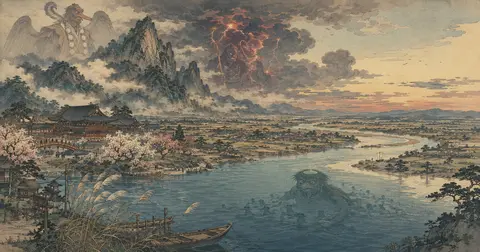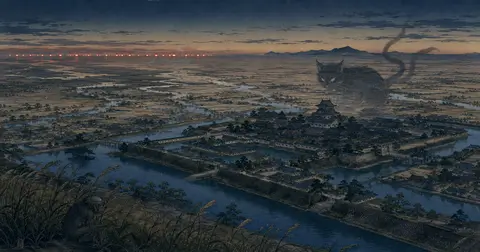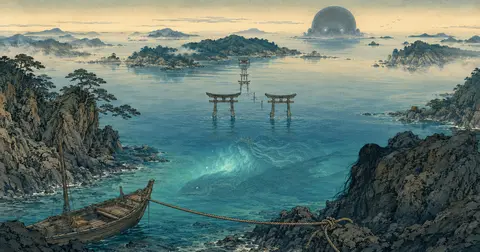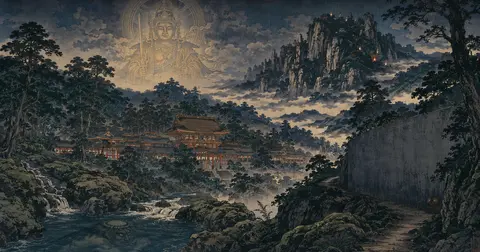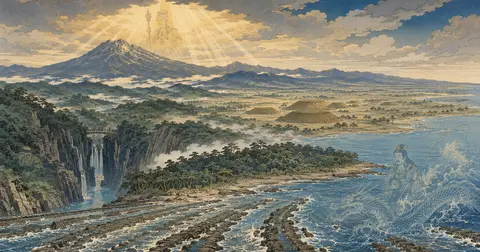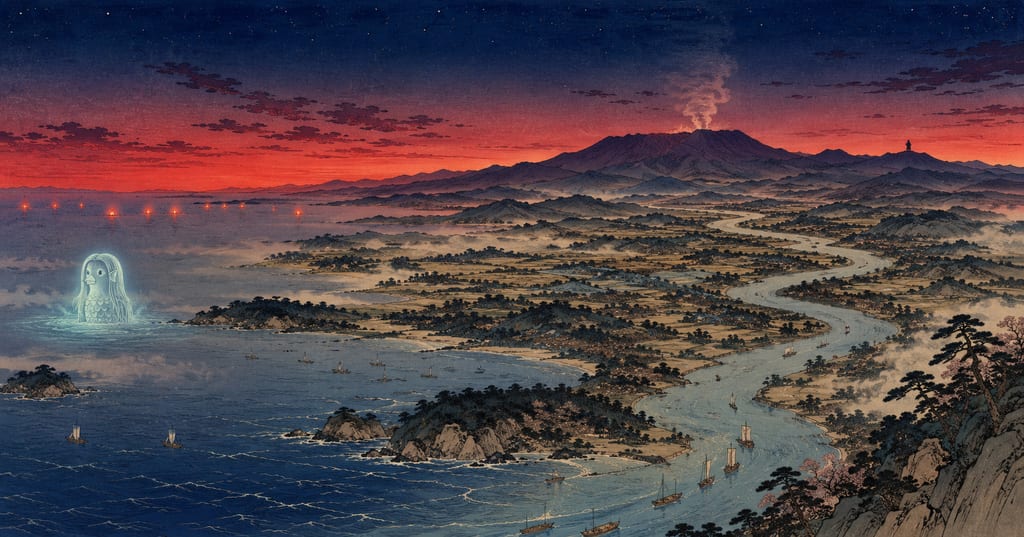
The yokai of Higo (present-day Kumamoto) have long coexisted with water. The Kuma River, counted among Japan's three most rapid rivers, has carved deep valleys and a vast estuary; the Ariake and Yatsushiro (Shiranui) Seas boast expansive tidal flats; and the Aso caldera holds an immense reservoir of groundwater and springs. Though known as the "Land of Fire," this region is equally a "Land of Water." Where there is water, there are kappa. Kumamoto is arguably the strongest stronghold of kappa worship in Japan. In its seas, prophetic beasts emerge to foretell plagues, while upon the fiery peak of Mount Aso rests a fierce demon, struck down only to be enshrined as a god. A yokai is nothing less than the crystallized form of a land's nature and history. Journeying from the mouth of the Kuma River to the crater of Mount Aso, let us trace these entities dwelling between water and fire to see what kind of imagination the province of Higo has nurtured.
In fact, the ancient name "Land of Fire" (Hi no Kuni) itself was born from a mysterious spectral flame called the Shiranui that appears over the dark sea. In this province, yokai are not mere superstitions pushed to the margins of daily life; they are deeply woven into the center of history as the origins of place names, festivals, and local heritage. A monument marking the kappa's arrival stands, a sacred fire continues to burn at Shimo Shrine, and people still await the Shiranui along the Yatsushiro coast. To speak of these apparitions is to speak of the land of Higo itself.
Where the Kappa Landed — The Kuma River and Kyusenbo
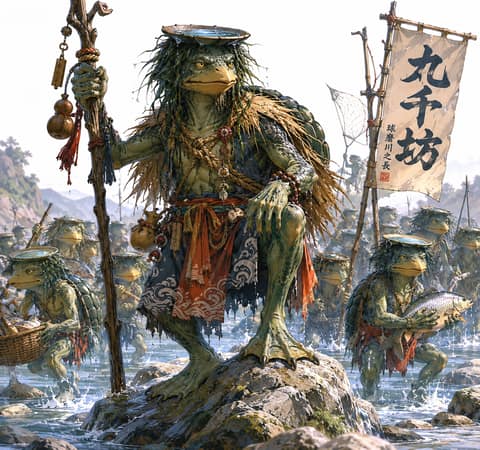
To speak of the kappa in Kumamoto, one must begin with a tale of an oceanic crossing. The mid-Edo period gazetteer, Senryo Kikuoka's *Honcho Zokugenshi* (1746), records that a clan of kappa navigated the ocean from a great river in mainland China, eventually settling at the mouth of the Kuma River in Yatsushiro, Higo Province[1]. Over time, the kappa multiplying in the river reached nine thousand in number, and their leader came to be known as Kyusenbo. The landing site, Tokubuchi in Yatsushiro, was a major gateway to the Yatsushiro Sea during the Middle Ages, serving as a bustling natural port where ships from the continent and southern lands arrived. It is only natural that a story of strange beings arriving from across the sea would rise from the memories of this port.

Kappa
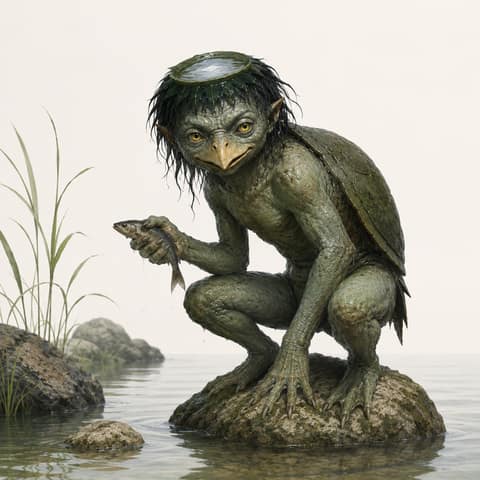
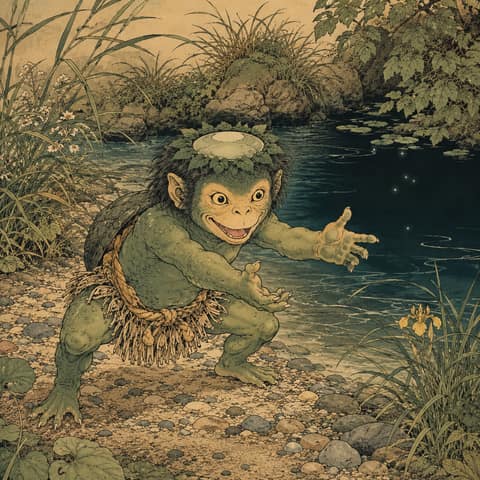
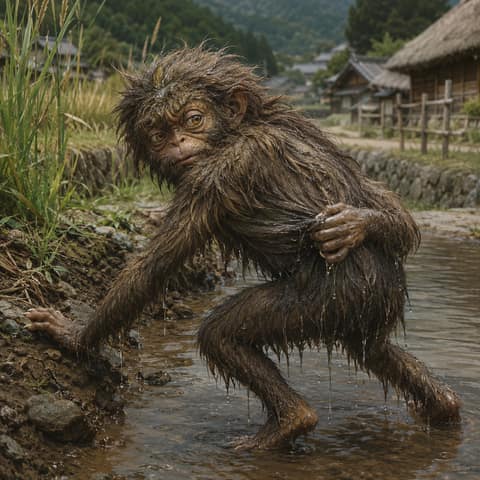
The kappa is among the most famous of all Japanese yokai, said to dwell wherever there is water—rivers, ponds, and marshes alike. It stands about the height of a four- or five-year-old child, with a water-filled dish (sara) set into the crown of its head, a shell on its back, a beak for a mouth, and webbed hands and feet. Its body is greenish or reddish in hue and is sometimes described as smelling fishy. That dish on its head is the very source of its power: should the water spill or dry out, the kappa is believed to lose its strength at once. From this came the well-known trick of bowing deeply to a kappa so that, returning the courtesy, it tips the water from its dish and can be caught. The kappa has two faces. One is fearsome—dragging people and horses into the water and taking their lives. The other is dutiful—keeping its promises faithfully, delighting in sumo, and sometimes passing on miraculous bone-setting remedies. Found across the whole country, it goes by more than eighty regional names: Garappa, Medochi, Enko, Hyosube, and many more. Among all the yokai of Japan, few are so deeply rooted in local life.
Read moreAt the foot of the Maekawa Bridge in Honmachi, Yatsushiro City, stands the "Monument to the Kappa's Arrival." Erected in 1954, it consists of two "Garappa Stones." The legend goes that a captured kappa swore upon these stones that "until this stone wears away, I will do no harm to humans or horses," and in exchange, pleaded for an annual festival. The local river festival's chant, "Ore-Ore-Deraita," is popularly believed in the region to be a corruption of "Many people have arrived from the land of Wu (Kure)," though its exact meaning remains unknown. At the Goshinji Shrine in Tokubuchi, an entirely different legend tells of a monk who founded the temple driving away a mischievous one-armed kappa. Even today, a river festival involving children taking their first swim is held in early summer. The kappa pull out a person's *shirikodama* (a mythical organ in the anus), love cucumbers, and challenge people to sumo wrestling. In Higo, these universal kappa traits have been passed down under the names "Garappa" or "Gawappa." The "horse-pulling" motif—where a kappa attempts to drag a horse into a river but fails, is captured, and is forced to write a letter of apology—is also deeply rooted in this land of water.

Kyūsenbō
Kyūsenbō (also Kusenbō) is the legendary grand chief said to command every kappa of Kyushu. According to the Edo-period Honchō Zokugenshi, he was a kappa who led his clan across from the Yellow River in China, came ashore at Yatsushiro in Higo, and settled on the Kuma River; because the clan grew to nine thousand, its headman took the name Kyūsenbō (“nine-thousand boss”). In form he is no different from an ordinary kappa, bearing no strange shape of his own. What sets Kyūsenbō apart is not his looks but his standing as the chief who governs nine thousand kappa across Kyushu. He holds power enough to trouble a whole province, yet is helpless before the monkey, the kappa’s natural enemy — the kappa’s twofold nature, at once formidable and fearful, writ large at the scale of a whole clan. He is known, too, for a tale of reform: later he moved to the Chikugo River and turned from a man-harming demon into a familiar of the water-god, guarding people against flood.
Read moreThe legends detailing Kyusenbo's subsequent fate span beyond Kumamoto. There are two variations of his feud with Kato Kiyomasa, the ruler of Higo. The first is the "monkey hunt" version, where Kiyomasa gathered monkeys—the kappa's natural enemy—from all over Kyushu to launch an all-out attack. The second is the "drowning of the page" version, wherein Kiyomasa's beloved page was dragged into the river and drowned, prompting the furious warlord to seal off the river and poison the water. Regardless of the version, the ousted Kyusenbo abandoned the Kuma River and relocated to Tanushimaru in Kurume, along the Chikugo River. The Arima clan, lords of the Kurume Domain, permitted him to reside there on the condition that he "cause no harm to humans or livestock." In return, Kyusenbo vowed to become a familiar of the Kurume Suitengu Shrine, pledging to protect the domain's people from floods. It is important to note that Kyusenbo is not the main deity of Suitengu, but rather its servant and familiar. The king of kappa, born in Higo, traveled downriver to another province and was ultimately elevated to a messenger of a water god. It is exceedingly rare for an ousted, defeated yokai to end up as a divine familiar in a foreign land. Kyusenbo's legend demonstrates the exceptionally high status afforded to Kumamoto's kappa in local folklore.
Why is Higo the Stronghold of Kappa?
Among the many provinces of Japan, why did Higo become a land so overflowing with kappa? The answer lies in the region's immense wealth of water. The Kuma River, counted alongside the Fuji and Mogami as one of Japan's three most rapid rivers, flows violently through deep gorges before pouring into the Yatsushiro Sea. The rapids swallow people, the deep pools claim the drowned, and the memory of these water casualties formed the seedbed for the fear of water gods—namely, kappa worship. At Tokubuchi Port by the river's mouth, ships from the continent and southern regions came and went, providing the perfect geography to invite myths of "strange beings arriving from across the sea." Further west lie the vast tidal flats of the Ariake and Yatsushiro Seas, where ocean specters like the Shiranui and the Iso-onna rise from the mud and fog left by the receding tide. To the north stands Mount Aso; though a mountain of fire, its massive caldera stores an enormous volume of groundwater and springs, serving as the water jug that nourishes the Kumamoto plains. The Land of Fire was, in truth, a land with water coursing through its every vein.
Surrounded by water in this way, the kappa of Higo did not remain in a single form. In the river's deep pools, the mountain valleys, and the seaside villages—each waterfront housed kappa of different names and appearances. While living in the river, they are Garappa; when they enter the mountains, they become Yamarow; and if they drift in from neighboring Saga, they are known as Hyosube. The concept that the exact same clan changes its name depending on the location and season is an imagination unique to a land where water permeates every corner of the topography.
Migrating Between Rivers and Mountains — Garappa,
Yamarow,
and Hyosube
The kappa of Higo possess a remarkable custom rarely seen in other regions: a seasonal migration.
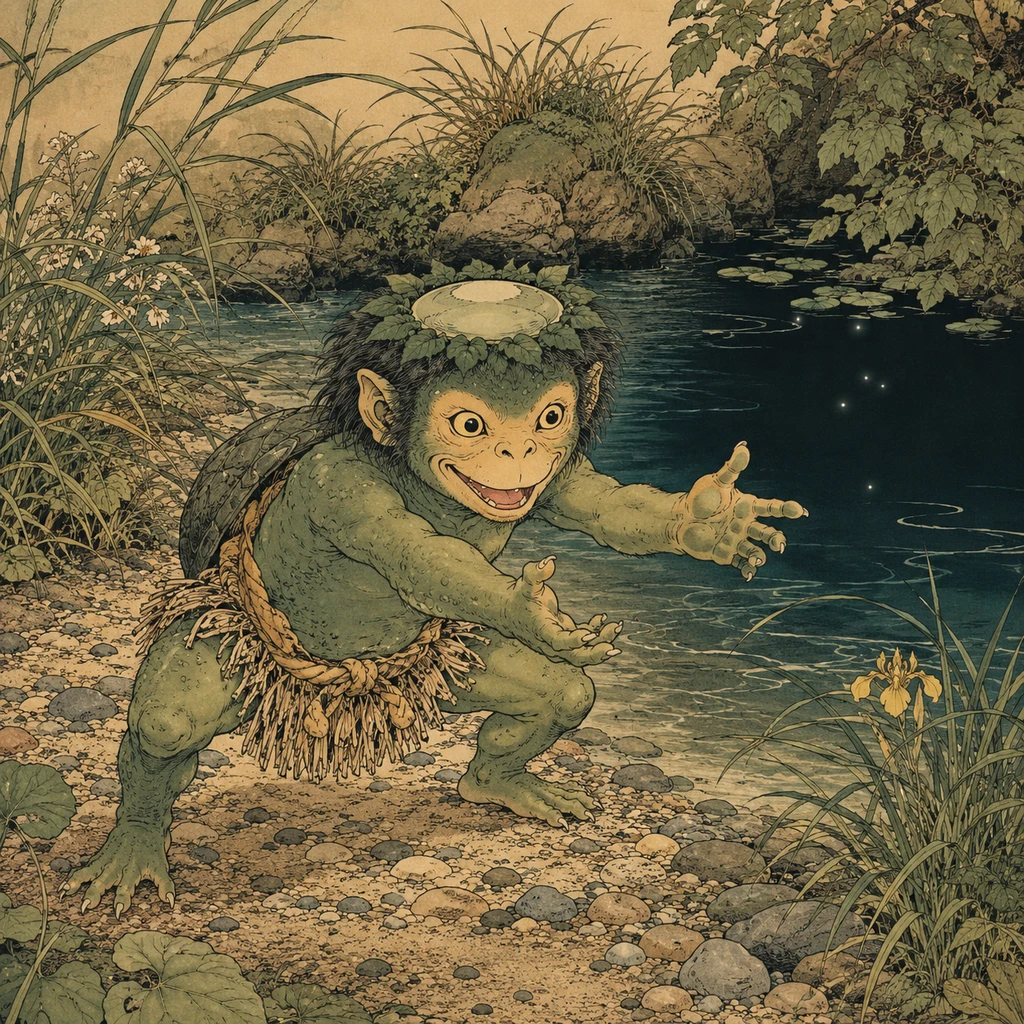


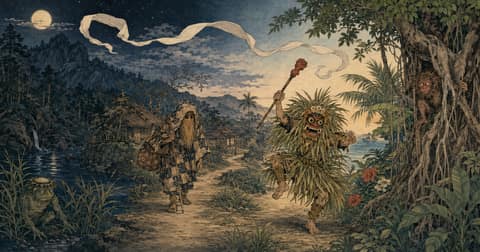
The Garappa, Kumamoto's term for kappa, live in the rivers during the summer, but during the autumn equinox, they retreat into the mountains to become Yamarow (mountain youths), only to descend back to the rivers during the spring equinox to revert to Garappa. The exact day of this transition varies intricately from place to place. In the Kuma District, it is said that "Kawan-taro" (river boy) and "Yaman-taro" (mountain boy) swap places on "Taro Tsutachi" (the first of February). In Yatsushiro and Minamata, they are said to travel between mountain and river on "Hi no Tsutachi" (the first of June). Folklorist Kunio Yanagita interpreted this nature of traveling back and forth between mountains and rivers as a reflection of the worship of the rice paddy god and the mountain god, who come and go according to the agricultural calendar. The kappa was not merely a water monster, but an entity intimately bound to the very seasons of rice farming.
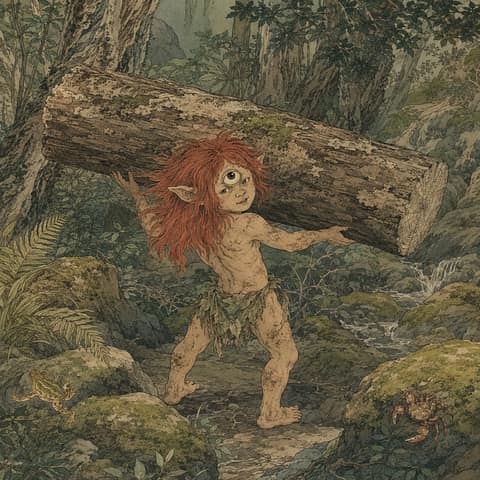
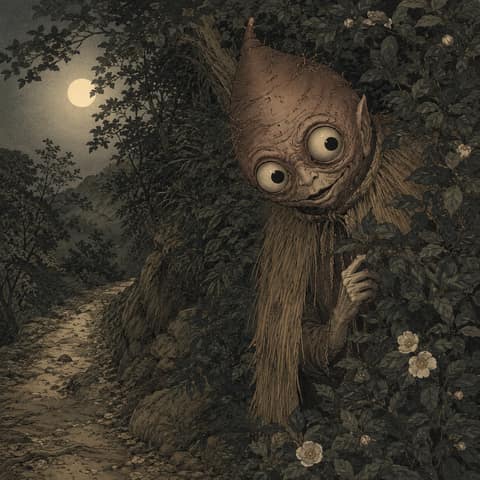
The Garappa that enter the mountains—the Yamarow—are widely spoken of from Ashikita, Kuma, and Aso in the Kyushu Mountains all the way to the Goto Islands, and are sometimes said to help woodcutters with their mountain labor. However, they always demand their promised reward of sake or rice balls in return; if given something different, they grow furious, and if paid in advance, they vanish without doing any work. In the Aso District, calling them "Yamarow" bluntly would anger them, so some areas respectfully called them "Seko." Their appearance is subject to various theories. The lineage of the *Wakan Sansai Zue* describes them as looking like a ten-year-old child covered entirely in long brownish hair, with a short torso, standing on two legs. However, some illustrated scrolls depict them as an aberration with long red hair hiding their eyes, pointed dog-like ears, and a single eye fixed in the center of their forehead.
Another relative of the Kyushu kappa is the Hyosube. This hairy, bald-headed yokai, who bares its teeth and cackles loudly, is distributed mainly in Hizen (Saga), but also in Higo and Miyazaki. It is said its name comes from its bird-like cry of "Hyo-hyo." Many legends attribute the kappa-like trait of migrating between rivers and mountains around the equinoxes to the Hyosube. Because they are extremely fond of eggplants, a custom emerged of offering the first eggplants of the harvest to them. Some theories suggest the name derives from the "hyozu" in "Hyozu-shin," an ancient imported deity. The frightening superstitions that "smiling back at a Hyosube will kill you" or "anyone who sees one will catch a high fever" seem to be popular misconceptions that spread relatively recently. The kappa, Garappa, Yamarow, and Hyosube—this clan that traverses between water and mountains while changing its name and form forms the very backbone of Higo's yokai world.
Prophecies from the Sea — Amabie and Amabiko
The sea of Higo is not merely a sea where monsters float. It is a sea that birthed a creature that foretells the future.
Amabie
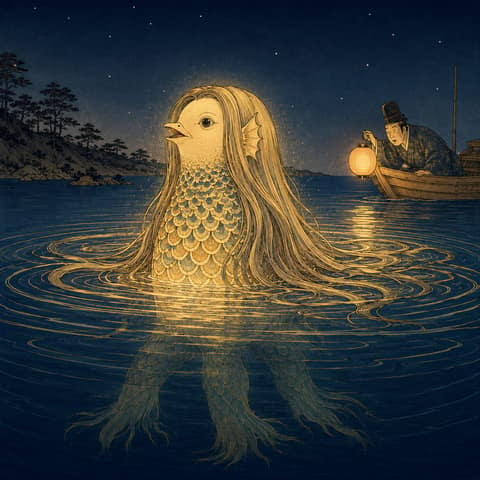
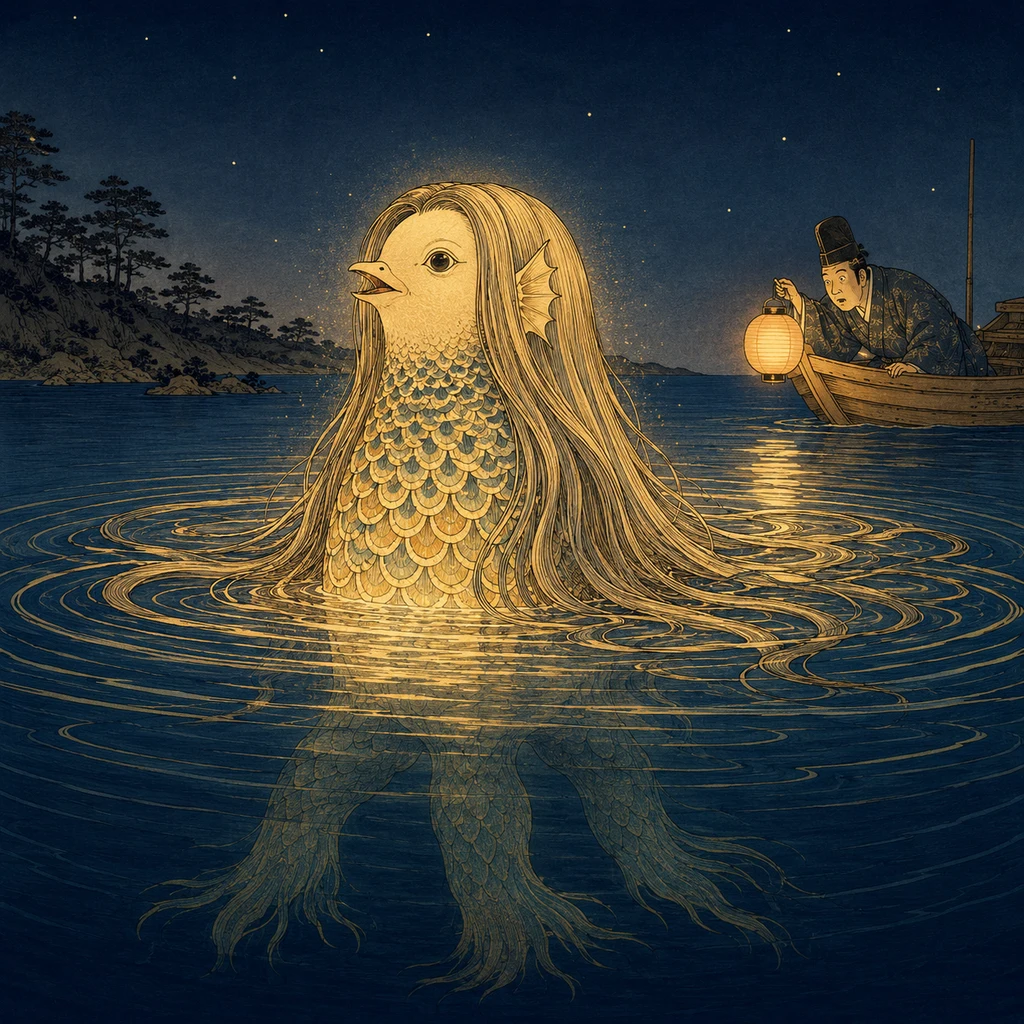
Amabie is a prophetic yokai said to have appeared in the sea off Higo Province in mid-April 1846. Its only known contemporary source is a single kawaraban held by Kyoto University Library; no parallel account from the period has been confirmed. According to the sheet, something shone in the sea night after night. When an official went to investigate, a creature appeared and announced, 'I am Amabie, a being who lives in the sea.' It foretold six years of abundant harvests across the provinces, together with an epidemic, and instructed people to copy its form and show it to others at once before disappearing beneath the water. The text describes its appearance only as 'like the picture.' In the accompanying image it has long hair, a beak, scales, and three leg- or fin-like appendages.
Read moreAround the middle of April in the third year of Koka (1846), a glowing object appeared every night in the sea of Higo Province. When an official went to investigate, the creature revealed itself, introduced itself as "Amabie," and delivered the following prophecy: "For the next six years, all the provinces will enjoy bountiful harvests. However, a plague will also spread, so quickly draw my image and show it to the people."[2] With those parting words, Amabie vanished into the sea. The *kawaraban* (broadsheet) that printed this story currently survives as a single existing copy in the Kyoto University Library. Its appearance—long hair, a beak-like mouth, covered in scales, and standing on three legs—is now known to everyone.
However, this single broadsheet is the only definitive historical document of Amabie. In 1999, yokai researcher Koichi Yumoto proposed the theory that this "Amabie" was originally a miscopy of "Amabiko" (尼彦, 天彦, or 海彦)—specifically, that the scribe mistakenly wrote the katakana "e" (ヱ) instead of "ko" (コ). In contrast, there are multiple broadsheet records of Amabiko, mostly depicting a creature that cries with a monkey-like voice and stands on three or many legs. The prevailing academic view today is that Amabie is merely a single surviving variant of Amabiko that coincidentally happened to have a fish-like appearance.


There are many other creatures possessing the prophetic and disaster-warding powers of Amabie. The Kudan, with the body of a cow and the face of a human, speaks prophecies of good and evil fortune in human language immediately after birth and dies within a few days—its prophecies are considered infallible, and pasting its image is believed to ensure family safety and ward off evil. There is also the Jinjahime, who appears in the sea claiming to be a messenger of the Dragon Palace to foretell good harvests and plagues, and the Himeuo, a human-faced fish that predicts misfortune. Within this lineage of creatures known as "prophetic beasts"[3], the Amabie, born from the sea of Higo, was resurrected nationwide—and indeed globally—during the 2020 COVID-19 pandemic. The Ministry of Health, Labour and Welfare adopted it as an icon for infection prevention awareness, and it even became the buzzword of the year. The monster that declared "show my image to the people" from the sea of Higo over 170 years ago thus appeared before the masses once again. A prophetic beast may very well be the shape of hope summoned by humanity in times of anxiety.
Spectral Fire and Sea Women — Shiranui,
Iso-onna,
and Funayurei
Beyond prophetic beasts, the sea of Higo flickers with ancient fires and harbors the shadows of women who abduct men.
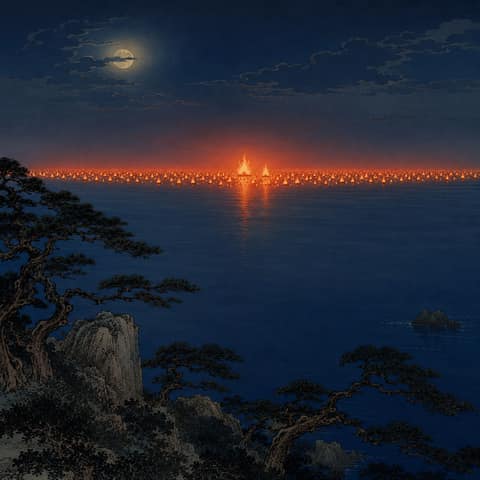
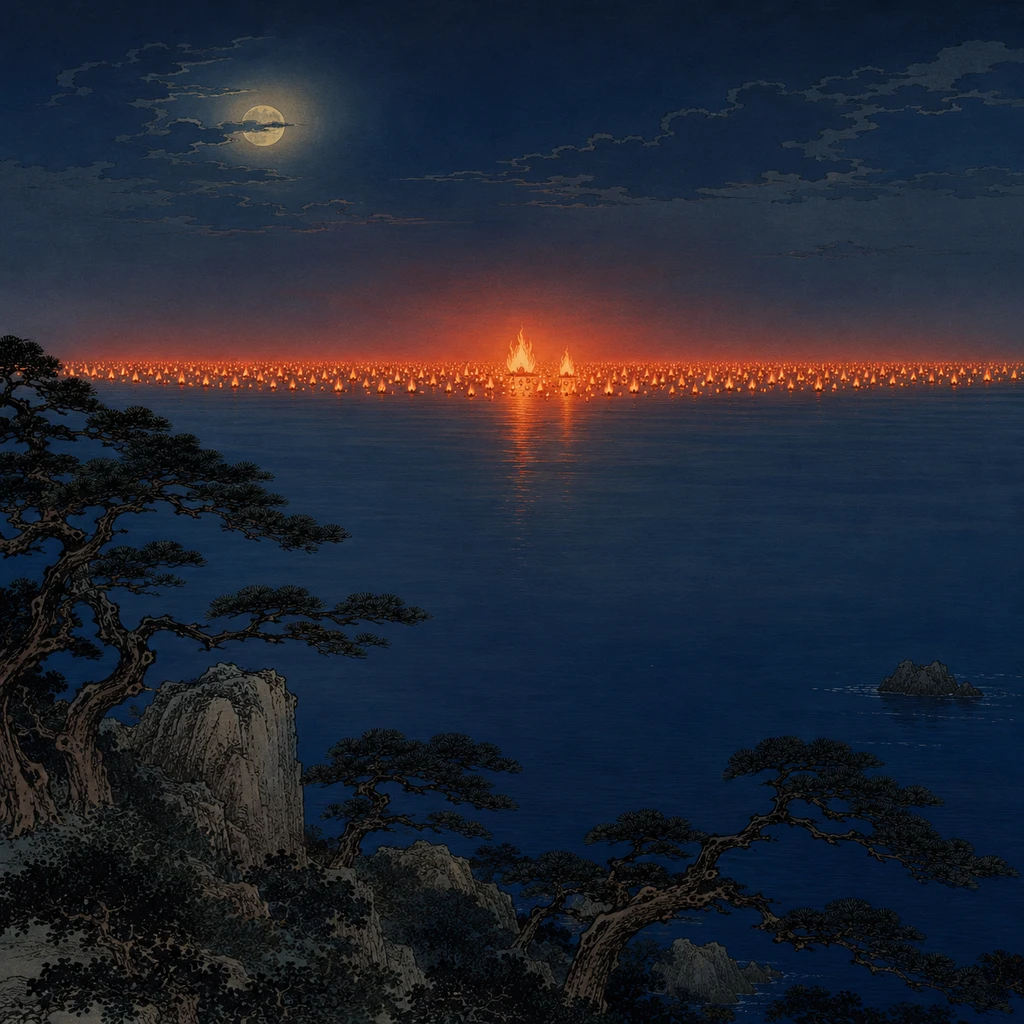
In the Yatsushiro and Ariake Seas, around the first day of the eighth lunar month, on moonless, windless nights, a mysterious fire appears. Initially, one or two "parent fires" ignite on the horizon, which then split horizontally and multiply, eventually forming a chain of hundreds to thousands of lights stretching for several kilometers. This is the Shiranui (unknown fire), and it is the reason the Yatsushiro Sea is called the "Shiranui Sea." The *Nihon Shoki*'s chronicle of Emperor Keiko records that when the Emperor set sail from Ashikita during his subjugation of the Kumaso and wandered in the dark sea, a fire appeared on the water, guiding his fleet safely to the shores of the Yatsushiro District[4]. When he asked who had lit the fire, no one knew, so he named it the "Shiranui" and bestowed upon this land the name "Land of Fire (Hi no Kuni)." People feared this fire as the lanterns of the Dragon God, and on nights when the Shiranui appeared, some fishing villages would cease all activity. The waters off the Uto Peninsula and the coast of Yatsushiro have been famous viewing spots since ancient times, where people would gather on the beach in the early hours of the eighth lunar month to await the Shiranui. Modern science explains this as a type of mirage, where fishing lights are abnormally refracted, split, and chained together by a layer of cold air over the tidal flats. Nevertheless, the fact remains that the very name of the Land of Fire was born from this spectral flame.
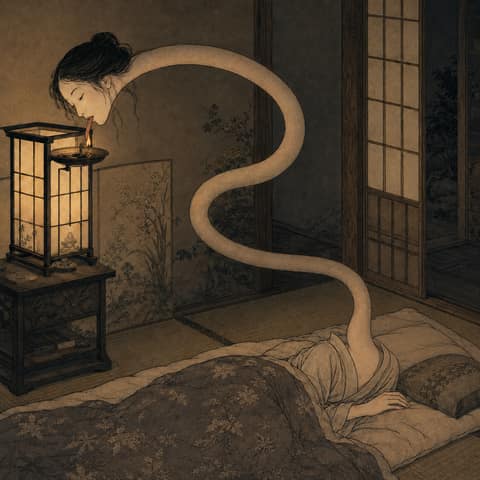
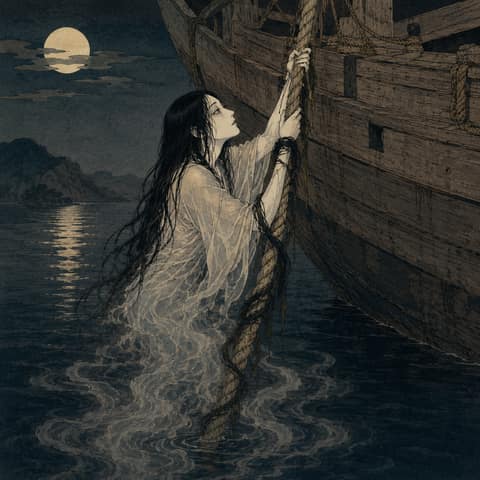
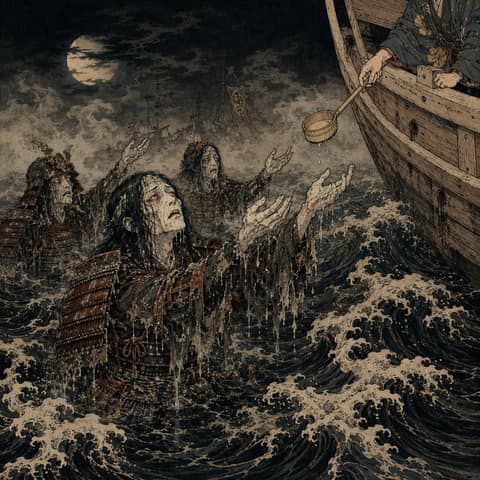
On the beaches of Amakusa, a different monster lurks: the Iso-onna (beach woman). At night, it is said the Iso-onna creeps onto boats anchored in the harbor by climbing the mooring lines at the stern. She drapes her long hair over the faces of sleeping sailors, drinking their blood through the hair until she claims their lives. Her upper half is that of a beautiful woman, but her lower half is either blurry like a ghost's or resembles a fish tail. Another theory claims she looks like a rock from behind. Fishermen believed that placing three stalks of miscanthus grass from their woven raincoats over their clothes while sleeping would protect them from her attacks. The archetype of a sea woman handing over a baby and pleading "please hold this child" is strongly associated with the Umi-nyobo of Izumo; the Iso-onna of Amakusa, however, is primarily known for this terrifying trait of sucking blood through her hair. Around ships sailing offshore, the Funayurei (ship ghost)—the spirits of shipwreck victims or the drowned—also appear. If one hands over the ladle they demand, the ghosts will scoop seawater into the boat until it sinks. Thus, the fishermen of Higo and Amakusa have passed down the survival tactic of handing them a ladle with the bottom knocked out.
The Savage God of the Fire Mountain — Kihachi of Aso
If water yokai shape the south and the vast seas of Higo, the towering Mount Aso to the north is the domain of fire and myth.
Kihachi
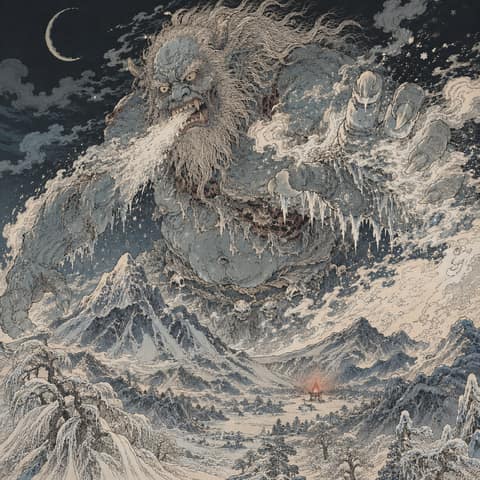
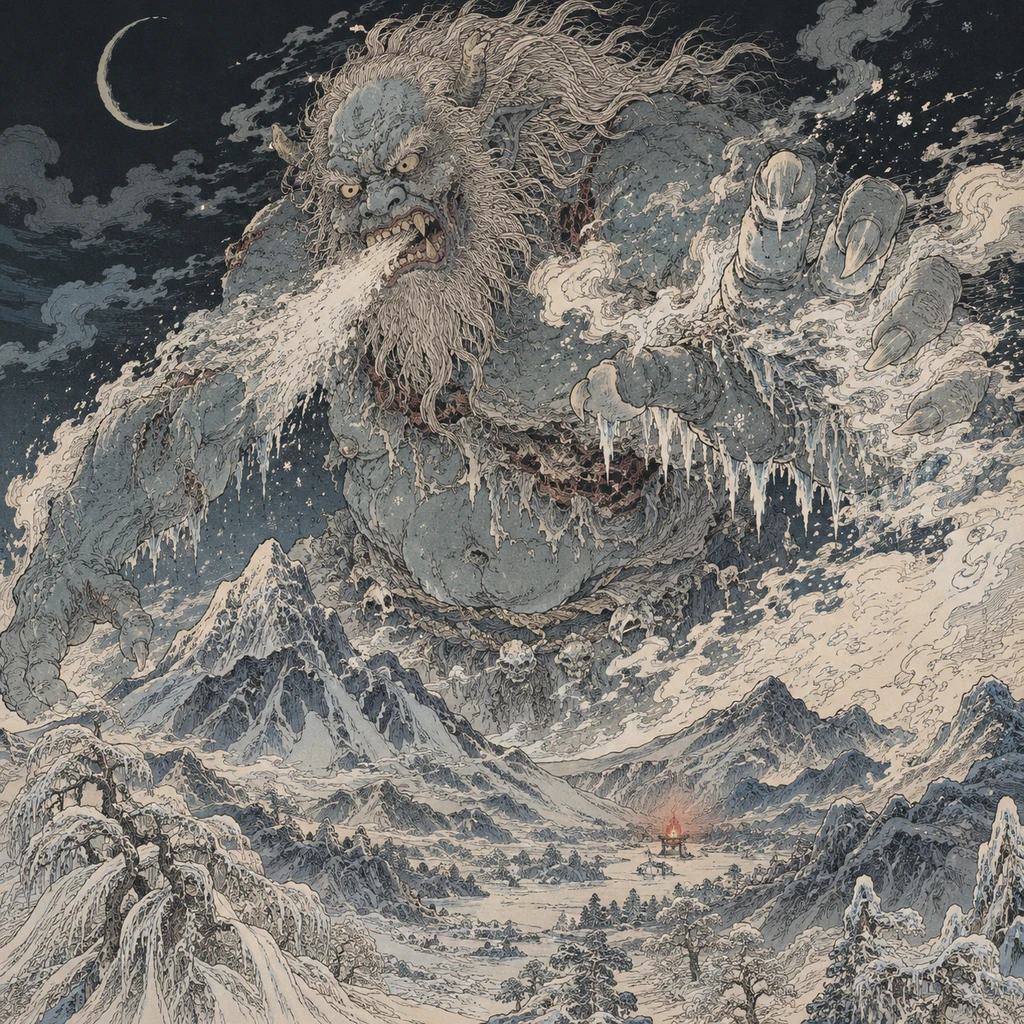
Kihachi, sometimes called Kihachi Hoshi, is a savage retainer deity slain by Takeiwatatsu-no-Mikoto, the pioneer god of Aso. According to myth, Takeiwatatsu-no-Mikoto would sit atop Mount Ojo and shoot one hundred arrows a day at a massive boulder called Matoishi, and it was Kihachi's duty to retrieve and return them. Originally a remarkably swift and powerful man, Kihachi grew so exhausted from fetching arrows that, upon retrieving the hundredth arrow, he used his toes instead of his hands to kick it back. This was deemed highly disrespectful and incurred the wrath of his master. Fleeing for his life, Kihachi was chased all the way to distant Takachiho in Hyuga Province, where he was finally slain. As a vengeful spirit bringing devastating frost and cold damage to Aso, he was later enshrined at Shimo Shrine to appease his wrath. He is the iconic demon of Aso, the Land of Fire, belonging to the lineage of "unruly ones" who are struck down only to be worshipped as deities.
Read moreTakeiwatatsu-no-Mikoto, the god who pioneered Aso, had an incredibly fast-footed retainer named Kihachi. The god would sit atop Mount Ojo on the caldera rim and shoot one hundred arrows a day at a massive boulder called "Matoishi" (target rock) across the valley, and it was Kihachi's duty to retrieve them. Kihachi was originally a remarkably swift and powerful man, but he grew utterly exhausted from the daily toil of fetching arrows. Finally, when retrieving the hundredth arrow, rather than using his hands, he caught it between his toes and kicked it back. This was deemed highly disrespectful and incurred his master's wrath. Kihachi fled for his life, running all the way to distant Takachiho in Hyuga Province, where he was finally caught and slain. The "Matoishi" still remains as a place name in Aso City today.
No matter how many times the slain Kihachi's head and torso were chopped apart, the severed limbs would attempt to reconnect and revive. Left with no choice, his slayers cut his body into three pieces and buried them separately. Even so, Kihachi laid a dying curse: "I will make frost fall upon the Aso Valley to haunt you." From then on, unseasonal early frosts and snow plagued the region, withering the crops. To quell this disaster, Takeiwatatsu-no-Mikoto enshrined Kihachi as a god to beg for his forgiveness, which is said to be the origin of the Shimo Shrine (Shimomiya). Because Kihachi had pleaded in his final moments that his severed body was cold and aching and needed to be warmed, a young maiden known as the "Hitaki Otome" (Fire-Lighting Maiden) keeps a sacred fire burning day and night for fifty-nine days starting on August 19th every year. This "Hitaki Shinji" (Fire-Lighting Ritual) of Shimo Shrine is designated as a Nationally Important Intangible Folk Cultural Property as an agricultural rite of Aso, and it continues to this day. Slashing down a violent demon is not the end; rather, they enshrine him as a god and continually soothe him with warming fire. Herein lies the deep-seated nature of the local faith: unruly rebels are not merely eliminated, but are incorporated back into the community through worship and ritual.
Aso Shrine, which enshrines Takeiwatatsu-no-Mikoto as its primary deity, sits in the Aso Valley as the supreme shrine (Ichinomiya) of Higo. The deity is regarded as the pioneer god of Aso and the grandson of Emperor Jimmu, who supposedly married Asotsuhime-no-Mikoto to cultivate the Aso lands. This god also features in a "kicking-open" myth that explains the very creation of Aso's geography. The Aso caldera was once a vast lake. To drain the water, the deity attempted to kick open the caldera rim. The first peak he kicked had a double barrier and would not break, earning it the name "Futae-no-Toge" (Double Pass). When he kicked the western rim a second time, it shattered, and the water rushed out. The deity kicked with such force that he fell on his rear and exclaimed, "I cannot stand (Tate-nu)," which is how the area became known as "Tateno." The waterfall carved by the rushing waters is the Sugaruga Falls of Tateno. A god kicked open a fire-spewing mountain to transform it into a land habitable for humans—and juxtaposed alongside this grand myth of geographical origins is the curse of Kihachi, slain and bringing frost. Aso Shrine, whose main gate and structures collapsed in the 2016 Kumamoto earthquakes, is currently undergoing restoration with national funds, proving that the faith of the mountain of fire lives on.
Interestingly, the story of Kihachi is not confined to Aso. A separate lineage of the Kihachi legend is passed down in Takachiho, Miyazaki Prefecture, across the provincial border. In the Takachiho version, the one who slays Kihachi is not Takeiwatatsu-no-Mikoto, but Mikeirino-no-Mikoto, the older brother of Emperor Jimmu. The "Kihachi Mound" remains, where the slain demon's corpse was divided into three parts—head, torso, and limbs—and buried. To pacify Kihachi's spirit and protect the grain harvest, Takachiho Shrine has historically held the "Shishikake Matsuri" (Boar Hanging Festival) on the third day of the twelfth lunar month, offering a whole wild boar. It is said that in ancient times a young maiden was sacrificed, but during the Sengoku period, by order of the local lord, it was changed to a boar. In Aso, he is soothed with warming fire; in Takachiho, he is appeased with the offering of a boar. The exact same story of a savage god forms a profound double exposure along the border of the Land of Fire and Hyuga, with both the slayer and the method of pacification altered.
The Aso clan, claiming descent from Takeiwatatsu-no-Mikoto, has long supported the Hitaki Shinji of Shimo Shrine that worships Kihachi. This family, which has hereditary held the position of High Priest (Daiguji) of Aso Shrine, is known as one of the oldest lineages in Japan. For over a thousand years at the foot of the fire mountain, they have served as the bridge between gods and humans. During the Hitaki Shinji, the chosen maiden confines herself to the shrine from August 19th through mid-October, cutting off all contact with the outside world to keep the sacred fire burning—a period of earnest, devoted prayer to warm the cold, severed body of Kihachi. Aso's violent nature, blowing smoke and occasionally shaking the earth, has often been conflated with Kihachi's curse. Both the unseasonal frosts that wither crops and the mountain spewing fire were viewed as the unappeased wrath of the slain fierce god. By lighting fires and ceaselessly performing rituals, the people sought to soothe this anger. The faith of the Land of Fire is not about subduing violent nature by force, but rather the very practice of enshrining it as divine, pacifying it, and living alongside it.
Possession and the Tales That Persist
The yokai of Higo are also born from the darkness of the human heart.
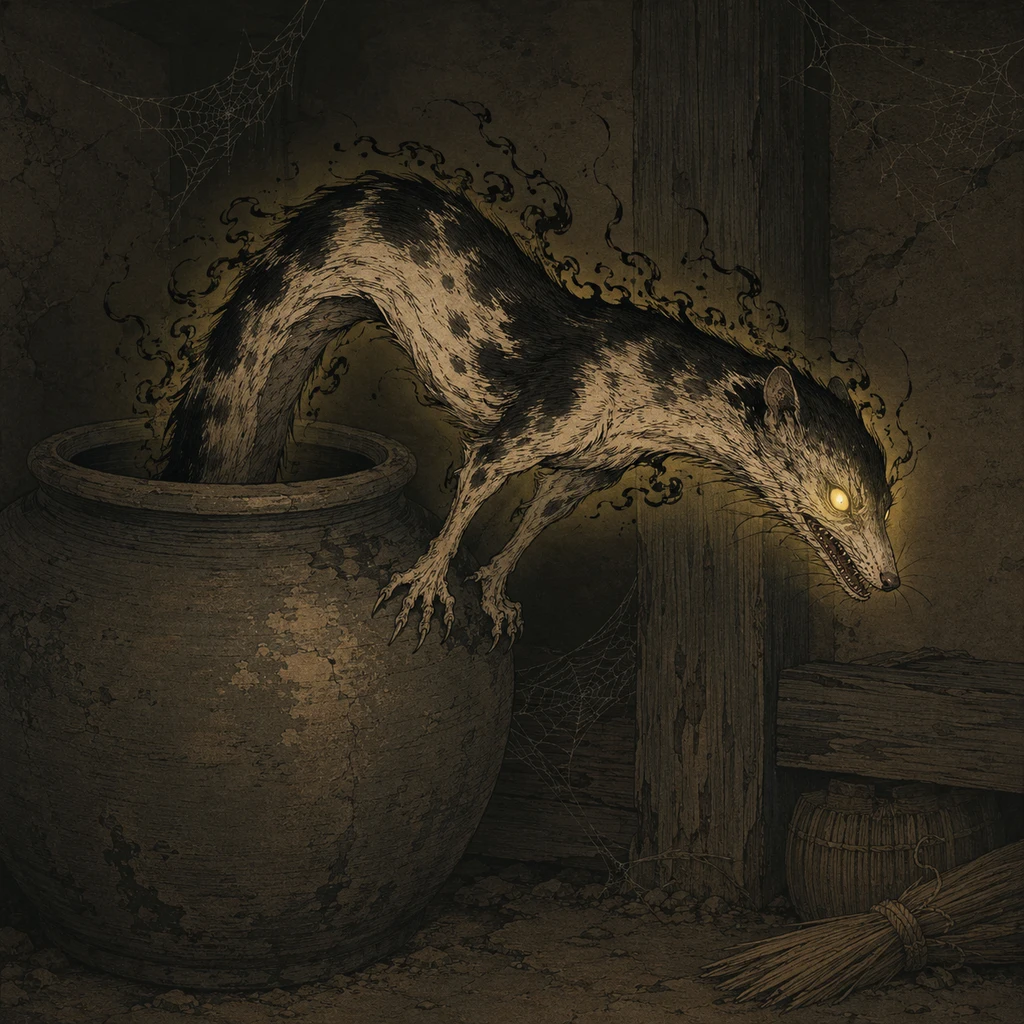
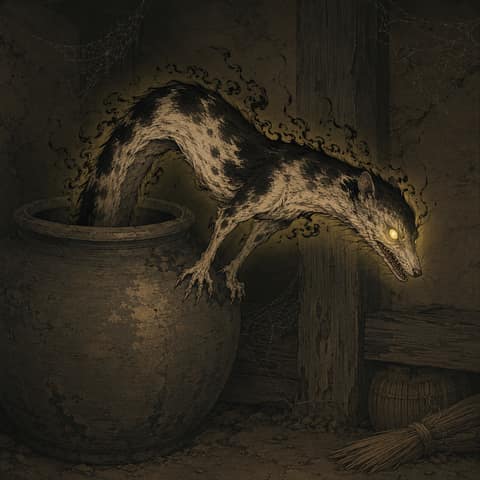
The Inugami (dog god), a possessing spirit widely distributed across western Japan, was also feared in Higo. In the Kuma District, the name was corrupted to "Ingame." Families believed to employ Inugami generation after generation were called "Inugami-suji" (Inugami lineages). It was feared that marrying into such a family would invite an Inugami possession, and they were actively shunned. This is not merely the gruesome flair of ghost stories, but a raw history of discrimination harbored by the community, a folklore that still requires sensitive handling today. There also exists a horrific origin tale claiming the Inugami was created by decapitating a starved dog and harnessing its intense obsession for black magic.
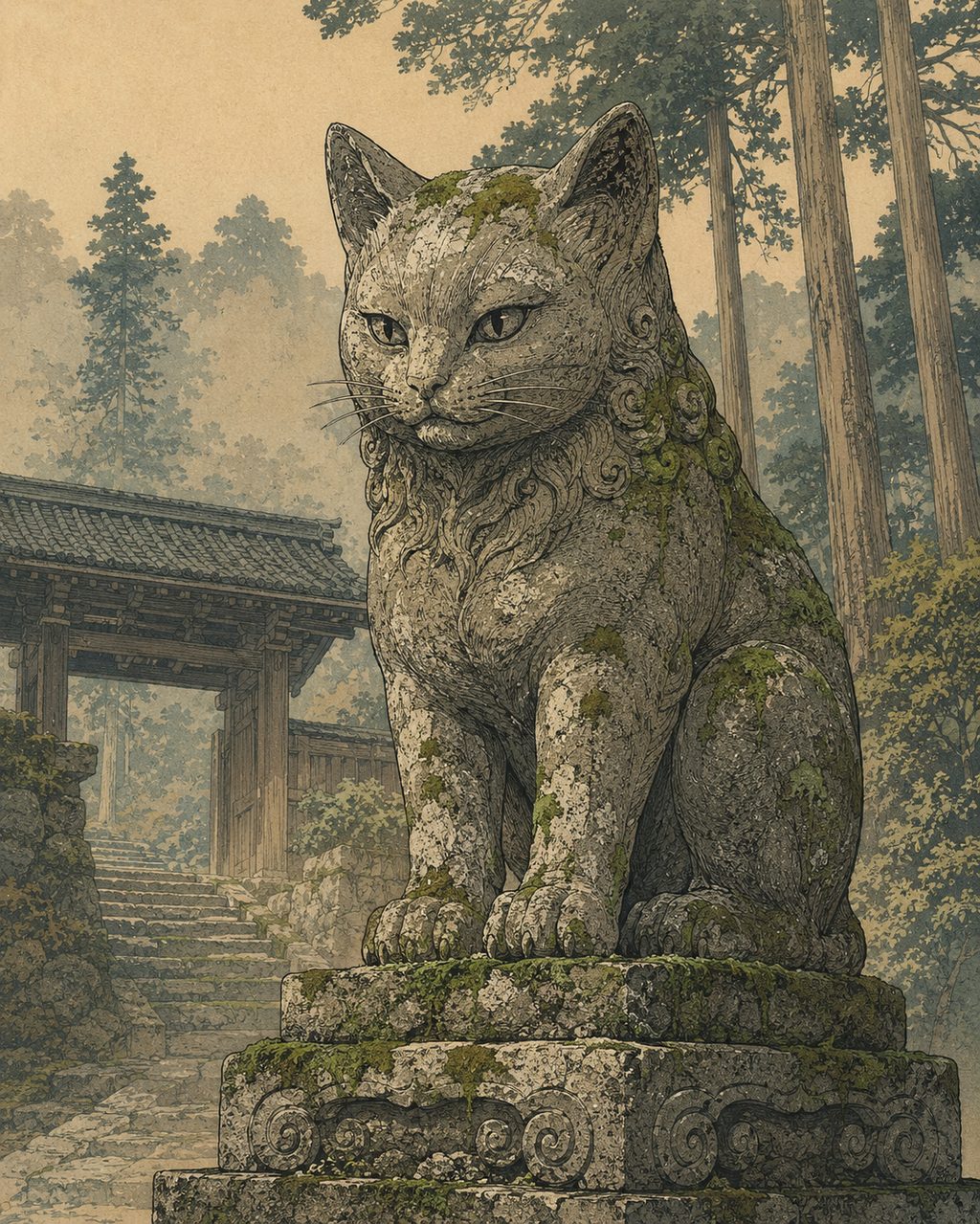
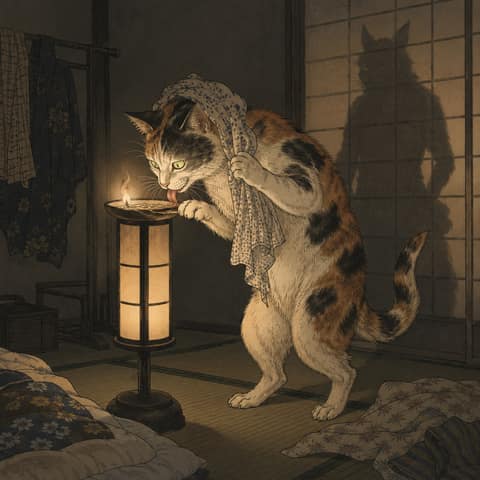
Deep in the mountains of Hitoyoshi and Kuma, a tragic tale of a *bakeneko* (monster cat) survives. In the tenth year of Tensho (1582), the chief priest of Fumonji Temple, Seiyo Hoin, was murdered by the Sagara clan on false charges. His mother took her beloved cat Tamatare and secluded herself at a shrine on Mount Ichifusa. Biting off her finger, she smeared the blood on the divine statue and the cat, urging them, "Let us become vengeful spirits and haunt them together." After fasting for twenty-one days, she threw herself into the Momaga Fuchi abyss. It is said that thereafter, the lords of the Sagara clan suffered nightly torment, and the original murderers went mad and died. To pacify the cat's curse, Shozen-in—now commonly called the "Cat Temple"—was erected. The Kannon hall, built in the second year of Kan'ei (1625), is a nationally designated Important Cultural Property, and its temple gate is guarded not by Komainu (lion-dogs), but by a rare pair of "Koma-neko" (guardian cats). The deeply isolated region of Hitoyoshi-Kuma is a land that has harbored countless such tales of grudges and curses.
And in Yatsushiro, the landing site of the kappa, there is yet another sacred beast that crossed the ocean. During the Yatsushiro Myoken Festival, one of Kyushu's three major festivals, a float of the "Kida" (a divine beast merging a turtle and a snake, affectionately called "Game" by locals) is paraded through the streets. Legend states that when the Myoken deity crossed the sea from China to Yatsushiro, he rode upon its back. At the very same port where the kappa drifted in from the continent, a divine beast carrying a god also crossed the ocean. This illustrates just how strongly the oceanic gateway of Yatsushiro attracted tales of "arrivals from the otherworld." The Myoken Festival is a Nationally Important Intangible Folk Cultural Property, and in 2016, it was registered as a UNESCO Intangible Cultural Heritage.
Kappa were born in the rapid currents of the Kuma River, prophetic beasts and sea women float in the inner seas of Ariake and Yatsushiro, and slain demons are enshrined in the crater of Aso. The yokai of Higo, Kumamoto dwell in the spaces between water and fire, hovering on the boundary between those who cross the sea and those who lay curses. Today, these yokai continue to be passed down through museums, local festivals, and tourist folklore. The "Land of Fire" is truly nothing less than another name for a country where the bizarre still breathes right alongside human life.