Shiranui
shiranui
Shiranui, the Parent Fires of Hassaku
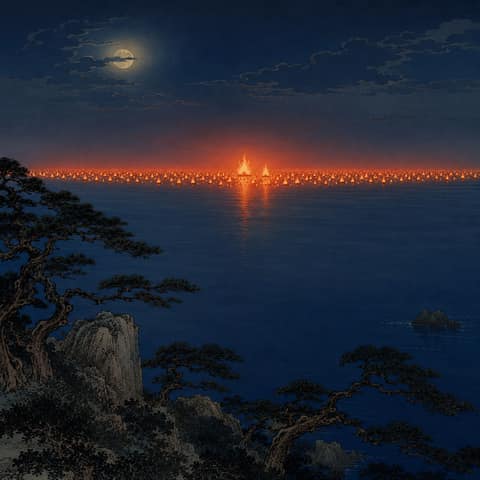
This form of Shiranui appears in ordered ranks before dawn on the first day of the eighth lunar month. Several kilometers offshore, one or two reddish lights first emerge. Coastal people call them oyabi, the 'parent fires.' They split to either side, producing more and more 'child fires' until hundreds or thousands form a single band across the sea. Tradition lets the line extend four to eight ri, roughly sixteen to thirty-two kilometers. It is almost invisible from a beach close to the water but clear from a headland or rise about ten ken above it. Around the deepest ebb of the tide, the lights settle into their most regular pattern, flickering behind the waves like the scales of a submerged dragon. The fires retreat when chased and draw away when a boat comes near. Anyone who tries to capture them sees both light and reflection slip aside, leaving only a direction back toward shore. An old account says that such a parent fire appeared when Emperor Keikō's vessel was surrounded by darkness and turned its prow safely landward. Coastal communities therefore treated the flame whose maker no one knew with reverence. On the night of Hassaku they stopped their nets, rested their oars, and waited for the line to come apart. Although the parent fires are sometimes linked with the presence of a violent dragon deity, they are not said to delight in harming people. Their lesson is against arrogance and haste. A boat intent on quick profit may wander among the lights and finally be forced to furl its sails. Someone who listens to the tide instead climbs a shore pine, studies the rhythm of the flames, and leaves quietly through a break in the line. The shoals then prove unexpectedly calm, and on the return journey a last light may sway against the shore as though welcoming the boat. Villagers call the display Thousand Lanterns or Dragon Lanterns and press their hands together. If people shout its name crudely or mock it, the ordered lights scatter at once into sea fog. Wind does not feed Shiranui as it would an ordinary flame; the lights grow and diminish only with the pulse of the tide. That is why they form a clean band from a cape or mound while vanishing at the water's edge. A seaside shrine rope bending slightly toward the water, or a change in the color of a lighthouse flame, is also said to warn that the offshore lights are beginning. Elders who know the signs tell young crews that the tide is falling and the fire will rise, and advise them not to sail. No ash or smoke remains. For a brief hour after dawn, shells on the tidal flat are said to glow pale rose and dew on the reeds to keep the fire's last color. On such mornings, villagers scatter salt on the beach and give thanks for the lives guided home. The parent fires open a way for those who understand awe and courtesy, retreat from the overconfident, and quietly draw the boundary between human beings and the sea anew.