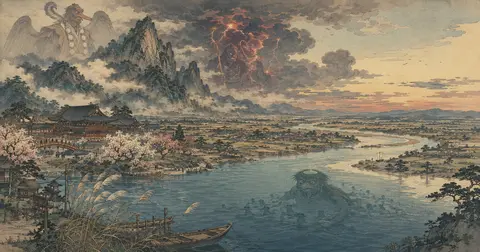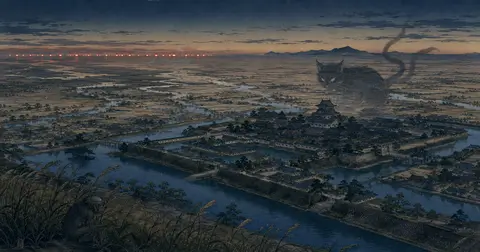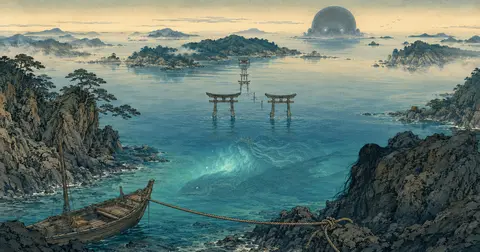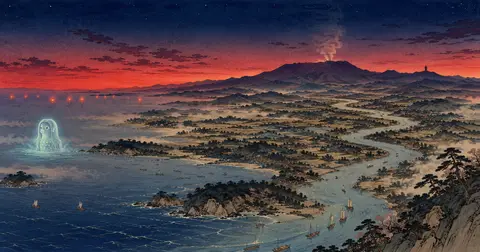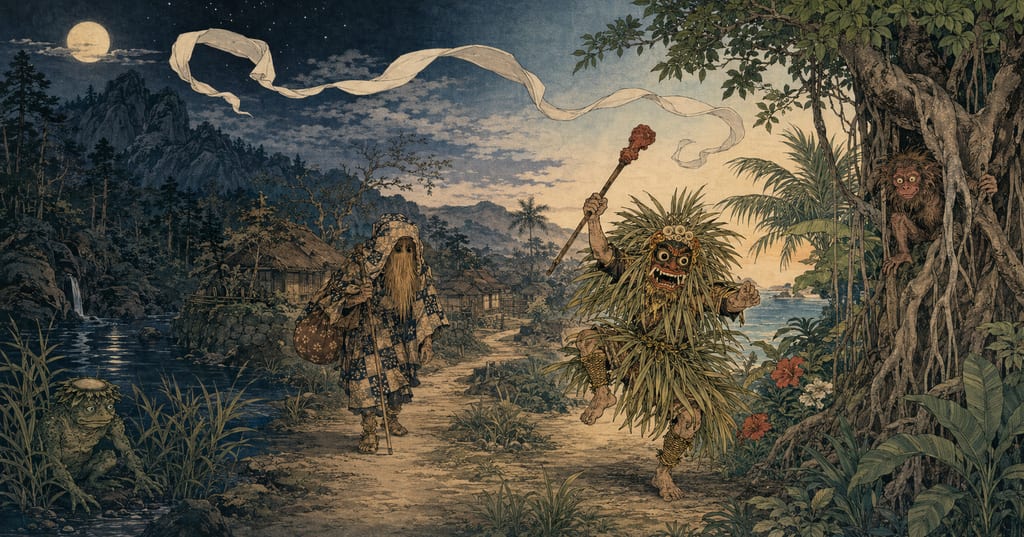
Kagoshima Prefecture is an elongated prefecture stretching approximately 600 kilometers from south to north, extending from the southern tip of the Kyushu mainland down to the Nansei Islands. This geography, unparalleled in Japan, has resulted in the inclusion of two completely different cultural spheres of yokai within a single prefecture.
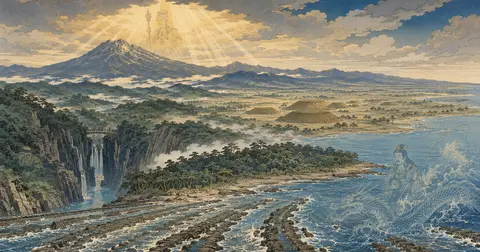
To the north, Satsuma and Osumi make up the mainland of volcanoes, forests, and rivers. Here, the memory of the *Tenson Korin* (the descent of the sun goddess's grandson to earth) from the ancient chronicles lies heavy, and behind that sanctity, the darkness of floating cloths on night roads, kappa by the waterside, and possessing spirits tied to family bloodlines has breathed in the lives of the people. On the other hand, across the sea to the south, the Amami and Tokara archipelagos form an island world of subtropical evergreen broadleaf forests and coral reefs. What dwells there are not so much "malicious yokai" but rather spirits and visiting deities (*raihoshin*) that seem to take the form of banyan trees or the ocean during the Bon festival.
These two layers were born entirely from Kagoshima's geography. The mainland side is a land where volcanoes like Sakurajima, Kirishima, and Mount Kaimon line up in a row; eruptions and ash fall are daily occurrences, and the barren earth of the shirasu plateaus sucks water underground. For this very reason, rivers and springs have been venerated as lifelines, and the worship of water deities—namely, kappa—has grown extraordinarily deep. Conversely, the islands of Amami and Tokara lie in the flow of the Kuroshio Current, long an intersecting maritime boundary between the rule of the Ryukyu Kingdom and the Satsuma Domain. In this island world where Yamato words and Ryukyuan words, mainland Buddhism and island ancestral worship are layered upon each other, yokai have also evolved differently from the mainland.
To trace the islands of Kagoshima from north to south is to journey through a long gradient where the Yamato yokai of the mainland gradually change their shapes into the spirits of the southern islands. This article will walk across those 600 kilometers in five chapters: the myths of Kirishima, the monsters of rivers and seas, the spirits of the southern islands, the masked visiting deities, and the darkness of possessing spirits.
The Myths of Kirishima:
The Mountain Where Gods Descended
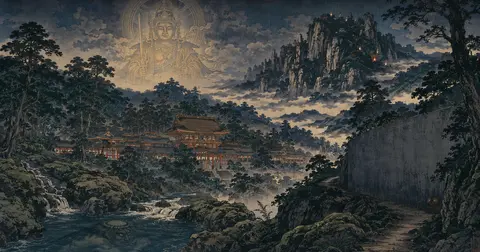
When speaking of the yokai culture of Kagoshima, one must first look up at the Kirishima mountain range. One peak of this volcanic group, which includes Mount Shinmoe and Mount Karakuni, is Mount Takachiho, long considered the site of the *Tenson Korin* in Japanese mythology.
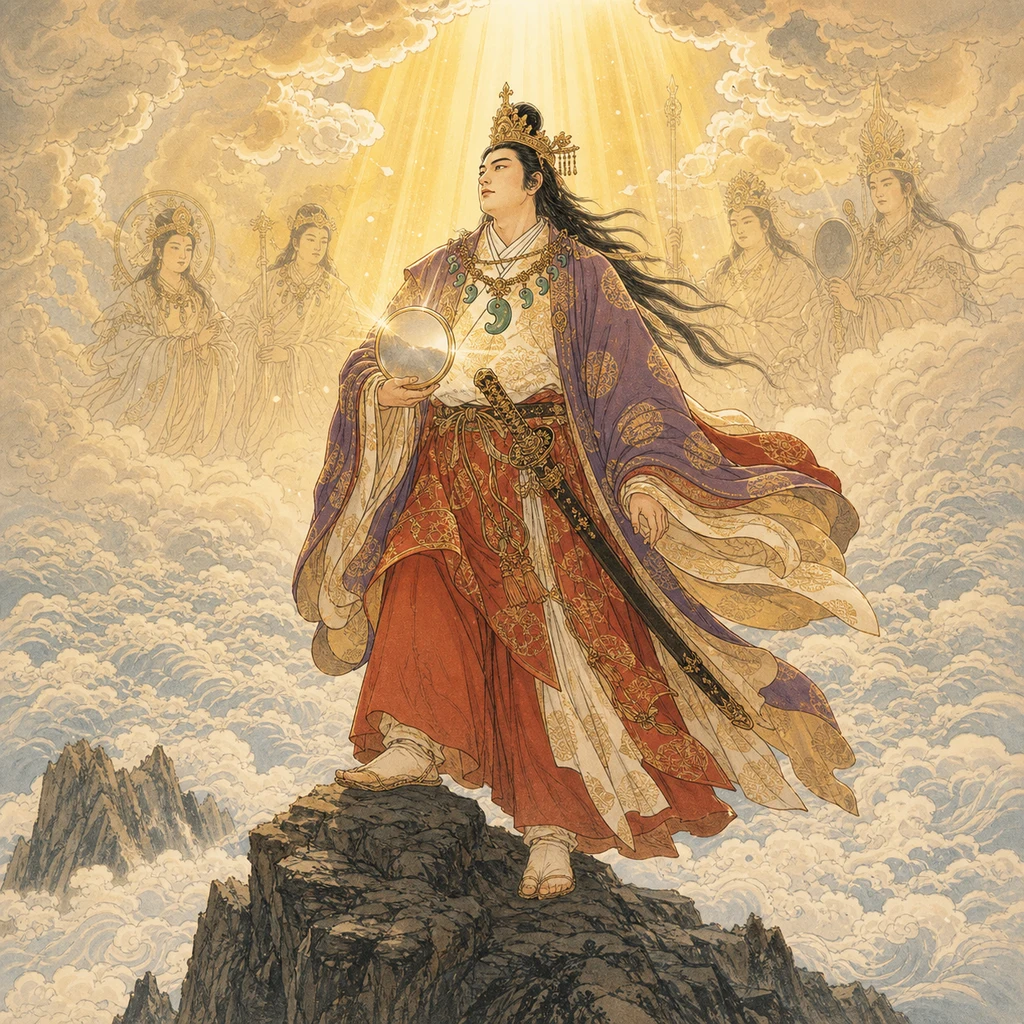
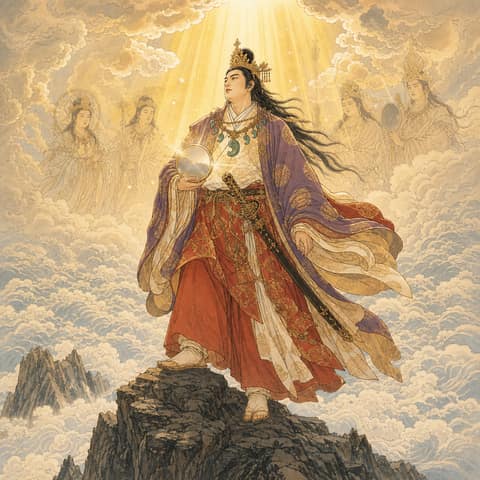
Ninigi-no-Mikoto
Ninigi-no-Mikoto is the central figure of the "Tenson Korin" (Descent of the Heavenly Grandson) in Japanese mythology, the founding ancestor god who descended from Takamagahara (the High Celestial Plain) to Ashihara no Nakatsukuni (the Japanese earthly realm) as the grandson of Amaterasu Omikami. In the Kojiki, he is recorded with the longest divine name in Japanese mythology, "Ame-nigishi-kuni-nigishi-amatsuhiko-hiko-ho-no-ninigi-no-mikoto," symbolizing the bountiful harvest of rice ears. Under the decree of Amaterasu, he descended to the peak of Takachiho in Hyuga, carrying the Three Sacred Treasures (the Yata no Kagami mirror, the Yasakani no Magatama jewel, and the Kusanagi sword) and leading the five pillar gods of rituals and arts (including Amenokoyane). On earth, he married Konohanasakuya-hime, the daughter of Oyamatsumi, becoming the father of Umisachi-hiko and Yamasachi-hiko, and the great-grandfather of the future Emperor Jimmu. Furthermore, the tale of his choosing Konohanasakuya-hime over the immortal Iwanaga-hime is known as the origin of why "Emperors and humans have a limited lifespan." He is an incredibly important deity who symbolizes the legitimacy of the ancient Japanese state and the roots of Japanese aesthetic consciousness.
Read more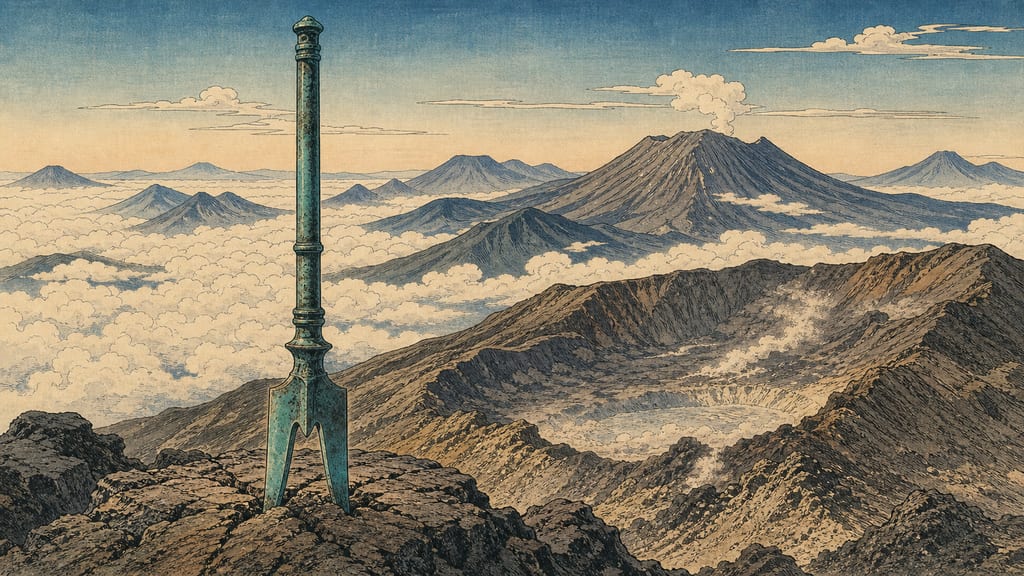
Ninigi-no-Mikoto, as the grandson of the sun goddess Amaterasu, descended from Takamagahara to the earthly realm bearing rice ears and the Three Sacred Treasures, accompanied by a host of deities. The *Kojiki*[1] and *Nihon Shoki*[2] record the landing site as "Takachiho in Hyuga of Tsukushi," and along with Takachiho on the Miyazaki Prefecture side, this Mount Takachiho in Kirishima has been considered a candidate since ancient times. At the summit of the peak, a bronze halberd said to have been thrust into the earth by Ninigi-no-Mikoto, the "Ama-no-Sakahoko" (Heavenly Reversed Halberd), still remains stuck upside down facing the sky. The anecdote that Sakamoto Ryoma climbed this peak with his wife Oryo and amused himself by pulling out the Ama-no-Sakahoko is well-known as the pioneer of the honeymoon in Japan.
The deity is enshrined at Kirishima Jingu. According to the shrine's tradition[3], the main sanctuary was originally situated between Mount Takachiho and Ohachi, but due to repeated volcanic eruptions, it was destroyed by fire and relocated several times. During the Tenryaku era of Emperor Murakami (mid-10th century), the Tendai monk Shoku Shonin rebuilt it at Takachiho-gawara, and it was later moved to its current location. Today's magnificent vermilion-lacquered main building was constructed in 1715 through a donation from the Satsuma domain lord, Shimazu Yoshitaka, and in 2022, the main hall, offering hall, and worship hall were designated as National Treasures.
Ninigi-no-Mikoto's descent is not a story that ends here. He met and married the beautiful Konohana-no-Sakuya-bime at Cape Kasasa, and that bloodline eventually led to the brothers Yamasachihiko and Umisachihiko, and further down to Emperor Jimmu. In other words, Kirishima has been spoken of as the place where the mythological origin of Japan's imperial family descended to earth. The fact that the Shimazu clan, who ruled the Satsuma domain, deeply revered Kirishima Jingu and had the lords themselves construct the shrine buildings was nothing other than because ruling this land carried the meaning of aligning with the orthodox line of mythology.
What is important here is that Ninigi-no-Mikoto is strictly speaking not a "yokai," but a fully-fledged deity. However, when discussing the otherworld of Kagoshima, this *Tenson Korin* myth forms an indispensable backbone. The memory of the mountain where the gods descended characterized this entire land full of volcanoes and forests as a "place where the extraordinary manifests," and in the margins of that sanctity, it created room for countless yokai and spirits to take up residence. The majesty of mythology and the darkness of local customs coexist back-to-back at the foot of Kirishima. A fire-breathing mountain, rising plumes of smoke, hot springs smelling of sulfur—the land of Kirishima itself is a place where powers beyond human comprehension manifest, and both gods and yokai have been feared as expressions of that power.
Monsters of Rivers and Seas:
Garappa and Iso-onna
The water that flows down from Kirishima as one of its sources eventually becomes rivers and pours into the sea. Those watersides are the areas with the deepest concentration of yokai in Kagoshima.
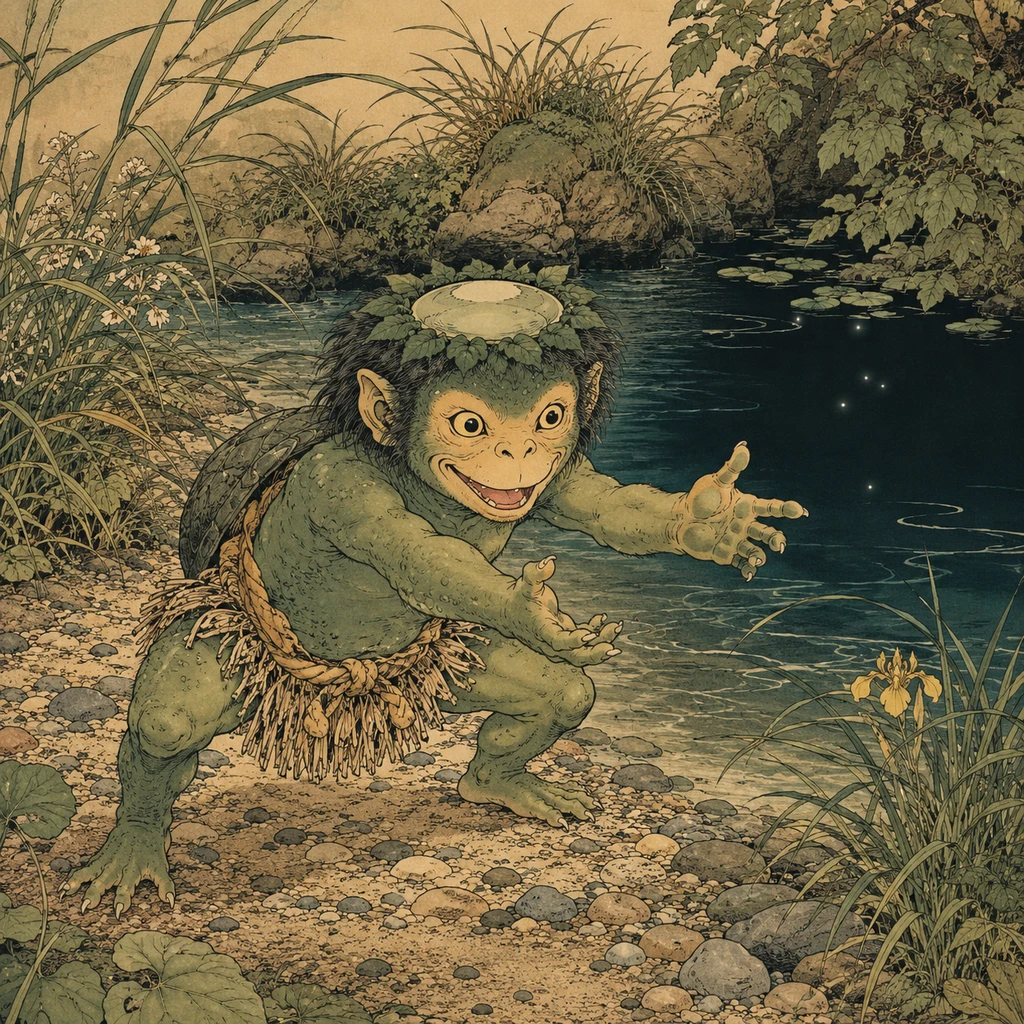
The kappa of southern Kyushu are called "Garappa." In the Kagoshima Prefecture mainland, kappa are called by this name almost everywhere, and the basin of the Sendai River, which flows through Satsumasendai City, has been known nationwide as the heartland of Garappa folklore.
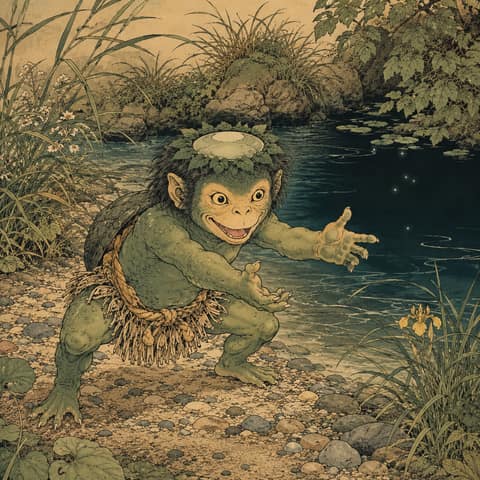
Garappa
"Garappa" is the name for kappa—and a distinct regional variant—widely known throughout southern Kyushu (primarily Kagoshima and southern Kumamoto). While its etymology traces back to a corruption of *kawawappa* (river child), its appearance and folklore are far more visceral and beast-like than standard kappa. It is often described as a grotesque, ape-like creature with unnervingly long, slender limbs, entirely covered in hair, and capable of walking upright. While it shares the typical kappa's cheerful disposition and love for sumo wrestling, the Garappa deeply retains the ecological cycle of "Yamakawa-oukan" (migrating between mountains and rivers) tied to the changing seasons. During the farming season from spring to autumn, they dwell in deep river pools; when winter arrives, they retreat into the mountains and become *yamawaro* (mountain children). This seasonal transformation perfectly mirrors the ancient Japanese agricultural rites and mountain worship—where the mountain deity descends to the village in spring to become the rice paddy deity, and returns to the mountains after the autumn harvest. This serves as profound evidence that the Garappa was not merely a water monster, but an animistic spirit governing the cycle of nature.
Read moreThe Garappa wears a dish on its head and lives by the riverbank. However, what decisively separates it from the typical kappa of the mainland is that it strongly retains the characteristic of migrating between the mountains and the rivers with the changing seasons. Throughout western Japan, there is a confirmed belief that kappa enter the mountains at the autumn equinox to become "Yamawaro" (mountain children), and return to the rivers at the spring equinox to become kappa once again[4], and the Garappa of southern Kyushu stands in this lineage. This means it is not simply a mischievous yokai, but retains the memory of a fallen water deity that travels between mountains and rivers to govern water. It is also said that its form cannot be seen, only its voice or sounds can be heard, or that it is visible only to specific people, and the ambiguity of its true identity has paradoxically deepened the fear of it.
The Garappa also shares the general characteristics of kappa, such as pulling people and horses into the water, challenging them to sumo wrestling, and removing their *shirikodama* (mythical organ). But the figure spoken of in southern Kyushu bears the imprint of the shirasu plateau's climate. For the people living on the barren plateau that sucks water underground, rivers and deep pools were life-sustaining blessings, while simultaneously being dangerous places that could swallow children. The fear of the Garappa functioned as a warning against approaching the water's edge too closely, and at the same time, it was a prayer to the beings that governed water. The reason Satsumasendai City loves the "Garappa" as a local symbol, to the point where even the Sendai River river office affixes its name with affection, is likely because the memory of this water deity still takes root in the earth today. The fact that the belief in the Garappa was elevated to the masked deity of festivals, as seen in the Yokkabu-i described later, is also a phenomenon unique to southern Kyushu.
If you go down the river and out to the coastline, a different kind of terror awaits there.

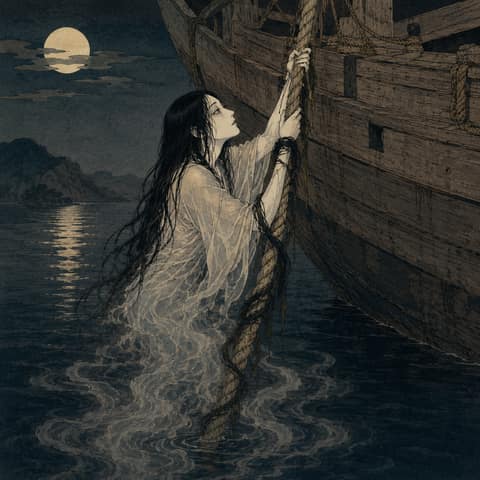
The Iso-onna is a female sea monster widely transmitted along the coast of Kyushu. Appearing on rocky shores and beaches in the guise of a beautiful woman, she ensnares people with her long hair and sucks their lifeblood through her hair, acting like a vampiric entity of the sea. In Nagashima Town, Izumi District, Kagoshima Prefecture, the Iso-onna is also called "Isohime," and is spoken of even more fiercely, saying that just catching a glimpse of her figure will result in death, and even if one quickly looks away, there is no salvation[5]. In adjacent Amakusa, Kumamoto Prefecture, it is said that she sneaks onto boats in the harbor in the middle of the night via the mooring ropes, covers sleeping sailors with her hair, and sucks their blood. Nagashima is positioned facing that Amakusa across the sea, and within the maritime culture sharing the same inland sea known as the Yatsushiro Sea (Shiranui Sea), the terror of the Iso-onna was continuous across prefectural borders. The rocky shores where ama divers and fishermen dive and row out every day are places of rich harvest, but at the same time, they are deadly realms that can easily swallow a person once a storm hits. The tale of a beautiful woman standing on those shores who sucks the lifeblood of those who approach can be said to be the mentality of fishing villages—where the longing for and terror of the sea are inseparably tied together—crystallized exactly into the form of a female monster. For fishing villages where shipwreck was a daily neighbor, the Iso-onna was likely also a metaphor for the unreasoning sea itself that takes lives.
And another entity dances in the night sky of Osumi, not far from the coast. It is the Ittan-momen, now nationally famous through Mizuki Shigeru's *GeGeGe no Kitaro*.
Ittan-Momen
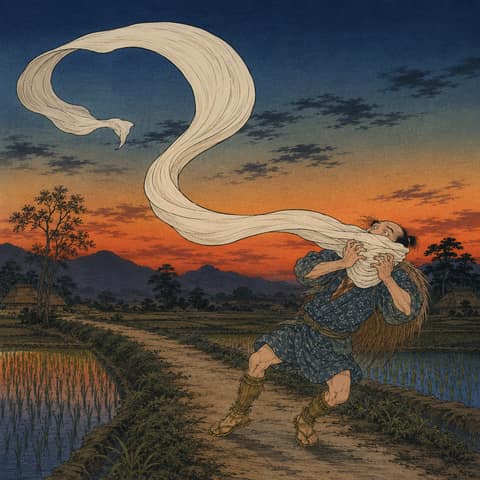
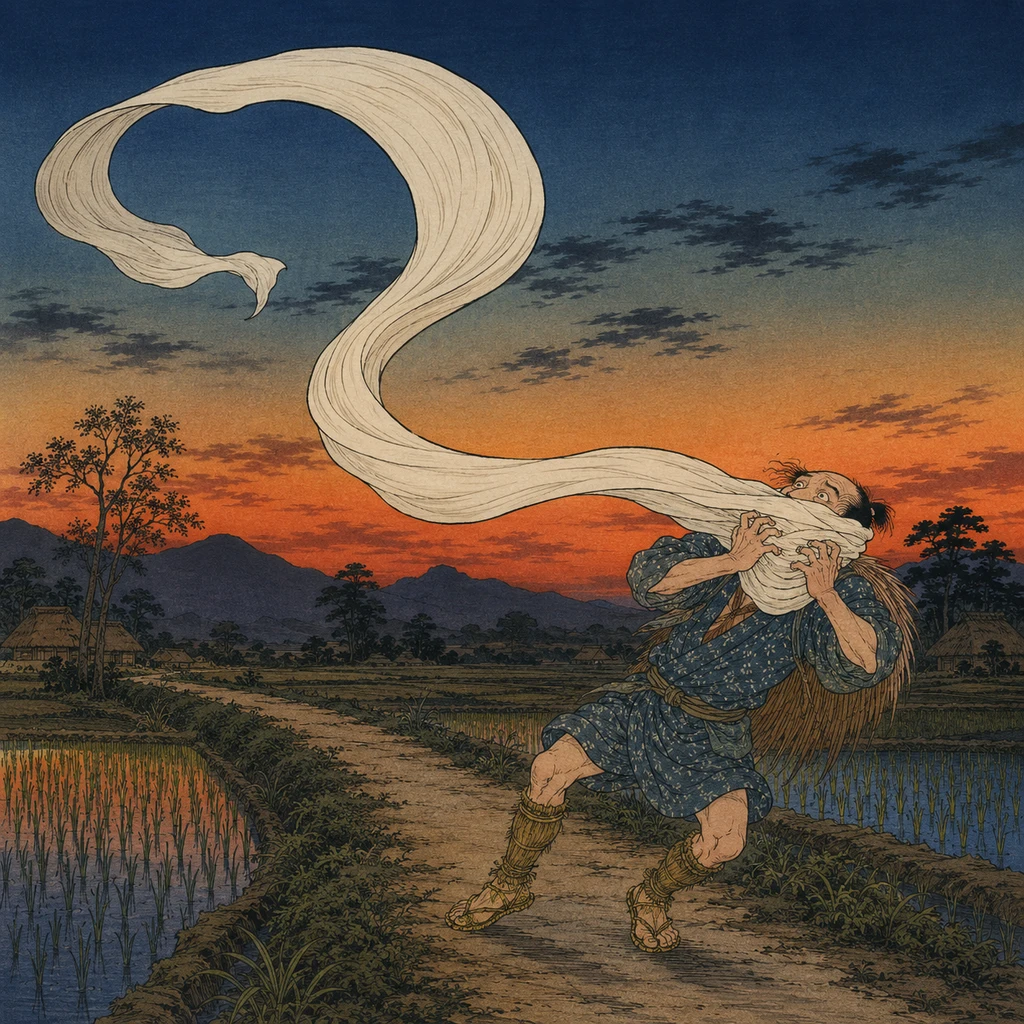
Ittan-Momen is a strange, long cotton-like presence associated with the Ōsumi Takayama region, around present-day Takayama in Kimotsuki Town, Kagoshima Prefecture. In 1938, Kunio Yanagita recorded that something in the form of an Ittan-Momen fluttered at night and attacked people. No color, face, limbs, or voice is given; what remains is the vivid sense of something long moving through the dark. A 1942 dialect collection calls “Ittan-Monmen” a kind of monster and describes it as a cotton-like object about one tan in length that attacks people at night. A tan measures a bolt of cloth, but its dimensions have varied by period, place, and textile; it cannot be reduced to one fixed number of meters. The name evokes a length of cloth long enough to cover a body, flickering like a living thing. Later local materials tell of Ittan-Momen flying in at dusk and winding around a person’s head or neck. Interviews conducted in Kimotsuki Town preserve accounts from Ikenosono, Hami, Gongen-yama, and the banks of the Kimotsuki River, while also noting communities where the story was unknown. This was not one uniform tale across all of Kagoshima, but a presence remembered unevenly in particular parts of Ōsumi. The figure now familiar throughout Japan owes much to Shigeru Mizuki. According to an account published by the Agency for Cultural Affairs, Mizuki gave distinctive designs to yokai named in *Yōkai Meii* whose appearances had not been handed down. Ittan-Momen, too, acquired the recognizable body of a long flying cloth and became known nationwide through manga and animation.
Read more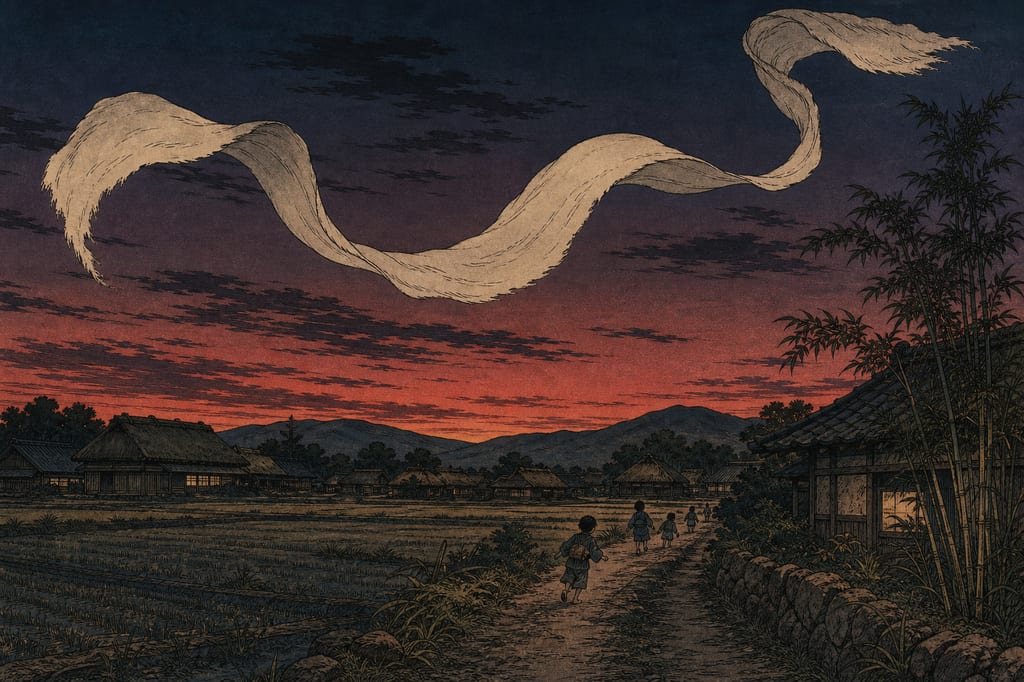
The Ittan-momen was originally an extremely localized yokai. It was Nomura Denshi, a local researcher and pupil of Natsume Soseki, who wrote its folklore down in literature. The *Osumi Kimotsuki-gun Hogenshu* compiled by Nomura[6] recorded it as a folk belief transmitted in Takayama Town, Kimotsuki District of the Osumi Peninsula (present-day Kimotsuki Town), describing a cloth like cotton about one *tan* in length (roughly 10.6 meters) that flies in at dusk to attack people. That cloth wraps around the neck of someone walking on a night road, covering their face and suffocating them[7]. It is said that in the past, parents in Osumi would tell children playing until dark, "An Ittan-momen will come out," to make them return home early. In other words, this was a monster intimately connected to the land, born from the life wisdom of teaching children the dangers of twilight. When Mizuki Shigeru gave eyes, a nose, and expressions to that one *tan* of cloth, making it fly nonchalantly through the sky, the terror of the night roads in Kimotsuki transformed into an endearing yokai known to children all over Japan. This is a vivid example of the process by which a yokai leaves its locale and becomes nationalized.
Spirits of the Southern Islands:
Banyan Trees,
Heavenly Maidens,
and Soul-Stealing Pigs
Crossing the sea to the south and reaching the Amami Islands, the texture of the yokai changes completely. From here on is the realm of spirits that seem to take the form of the subtropical nature itself, rather than products of dark passions.
Leading them is the Kenmun, which should be called Amami's greatest yokai.

Kenmun
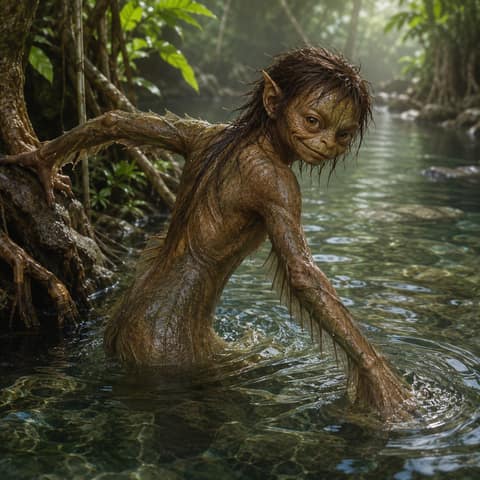
The kenmun is a yokai handed down in the Amami Islands of Kagoshima Prefecture—a water spirit of the southern isles regarded as kin to the mainland kappa. It is recorded as the "kenmon" in the late-Edo gazetteer Nantō Zatsuwa, and while it shares kappa-like traits such as a head-dish and a love of sumo, its other face—as a tree spirit dwelling in old banyans (gajumaru)—is just as pronounced. It is said to move between sea and mountains with the seasons and, at night, to make its body glow as it fishes among the rocks. In older traditions it was a harmless being that helped people, but in later times tales of curses and mischief grew more common.
Read more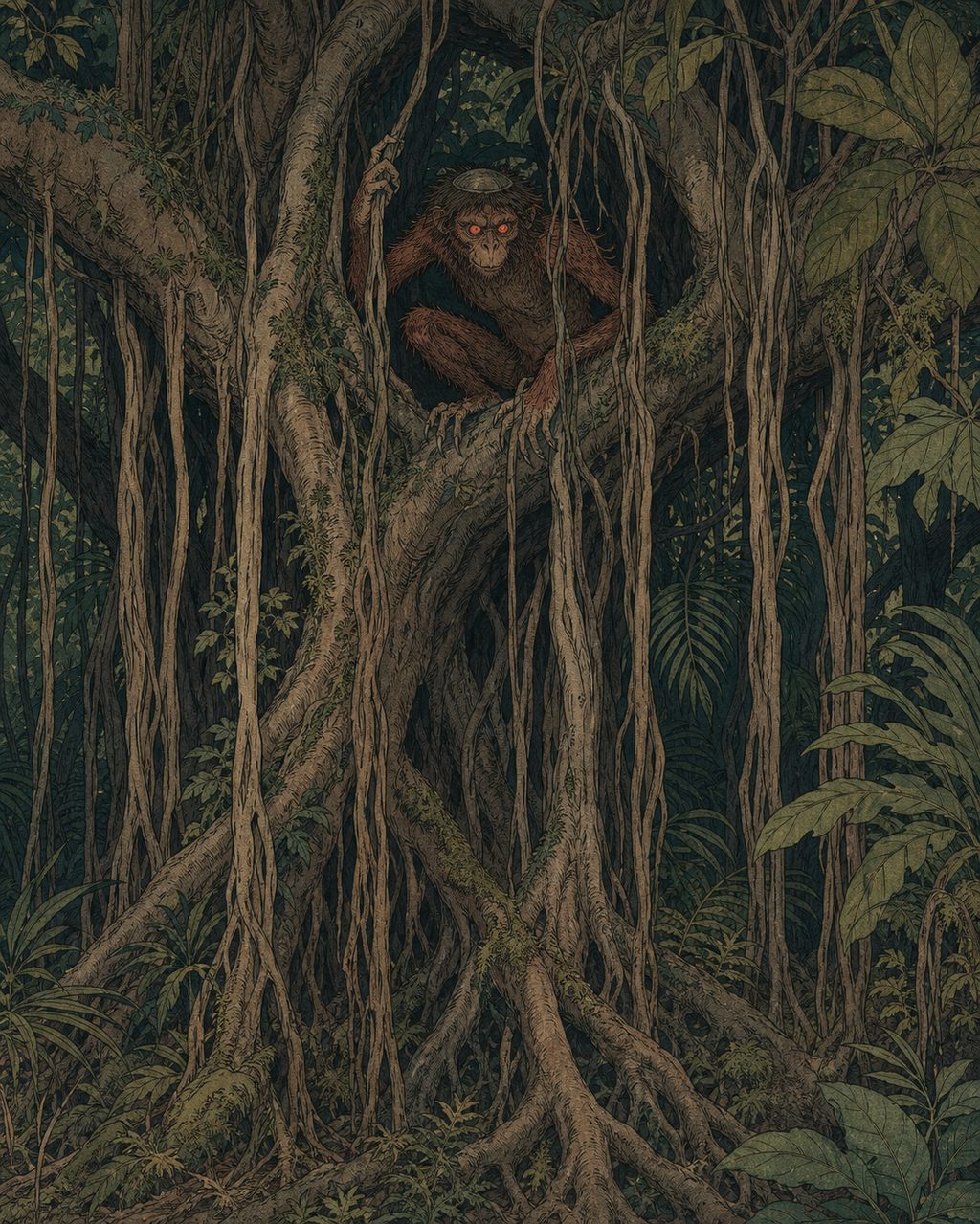
The Kenmun is said to be about the height of a child, with red eyes and slender limbs, covered in reddish hair, and smells like a wild yam. Like a kappa, it has an indentation on its head where it stores the liquid that acts as the source of its power. However, while the mainland kappa lives by the water, the Kenmun makes its home in the banyan tree (*gajumaru*)[8]. This character as a tree spirit is extremely close to the tree spirit Kijimuna of Okinawa, and the three—kappa, Kijimuna, and Kenmun—form a gradient of "spirits of trees and water" stretching from Kyushu to the Ryukyu Arc. Liking sumo and challenging people it meets to matches is also inherited from the kappa. In the past, it was a harmless being that helped woodcutters gather firewood, but it is said that as times progressed, terrifying aspects were emphasized, such as stealing people's souls or cursing those who cut down banyan trees. In Amami, the sensibility of hesitating to tamper with old banyan trees still remains, and the Kenmun embodies a reverence for the island's ecosystem itself. Seeing an unidentifiable fireball-like light on a night mountain path was attributed to the Kenmun's doing, and poor catches in fishing or unexplained illnesses were also explained as being caused by angering the Kenmun. Whereas the mainland kappa speaks of "waterside dangers," the Amami Kenmun speaks of the "spirituality of the forest itself." Despite being yokai of the same lineage, shifting its dwelling from water to tree changes its meaning this much. Incidentally, in the 2018 NHK Taiga drama *Segodon*, the Kenmun was mentioned in scenes surrounding Saigo Takamori, who was exiled to Amami, and his island wife Aikana, providing an opportunity for it to become widely known to mainland viewers.
If the Kenmun is a spirit of the trees, there are also female spirits that descend from the sky.
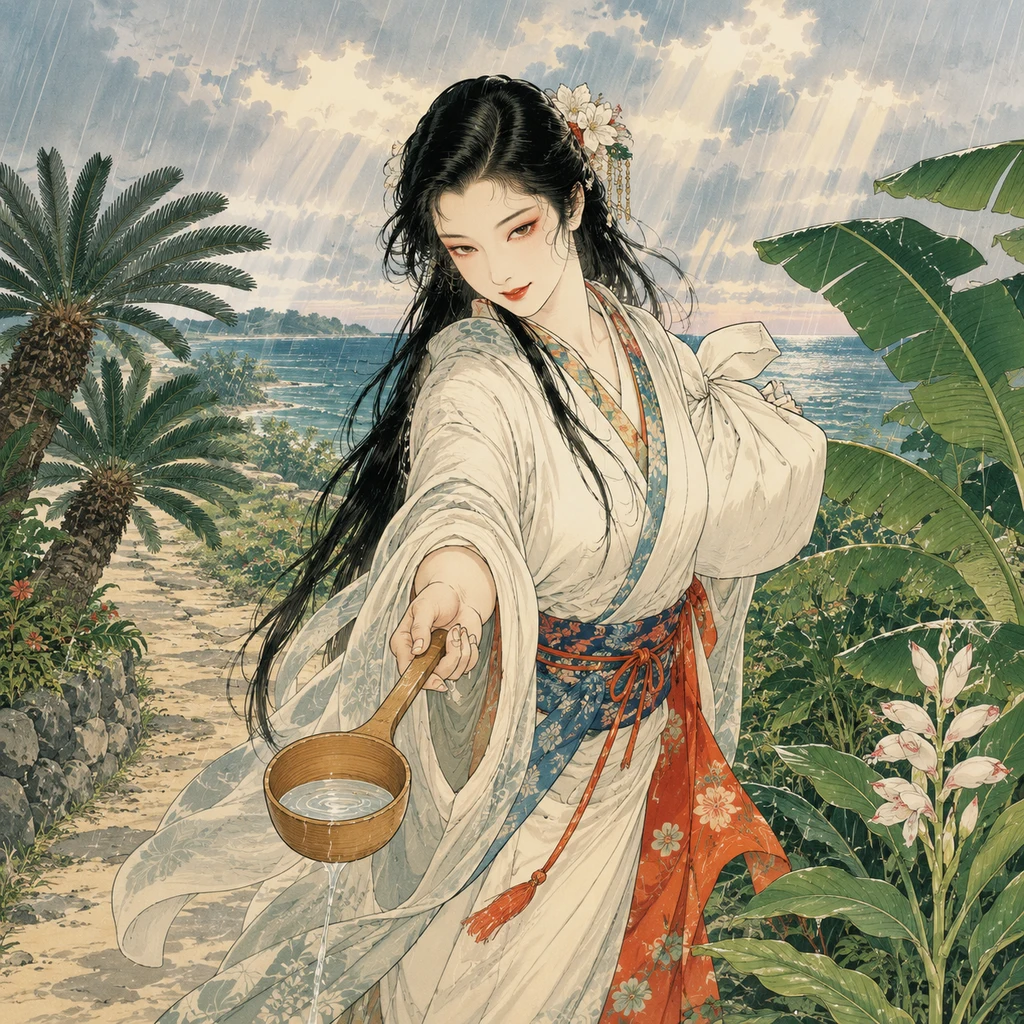

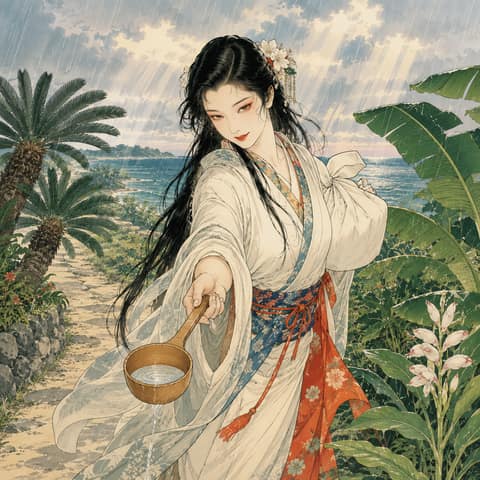
The Amorou-nagu is a heavenly maiden transmitted on Amami Oshima. She is said to descend from the sky carrying a white wrapping cloth on her back, and when she appears, a light rain inexplicably falls even on the clearest of days. Finding a man on the ground, she smiles bewitchingly to seduce him, and the man who yields to her temptation is robbed of his life. The result is the same even if she makes him drink water from a ladle she holds; his soul will be carried away to the heavens[9]. She is a death god-like being that hunts the lives of men, resembling but fundamentally differing from the heavenly maidens of the sorrowful swan maiden legends who are forced to remain on earth after their feather robes are stolen. The uniqueness of the southern islands' storytelling lies in taking the mainland's graceful image of a heavenly maiden and inverting it into a soul-stealing female spirit, all within the same framework of a "heavenly maiden."
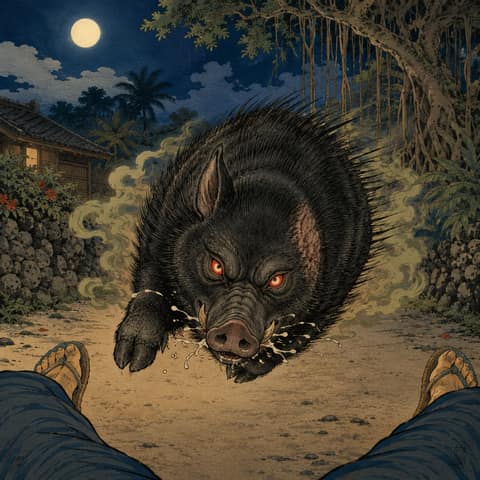
Even more bizarre is the Kata-kira-uwa. The Kata-kira-uwa is, as its name ("one-eared pig") suggests, a pig monster lacking one ear, said to appear near the city hall of former Naze City (present-day Amami City) on Amami Oshima and along the banks of the Nagata River. It bounds swiftly like a rabbit and emits a strong stench like a male goat. What is terrifying is how it attacks: it was believed that if it slips under a person's crotch, the person whose legs it passed under would have their soul extracted and die, or even if they barely survived, they would suffer a loss of reproductive functions. To prevent this, one need only cross both legs diagonally to block the crotch. Then the Kata-kira-uwa gives up and leaves[10]. On Tokunoshima, there are similar tales of the "Miminashi-buta" (earless pig) lacking both ears and the "Katame-buta" (one-eyed pig), showing that the islands of Amami and Tokunoshima shared a common imagination that transformed the familiar livestock of the pig into a deformed demon. Pigs are the livestock closest to the lives of the Nansei Islands, deeply involved in human life and death as offerings for New Year and festivals, and as a daily source of protein. The idea that this familiar pig appears at night in an incomplete form lacking an ear or an eye, extracting souls from beneath the crotch, carries an eeriness that touches the root of life and sexuality. While mainland yokai have foxes and tanuki as tricksters, in the southern islands, the pig occupies that seat—the land's lifestyle shines through even in what is chosen as a messenger of the otherworld.
Masked Visiting Deities:
Boze and Yokkabu-i
Shifting our gaze further from Amami, another pole of Kagoshima's yokai culture comes into view. Masked deities that visit villages at fixed seasons from beyond the sea or from the waterside—visiting deities (*raihoshin*).
Standing at the pinnacle of these is the Boze of Akusekijima in the Tokara Islands.
Boze
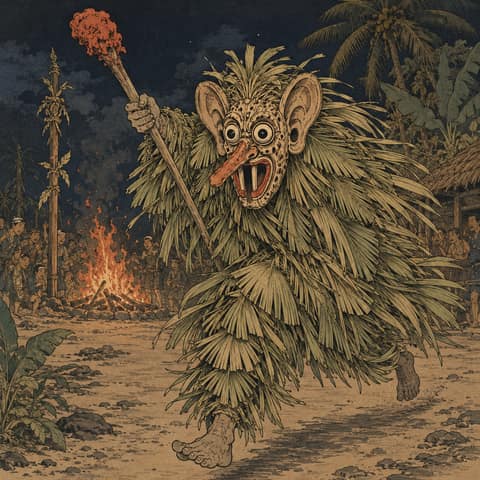
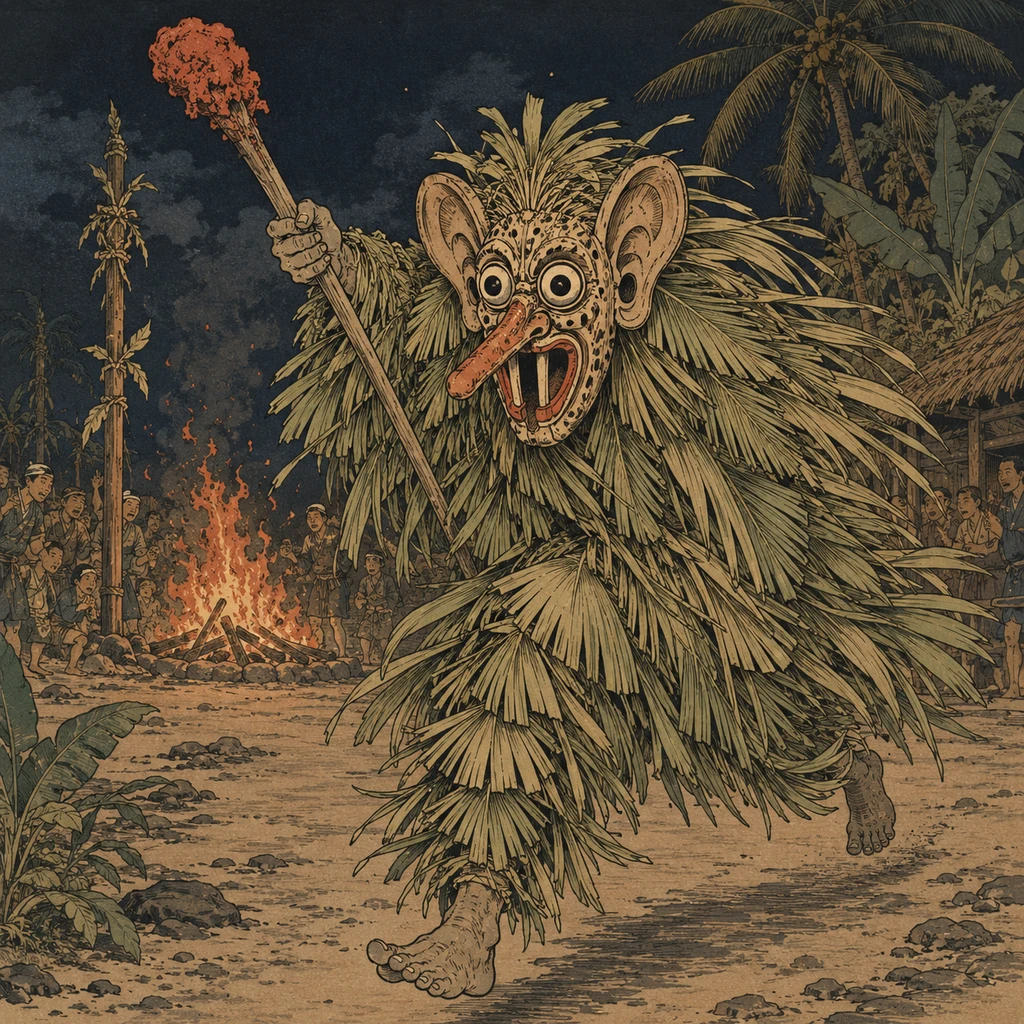
A visiting deity (*raihoshin*) passed down on Akusekijima in the Tokara Islands of Kagoshima Prefecture. Appearing on the final day of the Obon festival (July 16th on the lunar calendar), it is worshipped as a being that purges evil spirits and impurities while bringing good fortune to the people. In 2018, it was inscribed on the UNESCO Intangible Cultural Heritage list as one of the "Raihoshin: Ritual Visits of Deities in Masks and Costumes".
Read more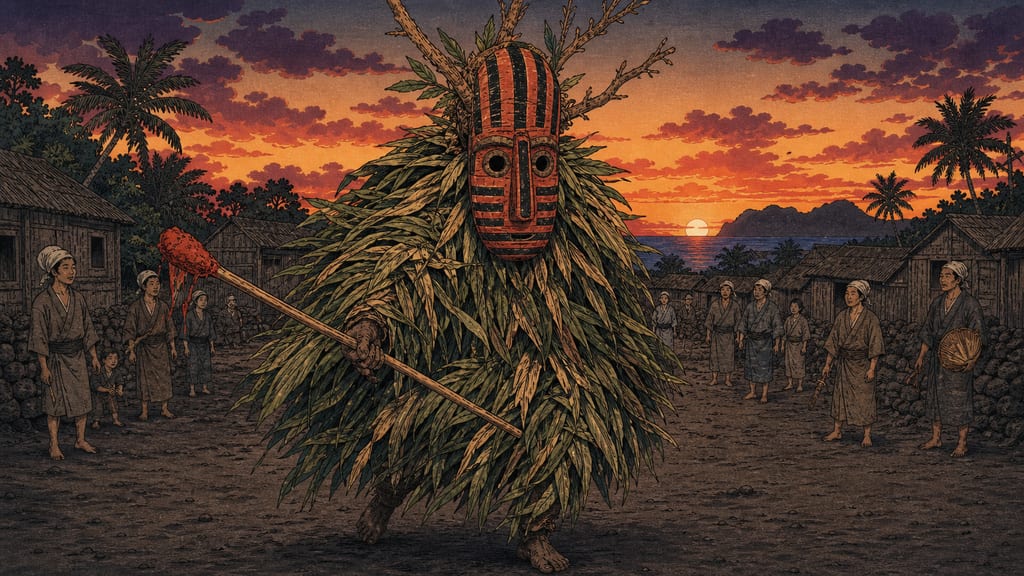
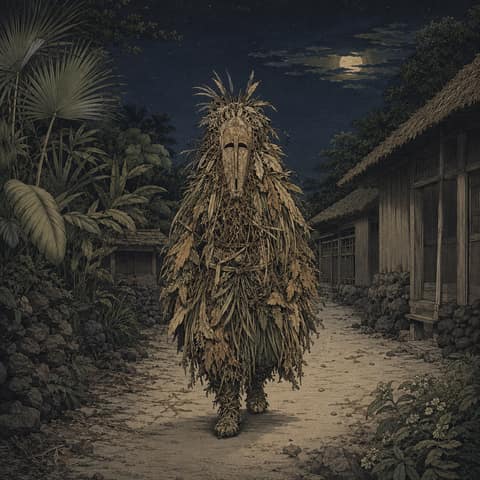
The Boze appears on the evening of the sixteenth day of the seventh lunar month, the final day of the Bon festival. Young men of the island appear in a bizarre form: wearing giant masks smeared with red clay and soot, wrapping their entire bodies in Chinese fan palm leaves, and adorning their limbs with palm bark and Japanese bead tree leaves. In their hands, they hold a long stick resembling a phallus called a "Bozemara."[11] They chase people around, trying to rub the red mud attached to its tip onto them. It has been passed down that having the mud applied purifies evil spirits, and if it is a woman, she will be blessed with children. Visiting from across the sea to purify the defilements of Bon and reviving the people into a new world of life—the Boze is a visiting deity standing on the boundary between life and death. The modeling of its mask is frequently pointed out for its resemblance to spirit figures of the South Seas, such as in Papua New Guinea, suggesting that this island was connected to the southern cultural sphere via the Kuroshio Current. Akusekijima is a small, isolated island with a population of only a few dozen, and for a long time was an unexplored region with limited regular ferry services. Precisely because of this, the ancient form of visiting deities, long lost on the mainland, has been preserved with high purity on this island. It is also told that the Boze masks are newly made for each festival, and once finished, are destroyed and returned to the sea or mountains; the deity is given form for a one-time appearance, and once its duty is complete, it returns again to the invisible beyond. That once-in-a-lifetime nature is at the very core of the visiting deity faith.
The Boze was designated as a National Important Intangible Folk Cultural Property in 2017[11], and the following year, in 2018, it was registered as one component of the UNESCO Intangible Cultural Heritage "Raihō-shin, visiting deities: masks and costumes." This registration took the form of an extension of the previously registered Toshidon of Koshikishima, comprising ten visiting deity events nationwide. Toshidon is also an event in Satsumasendai City's Koshikishima in Kagoshima, making Kagoshima a dense land of visiting deity culture that single-handedly sent multiple visiting deities to the UNESCO heritage list[12].
On the mainland side, there is a masked deity that resonates with this. It is the Yokkabu-i transmitted in Minamisatsuma City on the Satsuma Peninsula.
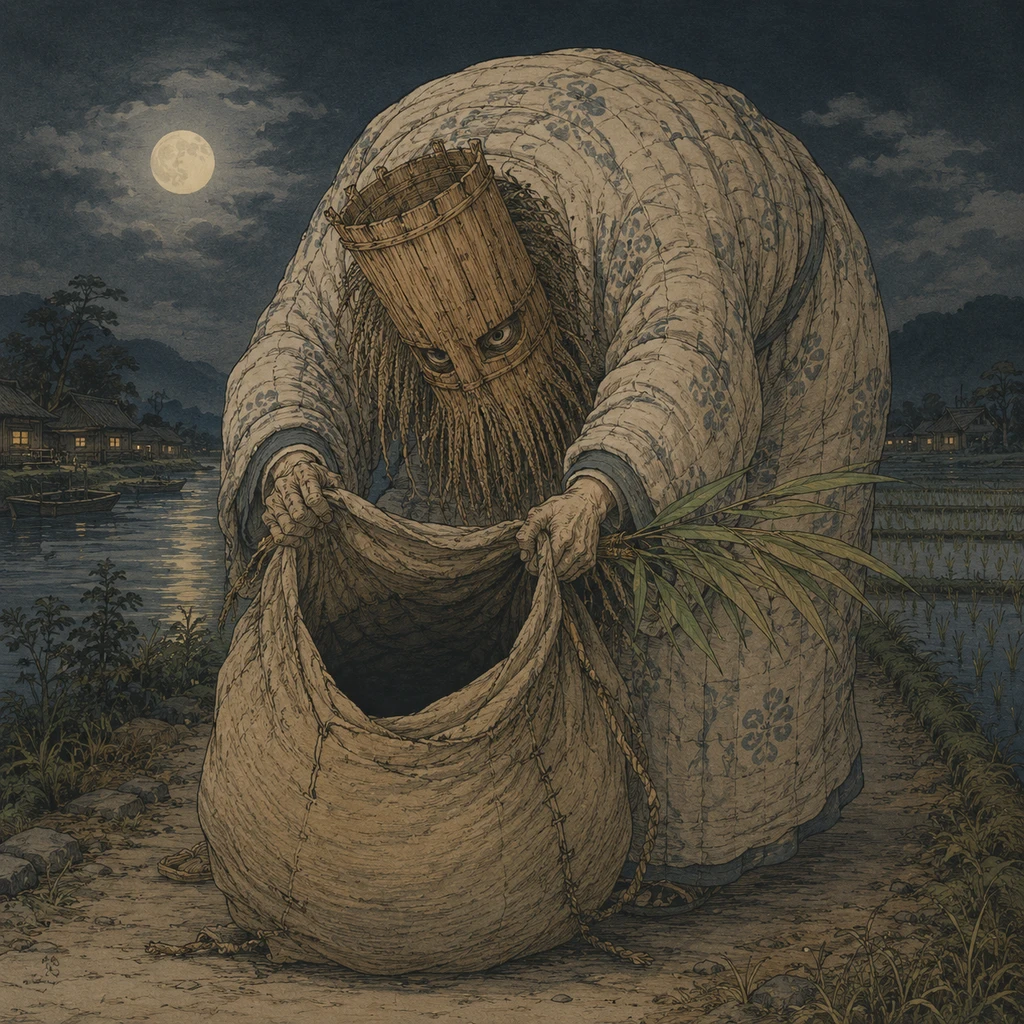
Yokkabu-i
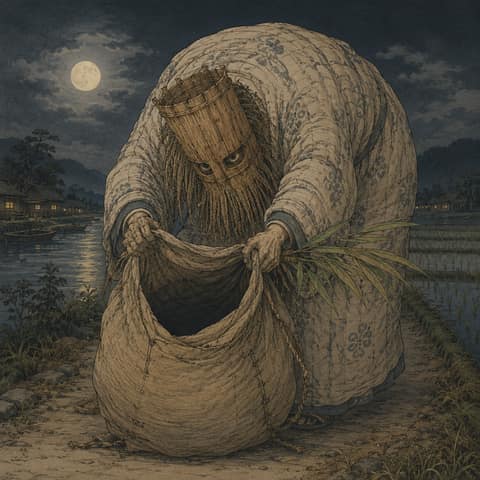
A visiting deity believed to be an incarnation of a Garappa (kappa), appearing during the "Water God Festival (Takahashi Juhachido Odori)" held every August on the lunar calendar in the Takahashi district of Kinpocho, Minamisatsuma City, Kagoshima Prefecture. It earned the name "Yokkabu-i" because it covers itself entirely with a "Yogi," a traditional form of bedding. Emitting strange shrieks, it threatens children with a hemp sack, acting as a warning against water accidents while being worshipped as a deity that brings good health and protection from illness.
Read moreThe Yokkabu-i is alternatively called the "Takahashi Jubachi-do Odori." It is a water deity festival dedicated every year on August 22 at the Tamate Shrine in Takahashi, Kinpo-cho, Minamisatsuma City. Men in their thirties to fifties dress as giant Garappa (kappa) wearing masks woven from palm bark and sleeping garments, chasing children while emitting bizarre cries of "Hyuu, hyuu." The captured children are stuffed into straw bags called "kamasu."[13] It is believed that children put in the bags will be protected from water accidents, and it also carries the meaning of purifying people with bamboo leaves and admonishing misbehaving children. Children screaming as they are stuffed into bags, and adults watching over them with smiles—that scene has the flavor of a rite of passage where a child grows a step by passing through terror. Prayers to the water deity to protect children from waterside accidents took the form of the kappa's masked deity—the previously seen Garappa faith and the visiting deity faith represented by Boze melt into one here. It can be said to be a rare example of the mainland kappa being elevated to a festival deity through a path different from that of the Amami Kenmun. Yokkabu-i has been selected as a National Selected Intangible Folk Cultural Property.
When placing Boze and Yokkabu-i side by side, an interesting contrast emerges. While the southern island's Boze visits from the sea during Bon to purify the defilements of death, the mainland's Yokkabu-i appears from the waterside in summer to protect children's lives from the water. The boundary of the sea and the boundary of the river, the purification of death and the protection of life—despite being similar masked deities, their roles are varied according to the nature and fears of the land.
The Darkness of Possessing Spirits:
Inugami and the Mainland's Passions
Finally, one must touch upon another darkness, different from the myths of Kirishima and the spirits of the southern islands. The yokai of possessing spirits that nest between people.
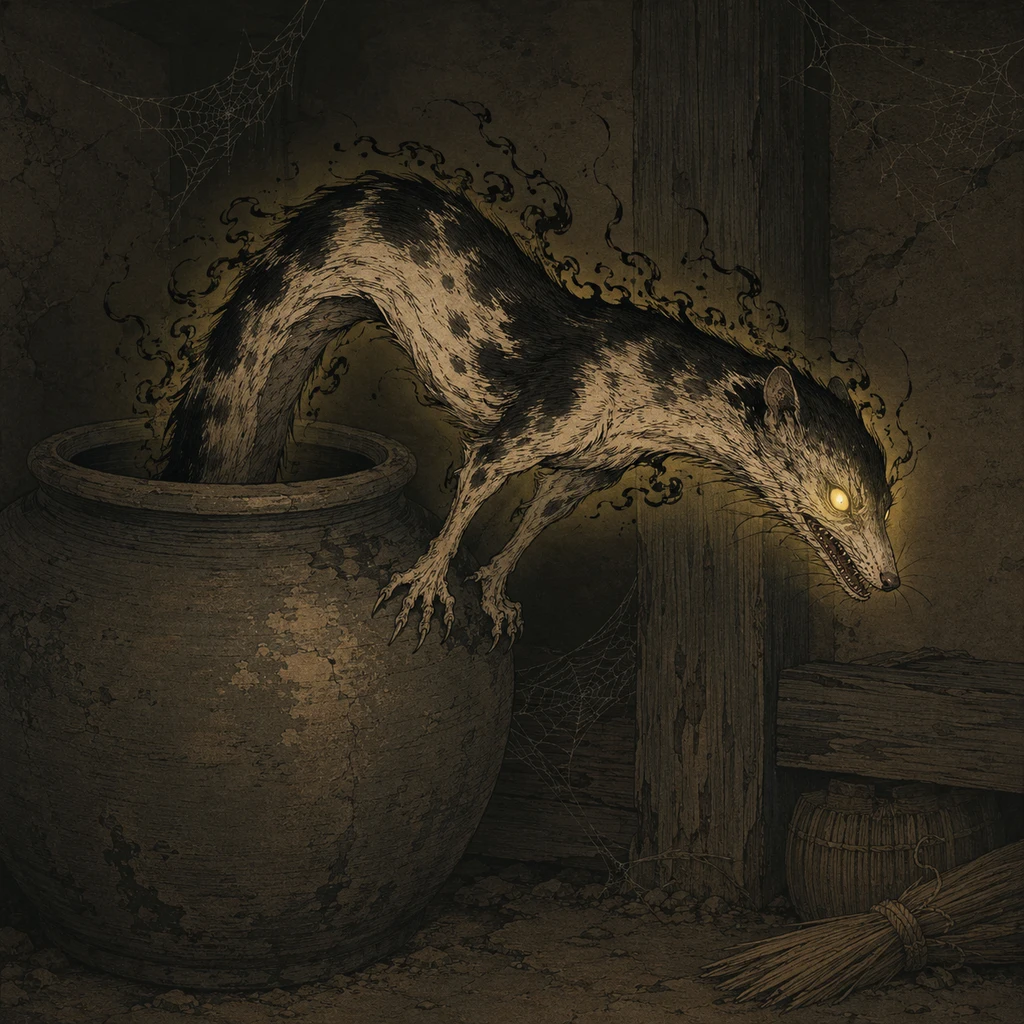
Inugami
Inugami are possessing dog-spirits found mainly in western Japan, counted alongside fox possession and kuda-gitsune as a powerful occult force. Shikoku—especially Tokushima, Kochi, and Ehime—is regarded as their heartland, with traces reported from Shimane and Yamaguchi down through Kyushu to the Satsunan Islands and Okinawa. Families believed to host hereditary Inugami—called “Inugami bloodlines”—were stigmatized, leading to marriage taboos and social discrimination. Their form and temperament vary widely by locale, with traditions describing them as mouse-like, weasel-like, or bat-like, among other shapes.
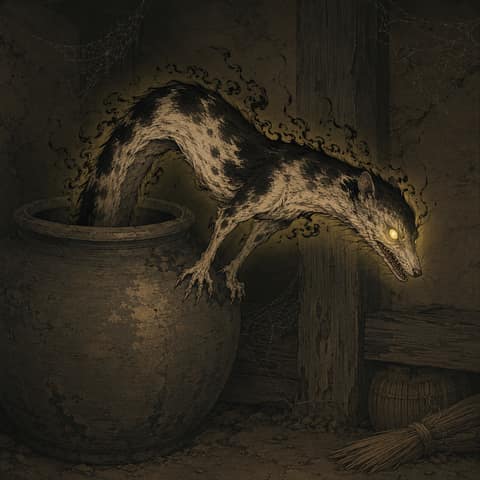
Read moreThe Inugami is a possessing spirit belief widely trusted across the Chugoku, Shikoku, and Kyushu regions, and Kagoshima is also included in its distribution area. The inugami is an animal spirit said to be either a small dog or a rat, and it was thought to lurk under the floorboards, in water jars, or in the storerooms of the families that kept them. What is terrifying is that it was believed to be passed down through generations in specific family lineages called "inugami-suji." When a member of that family harbors envy or a grudge against someone else, the target is possessed by the inugami, falls ill, and suffers[14]. This belief did not stop at mere ghost stories but produced severe social discrimination, where marriages with families considered *inugami-suji* were avoided. The origins of *inugami-suji* were frequently linked to the lineages of shamans and religious figures whose livelihood was prayer and magic. At the same time as they were revered as those who healed illnesses and conveyed the will of the gods, they were feared as individuals with the power to curse people, and were placed on the periphery of the community. It is a dark example of a yokai functioning as a device for suspicion and exclusion directed inside a community. While the gods of Kirishima descend from the heavens to bless the people, in the villages on the ground, envy toward neighbors takes the form of an inugami to curse people—this coexistence of light and shadow is precisely the basso continuo of the mainland's yokai culture.
The possessing spirit beliefs symbolized by the inugami lie exactly on the shadow side of the sacred mountains and fields where the gods of Kirishima land. Precisely because it is a land where gods descend from heaven, as the flip side of that sanctity, human passions condensed to become animal spirits, and the darkness of cursing a neighbor also put down deep roots. Just as the Ittan-momen speaks of the fears of the night road and the Iso-onna of the unreasonableness of the sea, the inugami was a yokai that spoke of the dark side of the human heart.
A Gradient of 600 Kilometers North to South
Walking through the otherworld of Kagoshima from north to south in this way, one great flow becomes visible. In Kirishima, gods descending from heaven sanctified the land, and in its rivers lived the Garappa, on its coasts the Iso-onna, and in its night sky the Ittan-momen. Crossing the sea to Amami, yokai take on the visage of nature's spirits rather than malice; Kenmun appear in banyan trees, Amorou-nagu in the sky, and Kata-kira-uwa by the roadside. And from the Bon sea comes the Boze, from the waterside the Yokkabu-i, visiting the villages seasonally wearing masks. Behind them, the inugami continues to reflect the darkness of the human heart.
The darkness of the mainland and the spirits of the southern islands, the majesty of mythology and the festivals of visiting deities—the yokai culture of Kagoshima Prefecture is the boundary itself where the two worlds of Yamato and the Ryukyu Arc melt and clash over 600 kilometers of sea and islands from north to south.