YOKAI.JP

Ittan-Momen(ittan momen)

Basic Description

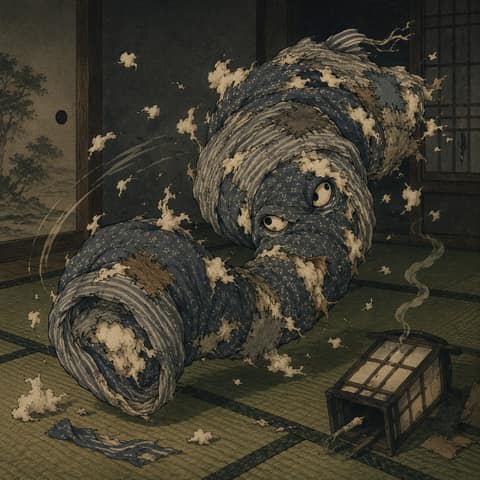
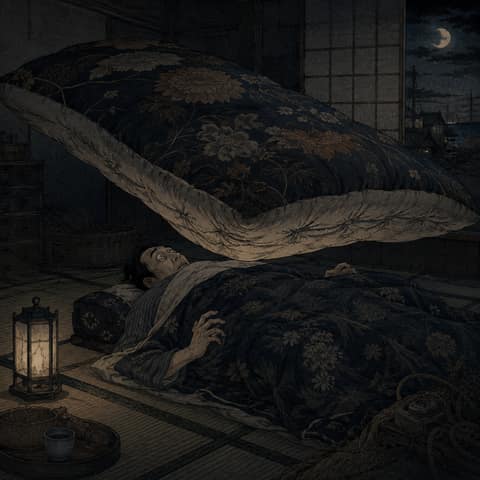
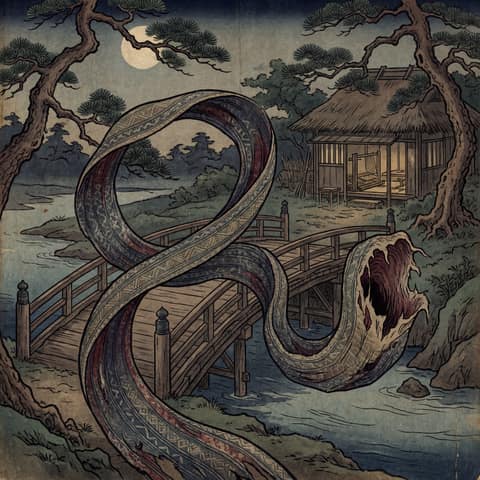
Ittan-Momen is a strange, long cotton-like presence associated with the Ōsumi Takayama region, around present-day Takayama in Kimotsuki Town, Kagoshima Prefecture. In 1938, Kunio Yanagita recorded that something in the form of an Ittan-Momen fluttered at night and attacked people. No color, face, limbs, or voice is given; what remains is the vivid sense of something long moving through the dark.

A 1942 dialect collection calls “Ittan-Monmen” a kind of monster and describes it as a cotton-like object about one tan in length that attacks people at night. A tan measures a bolt of cloth, but its dimensions have varied by period, place, and textile; it cannot be reduced to one fixed number of meters. The name evokes a length of cloth long enough to cover a body, flickering like a living thing.

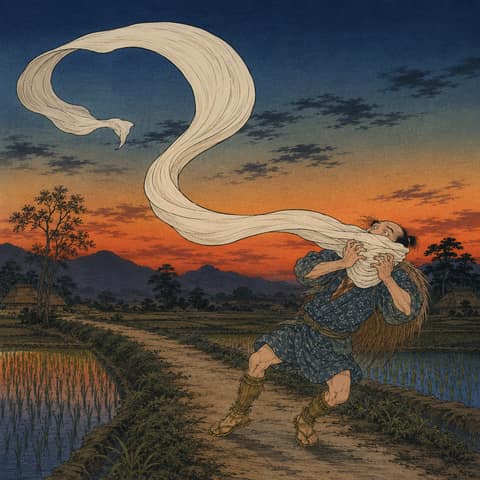
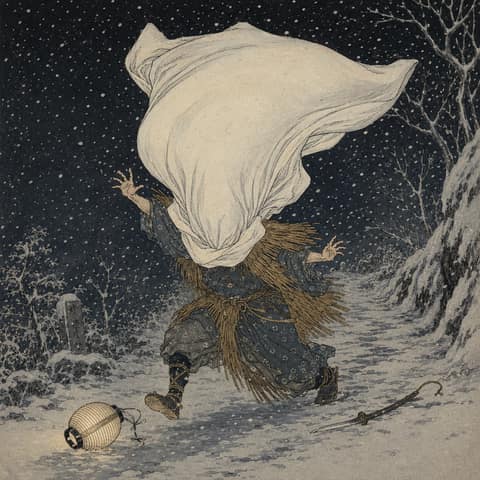
Later local materials tell of Ittan-Momen flying in at dusk and winding around a person’s head or neck. Interviews conducted in Kimotsuki Town preserve accounts from Ikenosono, Hami, Gongen-yama, and the banks of the Kimotsuki River, while also noting communities where the story was unknown. This was not one uniform tale across all of Kagoshima, but a presence remembered unevenly in particular parts of Ōsumi.

The figure now familiar throughout Japan owes much to Shigeru Mizuki. According to an account published by the Agency for Cultural Affairs, Mizuki gave distinctive designs to yokai named in *Yōkai Meii* whose appearances had not been handed down. Ittan-Momen, too, acquired the recognizable body of a long flying cloth and became known nationwide through manga and animation.

Folklore & Legends

“Yōkai Meii (IV),” published in the 1938 journal *Minkan Denshō*, lists Ittan-Momen as a monster of the Ōsumi Takayama region. Its account is brief: something shaped like an Ittan-Momen appears, flutters at night, and attacks people. Yet those few lines already contain the elements that define it: the place, the hour, a form suggestive of a bolt of cloth, wind-borne movement, and danger directed at people. Among published materials now identified, this is an early record.

*Ōsumi Kimotsuki-gun Hōgenshū*, written by Denji Nomura and edited by Kunio Yanagita, included “Ittan-Monmen” in 1942 as a kind of monster. Calling it “a cotton-like thing as much as one tan long” makes the form implied by the 1938 name more concrete. A tan is a unit for a quantity of cloth roughly sufficient for one garment, and its actual length has changed with period and textile type. Rather than assigning Ittan-Momen one numerical length, it is truer to the account to picture a bolt of cloth improbably long for a night road.

Later local material gives the attack a more definite shape. Accounts from Ikenosono and Hami, introduced by the Kimotsuki Town Tourist Information Office from *Takayama Kyōdoshi*, say that an Ittan-Momen flying in at dusk wound around a person’s head or neck and stopped their breath. A recollection from Heigoen in Hami also says its name was used to warn children not to stay out too late. The image of it wrapping around the neck does not appear in the short records of 1938 or 1942; it belongs to later local tellings.

The places of the stories differ in detail. The same interviews report an account near Okazaki in Kushira in which Ittan-Momen came from Gongen-yama, and the view that stories were especially common along the Kimotsuki River upstream from Hami. They also record that people in Kawakami, Uchinoura, and Kishira did not know the tale. A 1989 collection from Tadoko in Shibushi Town preserves another scene: an “Ittan-momen” appeared in a camellia tree by the gate. The same name could gather around different small landscapes from one locality to the next.

There is no known standard image of Ittan-Momen inherited from early-modern picture scrolls or yokai paintings. An essay from the Agency for Cultural Affairs’ Media Arts Current Contents explains that Shigeru Mizuki devised images for yokai such as Ittan-Momen, which had names in local tradition but no transmitted visual form. In postwar manga and animation, it became widely known as an affable flying figure that could carry companions through the air. The cloth-like being that attacks people in an Ōsumi night and the flying yokai of modern stories are not two unrelated creatures. They are earlier and later forms of a local tradition that gained a new visual life and travelled into the national imagination.

Yokai Cards7

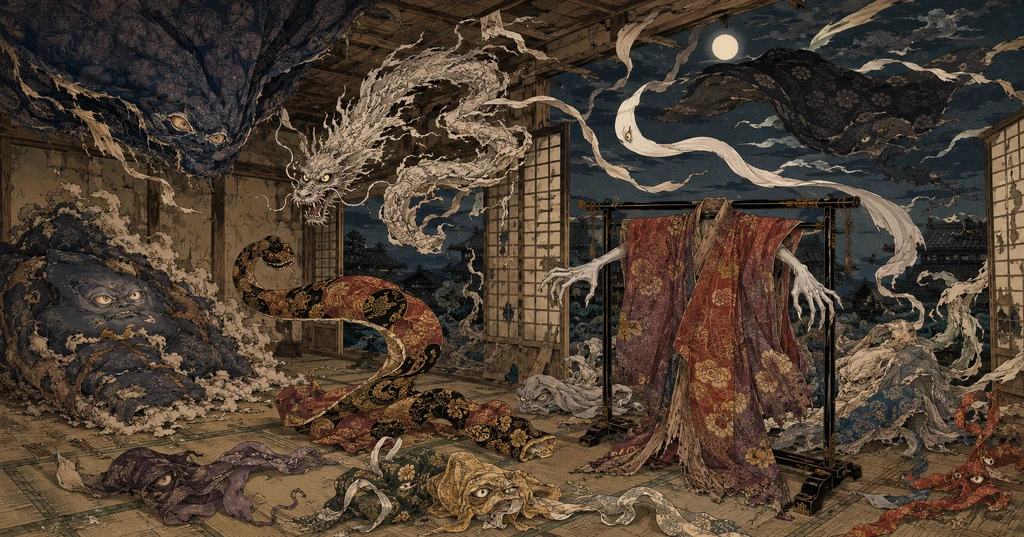
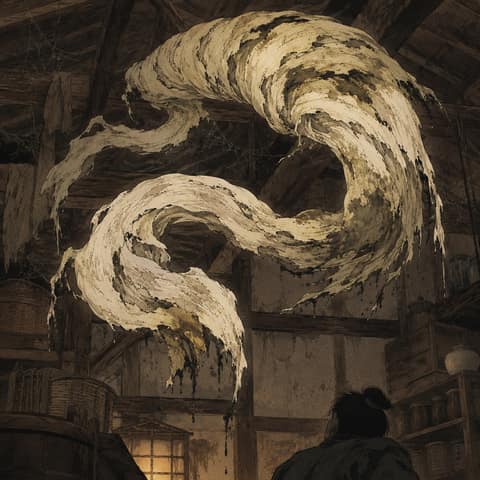
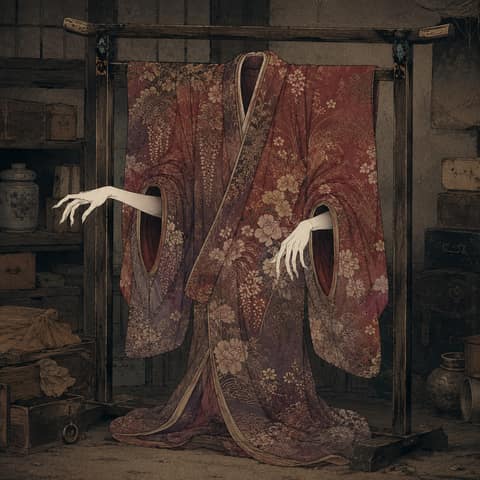
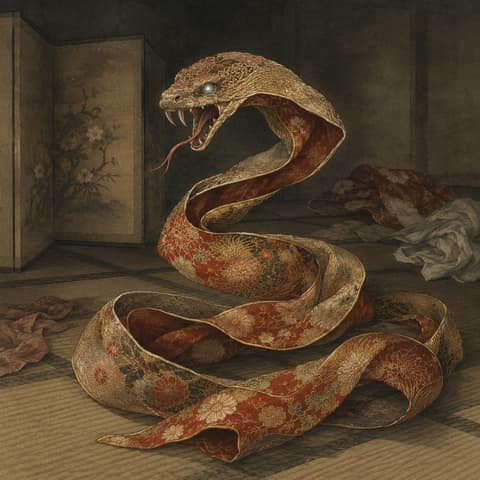
Ittan-Momen across multiple art-style decks

Card gallery

Maya Calendar Guardian KINs

Displaying the Maya calendar KINs that Ittan-Momen protects.

Detailed Analysis

A Brief Record from Ōsumi Takayama

The earliest outline of Ittan-Momen survives in a surprisingly short passage. In 1938, Kunio Yanagita’s “Yōkai Meii (IV)” named “Ittan-Momen” as a monster of the Ōsumi Takayama region and wrote that something in its form fluttered at night and attacked people. Place, time, movement, and action arrive in one breath: a long thing seems to descend over a night road.

The record gives no color, face, or voice. That brevity does not diminish Ittan-Momen; it sharpens its elusiveness. We cannot even decide whether it was cloth itself or something that only looked like cloth. Among published materials now identified, the 1938 article is an early record. This does not mean the tradition began that year. Rather, a name and a scene already told in the nights of Ōsumi Takayama came clearly into print for the first time.

The Length of “Ittan” and the Sound of “Monmen”

In 1942, *Ōsumi Kimotsuki-gun Hōgenshū*, written by Denji Nomura and edited by Kunio Yanagita, called “Ittan-Monmen” a kind of monster and described it as a cotton-like thing as much as one tan long, fluttering at night and attacking people. The name and motion in the 1938 article thus gained a clearer physical shape: something like cotton cloth.

Here, one tan is not a length that can be fixed at a single modern measurement. Originally, tan counted a quantity of cloth roughly sufficient for one garment, and its dimensions varied by period, region, and textile type. Ittan-Momen is frightening not because it has a particular number of meters, but because a bolt of cloth long enough to cover a human body flickers across the night sky like a living creature.

The form “Monmen” also carries an echo of the region. A local source in Kimotsuki Town notes that in Ōsumi, *men* and *mendon* could refer to a ghost or monster. The sound of a word for cotton overlaps with a local word for something uncanny, helping make the name unforgettable.

Later Tales of a Cloth Around the Neck

The Ittan-Momen best known today does more than fly: it winds around the head or neck of a passing person. In accounts from Ikenosono and Hami, introduced by the Kimotsuki Town Tourist Information Office from *Takayama Kyōdoshi*, something flying in at dusk wraps itself around the head or neck and cuts off the victim’s breath. What the brief records of 1938 and 1942 called simply an attack becomes, in later local materials, a distinct bodily terror.

The same interviews recall that at Heigoen in Hami, people invoked Ittan-Momen to warn children who stayed outdoors too late. Dusk is the hour when paths through fields and hills become hard to see. The story of a long uncanny thing arriving at that threshold was likely carried along with the lived knowledge of night in the region.

Local Traditions from Gongen-yama and Shibushi

Ittan-Momen was not told in the same form everywhere in Kagoshima Prefecture. Interviews in Kimotsuki Town record a story near Okazaki in Kushira in which it came from Gongen-yama, and describe a concentration of accounts along the Kimotsuki River upstream from Hami. At the same time, respondents in Kawakami, Uchinoura, and Kishira said they did not know it. Even within the Ōsumi Takayama region, the strength of the tradition differed from one settlement to another.

Elsewhere, Ittan-Momen appears in another setting. A story recorded in 1989 in Tadoko, Shibushi Town, says that “Ittan-momen” appeared in a camellia tree by a gate. Its plot differs from the stories of night roads in Takayama, and it does not mean that camellias are the dwelling place of every Ittan-Momen. It is a valuable example of the same name taking on a different small scene in another locality.

The Form Shigeru Mizuki Gave It

No standard illustration of Ittan-Momen has been found from the Edo period. According to an account from the Agency for Cultural Affairs, Shigeru Mizuki chose yokai such as Ittan-Momen from *Yōkai Meii*—beings whose names were known locally but whose forms had not been visually transmitted—and gave them shapes of his own invention. The friendly image of a long cloth body flying freely and carrying companions spread widely through postwar manga and animation.

That image is not a literal illustration of the older tradition. It gave a recognizable outline to the nameless form that fluttered in a few lines of prose. The cloth-like being that attacked people in the nights of Ōsumi Takayama, the creature that wound around necks in later local stories, and the flying companion loved throughout Japan each belong to a different moment. Viewed together, they show how Ittan-Momen moved from a handful of words into a rich visual culture.

Character Profile

This section is our own creative profile for storytelling. It is not historical fact or scholarship.

Rarity
Epic
Personality
No human-like personality is recorded. It appears fluttering at night and is described as something that attacks people.
Compatibility
For readers drawn to beings born from the land and language of Ōsumi, and to the way a brief tradition can spread through later images and stories.
Abilities
Appears fluttering at night and attacks peopleTakes the form of a long cotton-like length of clothIn later local traditions, winds around a person’s head or neckIn later accounts, is associated with night roads near Gongen-yama and the Kimotsuki River
Weaknesses
No shared way of driving it off or common weakness is recorded. No early source has been identified that names blades, fire, wind and rain, or bleeding as a weakness.
Habitat
The Ōsumi Takayama region, around present-day Takayama in Kimotsuki Town, Kagoshima Prefecture. Later local accounts also associate it with Ikenosono, Hami, Gongen-yama, and the Kimotsuki River.
Sources & References

6
  1. 妖怪名彙(四)柳田國男(『民間伝承』4巻1号(通巻37号), 1938年9月20日) [民俗採集記録]大隅高山地方の「一反木綿」を、夜間にひらひらとして人を襲う怪物として記録した、現在確認できる早い公刊資料。
  2. 大隅肝属郡方言集野村伝四著・柳田國男編(中央公論社, 1942年) [方言・民俗資料]「イッタンモンメン」を、お化けの一種で、長さ一反ほどの木綿のようなものが夜間に人を襲うと記す。
  3. いったんもめん(一反木綿)はどこにいた?肝付町観光案内所(肝付町観光案内所, 2017年(2022年最終更新)) [地域資料] Secondary『高山郷土誌』から紹介される池之園・波見の話、権現山との結びつき、肝付町内での聞き取りをまとめた地域資料。Notes: 『高山郷土誌』の版、刊年、該当頁は記事に明記されていないため、同記事が紹介する後代の地域資料・聞き取りとして用いる。
  4. 妖怪とデザイン前編 妖怪伝承とマンガ家・水木しげる天野行雄(文化庁メディア芸術カレントコンテンツ, 2020年) [現代資料] Secondary水木しげるが、姿形の描き伝えられていなかった「妖怪名彙」の妖怪に独自の造形を与えた経緯を解説する。
  5. 反物の長さを表す一反とは、どのくらいの長さなのか、知りたい。岡山県立図書館(国立国会図書館レファレンス協同データベース, 2011年(2025年更新)) [参考資料] Secondary布帛を数える「一反」の寸法が、時代、産地、布の種類によって異なることを参考文献とともに解説する。
  6. 潤ヶ野 口承文芸國學院大學民俗学研究会(『民俗採訪』昭和63年度号, 1989年) [民俗調査]鹿児島県志布志町田床の門前にあった椿の木に「一反もめん」が出たという、話者鳥浜卯一郎の語りを収録する。

Interested in this type of yokai?

Discover the yokai most similar to your personality with our yokai diagnosis

Start Yokai Diagnosis

Yokai Compatibility Test

The diagram below is a diagnostic evaluation chart for Ittan-Momen of Ōsumi Takayama. The higher the value of each item, the stronger that characteristic is expressed.

Love Yokai Type Test

The diagram below is a diagnostic evaluation chart for Ittan-Momen of Ōsumi Takayama. The higher the value of each item, the stronger that characteristic is expressed.

Meet your guardian yokai at the shrine

Draw an omikuji fortune and discover the yokai watching over you today.