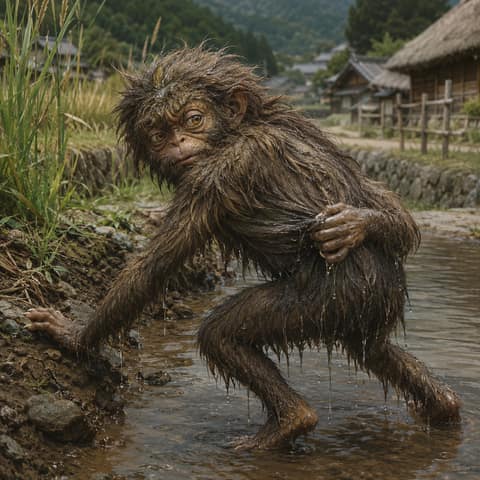
"Garappa" is the name for kappa—and a distinct regional variant—widely known throughout southern Kyushu (primarily Kagoshima and southern Kumamoto). While its etymology traces back to a corruption of *kawawappa* (river child), its appearance and folklore are far more visceral and beast-like than standard kappa. It is often described as a grotesque, ape-like creature with unnervingly long, slender limbs, entirely covered in hair, and capable of walking upright.
While it shares the typical kappa's cheerful disposition and love for sumo wrestling, the Garappa deeply retains the ecological cycle of "Yamakawa-oukan" (migrating between mountains and rivers) tied to the changing seasons. During the farming season from spring to autumn, they dwell in deep river pools; when winter arrives, they retreat into the mountains and become *yamawaro* (mountain children). This seasonal transformation perfectly mirrors the ancient Japanese agricultural rites and mountain worship—where the mountain deity descends to the village in spring to become the rice paddy deity, and returns to the mountains after the autumn harvest. This serves as profound evidence that the Garappa was not merely a water monster, but an animistic spirit governing the cycle of nature.
Folklore & Legends
In the Yatsushiro region of Kumamoto Prefecture, there is a prominent legend of a kappa chieftain named "Kusenbo," who is said to have migrated from China leading an army of nine thousand kappa followers[1]. The Kusenbo clan originally settled in the Kuma River, but after drawing the ire of the local warlord Kato Kiyomasa, they were attacked by all the monkeys of Kyushu and eventually fled to the Chikugo River, where they became familiars of the Suitengu shrine. This perspective of viewing the kappa not as isolated "individuals," but as a "clan or society," is a unique characteristic of southern Kyushu folklore.
Furthermore, the Sendai River basin in Kagoshima Prefecture is widely known as the epicenter of Garappa lore (Garappa faith in Satsumasendai City[2]). Although they are notoriously mischievous and occasionally drag horses into the river, they are also intensely fiercely loyal. If a human helps them, they are known to show their gratitude by secretly delivering fresh fish every night or helping with backbreaking farm work like planting rice. This duality as a water deity is still passed down by locals today. They are said to lose the magical power of their head-dish if they eat Buddhist offering rice (*butsuhan*), and they absolutely abhor metal tools and fishing nets—weaknesses commonly shared by ancient, deposed gods.
As pointed out by folklorist Kunio Yanagita in works like *Yokai Dangi* (Discussions on Japanese Monsters), the Garappa is perhaps the most vivid surviving example among all Japanese kappa legends of a "former water deity that has degenerated into a yokai over time." Their seasonal metamorphosis—entering the mountains in winter to become *yamawaro* and returning to the rivers in spring—is the very embodiment of the cyclical rotation of the mountain god and the rice paddy god in traditional rice-farming culture.
They are frequently feared as symbols of water-related disasters, prone to playing vicious pranks and occasionally claiming human lives. Yet, if treated with the proper respect, they transform into "reliable neighbors" who bless fishermen with bountiful catches and work through the night to assist with grueling rice planting. This dual nature is the very core of animism. Understanding the Garappa requires seeing beyond a simple river monster; in the harsh natural environment of southern Kyushu, bounded by rugged mountains and fierce rivers, the Garappa is a projection of the local people's "awe of nature" and their "prayer for coexistence," making them an indispensable presence in the regional community.
Character Profile
This section is our own creative profile for storytelling. It is not historical fact or scholarship.
Mischievous but highly dutiful. Cheerful and extremely fond of sumo wrestling.
Compatibility
Favorable towards those who respect nature and understand coexistence (especially fishermen and farmers). Incompatible with those who offer Buddhist rice or carry metal tools.
Abilities
Masterful sumo wrestling skillsGranting bountiful fishing catchesAssisting with agricultural labor (rice planting)
Weaknesses
Buddhist offering rice (causes loss of power), metal objects, fishing nets
Habitat
Deep pools of major rivers like the Sendai and Kuma rivers, and deep mountain forests during winter.
The diagram below is a diagnostic evaluation chart for The Deposed Water God of Southern Kyushu. The higher the value of each item, the stronger that characteristic is expressed.