Tanuki, mujina, mami: tangled names. To understand tanuki, one must first untangle the writing. In Chinese, the character 狸 originally referred to wildcats or leopard cats; in Japan it came to write tanuki, the raccoon dog. Before modern zoological usage, tanuki, mujina, mami, and several graphs were mixed in texts and local speech, and some regions called badgers, masked palm civets, and raccoon dogs mujina. Thus the Nihon Shoki's entry for 627[2], "There was a mujina in Mutsu; it changed into a person and sang," cannot be identified with perfect zoological certainty. The 1924 tanuki-mujina case[3] arose when a hunter accused of violating a closed season claimed he believed mujina were not tanuki; the court found no criminal intent. The ambiguity was not only literary. It reached modern law.
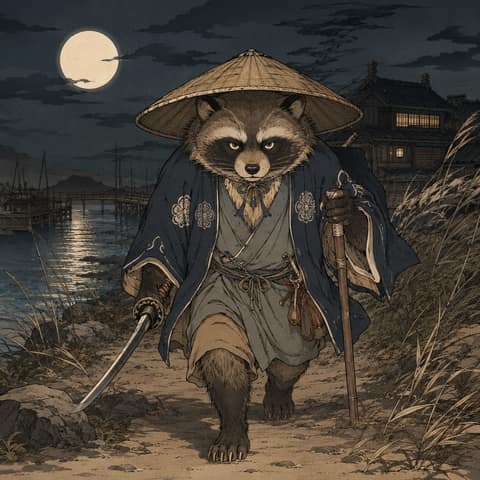
Classical bake-danuki.The Nihon Shoki entry for 627[2] is often quoted as the earliest textual example of a transforming tanuki or mujina. In Konjaku Monogatari-shu, volume 27, tale 22[12], an old hunter's mother becomes a demon and tries to eat her son; when he shoots her, her true form is an aged tanuki. The story states the idea that old beasts can become yokai. Other transformation tales appear in Nihon Ryoiki, Uji Shui Monogatari, and Kokon Chomonju. In Edo-period yokai art, Toriyama Sekien's Gazu Hyakki Yagyo of 1776[13] includes a tanuki image, often seen as an early example of the monk-like tanuki peering into a tea kettle.
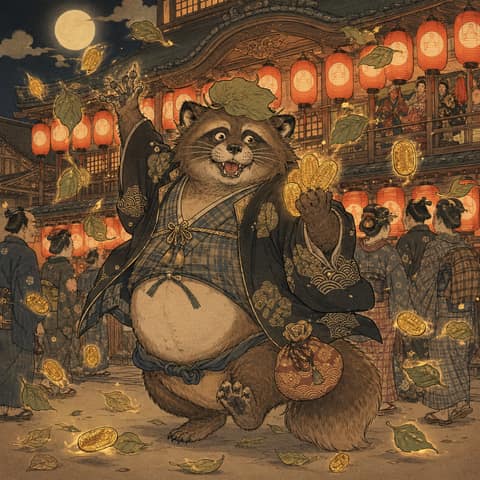
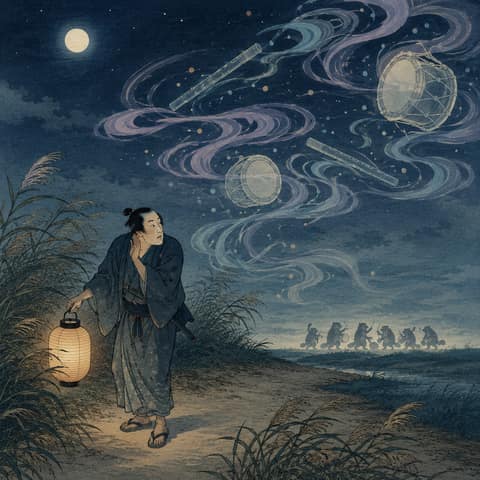
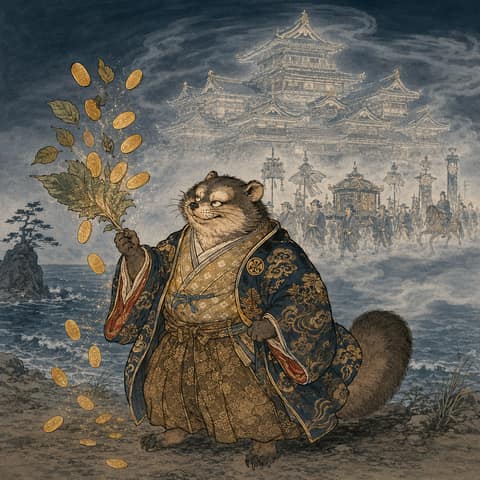
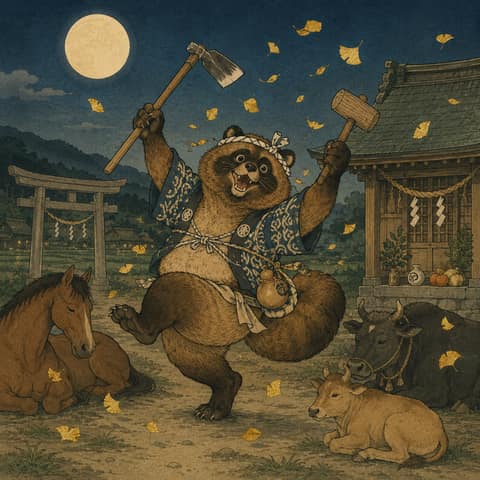
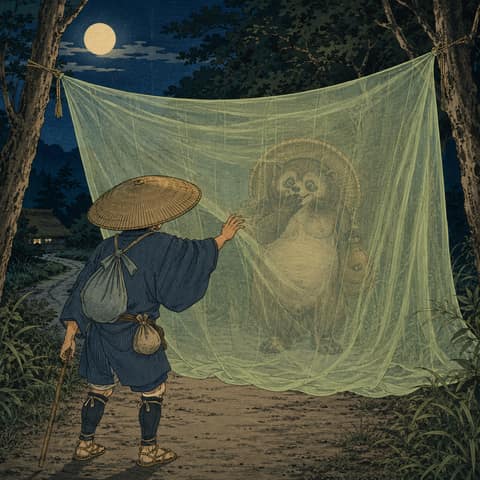
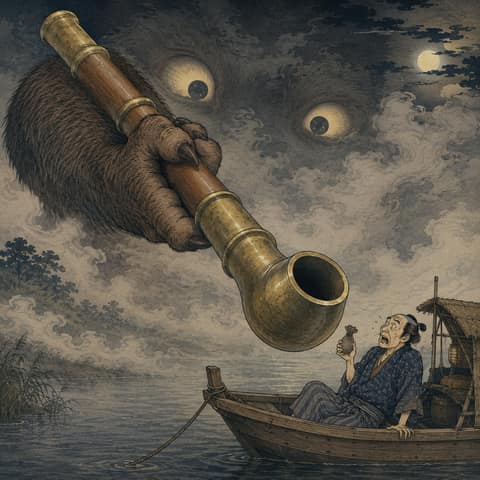
A catalogue of powers. Tanuki powers are varied. Belly drumming is the moonlit sound of a tanuki beating its belly, linked to the Shojoji tanuki-bayashi legend[14]. The "eight-mat" scrotum could become a room, temple hall, umbrella, net, or weapon; this grotesque joke is often explained through Edo gold-beating, where gold wrapped in tanuki skin was hammered thin and broad. Real raccoon dogs have no such anatomy; the image is cultural fiction. Tanuki also transform with a leaf on the head, perform tanuki-neiri or feigned sleep, and outrank foxes in the proverb about seven and eight transformations. Children's books and picture books of the Meiji and Taisho periods standardized these powers, and Shigaraki tanuki figures made them familiar after the war.
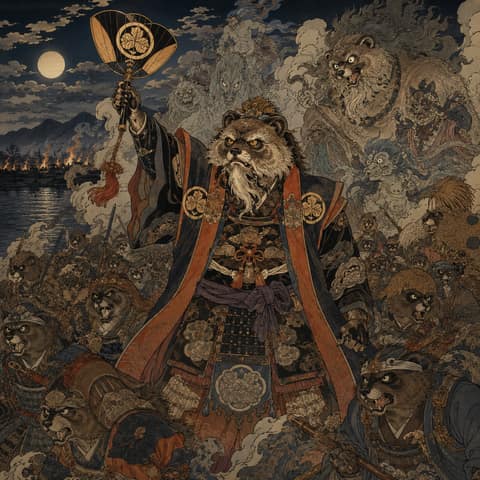
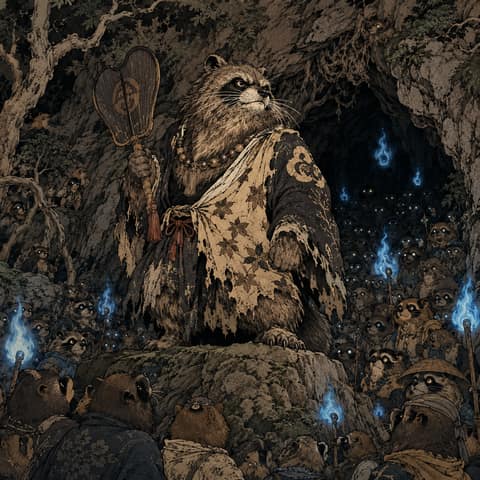
Famous tanuki of Shikoku, Sado, and Awaji. Bake-danuki legends lean strongly toward western Japan. Kincho Tanuki[4] of Komatsushima in Tokushima is central to the Awa Tanuki War against Rokuemon, while Tasaburo of Yashima is worshipped as Minoyama Daimyojin. Danzaburo Tanuki of Sado[5] is a boss-like tanuki known for lending money without interest and is enshrined as Futatsuiwa Daimyojin. Shibaemon Tanuki of Awaji[6] lives on Mount Mikuma, drums his belly by moonlight, and is said to have died after taking human form to watch kabuki in Osaka. Japan's Three Famous Tanuki are Danzaburo, Tasaburo, and Shibaemon. The Three Great Tanuki Legends are a different set: Inugami Gyobu[7], Bunbuku Chagama of Morinji[8], and the Shojoji tanuki-bayashi story.
Shigaraki ware and the modern shop-front tanuki. Shigaraki ware comes from Koka in Shiga Prefecture and belongs to Japan's six old kilns. Tanuki ceramics existed by the late Edo period, but the familiar friendly figure was shaped in the twentieth century. In 1951 Emperor Showa saw rows of Shigaraki tanuki holding national flags and composed a poem about them[9], making them famous nationwide. In 1952, Ishida Gosho explained the eight auspicious signs: hat against misfortune, large eyes for awareness, smile for friendliness, sake flask for sustenance, account book for trust, belly for calm judgment, money bag for fortune, and thick tail for finishing what one begins. The tanuki became a guardian of business prosperity.
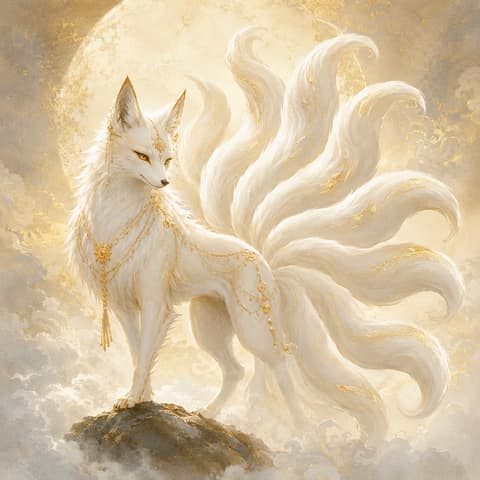
Foxes, tanuki, and geography. Foxes and tanuki are the two great animal shapeshifters, but their folklore distribution differs. Fox tales dominate much of eastern and northeastern Japan, while Shikoku, Sado, Awaji, and other western areas are rich in tanuki tales. The Ministry of the Environment's 2022 distribution survey[1] also notes the absence of tanuki in Okinawa. Okinawan forest yokai roles are instead filled by beings such as Kijimuna and the Amami Kenmun. Biological range and yokai geography mirror each other.
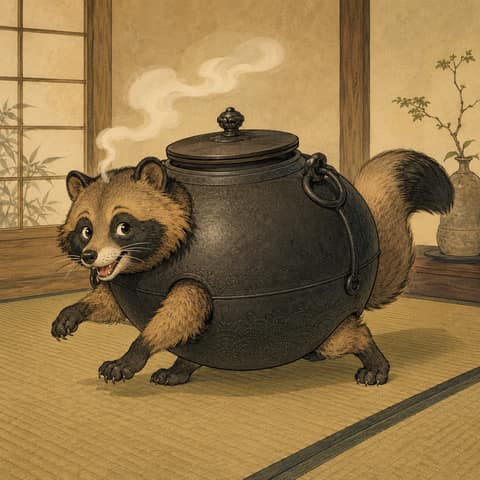
Buddhism, tea kettles, and tanuki gods. The best-known Buddhist tanuki tale is Bunbuku Chagama of Morinji in Tatebayashi[8]. Temple tradition tells of Shukaku, an old monk serving the abbot Gesshu Shocho, who produced a miraculous kettle at a 1570 ceremony and later revealed himself as a mujina or tanuki before leaving the temple. Matsuura Seizan's Kasshi Yawa records the Morinji kettle, while Iwaya Sazanami's children's version, in which a tanuki-kettle performs tricks after being found by a junk dealer, spread a different branch of the story. Danzaburo[5], Kincho, Tasaburo, and Shibaemon also become enshrined or honored as daimyojin. In Japan's mixed Buddhist and Shinto world, tanuki can move from animal to deity.
Postwar popular culture.Studio Ghibli's Pom Poko, released in 1994[10], sets tanuki against the development of Tama New Town and gathers figures such as Tasaburo, the sixth Kincho, and Inugami Gyobu[7]. Tomihiko Morimi's The Eccentric Family[11] makes Kyoto's Tadasu no Mori and the Shimogamo family into a modern tanuki stage. From classical texts, ukiyo-e, Shigaraki ware, and regional legends to animation and novels, the tanuki keeps changing shape because every era gives it a new one.
What "fox seven, tanuki eight" means."Foxes have seven transformations, tanuki have eight"[15] is a familiar Japanese proverb. It says that tanuki surpass foxes by one degree of shapeshifting. An expanded saying, "fox seven, tanuki eight, otter nine, cat ten," orders animal magic into a ladder. Konjaku Monogatari-shu, volume 27, tale 22[12], where an aged tanuki becomes a demon, expresses the same idea: long-lived beasts awaken stronger powers. Named old tanuki such as Kincho, Danzaburo, Tasaburo, Shibaemon, and Inugami Gyobu may even become daimyojin.
The eight-mat scrotum and Edo humor. The tanuki's scrotum is not biology but urban comedy. Edo goldbeaters were said to wrap a small amount of gold in tanuki skin and hammer it out to the size of eight tatami mats. Utagawa Kuniyoshi turned that joke into images of umbrellas, nets, rooms, shamisen, and sumo rings; Tsukioka Yoshitoshi moved toward the uncanny atmosphere of the Morinji kettle. Low-city caricature and temple ghost story together formed the early modern visual tanuki.
Three Famous Tanuki and Three Great Legends. The two sets are often mixed up. Japan's Three Famous Tanuki are Danzaburo, Tasaburo, and Shibaemon. The Three Great Tanuki Legends are Inugami Gyobu[7], Bunbuku Chagama of Morinji[8], and the Shojoji tanuki-bayashi tale[14]. The Awa Tanuki War, centered on Kincho and Rokuemon[4] and mediated by Tasaburo, belongs to another stream made famous through kodan storytelling and film.
The eight auspicious signs of Shigaraki tanuki.Shigaraki tanuki's eight auspicious signs[9] read the statue's hat, eyes, smile, flask, account book, belly, money bag, and tail as blessings for business: avoiding misfortune, watching carefully, welcoming customers, having food and drink, keeping trust, staying calm, gaining wealth, and finishing well. In effect, postwar merchant ethics were projected onto a round, friendly tanuki body. Pom Poko[10], with tanuki driven out by development, shows the other side of the same postwar consumer society that put Shigaraki tanuki at shop doors.
Why tanuki survive.Pom Poko from 1994[10] makes tanuki displaced local spirits under Tama New Town development and brings together famous tanuki, including Inugami Gyobu[7]. The Eccentric Family from 2007[11] imagines Kyoto as a city where tanuki, humans, tengu, and foxes overlap. The tanuki endures because it changes with each period: Edo joke, Meiji image, postwar business charm, modern urban fantasy.
Character Profile
This section is our own creative profile for storytelling. It is not historical fact or scholarship.
Skilled at transformation, loyal in its own way, and fond of belly drumming under the moon.
Compatibility
In tune with people who cherish old objects, moonlit nights, and old temples and shrines; at odds with those who mock sacred places, set dogs on it, or see through its feigned sleep.
Abilities
Takes on one more transformation than the fox through its eight changesTurns the eight-mat scrotum into a room, umbrella, net, or weaponDrums on its belly under the moon to bewilder passersbyPlaces a leaf on its head and changes form in an instant
Weaknesses
Guns and dogs; sutras and chanting at temples and shrines; people who see through tanuki-neiri; anyone who treats old objects and sacred places with contempt.
Habitat
The border between satoyama and village; old temple and shrine precincts; around tea kettles, sake flasks, and old bedding; moonlit woods and riverbanks; beside Shigaraki tanuki statues at shop fronts.
The diagram below is a diagnostic evaluation chart for One Step Beyond Seven: The Tanuki's Eight Transformations. The higher the value of each item, the stronger that characteristic is expressed.