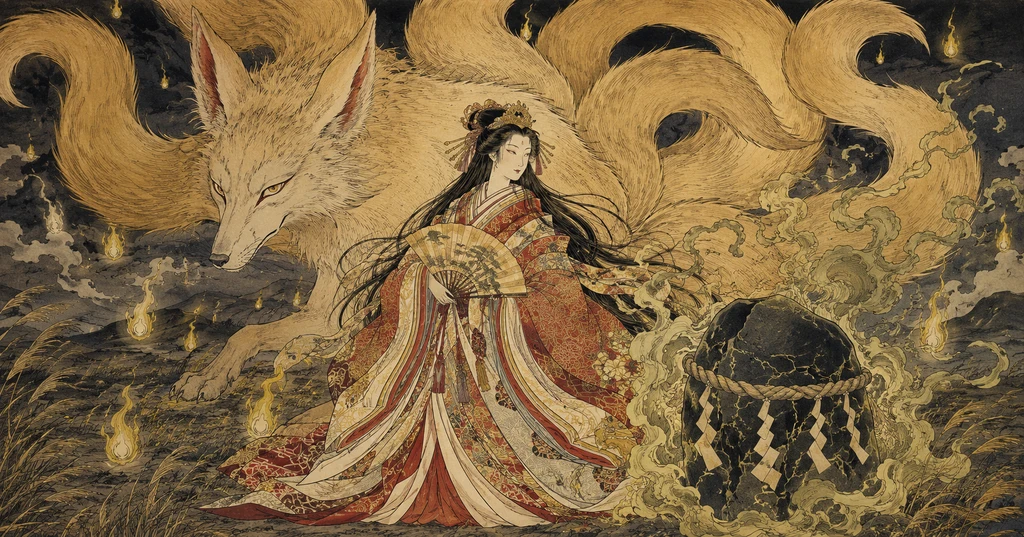
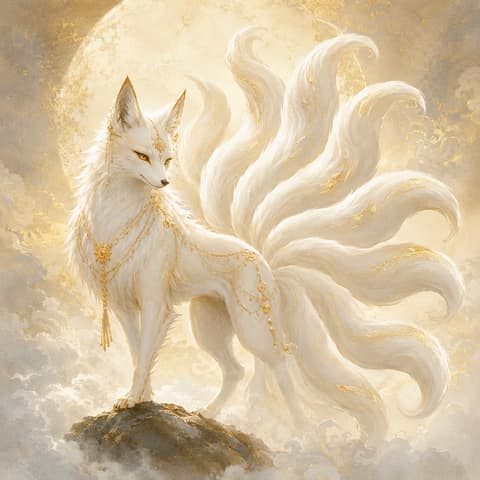
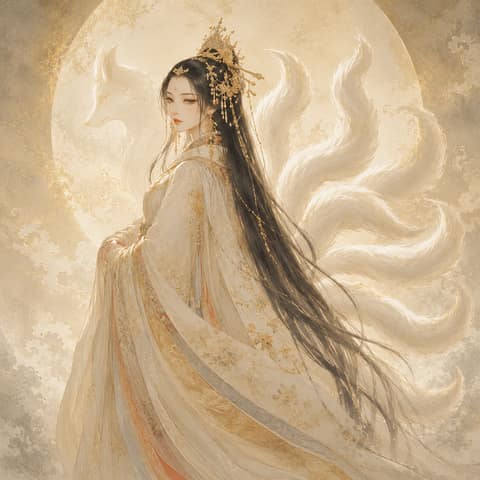
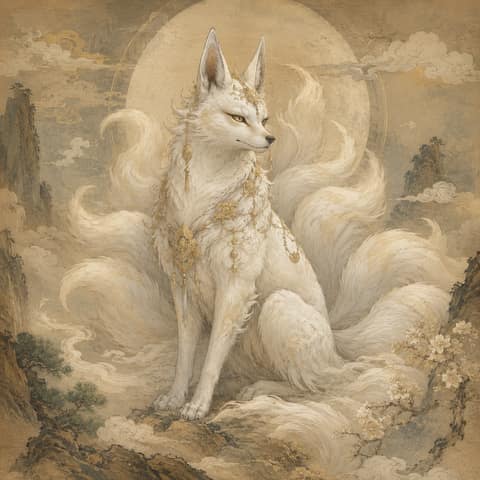
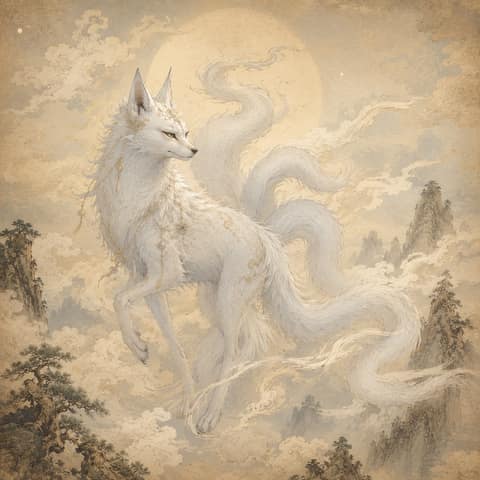
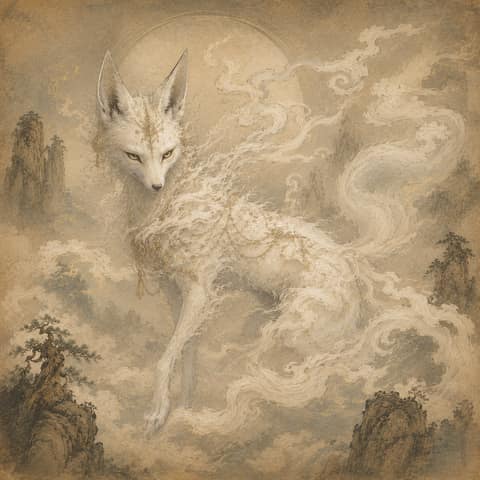
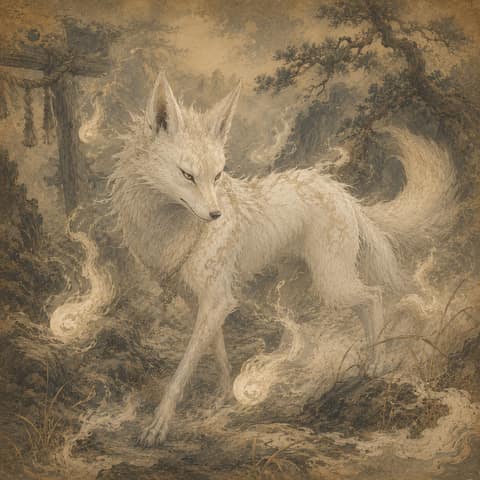
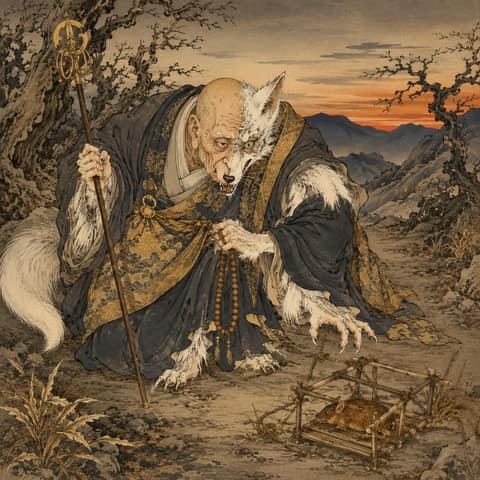
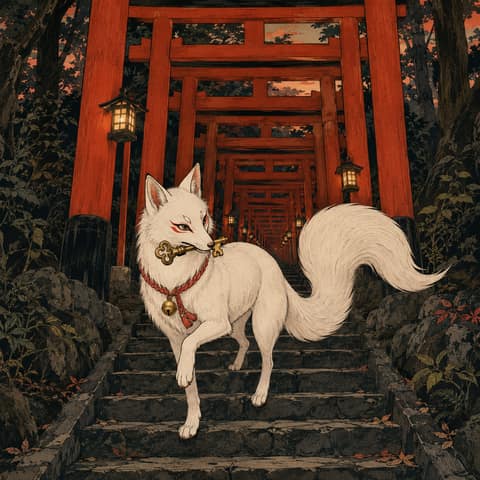
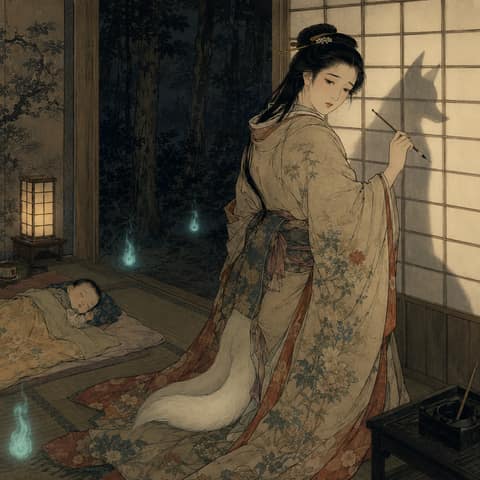
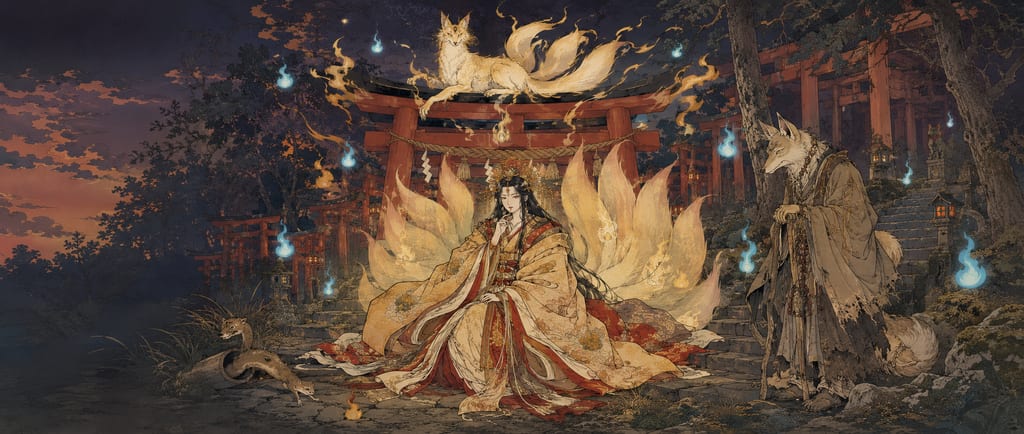
The "white-faced, golden-furred nine-tailed fox" is exactly what the name says: a fox-spirit with a white face, golden hair, and nine tails. Today it is almost automatically understood as Tamamo-no-Mae's true form, but that image did not appear fully formed. It grew from several lines that merged over time: the nine-tailed fox of Chinese classics, the tale of Daji becoming a nine-tailed fox, the Japanese Tamamo-no-Mae legend, and the Sesshoseki tradition of Nasu.
The older nine-tailed fox was not necessarily evil. The Shan Hai Jing[1] makes the Qingqiu fox a man-eating beast, yet the nine-tailed fox was also treated in ancient China as an auspicious creature, and Japan received the idea that the nine-tailed fox could be a sacred beast[2]. Nine tails, in other words, did not originally mark simple wickedness. They marked the extremity of otherworldly power. That power might bless kingship or destroy it; the uneasiness lies in that doubleness.
Nor was Tamamo-no-Mae always the white-faced, golden-furred nine-tailed fox. Shinmei-kyo[5] records her name, and Tamamo no Soshi[8] gives the story of a beauty serving Retired Emperor Toba who is exposed as a fox. But in the older form the fox has two tails. Terashima Shuichi's account stresses that almost four centuries of rewriting stand between that tale and the tight identification of Tamamo with the Nine-Tailed Fox[2]. Without that gap, the history of the legend's remaking disappears.
The decisive change was the joining of Daji's fox to Tamamo. The story that Daji, beloved of King Zhou of the Shang, became a nine-tailed fox was amplified through Chinese commentaries and fiction and reached Japan early. In the late Edo period, Japanese yomihon connected Daji, the Indian Kayo-fujin, and Tamamo-no-Mae as previous bodies and incarnations of one fox. Ehon Sangoku Yofuden[9] was especially important: it made a single fox-spirit bewitch rulers in India, China, and Japan, and fixed Tamamo-no-Mae as the Japanese manifestation of the white-faced, golden-furred nine-tailed fox.
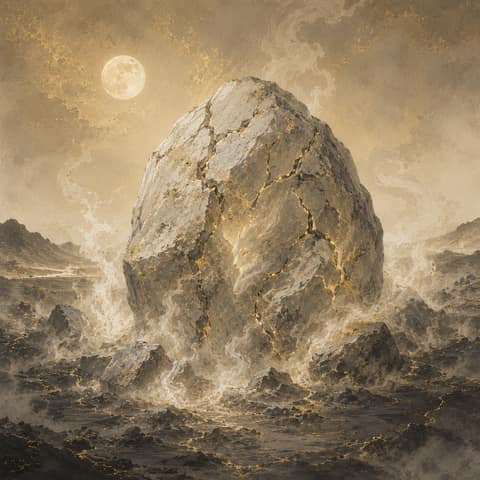
The Sesshoseki gave the fox a story after death. In the noh play Sesshoseki[10], the stone is not merely poisonous rock but the dwelling place of a fox-spirit still bound by obsession. A monk breaks and pacifies the stone through ritual power, changing fox-slaying into an act of salvation. Nasu Town's official tradition likewise says that the stone is the transformed fox that flew from India and China, joining the legend to the sulfurous landscape Basho described in Oku no Hosomichi[6]. Tamamo-no-Mae does not end when she is exposed at court. She remains in Nasu as stone.
Painting and performance made this doubleness visible. After the 1751 puppet play Tamamo-no-Mae Asahi no Tamoto[12], Tamamo appeared repeatedly in joruri and kabuki as a role that was both peerless beauty and fox-spirit. In Utagawa Kuniyoshi's Abe Yasuchika Praying over Tamamo-no-Mae[11], nine beams of light open behind the beauty, placing courtly grace and vulpine truth in the same image. Mirrors, reflected water, halos that become tails: all are devices for showing that Tamamo is a being who can be seen through.
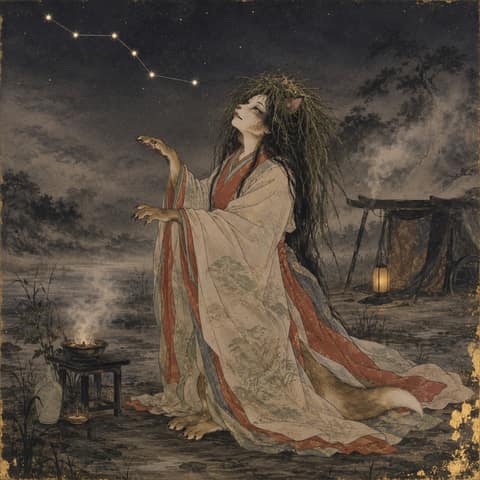
The terror of the white-faced, golden-furred fox lies not in teeth or claws, but in the fact that she first appears as beauty and intellect. She knows Buddhist texts, Chinese classics, waka, and court music; she answers questions without hesitation and earns trust and affection. She does not invade from outside. She is invited into the center. For that reason, force alone cannot expose her. Divination, prayer, mirrors, water, and the stories that keep retelling her are what bring the hidden fox into sight.
At the same time, she is not an entirely foreign enemy. She arises from the same fox imagination as Inari's white fox, the hierarchies of tenko and kuko, the tenderness of fox-wife stories, and the fear of fox possession. As Tamamo-no-Mae she may tilt royal power; as the Sesshoseki she leaves poison in the land. Yet people pacify her, enshrine her, paint her, perform her, and keep her in memory. The white-faced, golden-furred nine-tailed fox is not evil that has been erased. It is evil that remains speakable after defeat.
Character Profile
This section is our own creative profile for storytelling. It is not historical fact or scholarship.
Yokai Type - Traditional Yokai
Category - Animal Shapeshifters
Rarity - Legendary
Personality - A great spirit-fox with a white face, golden fur, and nine tails. Before humans she appears as a peerless beauty and a woman of deep learning, using language, scholarship, and affection to enter the center of power. She is not mere malice: she carries both the holiness of an auspicious beast and the danger of a fox that can bring a kingdom down.
Compatibility - Readers drawn to classical texts, noh, yomihon, and ukiyo-e; people who can see politics beneath elegance; anyone fascinated by both fox worship and legends of royal power.
Abilities - Transforming into a peerless beautyWinning courtly trust through learning and eloquenceSending fox-aura into illness, obsession, and desireConcealing her true form until mirror or water reveals itLeaving poison and legend behind as the Sesshoseki after death
Weaknesses - Onmyoji divination, prayer, and subjugation rites; the true form reflected in mirror or water; the ritual power of monks who break and pacify the Sesshoseki; later scholarship that exposes how the legend was assembled.
Habitat - Retired Emperor Toba's court, the Seiryoden, Nasu Plain in Shimotsuke, the Sesshoseki at Nasu Yumoto, and the worlds of noh, yomihon, joruri, kabuki, and ukiyo-e