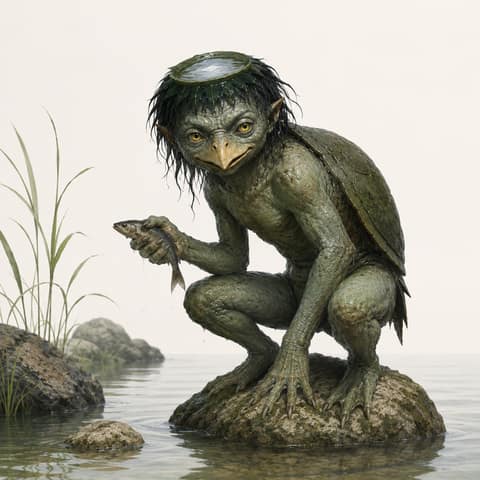
Gongo is the dialect name for the kappa in Mimasaka Province (present-day northern Okayama Prefecture, centered around Tsuyama City), and it is a water apparition deeply rooted in the region. There are two theories regarding its etymology: one suggests it evolved from "Kawako" (river child) through "Gougo" to "Gongo," while another traces its roots to the water deity "Kongo"[1]. Its appearance is the same as a typical kappa, with a dish on its head and a shell on its back. It is said to love sumo wrestling and to drag people and horses underwater. Its dwelling is said to be "Nozoki-buchi" (Peeping Abyss), a gently curving deep pool in the Yoshii River as it flows through the castle town of Tsuyama[2], where it was feared for its mischief of dragging swimmers underwater. It serves as a local apparition embodying water-related taboos, with adults warning children, "The Gongo will get you," to prevent them from drowning.
Folklore & Legends
In Shuzo Shimada's *Kokoro no Furusato Mimasaka Densetsuko* (Thoughts on the Legends of Mimasaka, the Homeland of the Heart), there is a chapter titled "The Gongo of Nozoki-buchi," which records that the Gongo living in the deep pools of the Yoshii River dragged swimmers into the water[2]. Regarding its etymology, both Sosuke Uetsuki's *Tsuyama Kotoba* (Tsuyama Dialect) and Fumiaki Kishimoto's *Kyodo Hakkutsu Okayama Kotoba Gogen Tankenki* (Local Excavation: Okayama Dialect Etymology Expedition) convey two theories: that it is a corruption of the old name for kappa, "Kawako," and that it is connected to "Kongo," a deity that governs water[1].
The custom of calling kappa "Gongo" in Mimasaka is geographically contiguous with the dialect region of southern Okayama and the entire Chugoku region, where kappa are called "Kawako" (river child). It is believed that the "Kawako" lineage of dialect uniquely corrupted into "Gongo" in Tsuyama[1]. Today, rather than being feared as a terrifying apparition that warns against water accidents, it has transformed into a symbol of local heritage. Every summer in Tsuyama, the "Tsuyama Noryo Gongo Festival" is held on the banks of the Yoshii River. The "Gongo Bus" touring the city and the "Gongo-dori" shopping street have made it a beloved local specialty[3].
Gongo is a kappa whose home territory is "Nozoki-buchi" in the Yoshii River of Tsuyama. While possessing the general characteristics of a kappa (a dish on its head, a shell, a love for sumo, and a habit of dragging people and horses underwater), it is distinguished from kappa of other regions by its Mimasaka dialect name and the local lore of Nozoki-buchi. Its name is said to be either a corruption of "Kawako" (river child) or derived from the water deity "Kongo," embodying both the divine nature of governing water and the monstrous nature of causing drowning accidents. By dwelling in the river pools that flow through the castle town, it stands on the boundary between the urban space of Tsuyama and the waterside, acting as the narrator of taboos that keep children away from water hazards. Since the modern era, it has transformed into a festival icon and a mascot-like symbol, becoming the face of the local region.
Character Profile
This section is our own creative profile for storytelling. It is not historical fact or scholarship.
The diagram below is a diagnostic evaluation chart for The Water Deity of Nozoki-buchi: Gongo. The higher the value of each item, the stronger that characteristic is expressed.